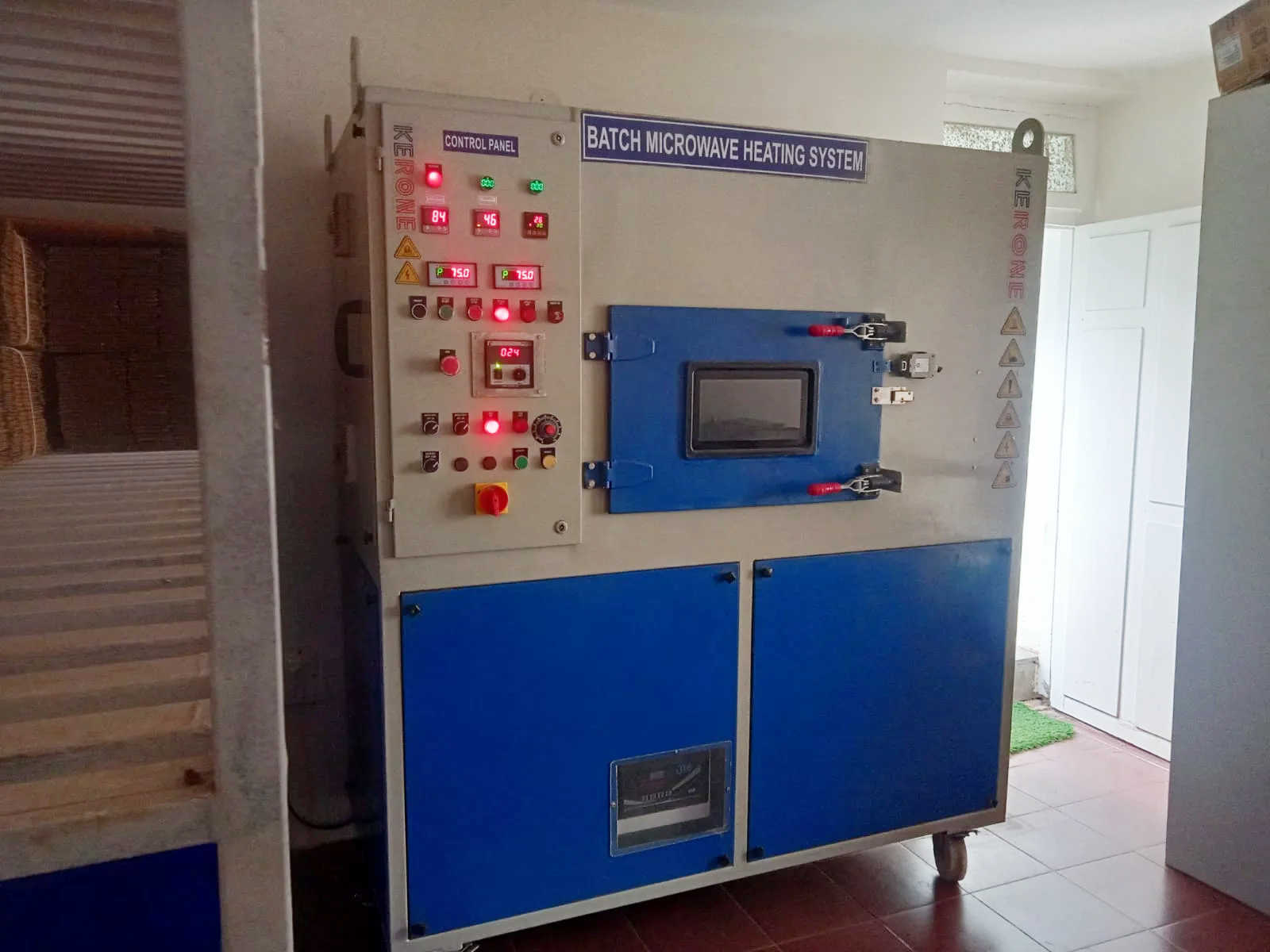
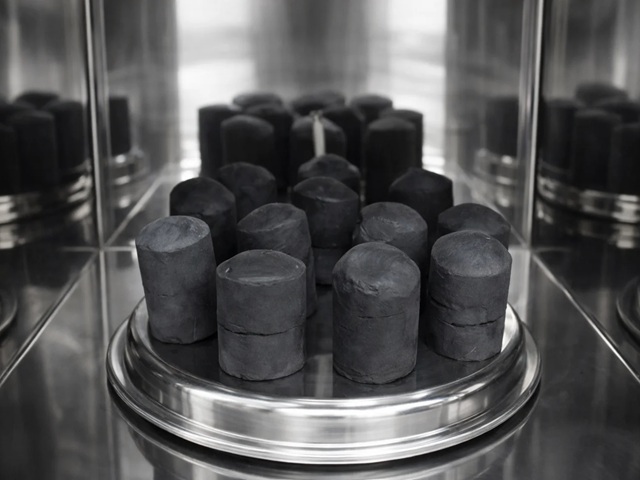
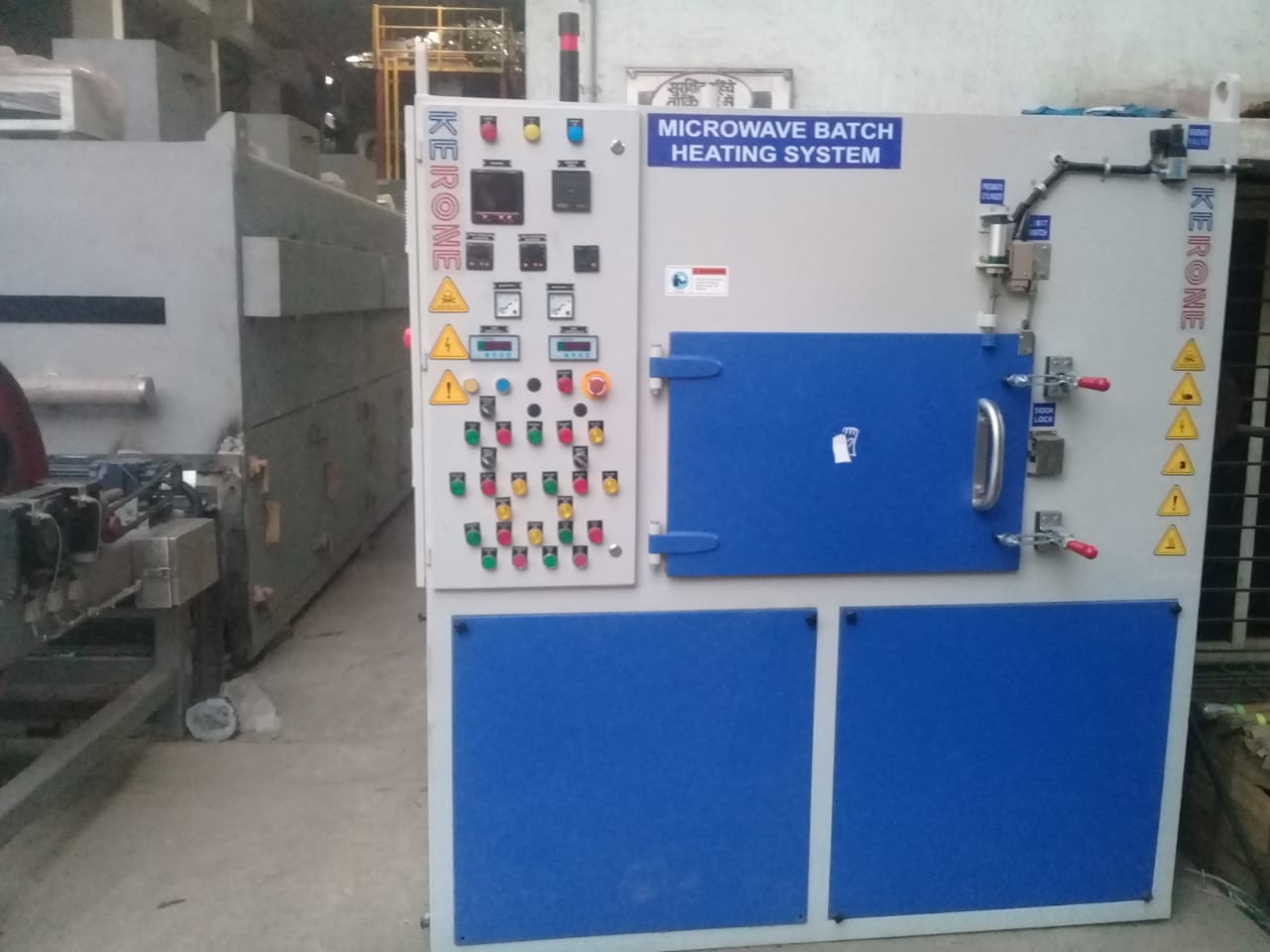
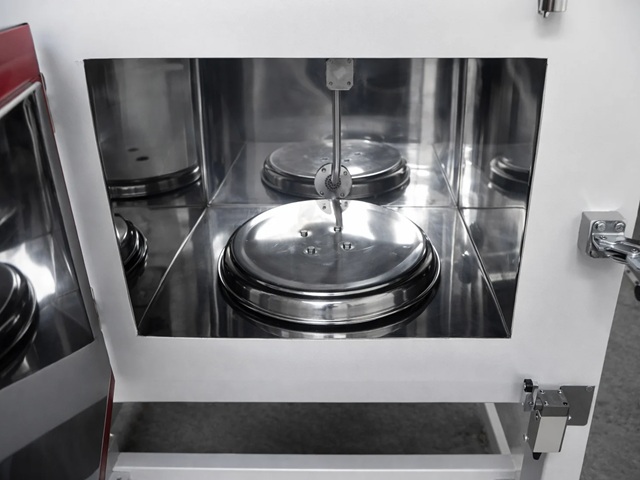
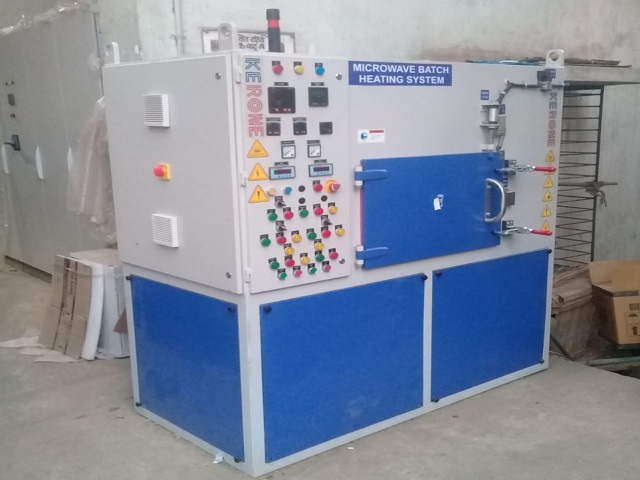
Kerone is an organization that helps the rubber manufactures and processors with its high quality and technically advanced electromagnetic based heating solution powered by microwave heating. Microwave heating technology has the capability that it penetrates within the rubber material under process and energizes the water molecules present within, this results in very high quality processing in shorter time. As rubber is a poor conductor to heat, this process is very effective. Our preheating solutions provide great benefit to our clients as the high built quality and technical advancements make our solutions more efficient and economical.
Why Choose Kerone Microwave Rubber Mould Preheating Systems
KERONE Engineering Solutions Ltd. is a pioneer in application and implementing engineering solutions with its vast experience and team of professionals. Since last 50+ years, it has been into designing, manufacturing & installing of Industrial machinery for various processing needs. The engineers & professionals at KERONE have in depth knowledge of different heating technologies and provide solutions applying them in a huge no. of Industrial machines.
Types and Features of Microwave Rubber Mould Preheating Systems
Features of Our Microwave Pre-Heaters
Longer Functional Life: Designed for extended and reliable operation.
Low and Easy Maintenance: Minimizes downtime and service costs.
Dense Construction: Compact and robust structural design.
Quick and Easy Installation: Simple integration into existing production lines.
Precisely Designed and Engineered: Built for accuracy and consistent performance.
Hassle-Free Functioning: User-friendly and smooth operational workflow.
Longer Service Life: High-quality components ensure durability.
Rugged Construction: Suitable for demanding industrial environments.
High Durability: Withstands heavy-duty processing conditions.
Energy and Cost Efficient: Optimized for reduced operational expenses.
Power Saving: Efficient utilization of electrical energy.
Efficient Performance: Delivers stable and uniform heating output.
Advantages of Microwave Pre-Heating Systems
Fast and Uniform Heating: Even volumetric heating throughout the material.
Selective Heating: Targets specific components without overheating the surface.
Direct Utilization of Large-Sized Feedstocks: Suitable for bulk material processing.
Treatment of Non-Homogeneous Materials: Efficient processing of mixed or uneven materials.
Waste Reduction and Material Recovery: Minimizes losses and improves resource efficiency.
Better Production Quality: Enhances product consistency and performance.
Supports New Materials and Products: Enables advanced material development.
Energy Efficiency: Lower energy consumption compared to conventional systems.
Improved Process Control: Accurate monitoring and adjustment of parameters.
Operates from Electrical Source: Clean and convenient energy operation.
Key Features
High thermal and processing efficiency
Low maintenance and easy operation
Suitable for heat-sensitive materials
Fully adjustable and customizable process parameters
Available in batch and continuous configurations
Uniform processing and consistent product quality
Powered by AI, ML & IoT
Future-Ready Engineering Driven by AI & IoT
Our advanced AI, ML, and IoT technologies, this solution delivers smarter automation, real-time insights, and predictive intelligence to enhance efficiency and drive future-ready growth.
Real-Time Monitoring & Control
Continuous tracking of process parameters with instant adjustments.
Predictive Maintenance
Intelligent fault detection to prevent failures before they occur.
Adaptive Process Optimization
Dynamic tuning of operations for maximum output and efficiency.
Cloud Dashboards & Analytics
Unified access to real-time insights and performance trends.
Energy & Resource Savings
Smarter utilization of energy to cut costs and reduce waste.
Secure IoT Connectivity
Encrypted data flow with seamless integration across plant systems.
Applications of Microwave Rubber Mould Preheating Systems
Kerone’s Microwave Rubber Mould Preheating Systems are extensively used in rubber moulding and manufacturing industries. Typical applications include:
Preheating rubber preforms for compression moulding of automotive rubber components
Rubber blank preheating for transfer moulding of seals, gaskets, and O-rings
Silicone rubber preform preheating for medical and food-grade moulded components
Industrial rubber component preheating for large compression-moulded parts
Vibration damper and rubber-to-metal bonded component preform preheating
Rubber mat and sheet compression moulding preheating applications
Kerone’s Microwave Rubber Mould Preheating Systems solutions are engineered to deliver maximum efficiency, long-term reliability and excellent operational stability. Our focus on innovation and customization ensures superior industrial results.
Seamless Export Connections Global & Local
Our Global Footprint in Industrial Excellence
Delivering world-class industrial and process solutions across countries with precision, innovation, and reliability.
Peru
Chile
Argentina
Mexico
Colombia
Brazil
USA
Canada
United Kingdom
France
Germany
Spain
Italy
Netherlands
Sweden
Switzerland
Poland
Portugal
Ireland
Czechia
Romania
Hungary
Austria
Greece
Kazakhstan
Uzbekistan
Turkmenistan
Algeria
Egypt
Nigeria
Kenya
South Africa
Saudi Arabia
UAE
Israel
Russia
India
China
Japan
South Korea
Thailand
Vietnam
Malaysia
Singapore
Indonesia
Philippines
Australia
New Zealand
Pan-India Presence. Local Expertise.
Raipur
Bilaspur
Panaji
Vasco da Gama
Gandhinagar
Ahmedabad
Surat
Chandigarh
Gurgaon
Shimla
Manali
Bengaluru
Mysore
Kochi
Pune
Mumbai
Thane
Navi Mumbai
Hyderabad
Chennai
Coimbatore
Kolkata
Lucknow
Jaipur
Udaipur
Jodhpur
Dehradun
Haridwar
Bhubaneswar
Product Gallery
Frequently Asked Questions (FAQ)
It is used for efficient processing, heating, drying or material transformation.
High efficiency, process reliability and complete customization.
Food, chemical, pharma, biomass, rubber, textile and more.
Kerone ensures high product quality through strict engineering standards, advanced testing procedures, and precision-controlled manufacturing systems.
With properly controlled microwave power and preheating time, scorching is prevented. Kerone's systems include automatic temperature monitoring and power cutoff to prevent overheating.
Natural rubber, EPDM, NBR, SBR, silicone, neoprene, and other standard moulding compounds can be preheated, with parameters adjusted for each compound's specific dielectric and thermal properties.
Properly preheated rubber preforms typically reduce press cycle time by 30–50%, depending on the part geometry, rubber compound, and initial preform temperature.
Rubber is a naturally poor conductor of heat, which means that in conventional press heating, the mould surface reaches curing temperature long before the rubber's core does. This forces manufacturers to hold the press closed longer to let heat conduct fully through the part, wasting press time. Microwave preheating solves this by exciting moisture and polar molecules throughout the rubber preform before it ever enters the press, bringing the entire mass close to a uniform target temperature in a separate, parallel step. When the preform reaches the mould already warm and uniform, the press only needs to complete cross-linking rather than also performing the slow job of heating the rubber from the outside in, which is why preheated stock can cut total press cycle time by roughly 30 to 50 percent depending on part geometry and compound.
Natural rubber, EPDM, NBR, SBR, neoprene, and silicone all preheat effectively because each contains enough polar content or moisture to couple with microwave energy, though the optimal power and exposure time differs by compound due to varying dielectric loss factors. Compounds with very low polarity or minimal moisture content respond more slowly and may need longer exposure or supplemental heating to reach target preheat temperature. Filler content also matters, since carbon black and certain mineral fillers can alter how energy distributes through the preform. Manufacturers switching between multiple compound families should expect to run trial batches to establish power and time settings for each formulation, since a setting optimized for EPDM will not transfer directly to silicone without adjustment.
Scorching occurs when localized areas of the rubber preform absorb energy faster than heat can dissipate, typically due to uneven preform geometry, inconsistent compound mixing, or excessive power applied for too long a duration. Kerone's systems address this through automatic temperature monitoring combined with power cutoff logic that halts or reduces energy input once target temperature is reached, rather than running a fixed time cycle regardless of actual preform temperature. Turntable or conveyor-based positioning also helps by continuously repositioning the preform within the microwave field, preventing any single zone from absorbing a disproportionate energy dose. Proper preform sizing and consistent compound mixing upstream further reduce scorch risk, since irregular shapes are more prone to hot-spot formation than uniform geometries.
Batch preheaters are well suited to operations producing a variety of rubber parts in smaller production runs, since each batch can be loaded with a specific compound and preform size, processed, then changed over to the next product without disrupting a continuous line. Continuous systems suit high-volume single-product manufacturing, such as a dedicated line producing one seal or gasket type at consistent output, because they synchronize preheating with conveyor speed and feed the press without operator intervention between cycles. The decision should be based on product mix variability: facilities running many small-batch SKUs typically get better utilization from batch systems, while facilities running long, repetitive production runs benefit from the throughput consistency of continuous configurations integrated directly into the moulding line.
Because microwave preheating brings the rubber preform to a uniform temperature throughout its mass before moulding, the resulting parts typically show more consistent cure state from surface to core, reducing the porosity and internal voids that occur when undercured cores trap volatiles during press closure. This uniformity also reduces dimensional variation between parts, since uneven shrinkage from inconsistent cure is minimized. Surface finish quality improves as well, since preheated stock flows more predictably into mould cavities, reducing short-shot defects in complex geometries. Manufacturers moulding technical rubber components with tight tolerance requirements, such as automotive seals or vibration dampers, often see scrap rate reductions as a direct result of this improved cure consistency.
Microwave preheating shifts a portion of the heating workload away from the press itself, which is typically the most energy-intensive station in a moulding line because it must maintain high temperature for extended dwell times. By moving a meaningful share of heat input to a microwave preheater operating on direct electrical coupling rather than conduction through steel mould platens, total energy consumption per part often decreases even though a new piece of equipment has been added. The press also completes its job faster per cycle, meaning it spends less time at full power per part produced. The net effect for most rubber processors is a reduction in combined energy cost per finished part, though the exact savings depend on existing press efficiency and the specific compound and part geometry being run.
Yes, microwave rubber mould preheaters are generally designed as standalone units positioned between the preform preparation stage and the moulding press, which means they can typically be integrated into an existing line layout with moderate modification rather than a full redesign. The main physical considerations are floor space for the preheater itself, conveyor or transfer mechanism alignment with the existing press infeed, and electrical supply capacity to support the microwave generator. Facilities with constrained floor space should discuss compact cavity designs with their supplier during the specification stage, since preheater footprint varies based on rated throughput and preform size range.
Kerone’s custom-designed heating and processing solutions are built to meet the demands of your growing operations. Whether you’re upgrading equipment, expanding production, or need a tailor-made solution


 Peru
Peru Chile
Chile Argentina
 Mexico
 Colombia
 Brazil
 USA
USA Canada
 United Kingdom
 France
 Germany
 Spain
Spain Italy
Italy Netherlands
 Sweden
 Switzerland
 Poland
 Portugal
 Ireland
 Czechia
 Romania
 Hungary
 Austria
 Greece
 Kazakhstan
 Uzbekistan
 Turkmenistan
 Algeria
 Egypt
Egypt Nigeria
 Kenya
Kenya South Africa
 Saudi Arabia
 UAE
UAE Israel
 Russia
 India
India China
China Japan
Japan South Korea
 Thailand
 Vietnam
 Malaysia
 Singapore
 Indonesia
 Philippines
 Australia
 New Zealand