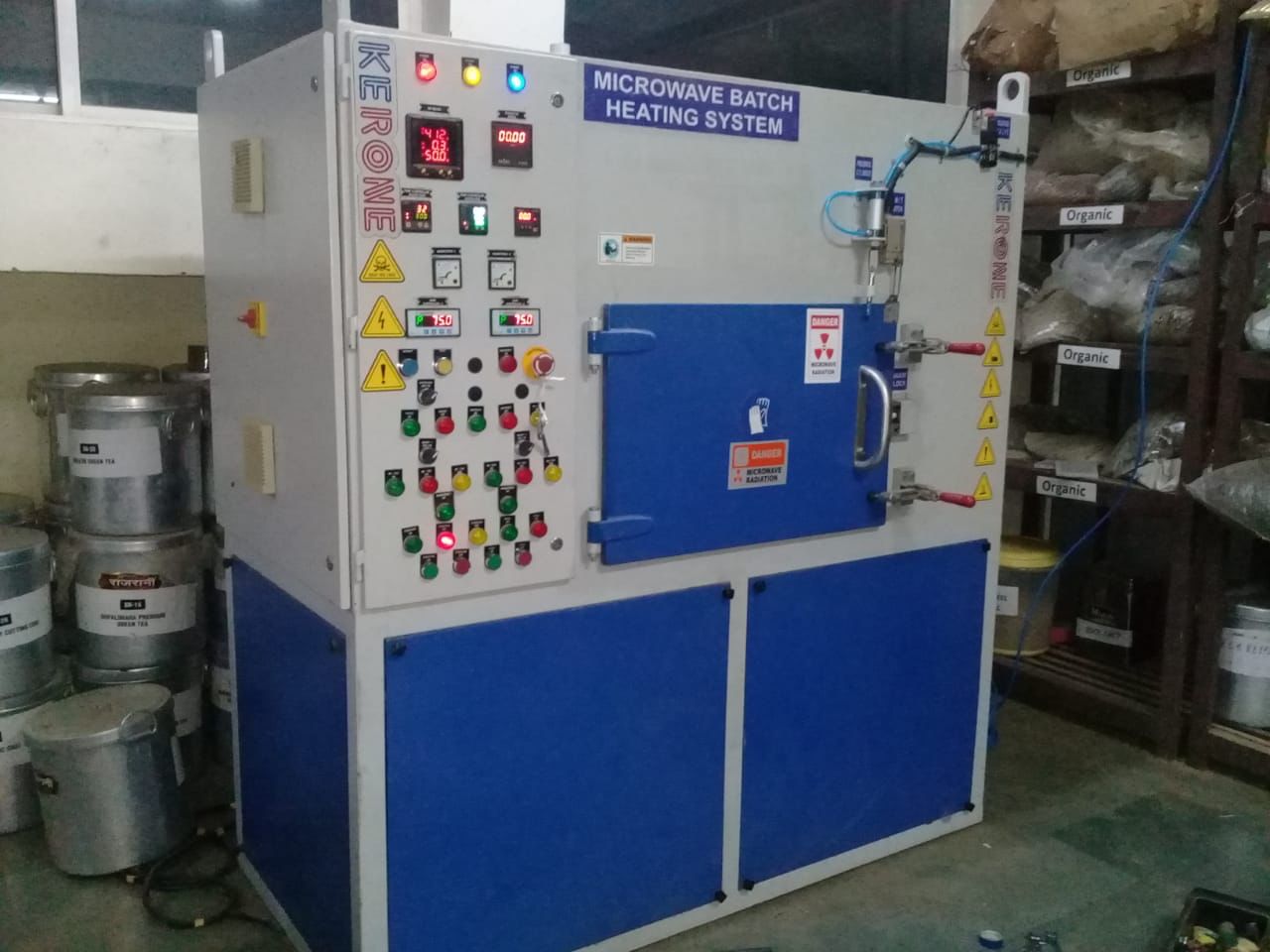
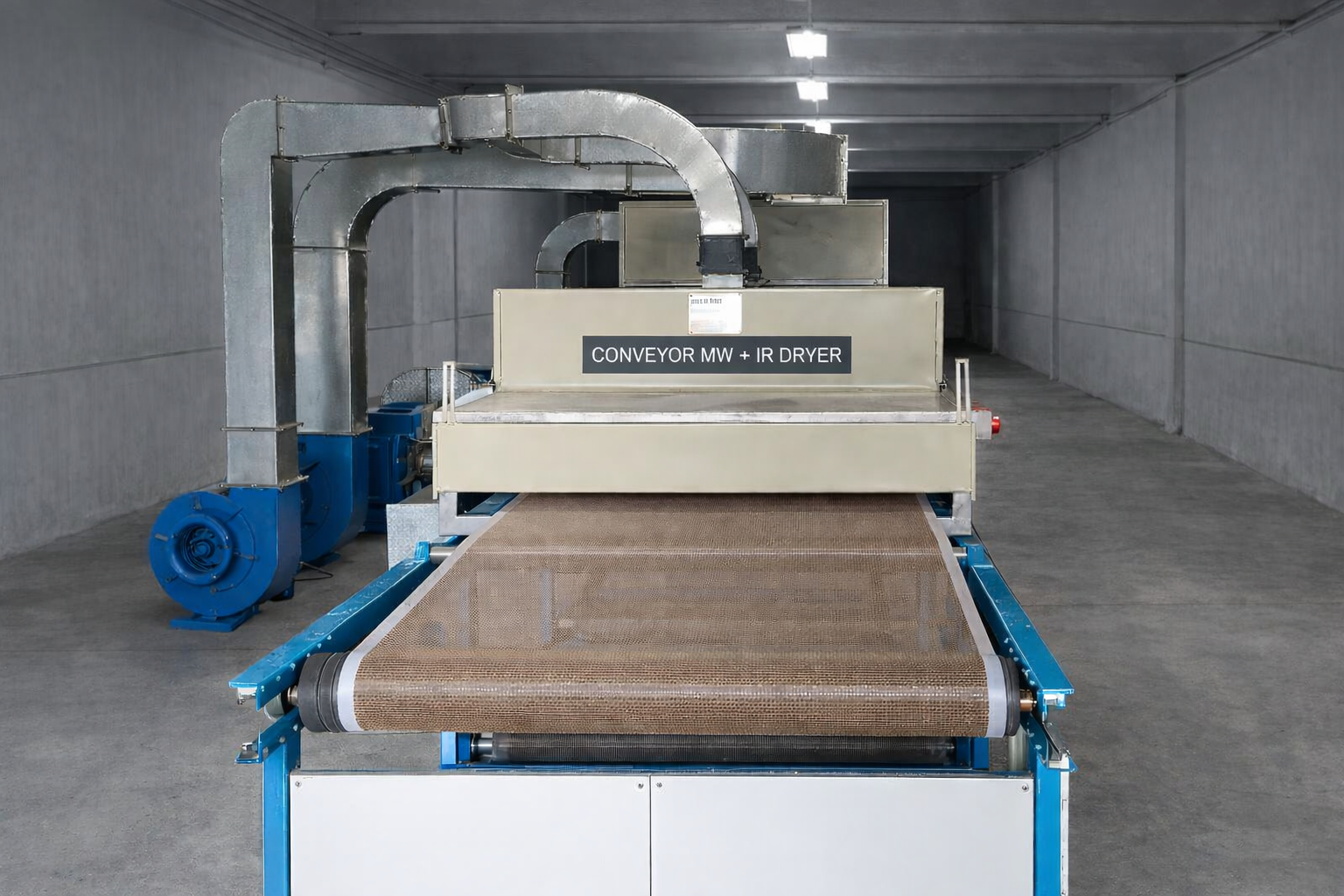
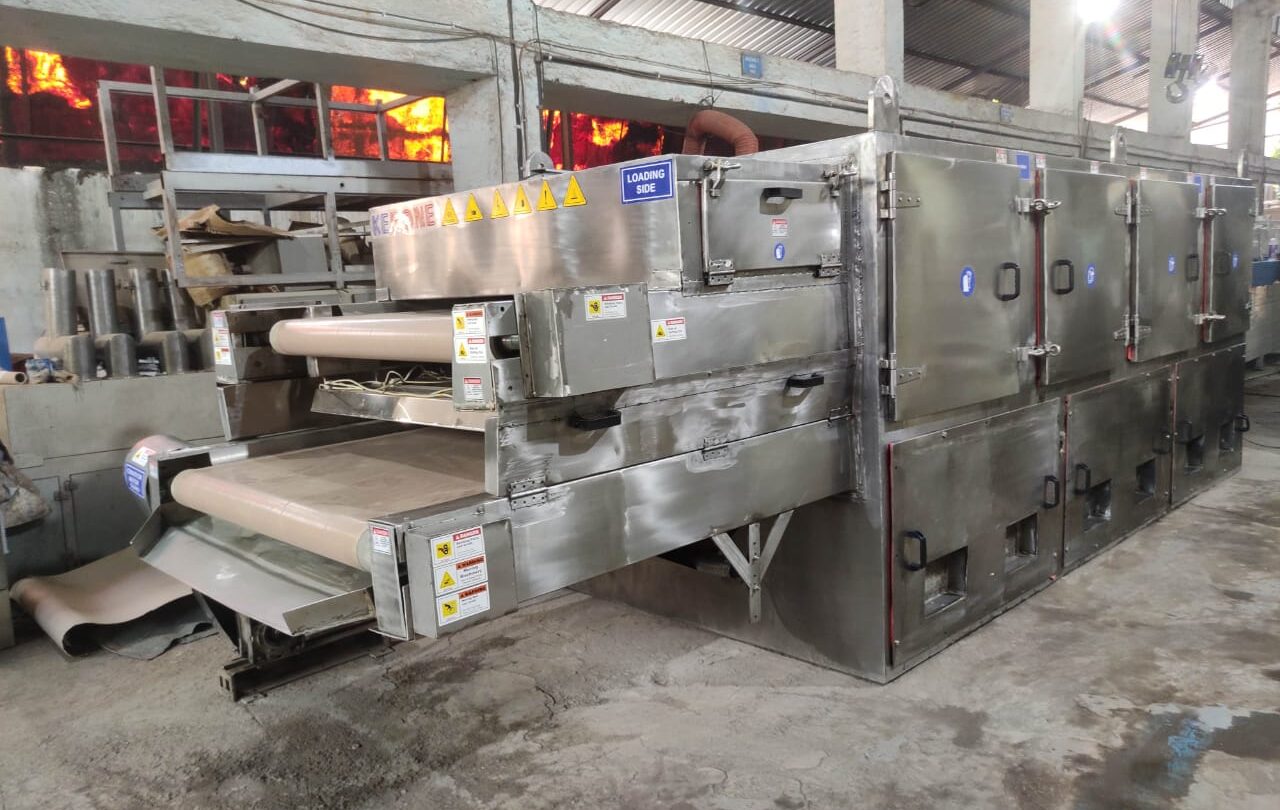
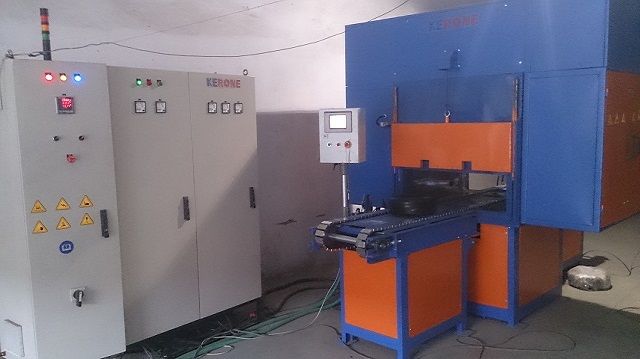
Kerone has been a trusted name in innovative industrial engineering for more than 50 years. Our Microwave Heating for Minerals Processing systems are designed to deliver high-efficiency processing, optimized performance, and consistent output across multiple industrial sectors.
Microwave offers the advantages as the most of the energy waste in mineral processing at time of heat generation which was approx. 50-70% of total energy requirement (Walkiewicz et al., 1991). Microwave based processing of minerals and ores provide the benefits as the heat is generated from the within the ores and waste materials. These differentials induce tensile fractures in the material and as a consequence, substantially reduce the energy required in grinding to separate the values from the waste material.
Why Choose Kerone Microwave Heating for Minerals Processing
Kerone is known for delivering highly efficient, reliable and fully customized MW Heating for Minerals Processing solutions engineered after a detailed analysis of material characteristics, process goals and expected output requirements.
we offer microwave based solution for mineral processing industries as the minerals and extractive metallurgy industry consumes of energy and degrades the environment. Our microwave based processing systems provides significant benefits in reducing energy consumption and environmental impact by this industry.
Types and Features of Microwave Heating for Minerals Processing
In mineral processing, the removal of values in an ore from the excess or gangue is an energy exhaustive and energy inefficient process.
Advantages of Microwave Technology
Reduced Processing Time: Significantly shortens production cycles.
Environment-Friendly Solution: Cleaner process with minimal emissions.
Lesser Energy Consumption: Direct heating reduces overall energy usage.
No Surface Overheating: Uniform internal heating prevents surface damage.
Rapid Volumetric Heating: Energy penetrates material for consistent core heating.
Highly Energy Efficient System: Optimized power utilization.
Lesser Power Consumption: Requires comparatively lower electrical input.
No Residual Production: Clean process with minimal by-products.
Features of Kerone’s Microwave Systems
Longer Working Life: Greater durability compared to conventional heating systems.
Quick and Easy Installation: Designed for seamless integration.
Lesser Maintenance: Robust construction reduces service requirements.
Compact Construction: Space-saving and efficient design.
Adjustable Conveyor Speed and Heating: Flexible process control.
Accurately Designed and Engineered: Precision-built for reliable performance.
Hassle-Free Operation: User-friendly system design.
Highly Durable: Built for long-term industrial use.
Energy and Cost Efficient: Optimized operational expenses.
Consumes Less Power: Efficient electrical utilization.
Efficient Performance: Consistent and stable output.
Fit to Pocket: Cost-effective investment.
Key Features
High thermal and processing efficiency
Low maintenance and easy operation
Suitable for heat-sensitive materials
Fully adjustable and customizable process parameters
Available in batch and continuous configurations
Uniform processing and consistent product quality
Powered by AI, ML & IoT
Future-Ready Engineering Driven by AI & IoT
Our advanced AI, ML, and IoT technologies, this solution delivers smarter automation, real-time insights, and predictive intelligence to enhance efficiency and drive future-ready growth.
Real-Time Monitoring & Control
Continuous tracking of process parameters with instant adjustments.
Predictive Maintenance
Intelligent fault detection to prevent failures before they occur.
Adaptive Process Optimization
Dynamic tuning of operations for maximum output and efficiency.
Cloud Dashboards & Analytics
Unified access to real-time insights and performance trends.
Energy & Resource Savings
Smarter utilization of energy to cut costs and reduce waste.
Secure IoT Connectivity
Encrypted data flow with seamless integration across plant systems.
Applications of Microwave Heating for Minerals Processing
Food industry processing systems
Chemical and polymer processing
Pharmaceutical ingredients and intermediates
Ready‑to‑eat (RTE) food production
Specialized heating, drying, or material transformation processes
Industrial material modification and thermal treatment
Kerone’s Microwave Heating for Minerals Processing solutions are engineered to deliver maximum efficiency, long-term reliability and excellent operational stability. Our focus on innovation and customization ensures superior industrial results.
Seamless Export Connections Global & Local
Our Global Footprint in Industrial Excellence
Delivering world-class industrial and process solutions across countries with precision, innovation, and reliability.
Peru
Chile
Argentina
Mexico
Colombia
Brazil
USA
Canada
United Kingdom
France
Germany
Spain
Italy
Netherlands
Sweden
Switzerland
Poland
Portugal
Ireland
Czechia
Romania
Hungary
Austria
Greece
Kazakhstan
Uzbekistan
Turkmenistan
Algeria
Egypt
Nigeria
Kenya
South Africa
Saudi Arabia
UAE
Israel
Russia
India
China
Japan
South Korea
Thailand
Vietnam
Malaysia
Singapore
Indonesia
Philippines
Australia
New Zealand
Pan-India Presence. Local Expertise.
Raipur
Bilaspur
Panaji
Vasco da Gama
Gandhinagar
Ahmedabad
Surat
Chandigarh
Gurgaon
Shimla
Manali
Bengaluru
Mysore
Kochi
Pune
Mumbai
Thane
Navi Mumbai
Hyderabad
Chennai
Coimbatore
Kolkata
Lucknow
Jaipur
Udaipur
Jodhpur
Dehradun
Haridwar
Bhubaneswar
Product Gallery
Frequently Asked Questions (FAQ)
Industry research, including foundational work by Walkiewicz and colleagues, has identified that heat generation during conventional mineral processing accounts for a substantial share, often cited around 50 to 70 percent, of total energy consumption in some operations, which represents the scale of energy currently used inefficiently that microwave pretreatment targets. Actual achieved savings from implementing microwave pretreatment depend heavily on the specific ore's response characteristics and how the pretreatment integrates with existing comminution circuit design, so published energy savings figures from research studies shouldn't be assumed to transfer directly to a different ore body without site-specific testing. Operators should treat microwave pretreatment as a potential energy reduction strategy requiring validation against their specific ore characteristics rather than a guaranteed percentage improvement applicable universally.
High efficiency, process reliability and complete customization.
Reducing the energy intensity of comminution directly lowers the carbon footprint associated with electricity or fuel consumption for grinding and crushing operations, which represents one of the largest environmental impact categories in mineral processing. Microwave pretreatment that improves liberation of valuable minerals from gangue can also reduce the volume of waste rock requiring disposal for a given amount of recovered mineral, since better liberation efficiency means less material needs to be processed to achieve target recovery rates. Additionally, because microwave heating doesn't involve combustion or chemical reagents in the pretreatment step itself, it avoids adding direct emissions or chemical residue concerns at that specific stage of the process, though downstream extraction and beneficiation steps retain their own separate environmental considerations.
Mineral processing applications generally involve handling abrasive, dense materials in bulk volumes, which requires more robust conveying and material handling systems than food or chemical powder applications, along with greater attention to dust containment and equipment wear resistance given the abrasive nature of crushed rock and ore. Power density requirements also tend to differ, since the goal in mineral processing is often inducing thermal stress fracturing rather than achieving a uniform target temperature throughout the material, which can permit different power and exposure time profiles than food pasteurization or chemical drying applications where uniform temperature achievement is the primary goal. Equipment suppliers typically configure conveying, dust management, and power delivery specifically around the ore characteristics and desired processing outcome rather than applying a generic industrial microwave design across mineral, food, and chemical applications interchangeably.
Kerone ensures high product quality through strict engineering standards, advanced testing procedures, and precision-controlled manufacturing systems.
Microwave pretreatment units are typically positioned between primary crushing and secondary grinding stages, treating ore after initial size reduction has created particle sizes suited to effective microwave exposure but before the energy-intensive fine grinding stage where the energy savings benefit is realized. This positioning allows the microwave stage to be added to an existing circuit as a discrete unit operation without necessarily requiring redesign of the upstream crushing or downstream grinding equipment, provided material handling interfaces and throughput rates are compatible. Integration planning should confirm that the existing circuit's throughput capacity isn't bottlenecked by the microwave stage's processing rate, since a mismatch here would create a new constraint rather than simply adding an energy-saving step.
Microwave-based mineral processing operates on electrical energy converted directly to electromagnetic radiation, producing no combustion emissions and no flue gas requiring scrubbing or treatment, unlike conventional thermal pretreatment methods that rely on burning fossil fuels to achieve target temperatures. Because microwave heating can reduce the energy intensity of downstream grinding, the cumulative energy footprint of the full processing chain, from ore to separated mineral, can be lower than conventional approaches relying solely on mechanical comminution. For mining operations under increasing pressure to report and reduce their carbon footprint, microwave pretreatment offers a pathway to lower both direct emissions from the heating process itself and indirect emissions tied to the substantial electricity demand of grinding circuits.
Microwave heating is suitable for processing gold, copper, iron ore, nickel, zinc, and other mineral concentrates that respond to dielectric heating.
Capacity sizing depends on the ore throughput rate the pretreatment stage needs to support relative to the downstream grinding circuit's design capacity, since the microwave unit must keep pace with the mill feed rate to avoid becoming a bottleneck. Adjustable conveyor speed and heating power allow the system to be tuned for varying ore hardness and moisture content, which fluctuate as mining operations move through different zones of an ore body. Mining operations typically conduct continuous pilot-scale testing across representative ore samples from different parts of the deposit before finalizing full-scale equipment sizing, since a system calibrated only for average ore characteristics may struggle to maintain throughput when processing harder or more variable ore sections.
Since grinding represents such a substantial share of total processing energy in mineral extraction, even modest reductions in required grinding energy translate into meaningful operational cost savings at the scale most mining operations run, given their continuous high-tonnage throughput. Savings show up as reduced electricity consumption per tonne of ore processed through the grinding circuit, potentially extended mill liner and grinding media life due to reduced mechanical stress on pre-weakened ore, and in some cases the ability to achieve target particle size distribution with fewer grinding stages. The exact savings percentage depends heavily on baseline ore hardness and the specific microwave pretreatment parameters applied, which is why most facilities run a detailed pilot trial to quantify expected savings before committing to full-scale implementation.
Mining environments expose processing equipment to abrasive dust, variable ambient temperatures, and continuous high-tonnage material flow, all of which demand robust, compact construction for any equipment installed in this setting. Microwave mineral processing systems are generally built with adjustable conveyor speed and heating controls to handle this variability, along with construction designed for durability under sustained industrial operation. Because there are no burners or combustion-related wear components, maintenance demands tend to be lower than thermal pretreatment alternatives, though the dusty mining environment requires more frequent housekeeping and inspection of seals and access points to prevent material ingress into sensitive electronic and waveguide components than would be typical in a cleaner manufacturing setting.
Microwave pretreatment targets energy reduction specifically at the comminution stage through pre-weakening ore via differential thermal stress, whereas blasting optimization focuses on fragmentation before ore even reaches the plant, and high-pressure grinding rolls represent a mechanical alternative to conventional ball or rod milling. These approaches are not mutually exclusive and are increasingly evaluated in combination, since microwave pretreatment can complement rather than replace other comminution efficiency strategies. The relative cost-effectiveness of microwave pretreatment depends on the specific ore's response to differential heating, existing grinding circuit efficiency, and electricity cost at the operating site, making a site-specific techno-economic study a more reliable basis for investment decisions than general industry comparisons.
A frequent misconception is that laboratory-scale microwave heating results, often achieved with small, well-characterized ore samples under highly controlled conditions, will translate directly to full-scale industrial throughput without significant process engineering. In practice, scaling microwave energy delivery to handle continuous, high-tonnage ore flow while maintaining the differential heating effect that drives micro-fracturing requires careful cavity design, power distribution engineering, and conveyor residence time optimization that differs substantially from small batch laboratory conditions. Mining operations should expect a structured pilot-scale validation phase between laboratory proof of concept and full industrial deployment, rather than assuming laboratory energy reduction percentages will be achieved immediately at production scale.
The economic case for microwave pretreatment investment strengthens with higher ore processing volumes, since the capital cost of microwave equipment is spread across more processed tonnage, and with ores showing strong differential heating response, since this directly determines the magnitude of energy savings achieved in downstream grinding. Operations processing lower-value ore at high volume may find the energy savings alone justify investment, while operations with smaller throughput or ore showing marginal microwave response may find the payback period extends beyond an acceptable threshold. A realistic economic evaluation requires combining ore-specific microwave response testing with the operation's actual energy cost structure and throughput volume, rather than relying on generic industry energy-saving percentages that don't account for site-specific variables.
Mineral composition and mineral association patterns often vary across different zones within a single ore body, meaning the dielectric contrast that drives effective microwave pretreatment in one part of the mine may not be consistent in another zone mined later in the operation's life. This variability means a microwave pretreatment system validated against initial ore samples may show declining or inconsistent benefit as mining progresses into different geological zones, unless the operation periodically reassesses ore characteristics and adjusts microwave processing parameters accordingly. Operations planning long-life mines with known geological variability should factor this into their evaluation of microwave pretreatment economics, treating initial test results as representative of early-stage ore rather than assuming identical performance will hold across the full my life.
Kerone’s custom-designed heating and processing solutions are built to meet the demands of your growing operations. Whether you’re upgrading equipment, expanding production, or need a tailor-made solution


 Peru
Peru Chile
Chile Argentina
 Mexico
 Colombia
 Brazil
 USA
USA Canada
 United Kingdom
 France
 Germany
 Spain
Spain Italy
Italy Netherlands
 Sweden
 Switzerland
 Poland
 Portugal
 Ireland
 Czechia
 Romania
 Hungary
 Austria
 Greece
 Kazakhstan
 Uzbekistan
 Turkmenistan
 Algeria
 Egypt
Egypt Nigeria
 Kenya
Kenya South Africa
 Saudi Arabia
 UAE
UAE Israel
 Russia
 India
India China
China Japan
Japan South Korea
 Thailand
 Vietnam
 Malaysia
 Singapore
 Indonesia
 Philippines
 Australia
 New Zealand