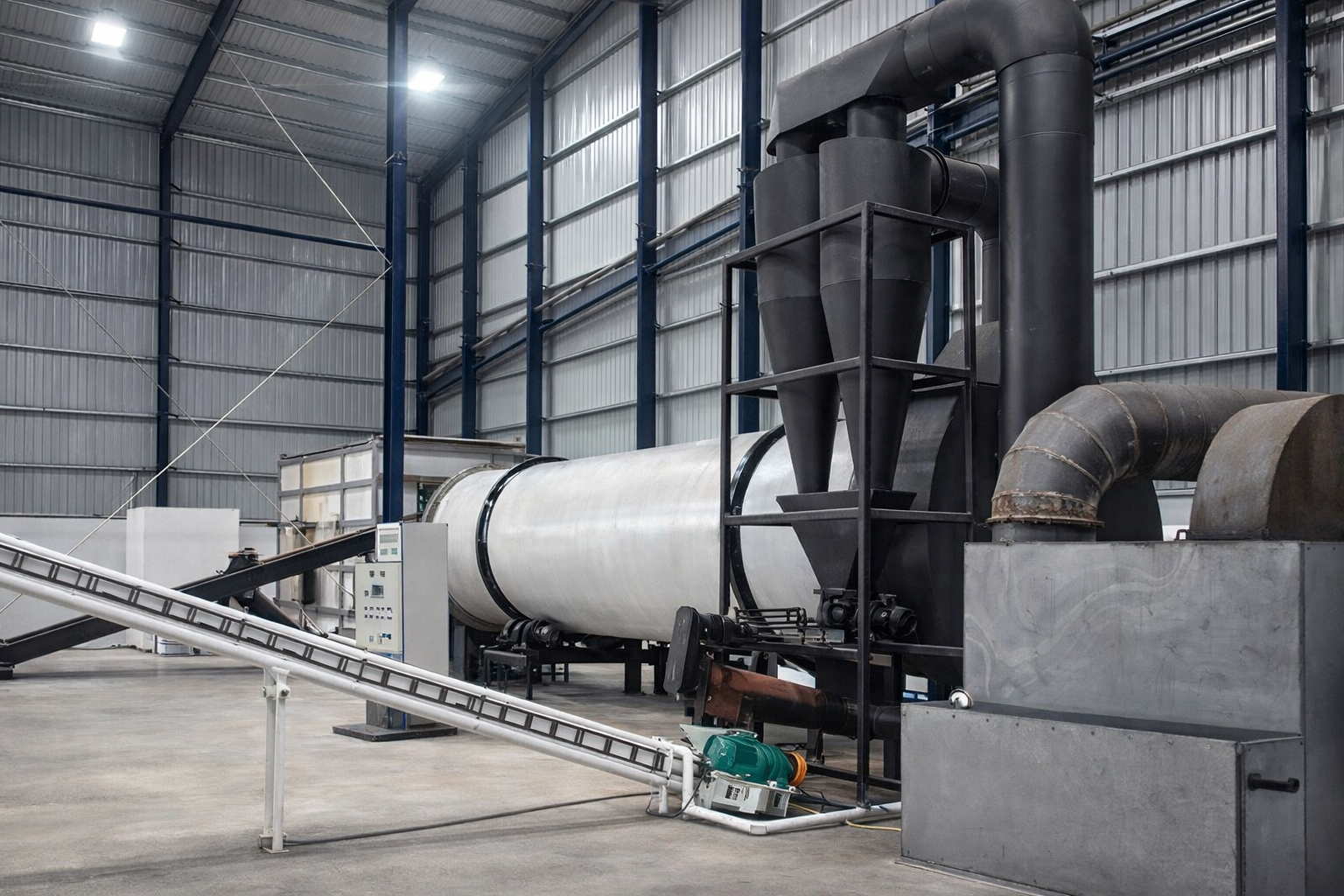
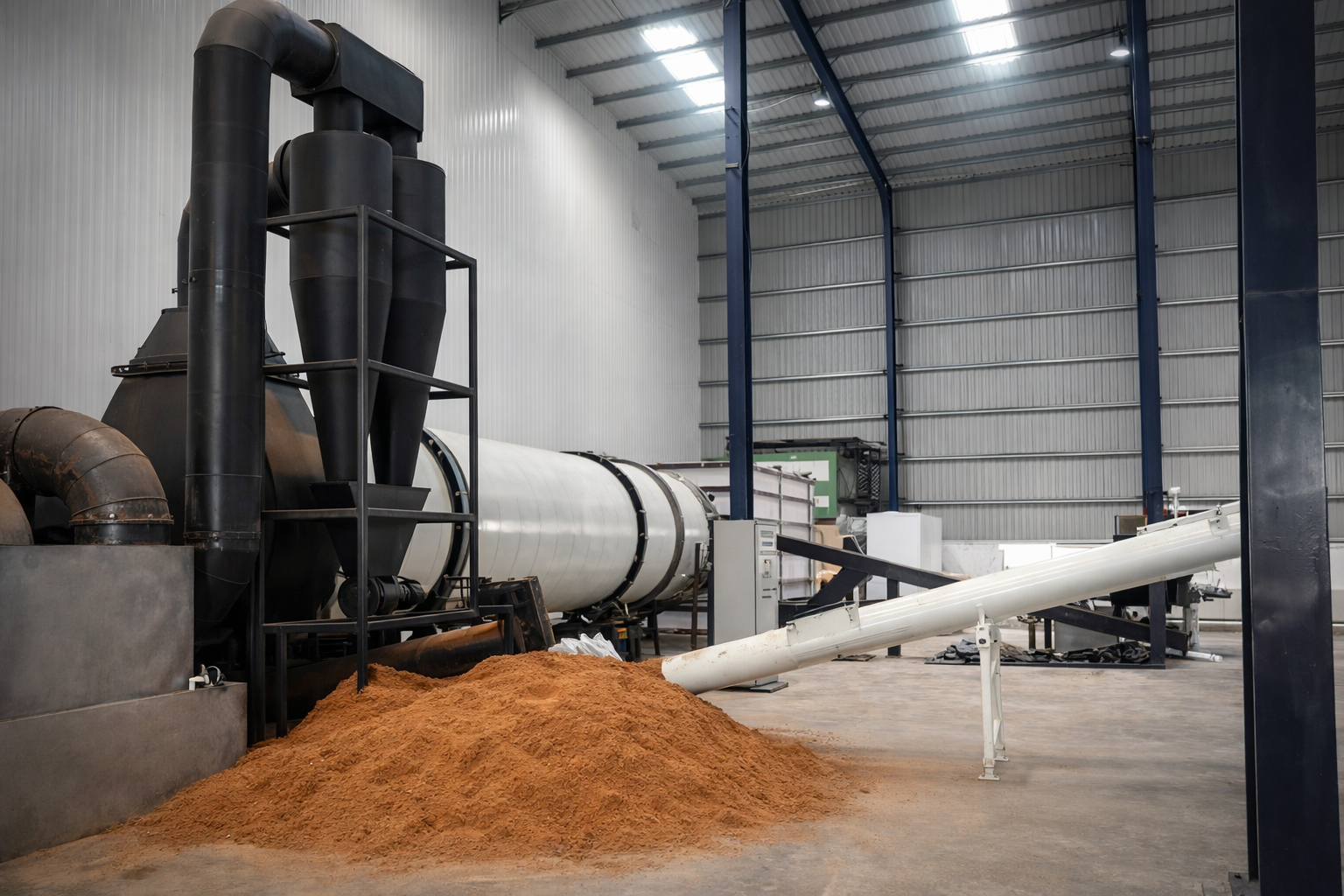
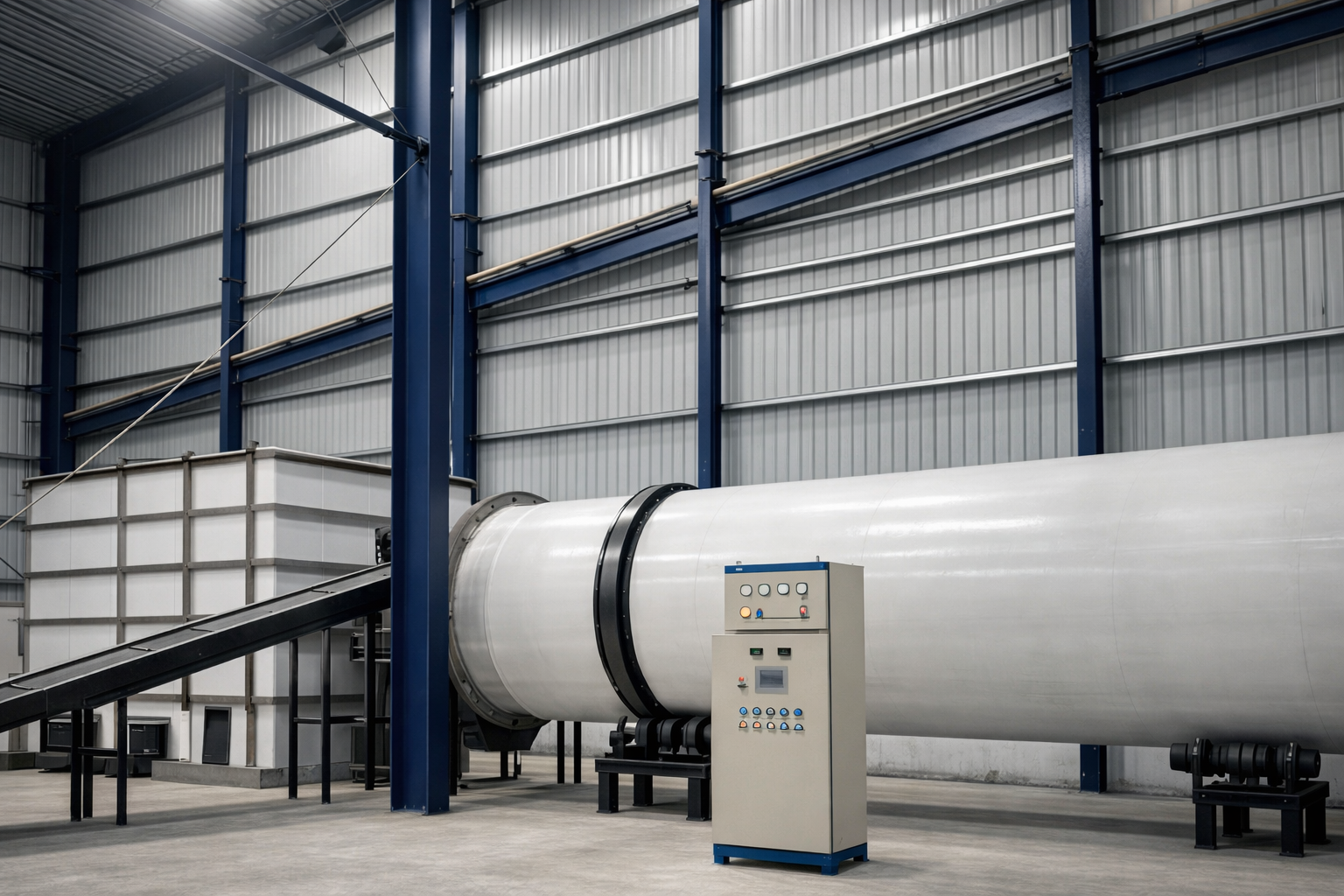
Paddle Rotary Dryer is engineered to provide optimal drying efficiency and material handling performance. It ensures reliability, uniform heat transfer, and minimal degradation for sensitive or bulk materials.
Kerone Engineering Solutions Ltd. is a leading company in the provision of advanced industrial heating, drying, and process solutions of engineering globally. Having more than 50 years of expertise, we are experts in designing, producing, and delivering custom-made, state-of-the-art systems to meet the ever-changing requirements of the industries across the globe.
Why Choose Kerone Paddle Rotary Dryer
Kerone’s Paddle Rotary Dryer integrates precision engineering, robust construction, and advanced control systems that ensure consistent output and long‑term durability across various industrial applications.
The KERONE paddle dryer offers a once-through drying technology that avoids back-mixing, according to the demand of the market KERONE designs and manufactures paddle rotary dryer that is also named a paddle-harrow rotary dryer. It’s specifically designed according to the issues of the normal rotary dryer which isn’t suitable for high-moisture materials that moisture Content is beyond 50% and the viscosity is relatively low.
Types and Features of Paddle Rotary Dryer
The Paddle Rotary Dryer is available in multiple industrial configurations tailored for specific materials, production capacities, and environmental requirements, ensuring operational flexibility and efficiency.
According to the practical test, the unit vaporization capacity per hour of paddle rotary dryer is as much as 25-60kg/m2, which is twice of traditional rotary dryer. The output is raised by 50% and fuel consumption is reduced by 30%. At the same time, the footprint and drying efficiency is raised by 40%.
Key Features
Dual paddle agitators ensure thorough material mixing
Ideal for sticky, slurry-based, and high-viscosity materials
Uniform indirect heating with minimal dust generation
Precise temperature control for sensitive materials
Wear-resistant paddles that maintain efficiency over long use
Efficient heat transfer through hollow shaft and blades
Compact system footprint for industrial plants
Low maintenance due to fewer moving parts
Powered by AI, ML & IoT
Future-Ready Engineering Driven by AI & IoT
Our advanced AI, ML, and IoT technologies, this solution delivers smarter automation, real-time insights, and predictive intelligence to enhance efficiency and drive future-ready growth.
Real-Time Monitoring & Control
Continuous tracking of process parameters with instant adjustments.
Predictive Maintenance
Intelligent fault detection to prevent failures before they occur.
Adaptive Process Optimization
Dynamic tuning of operations for maximum output and efficiency.
Cloud Dashboards & Analytics
Unified access to real-time insights and performance trends.
Energy & Resource Savings
Smarter utilization of energy to cut costs and reduce waste.
Secure IoT Connectivity
Encrypted data flow with seamless integration across plant systems.
Applications of Paddle Rotary Dryer
Kerone’s Paddle Rotary Dryer are extensively used in industries. Typical applications include:
Drying sticky or pasty materials efficiently
Processing industrial sludge and chemical residues
Handling high-moisture biomass materials
Producing uniform powders from slurry feed
Supporting wastewater treatment plants
Drying food and pharma intermediates with controlled heating
The Paddle Rotary Dryer provides dependable, efficient, and customizable drying capabilities suitable for diverse industrial segments, ensuring productivity and consistent output quality.
A paddle rotary dryer is widely used for drying sticky, pasty, and high-moisture materials that are difficult to handle in conventional dryers. It is commonly applied in the drying of sludge from wastewater treatment plants, chemical pastes, bio-waste, and organic residues. Industries such as fertilizer manufacturing use it to dry manure and compost, while food processing units apply it for drying starch, pulp, and other semi-solid materials. The paddle mechanism ensures continuous mixing and uniform heat transfer, making it suitable for materials that require controlled, efficient, and energy-saving drying processes.
Seamless Export Connections Global & Local
Our Global Footprint in Industrial Excellence
Delivering world-class industrial and process solutions across countries with precision, innovation, and reliability.
Peru
Chile
Argentina
Mexico
Colombia
Brazil
USA
Canada
United Kingdom
France
Germany
Spain
Italy
Netherlands
Sweden
Switzerland
Poland
Portugal
Ireland
Czechia
Romania
Hungary
Austria
Greece
Kazakhstan
Uzbekistan
Turkmenistan
Algeria
Egypt
Nigeria
Kenya
South Africa
Saudi Arabia
UAE
Israel
Russia
India
China
Japan
South Korea
Thailand
Vietnam
Malaysia
Singapore
Indonesia
Philippines
Australia
New Zealand
Pan-India Presence. Local Expertise.
Raipur
Bilaspur
Panaji
Vasco da Gama
Gandhinagar
Ahmedabad
Surat
Chandigarh
Gurgaon
Shimla
Manali
Bengaluru
Mysore
Kochi
Pune
Mumbai
Thane
Navi Mumbai
Hyderabad
Chennai
Coimbatore
Kolkata
Lucknow
Jaipur
Udaipur
Jodhpur
Dehradun
Haridwar
Bhubaneswar
Product Gallery
Frequently Asked Questions (FAQ)
It is designed for efficient industrial drying of material specific to its category.
Yes, it is engineered for uninterrupted workflow depending on model selection.
Routine inspection, lubrication, and cleaning based on material type.
Kerone provides multiple customization options for capacity, controls, and thermal systems.
Food, chemical, pharma, agriculture, and material‑processing sectors extensively use it.
The system is optimized to reduce energy use while maintaining high drying efficiency.
A paddle rotary dryer combines features of both paddle dryers and rotary drum dryers. It incorporates a rotating drum with internally mounted paddle agitators that provide additional mechanical agitation to the material beyond what standard lifting flights provide. This design improves heat transfer and handles sticky or cohesive materials that would accumulate on simple flight surfaces. Paddle rotary dryers are used where both high throughput and good handling of difficult materials is required.
Paddle rotary dryers are particularly effective for materials that are cohesive or sticky at intermediate moisture levels, such as animal manure, compost, sludge, sawdust, mineral concentrates, clay, and food processing byproducts. The paddle action continuously breaks up agglomerates and exposes fresh surfaces for drying, unlike plain rotary dryers where sticky materials can accumulate on the drum wall and flights without drying.
Heat transfer in a paddle rotary dryer can be either direct (hot gas passes through the rotating drum and contacts the material) or indirect (heat is transferred through the jacketed drum shell and hollow paddles carrying steam or thermal oil). Indirect paddle rotary dryers offer the advantage of no direct contact between combustion gases and the product, which is important for applications where gas contamination must be avoided.
Retention times in paddle rotary dryers typically range from 20 minutes to 3 hours, depending on material moisture content, required outlet moisture, and material properties. The paddles can be configured to control material flow rate through the drum independently of drum rotation speed, providing more precise control over residence time than conventional rotary dryers.
It adds internal paddle agitators on top of the usual rotating drum, giving extra mechanical mixing that plain lifting flights don't provide. This matters for materials that would otherwise stick to the drum walls instead of drying evenly.
Yes, this is actually one of its main advantages. Standard rotary dryers struggle with material above 50% moisture, but the paddle design was developed specifically to manage that higher moisture range without clogging.
It can be either. Direct heating passes hot gas through the drum and onto the material, while indirect heating runs steam or thermal oil through a jacketed shell and hollow paddles, indirect is the better choice if combustion gas contact with your product is a concern.
The paddle configuration lets operators control how fast material moves through the drum somewhat independently of drum rotation speed, giving more precise control over how long the material actually stays inside, typically between 20 minutes and 3 hours.
Sticky, cohesive materials like sludge, compost, mineral concentrates, clay, and sawdust are the main candidates, these tend to build up on flights in a standard rotary dryer, but the paddle action keeps breaking that build-up apart.
Kerone’s custom-designed heating and processing solutions are built to meet the demands of your growing operations. Whether you’re upgrading equipment, expanding production, or need a tailor-made solution




 Peru
Peru Chile
Chile Argentina
 Mexico
 Colombia
 Brazil
 USA
USA Canada
 United Kingdom
 France
 Germany
 Spain
Spain Italy
Italy Netherlands
 Sweden
 Switzerland
 Poland
 Portugal
 Ireland
 Czechia
 Romania
 Hungary
 Austria
 Greece
 Kazakhstan
 Uzbekistan
 Turkmenistan
 Algeria
 Egypt
Egypt Nigeria
 Kenya
Kenya South Africa
 Saudi Arabia
 UAE
UAE Israel
 Russia
 India
India China
China Japan
Japan South Korea
 Thailand
 Vietnam
 Malaysia
 Singapore
 Indonesia
 Philippines
 Australia
 New Zealand