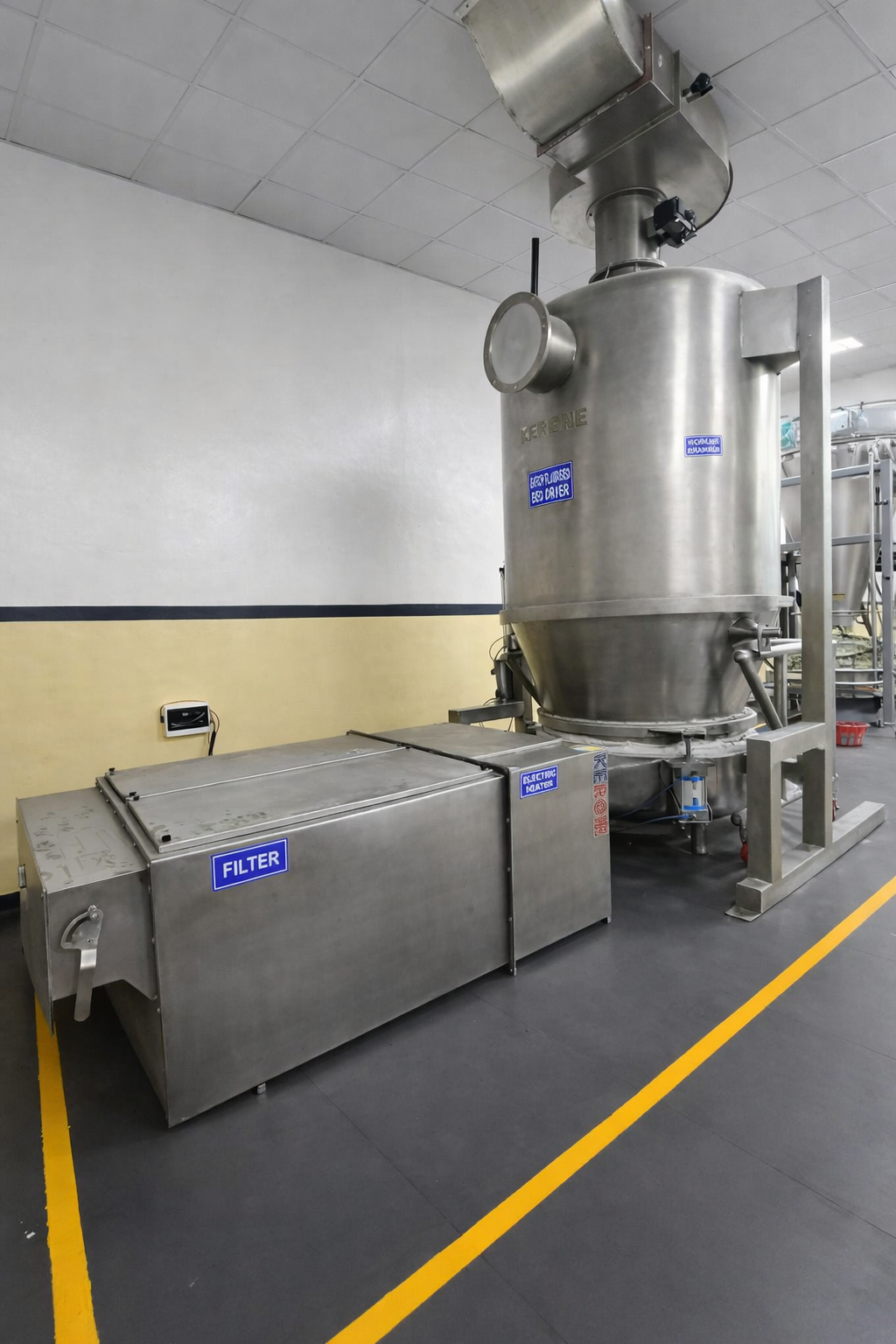
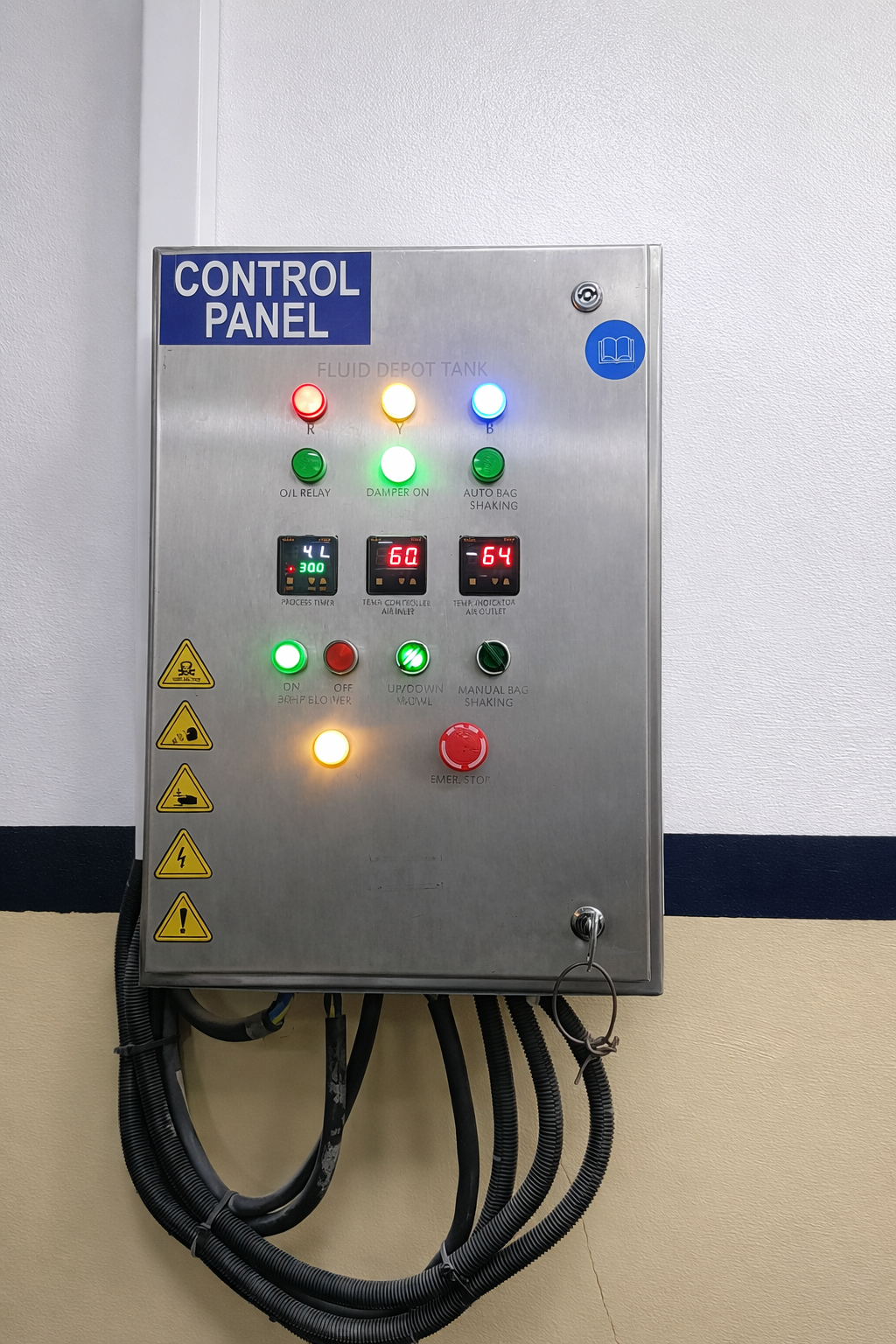
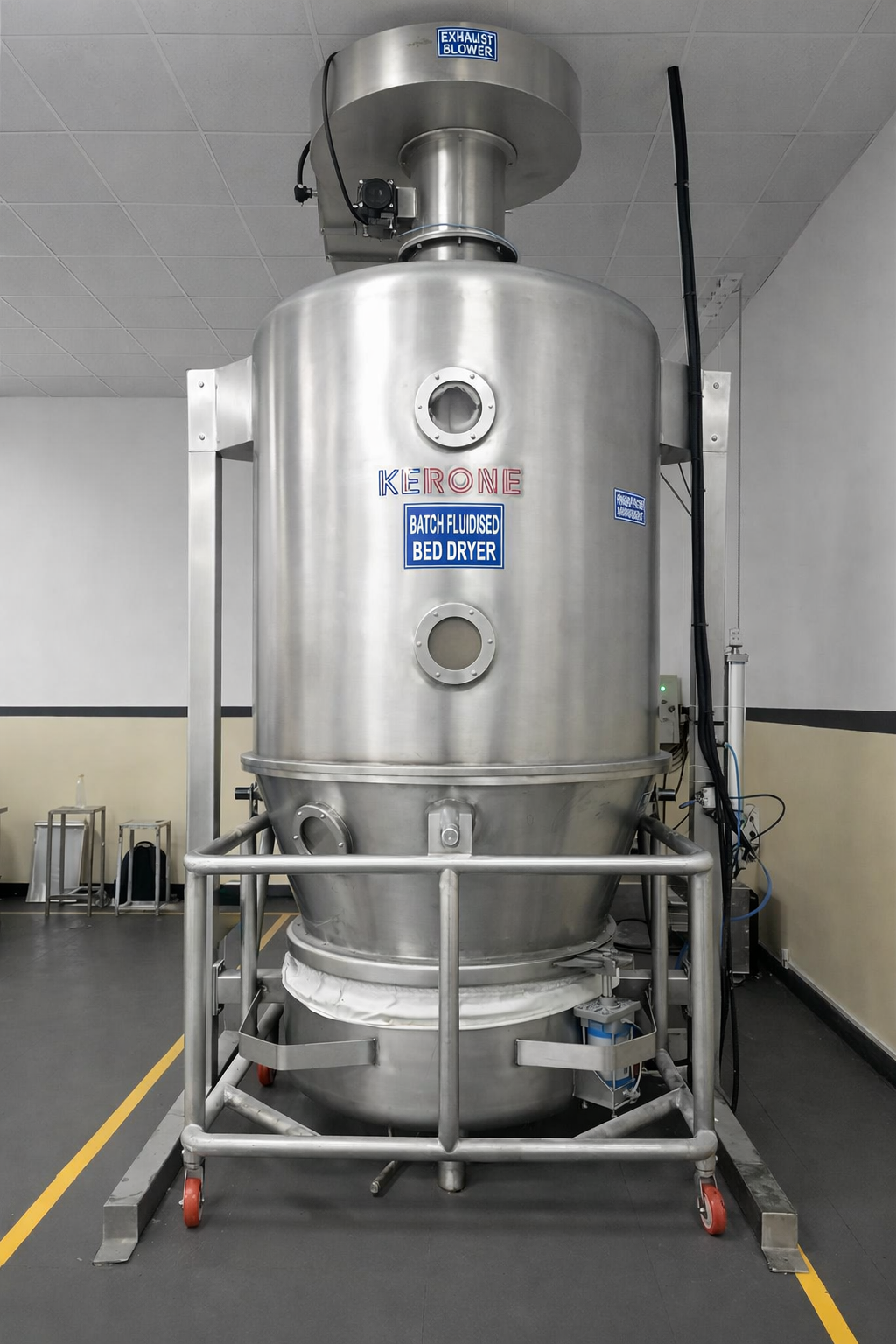
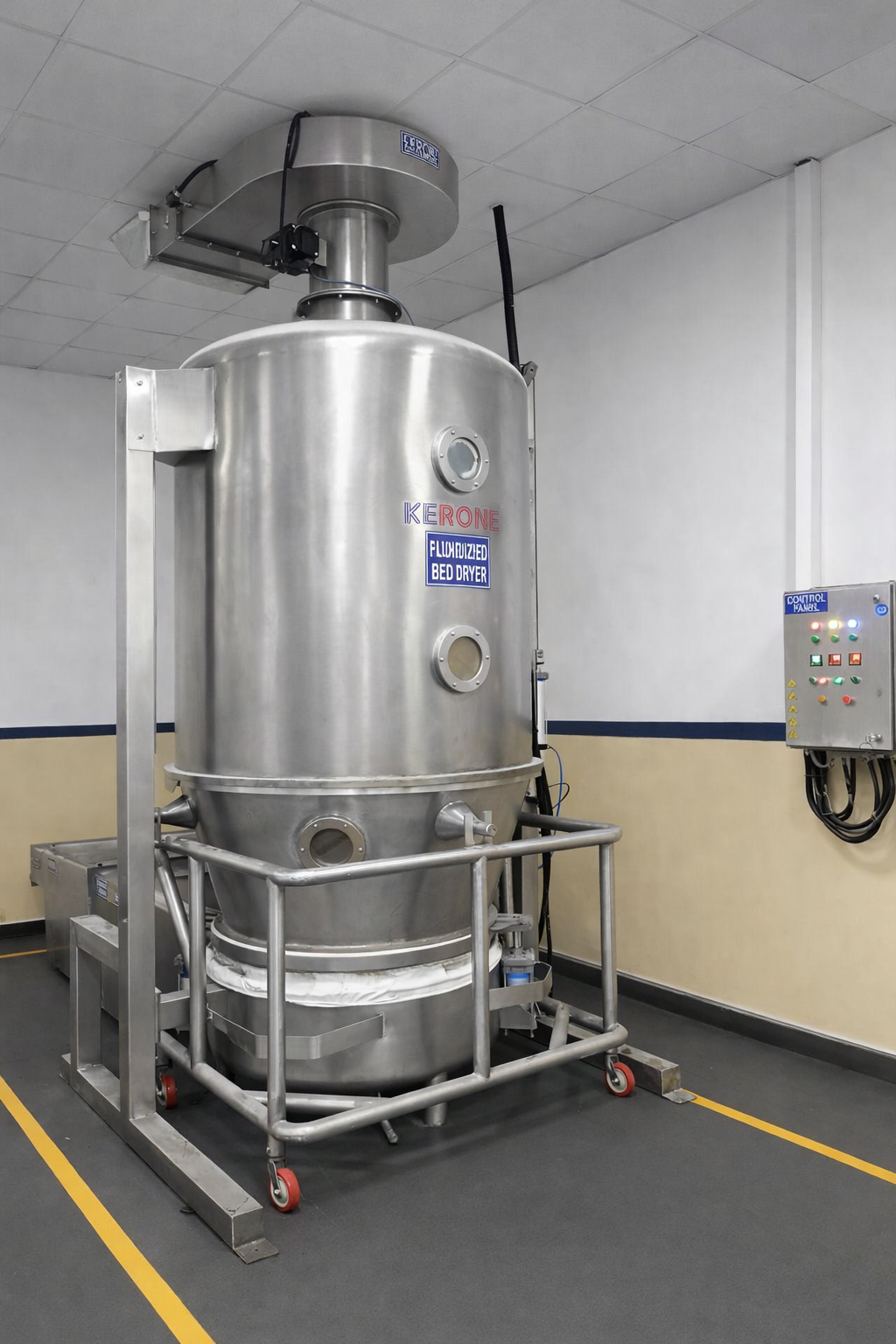
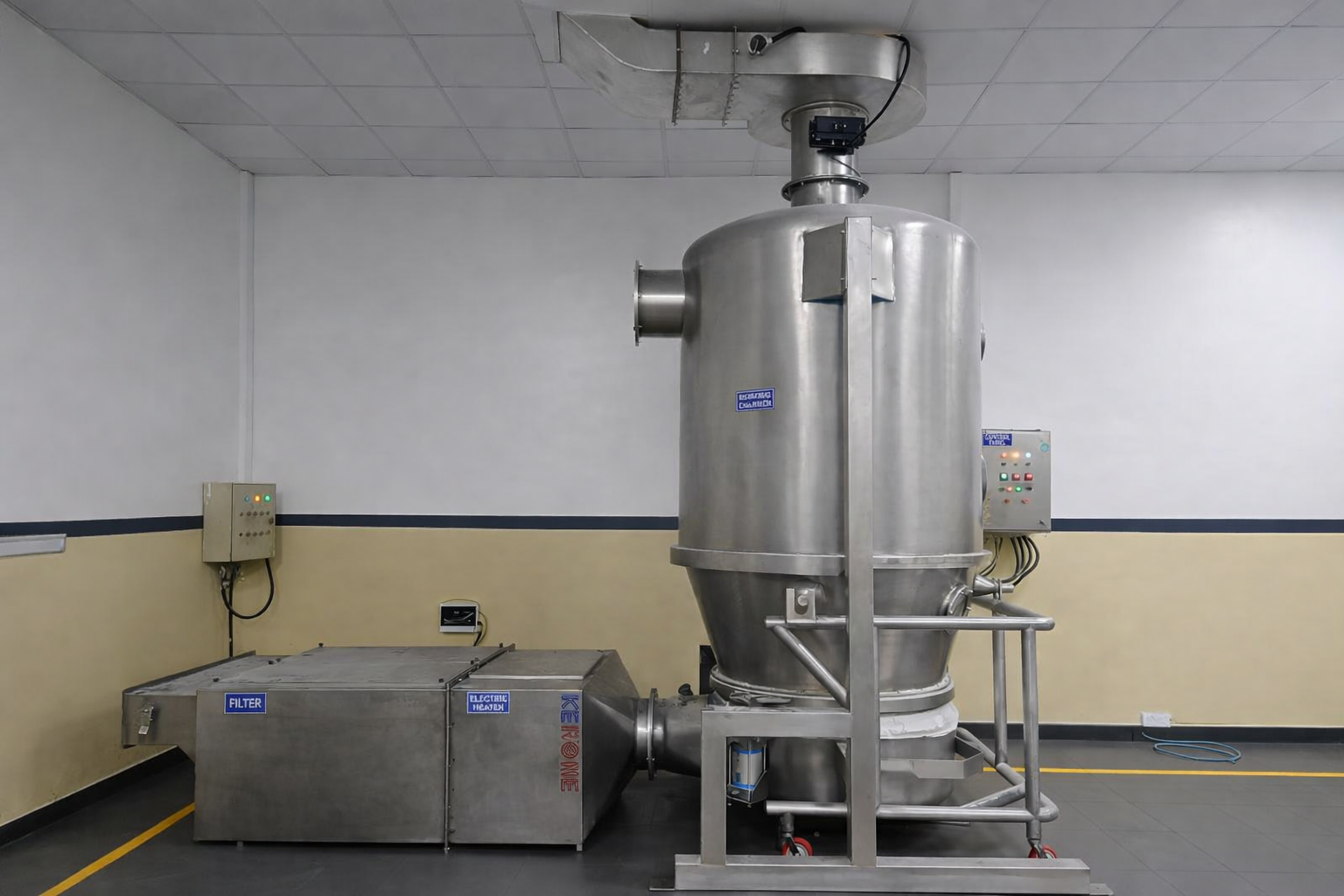
Kerone brings over 50 years of experience in designing high-performance fluidised bed dryers for a wide range of industrial and commercial applications. Built with advanced heat transfer mechanisms and automated controls, Kerone’s fluidised bed dryers are engineered to deliver optimal drying performance while maintaining product integrity.
Fluidized bed dryer provided the good solid mixing, high rate of heat and mass transfer and transportation of material. Fluidized bed dryer are more suitable for the drying of fine powder particle sizing from 10 to 2000 mm as compared to other conventional drying methods.
Why Choose Kerone Fluidised Bed Dryers
Kerone’s fluidised bed dryers are known for their quality, durability, and energy optimization. Each unit is engineered to meet specific process needs, ensuring reduced drying times, higher throughput, and superior quality output. The systems integrate innovative heating technologies, allowing maximum efficiency with minimal energy loss.
Our fluidized bed dryers find application in drying of granular materials, pastes, solutions, suspensions, and molten materials in both a batch and a continuous type of model. Kerone provides complete solution from design, manufacturing, erection, commissioning and after installation support.
Types and Features of Fluidised Bed Dryers
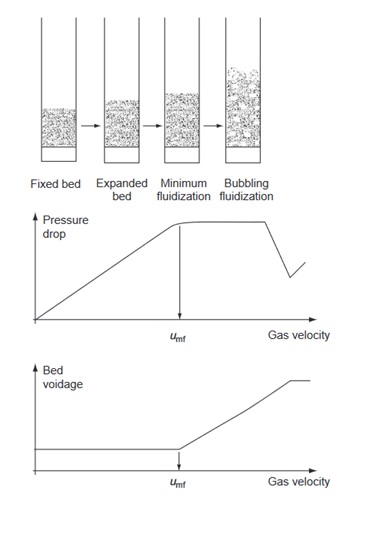
Fluidized bed is achieved by passing a gas stream from the bottom of a bed of particulate solids. At low velocity of gas the bed stays in static condition, and the particles lay on a gas distributor plate. The fluidizing gas passes through the distributor and it is uniformly distributed across the bed. The gas velocity is increased such that to achieve the fluidization of bed, gas velocity at which the bed achieves the fluidization is known as minimum fluidization velocity. A Fluidised bed dryer operates at gas velocity higher than the minimum fluidization velocity of material under processing. This increase in the gas velocity result in suspension of particles under processing in air, this appears as the boiling of solid particles of material under processing.
Features of Kerone’s Fluidized Bed Dryer:
Materials dried in a constant-rate drying process
Effective drying of materials with low moisture content at relatively low temperatures
Suitable for granules or crystallized materials without causing particle damage
High drying efficiency
Modular design
Uniform drying with reduced drying time
Provides extended residence times
Fireproof construction
Easy removal and replacement of heat exchanger
Flexible control over residence time and temperature
Key Features
Energy-efficient design with advanced heat management.
Uniform drying with consistent temperature distribution.
Customizable airflow and heating configurations.
Automatic control systems for precision and safety.
Robust construction ensuring long operational life.
Low maintenance with easy-to-clean components.
Ideal for both batch and continuous drying processes.
Optimized for sensitive and bulk materials alike.
Powered by AI, ML & IoT
Future-Ready Engineering Driven by AI & IoT
Our advanced AI, ML, and IoT technologies, this solution delivers smarter automation, real-time insights, and predictive intelligence to enhance efficiency and drive future-ready growth.
Real-Time Monitoring & Control
Continuous tracking of process parameters with instant adjustments.
Predictive Maintenance
Intelligent fault detection to prevent failures before they occur.
Adaptive Process Optimization
Dynamic tuning of operations for maximum output and efficiency.
Cloud Dashboards & Analytics
Unified access to real-time insights and performance trends.
Energy & Resource Savings
Smarter utilization of energy to cut costs and reduce waste.
Secure IoT Connectivity
Encrypted data flow with seamless integration across plant systems.
Applications of Fluidised Bed Dryers
Kerone’s fluidised bed dryers find wide applications across industries, providing reliable drying solutions for varied materials. Common applications include:
Food & Beverage
Drying fruits, vegetables, meat, fish, and herbs.
Agriculture
Moisture removal from grains, seeds, and crops.
Pharmaceutical
Drying herbal extracts, granules, and powders.
Chemical & Mineral
Processing catalysts, pigments, and minerals.
Industrial
Drying of ceramics, coal, polymers, and composites.
Kerone’s fluidised bed dryers combine technological innovation with practical design. Built for reliability, scalability, and energy efficiency, they help industries achieve higher productivity with minimal operational costs. Through continuous research and development, Kerone continues to lead in industrial drying innovation, offering tailored solutions for global industries.
It is commonly used across a remarkably broad range of industries and applications, including the processing of chemicals, carbohydrates, foodstuff, and biomaterials, as well as beverage products, ceramics, and pharmaceuticals in powder or agglomerated form. They are equally well-suited for health-care products, pesticides and agrochemicals, dyestuffs and pigments, and detergents and surface-active agents. Further applications extend to fertilizers, polymers and resins, and tannins, while the technology also finds use in products for calcination, combustion, and incineration, as well as waste management and environmental protection processes.
Seamless Export Connections Global & Local
Our Global Footprint in Industrial Excellence
Delivering world-class industrial and process solutions across countries with precision, innovation, and reliability.
Peru
Chile
Argentina
Mexico
Colombia
Brazil
USA
Canada
United Kingdom
France
Germany
Spain
Italy
Netherlands
Sweden
Switzerland
Poland
Portugal
Ireland
Czechia
Romania
Hungary
Austria
Greece
Kazakhstan
Uzbekistan
Turkmenistan
Algeria
Egypt
Nigeria
Kenya
South Africa
Saudi Arabia
UAE
Israel
Russia
India
China
Japan
South Korea
Thailand
Vietnam
Malaysia
Singapore
Indonesia
Philippines
Australia
New Zealand
Pan-India Presence. Local Expertise.
Raipur
Bilaspur
Panaji
Vasco da Gama
Gandhinagar
Ahmedabad
Surat
Chandigarh
Gurgaon
Shimla
Manali
Bengaluru
Mysore
Kochi
Pune
Mumbai
Thane
Navi Mumbai
Hyderabad
Chennai
Coimbatore
Kolkata
Lucknow
Jaipur
Udaipur
Jodhpur
Dehradun
Haridwar
Bhubaneswar
Product Gallery
Frequently Asked Questions (FAQ)
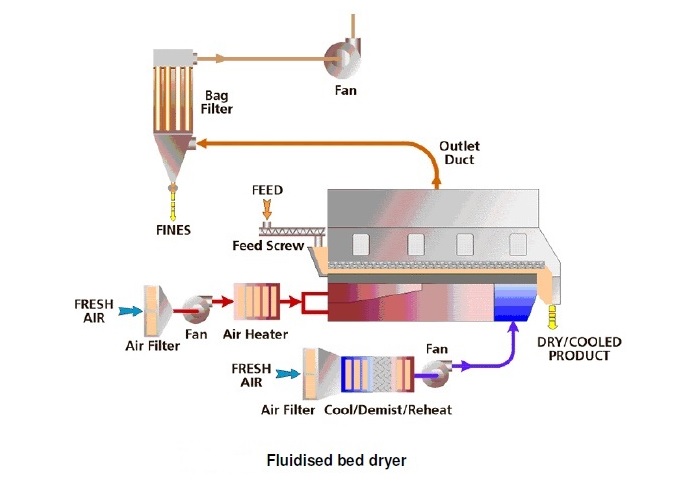
A fluidised bed dryers is an industrial system that removes moisture from materials using controlled heat and airflow.
It operates by circulating hot air or transferring heat to evaporate moisture from products efficiently.
It ensures faster drying, energy efficiency, and product uniformity.
Industries like food, agriculture, pharmaceutical, and chemical commonly use these dryers.
Yes, Kerone designs every system according to specific industry and process needs.
Yes, precise temperature control ensures safe drying for sensitive materials.
Kerone’s designs optimize heat recovery and minimize energy consumption.
Regular inspection, cleaning, and calibration ensure optimal performance and longer lifespan.
It ensures high heat-transfer efficiency and consistent product quality.
Both rotary dryers and fluid bed dryers are widely used in chemical processing, but their suitability depends on the material properties. Rotary dryers are better for granular, lumpy, or abrasive materials that can tolerate mechanical contact and longer residence times. Fluid bed dryers are ideal for free-flowing, uniform-particle-size materials that benefit from excellent gas-solid contact and faster drying rates. Kerone offers both systems, with fluid bed dryers providing better control over product temperature and moisture uniformity, making them preferred for fine or heat-sensitive chemicals.
Minimum fluidization velocity is the gas velocity at which a bed of particulate solids transitions from a static, settled state into a suspended, bubbling condition that resembles a boiling liquid. Below this velocity, the bed behaves like a packed solid with poor gas-particle contact, while operating at or above it is what enables the excellent heat and mass transfer fluidized bed dryers are known for. Setting gas velocity too far above minimum fluidization risks excessive particle carryover into the exhaust and increased erosion, while running too close to the minimum risks incomplete fluidization in parts of the bed. Kerone calculates this velocity based on the specific particle size, density, and shape of each material before finalizing the design.
Fluidized bed dryers are generally most effective for particle sizes in the range of roughly 10 to 2000 microns, where particles are light and small enough to be readily suspended by a practical gas velocity without requiring excessive air volume or fan power. Particles significantly larger or denser than this range need much higher gas velocities to fluidize, which becomes energy-inefficient and can cause excessive wear on the distributor plate and ductwork. Conversely, extremely fine particles below this range risk being carried out of the bed entirely with the exhaust gas before adequate drying occurs, requiring more aggressive downstream filtration. Materials outside the ideal range are often better suited to rotary or flash drying instead.
The distributor plate sits at the base of the bed and is responsible for spreading incoming gas evenly across the entire bed cross-section before it passes upward through the particles. Uneven gas distribution from a poorly designed or worn distributor plate creates channeling, where gas preferentially flows through certain areas while other parts of the bed remain poorly fluidized or even static, leading to inconsistent drying across the batch. Distributor plate design must balance even gas distribution against pressure drop and the risk of particles falling through the plate openings when fluidization is interrupted, such as during startup and shutdown. Kerone's modular design allows the heat exchanger and distributor components to be inspected and replaced without major dryer downtime.
Spray drying atomizes a liquid feed into fine droplets that dry almost instantly in a hot air chamber, producing a fine powder directly from a liquid or slurry in a single step. Fluidized bed drying, by contrast, typically works on material that is already in granular or particulate form, or uses fluidization to dry and sometimes agglomerate wet granules into a more uniform particle size. Kerone's fluidized bed systems can handle granular materials, pastes, solutions, and suspensions in batch or continuous configurations, but the underlying mechanism relies on suspending discrete particles rather than atomizing liquid droplets. The choice between the two often comes down to whether the desired final product form is a fine powder or a more structured granule.
Some products require longer exposure to the drying gas stream than a standard single-pass fluidized bed provides, particularly materials with moisture bound more deeply within the particle structure rather than just on the surface. Kerone's fluidized bed dryers can be configured to provide extended residence times through bed depth, multi-stage chambers, or recirculation arrangements that keep particles in the fluidized state longer without simply running the gas velocity higher. This allows more complete moisture removal for materials with slower internal diffusion rates, without resorting to excessive temperatures that could damage heat-sensitive particles. Buyers with materials known to have slow-release internal moisture should flag this during the design consultation.
Kerone’s custom-designed heating and processing solutions are built to meet the demands of your growing operations. Whether you’re upgrading equipment, expanding production, or need a tailor-made solution




 Peru
Peru Chile
Chile Argentina
 Mexico
 Colombia
 Brazil
 USA
USA Canada
 United Kingdom
 France
 Germany
 Spain
Spain Italy
Italy Netherlands
 Sweden
 Switzerland
 Poland
 Portugal
 Ireland
 Czechia
 Romania
 Hungary
 Austria
 Greece
 Kazakhstan
 Uzbekistan
 Turkmenistan
 Algeria
 Egypt
Egypt Nigeria
 Kenya
Kenya South Africa
 Saudi Arabia
 UAE
UAE Israel
 Russia
 India
India China
China Japan
Japan South Korea
 Thailand
 Vietnam
 Malaysia
 Singapore
 Indonesia
 Philippines
 Australia
 New Zealand