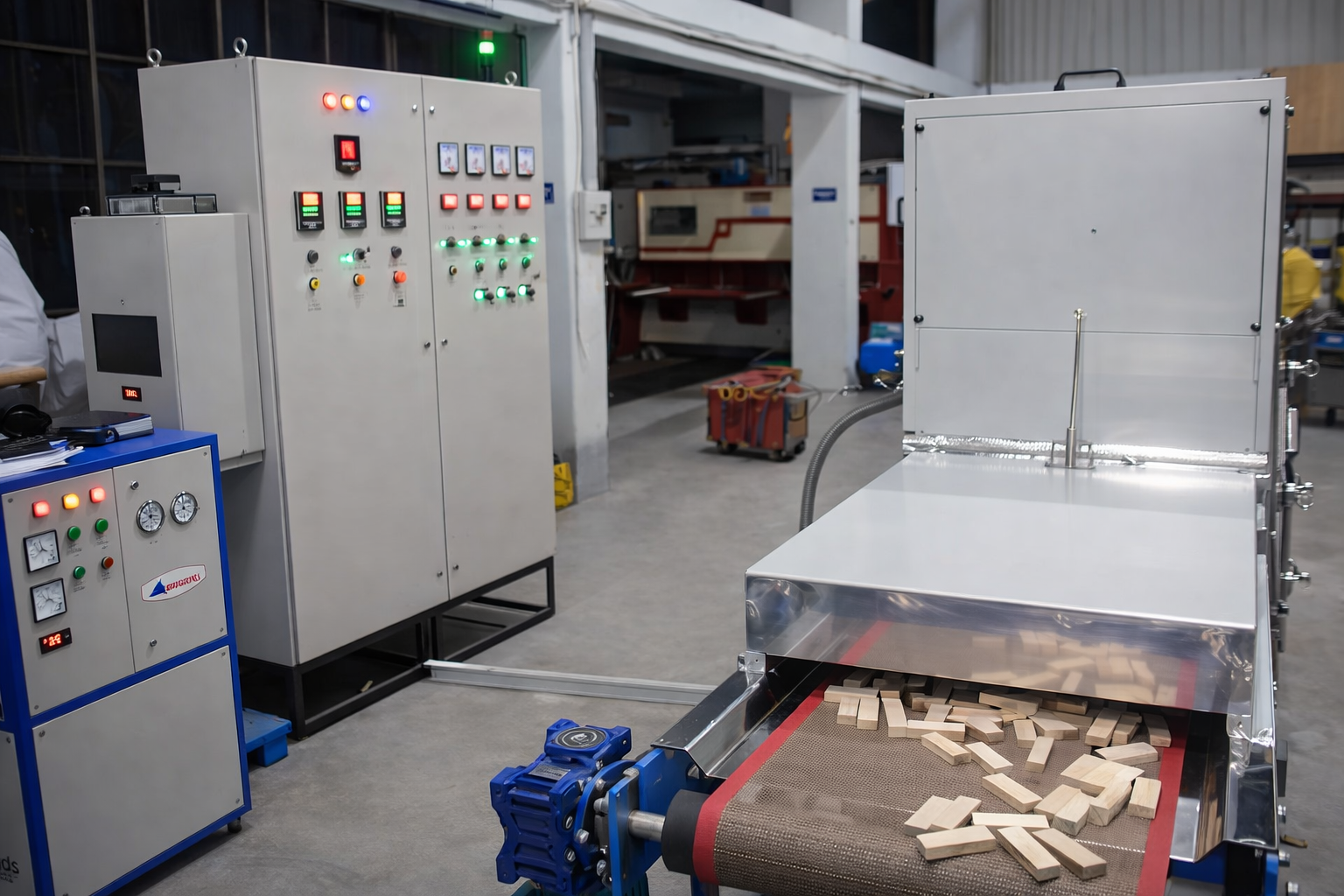
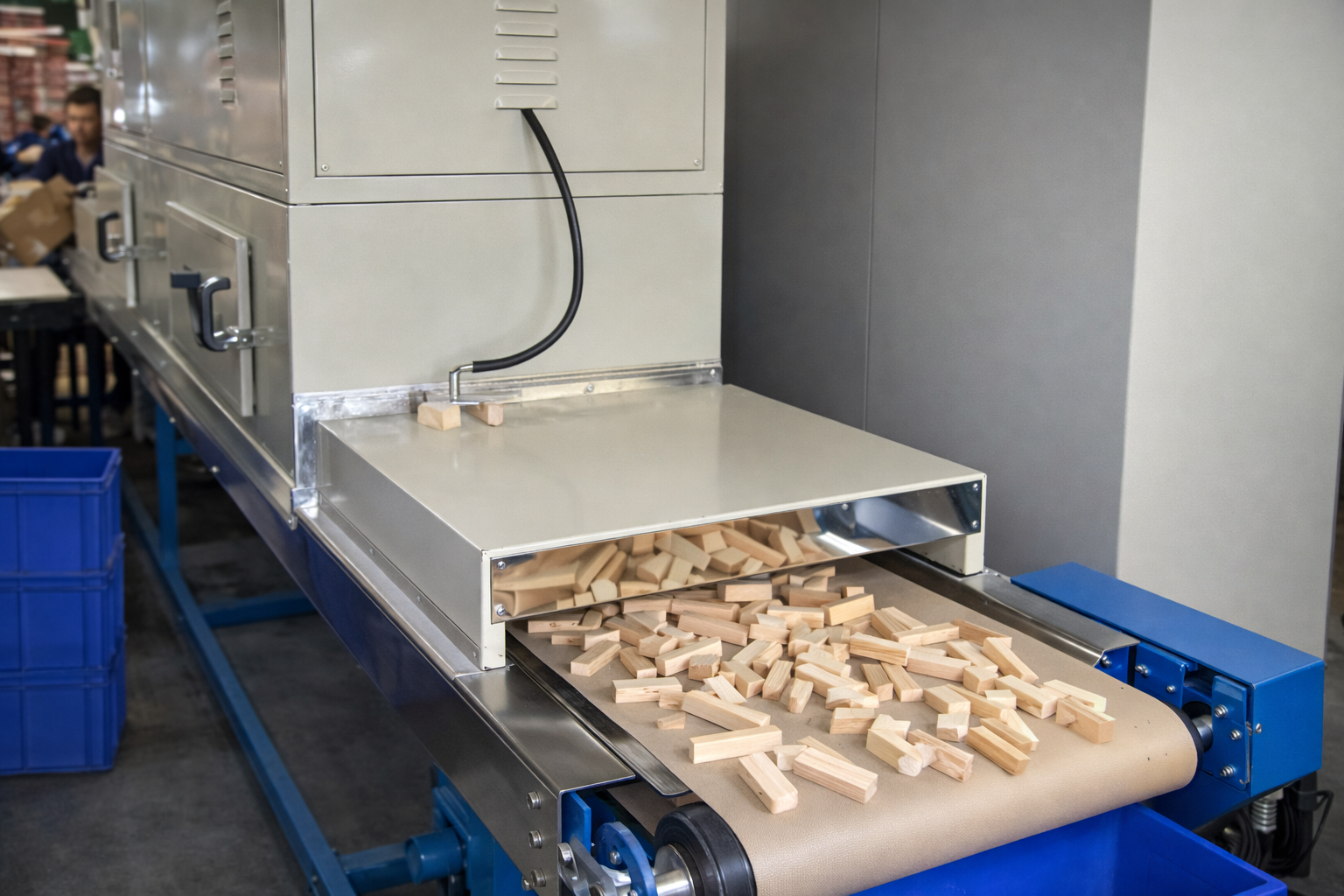
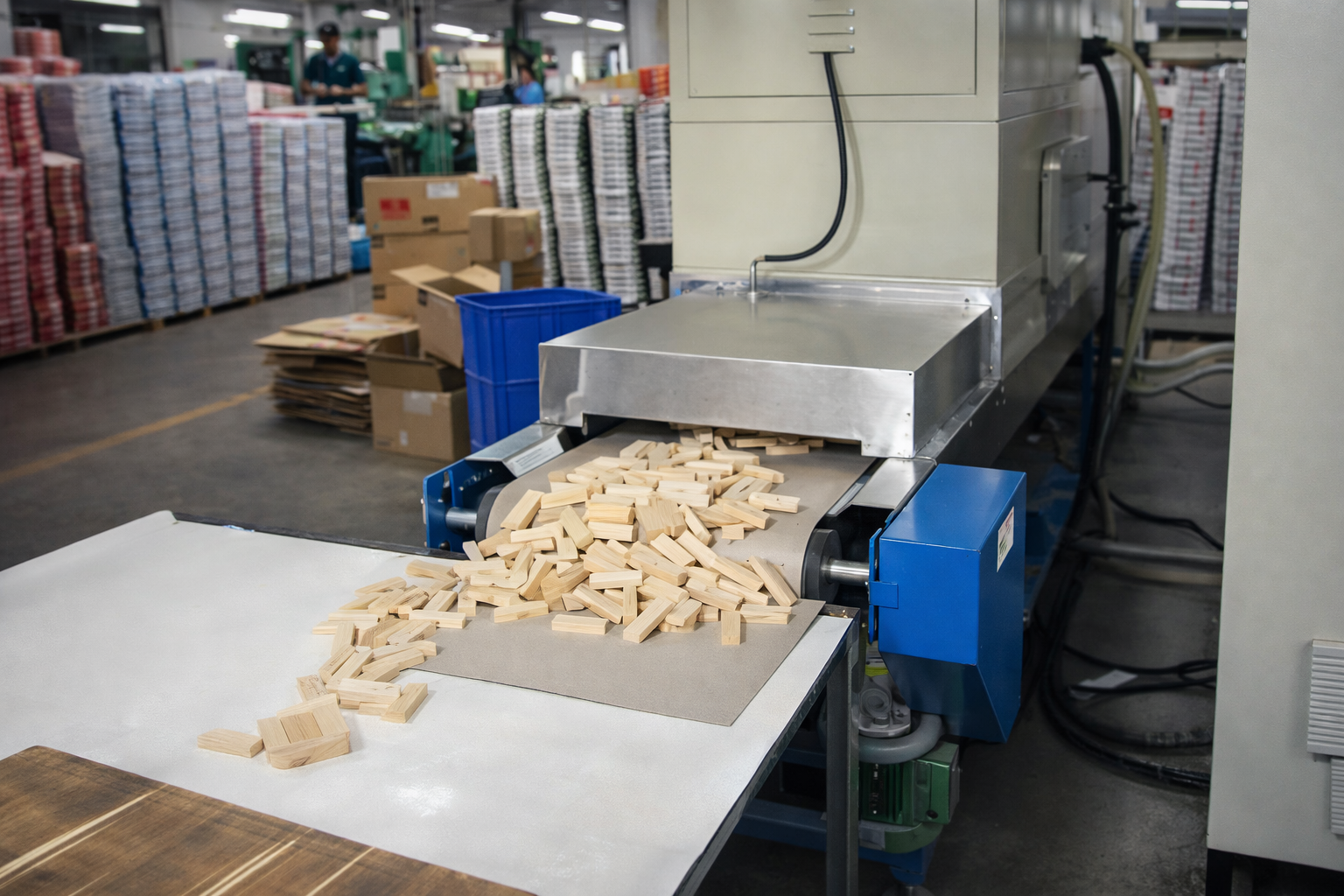
Microwave pre-treatment is a technique to improve process efficiency and product performance of wood in the forest product industry. High-intensity microwave pre-treatment for wood modification originated from Australia at the end of last century, in which water in wood absorbed enough energy from the transient electromagnetic wave and turned into steam. High internal steam pressure destructed the weaker elements of wood and the micro voids in the radial-longitudinal planes of wood were created, which puffed wood into loose structure, increased wood permeability, and improved the drying process. Some studies reported that several properties of wood were improved after microwave pre-treatment.
Why Choose Kerone Microwave Heating For Wood
We at Kerone are having more than 50 year of experience in helping society with best possible technology of microwave heating for wood treatment. Microwave heating based systems designed and manufactured by us comply to international standards for safety and treatment. Kerone Microwave heating technology used for Drying, Foaming, Modifying, Upgrading, Pre-treatment, Adhesive curing, Wood Joinery, Wood bending, Moisture removal, gluing in wood industry.
Kerone microwave dryer is normally applied for wood second process before we make any woodcraft or wood furniture. When the wood is about 10 percent of water content, traditional drying method is barely dehydration from wood. However, microwave wood dryer could further dry off those wood to achieve the excellent drying result. In additional, microwave drying possess the sterilization and disinfestation function to assure longer wood reserving time and prevent moldy.
Types and Features of Microwave Heating For Wood
Drying wood using microwave energy is not very common, but could be a complement to conventional air-circulation drying due to the possibility to dry wood faster than the conventional drying methods with preserved quality. Furthermore, this technique could be used to condition boards with too high moisture content gradient.
The use of microwaves for heating is well established in society, being used in domestic and some industrial processes. However, there is potential for this technology to be introduced and applied to many other industrial heating processes.
Key Features
High thermal and processing efficiency
Low maintenance and easy operation
Suitable for heat-sensitive materials
Fully adjustable and customizable process parameters
Available in batch and continuous configurations
Uniform processing and consistent product quality
Powered by AI, ML & IoT
Future-Ready Engineering Driven by AI & IoT
Our advanced AI, ML, and IoT technologies, this solution delivers smarter automation, real-time insights, and predictive intelligence to enhance efficiency and drive future-ready growth.
Real-Time Monitoring & Control
Continuous tracking of process parameters with instant adjustments.
Predictive Maintenance
Intelligent fault detection to prevent failures before they occur.
Adaptive Process Optimization
Dynamic tuning of operations for maximum output and efficiency.
Cloud Dashboards & Analytics
Unified access to real-time insights and performance trends.
Energy & Resource Savings
Smarter utilization of energy to cut costs and reduce waste.
Secure IoT Connectivity
Encrypted data flow with seamless integration across plant systems.
Applications of Microwave Heating For Wood
Food industry processing systems
Chemical and polymer processing
Pharmaceutical ingredients and intermediates
Ready‑to‑eat (RTE) food production
Specialized heating, drying, or material transformation processes
Industrial material modification and thermal treatment
Kerone’s Microwave Heating For Wood solutions are engineered to deliver maximum efficiency, long-term reliability and excellent operational stability. Our focus on innovation and customization ensures superior industrial results.
One of the Advantages of microwave heating is that a larger size piece of wood can be used. To complete the wood pyrolysis using microwaves required only 10 or 15 min.
Seamless Export Connections Global & Local
Our Global Footprint in Industrial Excellence
Delivering world-class industrial and process solutions across countries with precision, innovation, and reliability.
Peru
Chile
Argentina
Mexico
Colombia
Brazil
USA
Canada
United Kingdom
France
Germany
Spain
Italy
Netherlands
Sweden
Switzerland
Poland
Portugal
Ireland
Czechia
Romania
Hungary
Austria
Greece
Kazakhstan
Uzbekistan
Turkmenistan
Algeria
Egypt
Nigeria
Kenya
South Africa
Saudi Arabia
UAE
Israel
Russia
India
China
Japan
South Korea
Thailand
Vietnam
Malaysia
Singapore
Indonesia
Philippines
Australia
New Zealand
Pan-India Presence. Local Expertise.
Raipur
Bilaspur
Panaji
Vasco da Gama
Gandhinagar
Ahmedabad
Surat
Chandigarh
Gurgaon
Shimla
Manali
Bengaluru
Mysore
Kochi
Pune
Mumbai
Thane
Navi Mumbai
Hyderabad
Chennai
Coimbatore
Kolkata
Lucknow
Jaipur
Udaipur
Jodhpur
Dehradun
Haridwar
Bhubaneswar
Product Gallery
Frequently Asked Questions (FAQ)
It is used for efficient processing, heating, drying or material transformation.
High efficiency, process reliability and complete customization.
Food, chemical, pharma, biomass, rubber, textile and more.
Kerone ensures high product quality through strict engineering standards, advanced testing procedures, and precision-controlled manufacturing systems.
No, when properly controlled, microwave heating preserves the wood’s structural integrity and reduces internal stress compared to traditional methods.
It is commonly used for drying, seasoning, pest control, resin curing, and improving dimensional stability of wood products.
Unlike conventional hot air drying, microwave heating penetrates deep into the wood, resulting in faster drying, reduced cracks, and improved moisture control.
Microwave heating applications in wood processing extend to foaming and structural modification of wood for permeability enhancement, adhesive curing in engineered wood products, accelerating wood bending processes for furniture and architectural components, and moisture removal combined with sterilization to prevent mold growth during storage. The sterilization and disinfestation effect of microwave treatment is a notable secondary benefit, since the same heating process that removes moisture also addresses fungal spores and wood-boring insects that can compromise wood quality during extended storage or shipping, extending the usable shelf life of processed wood products beyond what drying alone would provide.
When properly controlled, the steam pressure generated during microwave pretreatment is calibrated to create beneficial micro-void formation without causing the macroscopic cracking or checking that uncontrolled rapid drying can produce in conventional kiln operations. The process actually tends to reduce certain types of internal stress compared to traditional drying methods, since the engineered permeability increase allows more even moisture migration during subsequent drying stages, reducing the moisture content gradients between a board's surface and core that are a primary cause of warping and checking in conventionally dried lumber. Process parameters need to be matched to wood species and initial moisture content, since species with different density and permeability characteristics respond differently to the same power and exposure settings.
Microwave heating can dry wood considerably faster than conventional air-circulation methods because energy penetrates directly into the wood's internal moisture rather than relying on the comparatively slow process of moisture migrating to the surface through natural capillary action before evaporating into circulated air. This speed advantage becomes more pronounced for thicker wood sections or for wood with naturally low permeability, where conventional drying times can stretch significantly. For certain pretreatment applications, such as preparing wood for pyrolysis processing, complete treatment can be achieved in as little as ten to fifteen minutes using microwave technology, compared to substantially longer timeframes required by conventional thermal methods applied to equivalent wood volumes.
One practical advantage of microwave wood treatment is the ability to process larger pieces of wood than some conventional rapid-drying alternatives can handle effectively, since the volumetric heating mechanism does not depend on heat conducting in from the surface as it does in many conventional intensive drying methods. This makes microwave technology applicable across a range of wood product types, from rough sawn lumber requiring moisture conditioning to finished components needing precise final moisture adjustment before assembly. The appropriate system configuration depends on the specific wood dimensions, species density, and target outcome, whether that is bulk moisture reduction, pretreatment for downstream processing, or precision conditioning for high-value finished products.
Microwave energy heats the moisture trapped within wood cells rapidly, converting it to steam faster than it can escape through the wood's natural permeability. This generates internal steam pressure that mechanically weakens and ruptures cell wall structures, particularly along the radial-longitudinal planes, creating microscopic voids throughout the wood. This puffed, more permeable structure is the key benefit of microwave pretreatment, since increased permeability allows moisture to migrate out of the wood far more readily during subsequent drying stages than would be possible with the wood's original dense cellular structure. The technique essentially opens pathways for moisture movement before conventional drying begins, which is why it functions as a pretreatment step rather than a complete standalone drying solution in most applications.
Yes, when wood has already been dried to around 10 percent moisture content using conventional methods, further dehydration with traditional air-circulation or kiln drying becomes increasingly slow and inefficient, since the remaining bound moisture is held tightly within the wood's cellular structure. Microwave drying can continue reducing moisture content beyond this point more effectively because the energy targets remaining water molecules directly rather than relying on the diminishing moisture gradient that drives conventional drying. This makes microwave technology particularly useful as a finishing step for applications requiring very low final moisture content, such as wood destined for fine furniture or precision joinery where dimensional stability depends on minimizing residual moisture beyond what standard kiln drying typically achieves.
Wood processed with microwave pretreatment or finishing typically shows improved dimensional stability due to more even moisture distribution, reduced incidence of checking and warping that result from uneven drying stresses, and the added benefit of reduced mold risk during storage due to the sterilization effect of the heating process. For wood destined for furniture, joinery, or other applications where precise final dimensions and surface quality matter significantly, these improvements can reduce downstream processing rejects and improve the consistency of finished product quality. Processors working with premium wood species or high-value finished applications often find these quality improvements justify the additional processing step even when bulk drying time savings alone might not fully justify the investment.
Kerone’s custom-designed heating and processing solutions are built to meet the demands of your growing operations. Whether you’re upgrading equipment, expanding production, or need a tailor-made solution


 Peru
Peru Chile
Chile Argentina
 Mexico
 Colombia
 Brazil
 USA
USA Canada
 United Kingdom
 France
 Germany
 Spain
Spain Italy
Italy Netherlands
 Sweden
 Switzerland
 Poland
 Portugal
 Ireland
 Czechia
 Romania
 Hungary
 Austria
 Greece
 Kazakhstan
 Uzbekistan
 Turkmenistan
 Algeria
 Egypt
Egypt Nigeria
 Kenya
Kenya South Africa
 Saudi Arabia
 UAE
UAE Israel
 Russia
 India
India China
China Japan
Japan South Korea
 Thailand
 Vietnam
 Malaysia
 Singapore
 Indonesia
 Philippines
 Australia
 New Zealand