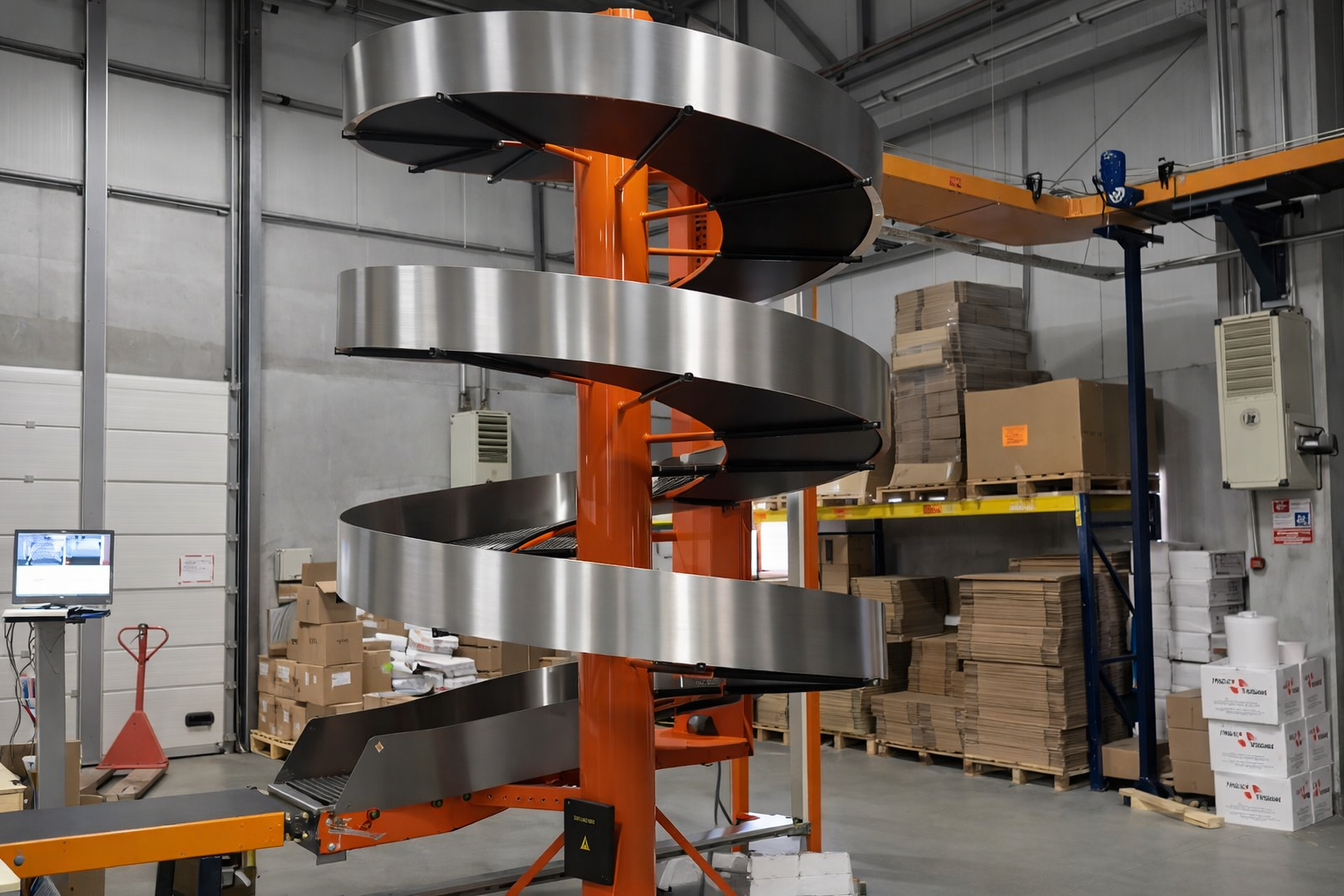
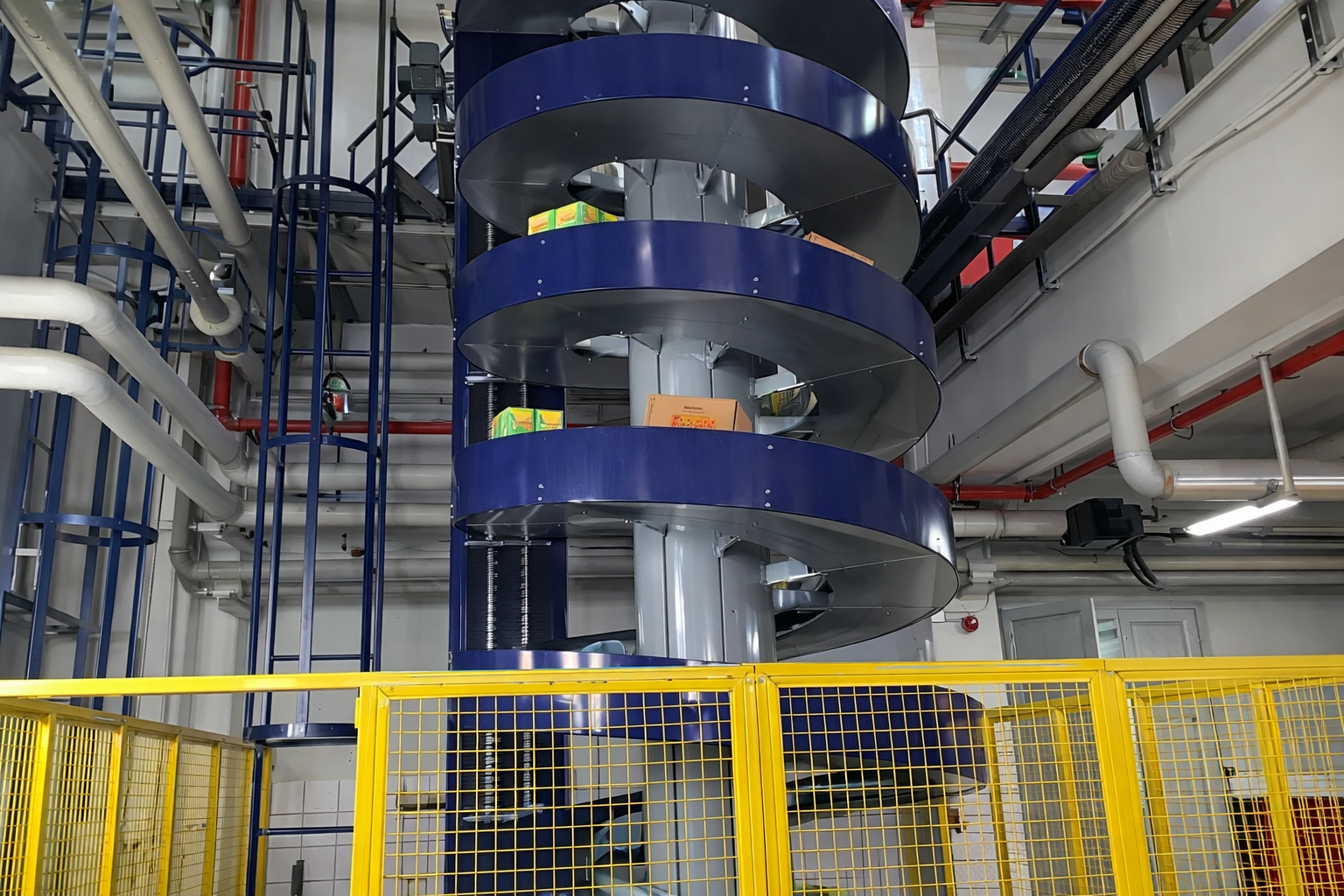
At Kerone, we are having more than 50 years’ experience in helping various types of industries with designing; manufacturing and installation of various types of custom build industrial spiral drying solution. Kerone Spiral dryers are very useful in the automated manufacturing process and can be used to carry various solid items or solid-liquid mixes from loose materials and manufactured items to finished, packaged products.
Why Choose Kerone Spiral Conveyor Dryers
Kerone Spiral Conveyors System are based on a new and innovative technology, offering many features and benefits. Spiral conveyors from KERONE needs less floor space than conventional conveyors and are also faster and more reliable than any elevator or lift. Central to our design is the proprietary slat-type belts with rolling friction and without any sliding movements or wear-strips.
Types and Features of Spiral Conveyor Dryers
Spiral conveyor provides automation of production processes, increase profitability and saving of production space. These conveyor systems have already gained its popularity among food producers.Industrial Spiral Conveyor System offered finds use for handling goods movement involving floor-to-floor handling as well as in specific directions including from top to bottom and from bottom to top.
Spiral conveyor dryer are very completed and can improve the productivity as much as possible in spiral application. Low cost, high efficiency. To breakthrough the bottleneck restriction of production line, improve efficiency and lower costs. Some of its features include can handle different support processes like stirring, mixing, heating and cooling operations at time of conveying; suitable for handling transportation needs of granular materials like mineral powder, cement powder, fly ash, sand, coal and others.
Features:
Highly flexible design and advanced technology
Easy maintenance
Low cost of operation
Controlled pollution level
Energy-saving operation
Easy to operate
Fast and simple installation
Key Features
High drying efficiency with precise temperature regulation.
Custom-built for specific material characteristics and moisture levels.
Energy-saving design with optimized air circulation and heat recovery.
Fully automatic operation with real-time process monitoring.
Durable stainless steel construction for hygiene and longevity.
Uniform drying with minimal product degradation or discoloration.
Suitable for continuous and batch processing modes.
Powered by AI, ML & IoT
Future-Ready Engineering Driven by AI & IoT
Our advanced AI, ML, and IoT technologies, this solution delivers smarter automation, real-time insights, and predictive intelligence to enhance efficiency and drive future-ready growth.
Real-Time Monitoring & Control
Continuous tracking of process parameters with instant adjustments.
Predictive Maintenance
Intelligent fault detection to prevent failures before they occur.
Adaptive Process Optimization
Dynamic tuning of operations for maximum output and efficiency.
Cloud Dashboards & Analytics
Unified access to real-time insights and performance trends.
Energy & Resource Savings
Smarter utilization of energy to cut costs and reduce waste.
Secure IoT Connectivity
Encrypted data flow with seamless integration across plant systems.
Applications of Spiral Conveyor Dryers
Kerone’s spiral conveyor dryers are used in multiple industries where efficient moisture removal and product consistency are essential. Common applications include:
Food Industry
Drying of fish, seafood, spices, fruits, and vegetables.
Pharmaceutical
Moisture control for herbal extracts and powders.
Chemical
Drying of compounds, catalysts, and pigments.
Agriculture
Processing of seeds, grains, and herbs.
Industrial
Dehydration of materials requiring uniform temperature distribution.
Kerone’s spiral conveyor dryers exemplify innovation, reliability, and customization. Built with advanced heating systems and intelligent control, they ensure high efficiency, uniform drying, and consistent output quality. From small-scale production to large industrial setups, Kerone continues to provide world-class drying technology to meet evolving market demands.
It represent an elegant engineering solution to the challenge of providing long drying paths in limited floor space, making them a preferred choice for high-throughput food production facilities where continuous drying and cooling of baked goods, snack foods, and processed products must be achieved within constrained factory footprints. The combination of space efficiency, hygienic design, and precise process control makes them a valuable addition to modern food processing lines. Kerone’s spiral conveyor dryer solutions, built to food-grade standards and backed by deep conveyor and airflow engineering experience, provide food manufacturers with reliable, efficient, and cleanable continuous drying and cooling systems.
Seamless Export Connections Global & Local
Our Global Footprint in Industrial Excellence
Delivering world-class industrial and process solutions across countries with precision, innovation, and reliability.
Peru
Chile
Argentina
Mexico
Colombia
Brazil
USA
Canada
United Kingdom
France
Germany
Spain
Italy
Netherlands
Sweden
Switzerland
Poland
Portugal
Ireland
Czechia
Romania
Hungary
Austria
Greece
Kazakhstan
Uzbekistan
Turkmenistan
Algeria
Egypt
Nigeria
Kenya
South Africa
Saudi Arabia
UAE
Israel
Russia
India
China
Japan
South Korea
Thailand
Vietnam
Malaysia
Singapore
Indonesia
Philippines
Australia
New Zealand
Pan-India Presence. Local Expertise.
Raipur
Bilaspur
Panaji
Vasco da Gama
Gandhinagar
Ahmedabad
Surat
Chandigarh
Gurgaon
Shimla
Manali
Bengaluru
Mysore
Kochi
Pune
Mumbai
Thane
Navi Mumbai
Hyderabad
Chennai
Coimbatore
Kolkata
Lucknow
Jaipur
Udaipur
Jodhpur
Dehradun
Haridwar
Bhubaneswar
Product Gallery
Frequently Asked Questions (FAQ)
A spiral conveyor dryers is a high-performance system designed for uniform drying of materials through controlled heat and airflow.
It operates by circulating heated air or energy through the material, ensuring even moisture evaporation and high throughput.
They provide faster drying, energy savings, and consistent product quality.
Industries such as food, chemical, and pharmaceutical widely use these dryers.
Yes, Kerone’s designs are fully customizable based on process requirements.
Yes, these dryers offer precise temperature control to protect sensitive products.
The system is designed to minimize energy waste and optimize heat utilization.
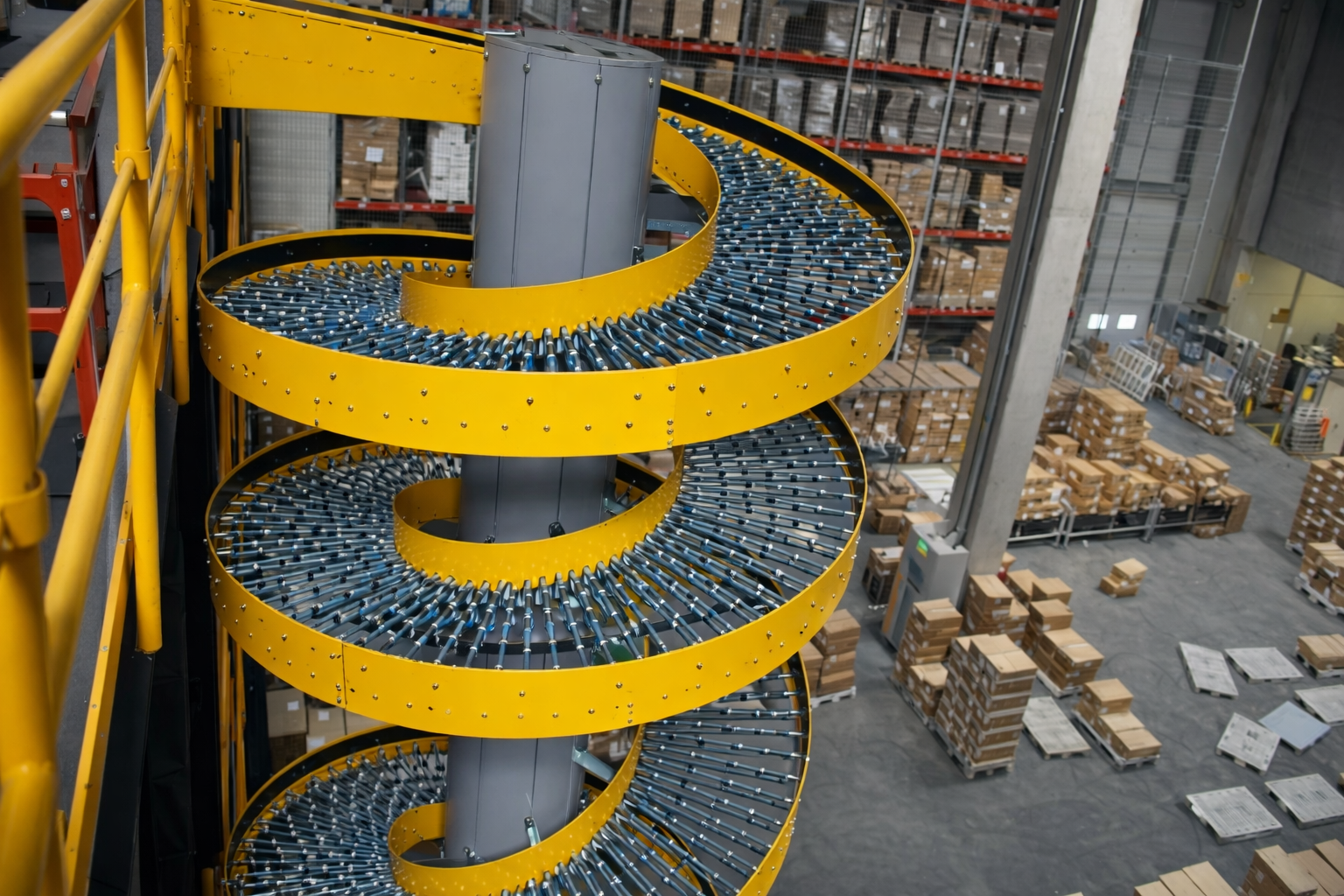
A central rotating cage drum or perimeter drive system provides the continuous drive force to the belt through friction or positive engagement, with the belt self-stacking on the spiral path and unwinding at the outlet.
Kerone designs CIP (clean-in-place) systems with spray nozzles at multiple tiers that deliver hot water and detergent solutions to the belt and enclosure surfaces; the entire spiral assembly can be cleaned without disassembly.
Yes, products with sauce or glaze coatings can be processed, but careful attention to belt selection and drainage design is required to prevent sauce dripping from upper tiers contaminating products on lower tiers.
A spiral conveyor dryer stacks its conveying path vertically in a helical configuration rather than laying it out horizontally, which means a long effective drying or cooling path â sometimes equivalent to dozens of meters of straight conveyor â fits within a footprint not much larger than the spiral's own diameter. This vertical stacking is what makes spiral systems attractive for facilities where floor space is constrained but a long residence time is still needed for proper drying or cooling. The tradeoff is that spiral systems require adequate ceiling height to accommodate the vertical stack, so buyers need to confirm their facility's vertical clearance before specifying a spiral configuration over a traditional horizontal tunnel.
Kerone's spiral conveyor systems use a slat-type belt design built around rolling friction rather than the sliding contact and wear-strips common in some conventional spiral conveyor designs. Sliding-contact systems generate more friction-related wear over time, requiring more frequent belt or wear-strip replacement and creating more opportunity for debris generation that could contaminate food or pharmaceutical products. The rolling-friction slat design reduces this wear mechanism, which extends belt service life and reduces the maintenance burden associated with keeping the conveyor mechanically sound across the thousands of operating hours a continuous production line accumulates. This is a meaningful differentiator in long-term operating cost versus simpler spiral conveyor designs.
Yes, spiral conveyor systems are versatile enough to handle granular materials like mineral powder, cement powder, fly ash, sand, and coal, as well as discrete solid items or finished packaged products, because the underlying conveying mechanism doesn't depend on the product being a specific shape or form. Some configurations can also support stirring, mixing, heating, and cooling operations simultaneously with conveying, which adds processing value beyond simple transport. This flexibility is part of why spiral conveyors have found broad adoption not just in food production lines but also in bulk material handling applications where vertical space efficiency and continuous movement between floor levels are valuable.
Food production facilities making baked goods and snack foods often need continuous drying or cooling paths long enough to bring product to a stable temperature or moisture level before packaging, but factory floor space for a straight tunnel of equivalent length is frequently unavailable or prohibitively expensive. The spiral configuration solves this by delivering the needed drying or cooling path length within a compact vertical footprint, while still maintaining continuous, hygienic processing without breaks in the line. Combined with food-grade construction and cleanable belt surfaces, this combination of space efficiency and hygienic design is precisely what makes spiral systems a preferred choice for high-throughput food manufacturing rather than a general-purpose drying solution.
A central rotating cage drum, or alternatively a perimeter drive system, provides the continuous driving force to the belt through friction or positive mechanical engagement, while the belt self-stacks along the spiral path as it's driven and unwinds again at the outlet end. This is a fundamentally different drive mechanism than a simple straight conveyor, where the belt forms a closed loop around two end rollers. The self-stacking behavior is what allows the long path length to be achieved within the compact spiral footprint, but it also means belt tension and tracking must be carefully engineered to prevent slippage or misalignment as the belt builds up through multiple tiers.
Kerone’s custom-designed heating and processing solutions are built to meet the demands of your growing operations. Whether you’re upgrading equipment, expanding production, or need a tailor-made solution



 Peru
Peru Chile
Chile Argentina
 Mexico
 Colombia
 Brazil
 USA
USA Canada
 United Kingdom
 France
 Germany
 Spain
Spain Italy
Italy Netherlands
 Sweden
 Switzerland
 Poland
 Portugal
 Ireland
 Czechia
 Romania
 Hungary
 Austria
 Greece
 Kazakhstan
 Uzbekistan
 Turkmenistan
 Algeria
 Egypt
Egypt Nigeria
 Kenya
Kenya South Africa
 Saudi Arabia
 UAE
UAE Israel
 Russia
 India
India China
China Japan
Japan South Korea
 Thailand
 Vietnam
 Malaysia
 Singapore
 Indonesia
 Philippines
 Australia
 New Zealand