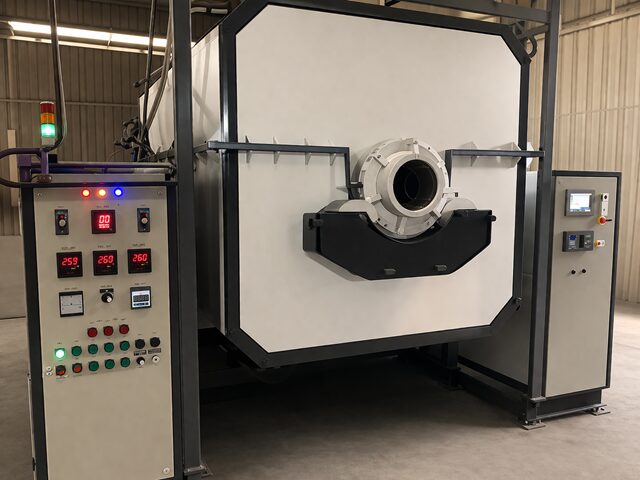
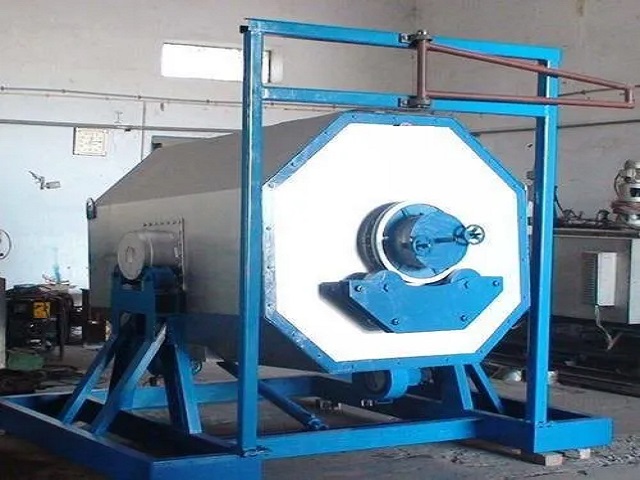
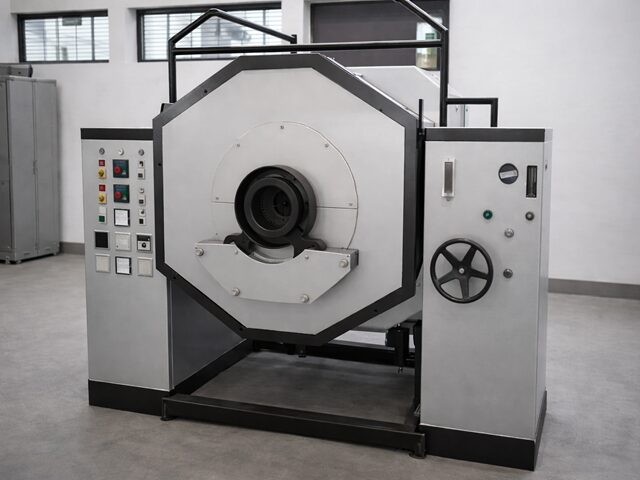
The rotary retort have been utilized for the continuous heat treatment of a variety of raw materials. The rotary retort furnaces is particularly adaptable to controlled atmosphere operation up to 500 ° c. These furnaces are particularly well suited for the processing of raw materials because the rotary conveying action tumbles the materials, breaking up any jams or tangled clumps facilitating further thorough heat treatment of each of the individual part. The traditional rotary retort concept isn’t without problems improper and uneven loading, jams of parts formed at the charge end that cannot be broken up in the retort, the maintenance of rotary bearing and seals within the heated shell and the loss of controlled atmosphere.
Why Choose Kerone Rotary Retort Furnace
The rotary draw to complete the rotary retort raw materials heat treating line, offers a rotary retort draw furnace with the same cantilevered retort design advantages as the rotary retort hardening furnace. The furnace features a recirculation system designed to keep heated gases in contact with the work as it progresses through the cycle. Convection heating is used to full advantage for effective heat transfer in a minimal floor space. The furnace needed no pit or special foundation.
Types and Features of Rotary Retort Furnace
No special pit or foundation
Low maintenance – maintenance is limited
Flexibility – small or large production runs can be handled alternately or continuously; close control of furnace operation is easily obtained
Automation – heat treating is completely automatic after loading raw materials into hopper
Uniform loading – a specially designed vibratory hopper and weight-actuated skip loader deposit precisely measured charges into the furnace
Key Features
Fully sealed retort design for complete isolation from combustion gases
Operating temperatures up to 1200°C with precise temperature uniformity
High-alloy retort materials: SS 310, Inconel 601, and other high-temperature alloys
Atmosphere control for nitrogen, hydrogen, argon, and reactive gas environments
Continuous or batch processing modes for operational flexibility
Adjustable rotation speed (0.5-10 RPM) for residence time optimization
Integrated cooling sections for controlled product quenching
Complete PLC-based automation with atmosphere monitoring and safety interlocks
Powered by AI, ML & IoT
Future-Ready Engineering Driven by AI & IoT
Our advanced AI, ML, and IoT technologies, this solution delivers smarter automation, real-time insights, and predictive intelligence to enhance efficiency and drive future-ready growth.
Real-Time Monitoring & Control
Continuous tracking of process parameters with instant adjustments.
Predictive Maintenance
Intelligent fault detection to prevent failures before they occur.
Adaptive Process Optimization
Dynamic tuning of operations for maximum output and efficiency.
Cloud Dashboards & Analytics
Unified access to real-time insights and performance trends.
Energy & Resource Savings
Smarter utilization of energy to cut costs and reduce waste.
Secure IoT Connectivity
Encrypted data flow with seamless integration across plant systems.
Applications of Rotary Retort Furnace
Kerone’s Rotary Retort Furnaces are extensively used in advanced materials processing and metallurgical applications requiring controlled-atmosphere continuous heat treatment.
Typical applications include:
Metal powder processing — sintering, reduction, and annealing of iron, copper, and stainless steel powders
Battery materials production — lithium cathode material calcination and coating processes
Catalyst production — reduction and activation of metallic catalysts under hydrogen atmosphere
Advanced ceramics — continuous sintering of alumina, barium titanate, and other technical ceramics
Carbon and graphite processing — heat treatment of carbon black and graphite precursors
Rare earth processing — calcination and reduction of rare earth compounds
Kerone’s advanced rotary retort furnace systems deliver consistent performance, high thermal efficiency, and maximum reliability. With fully customizable engineering and intelligent automation, Kerone ensures long-term operational stability and superior output quality.
Seamless Export Connections Global & Local
Our Global Footprint in Industrial Excellence
Delivering world-class industrial and process solutions across countries with precision, innovation, and reliability.
Peru
Chile
Argentina
Mexico
Colombia
Brazil
USA
Canada
United Kingdom
France
Germany
Spain
Italy
Netherlands
Sweden
Switzerland
Poland
Portugal
Ireland
Czechia
Romania
Hungary
Austria
Greece
Kazakhstan
Uzbekistan
Turkmenistan
Algeria
Egypt
Nigeria
Kenya
South Africa
Saudi Arabia
UAE
Israel
Russia
India
China
Japan
South Korea
Thailand
Vietnam
Malaysia
Singapore
Indonesia
Philippines
Australia
New Zealand
Pan-India Presence. Local Expertise.
Raipur
Bilaspur
Panaji
Vasco da Gama
Gandhinagar
Ahmedabad
Surat
Chandigarh
Gurgaon
Shimla
Manali
Bengaluru
Mysore
Kochi
Pune
Mumbai
Thane
Navi Mumbai
Hyderabad
Chennai
Coimbatore
Kolkata
Lucknow
Jaipur
Udaipur
Jodhpur
Dehradun
Haridwar
Bhubaneswar
Product Gallery
Frequently Asked Questions (FAQ)
Yes, Kerone provides fully customized designs tailored to your process, capacity, temperature range, and material type.
A rotary retort furnace uses an indirect heating approach with a sealed inner retort tube, isolating the material from combustion gases and enabling controlled atmosphere processing.
Our furnaces support nitrogen, hydrogen, argon, dissociated ammonia, endothermic gas, and other inert or reducing atmospheres.
Retort tubes are manufactured from SS 310, Inconel 601, Inconel 625, or other high-temperature alloys depending on process temperature and atmosphere.
Kerone's retort furnaces achieve temperature uniformity within ±10°C along the processing zone, ensuring consistent material treatment.
Retort furnaces are suitable for powders, granules, pellets, and small parts from fine micron-size powders to components up to several centimeters in size.
Rotation speed controls residence time and the degree of material mixing inside the retort, both of which directly affect process outcomes. Slower rotation increases residence time, giving material more exposure to heat and atmosphere, which suits processes requiring complete reduction, sintering, or thorough reaction, but it reduces overall throughput. Faster rotation shortens residence time and increases tumbling action, which improves heat transfer uniformity for fine powders but may not allow enough dwell time for slower reactions to complete. The optimal rotation speed is process-specific and is typically determined through pilot testing on the actual material, since published rotation ranges only indicate the furnace's mechanical capability, not the correct setting for a given chemistry or particle size.
In continuous mode, material is fed steadily into one end of the retort and discharged from the other as the furnace rotates, making it suitable for high-volume production where consistent throughput matters more than precise control over an individual batch. Batch mode processes a fixed charge of material through a complete heating cycle before unloading, which gives tighter control over the exact thermal history each batch experiences — useful when small variations in process timing significantly affect product quality, such as in some catalyst activation processes. Continuous operation generally offers better cost efficiency per unit processed at scale, while batch operation offers more precise quality control for smaller, higher-value production runs. Many operations use continuous mode for bulk materials and reserve batch processing for specialty or R&D-scale runs.
Retort alloy selection depends on the combination of operating temperature, atmosphere chemistry, and expected service life, not temperature alone. SS 310 stainless steel handles oxidizing atmospheres well up to moderate high temperatures and offers good value for less aggressive processes. Inconel 601 and Inconel 625 provide superior resistance to both oxidizing and certain reducing atmospheres at higher temperatures, making them the better choice for processes involving hydrogen, nitrogen-hydrogen mixtures, or other reactive gas environments where standard stainless steel would degrade faster. Atmosphere aggressiveness matters as much as peak temperature; a process running at moderate temperature but with a highly reactive atmosphere may need a higher-grade alloy than a process running hotter in an inert environment. Kerone's engineering team reviews both factors together when recommending retort material.
Jamming traditionally occurs when material clumps form at the charge end and can't break apart as they move through the retort, often due to improper loading rate, material moisture content, or particle size inconsistency. Uneven loading — where material enters the retort in inconsistent bursts rather than a steady, measured flow — is one of the most common root causes, since irregular charge volumes disrupt the tumbling action needed to keep material moving smoothly. Kerone addresses this with vibratory hopper feed systems and weight-actuated skip loaders that deposit precisely measured charges at controlled intervals, rather than relying on gravity feed alone. Material pre-conditioning, such as controlling moisture content before it enters the furnace, also significantly reduces clumping tendency for materials prone to agglomeration.
Conventional rotary retort designs place rotating seals and bearings directly in the high-temperature zone, where thermal expansion, scale buildup, and continuous heat exposure accelerate wear and make maintenance access difficult without a full shutdown. Kerone's cantilevered retort design positions critical bearing and seal components outside the directly heated zone, reducing thermal stress on these wear parts and making scheduled maintenance significantly less disruptive to production uptime. This design choice also helps maintain atmosphere integrity over longer operating periods, since seal degradation in the hot zone is one of the most common causes of controlled-atmosphere loss in older rotary retort installations. Buyers replacing aging rotary retort equipment often cite reduced unplanned downtime as the primary improvement after switching to this configuration.
The continuous tumbling action inherent to rotary retort processing exposes every particle or part to more uniform heat and atmosphere conditions than static batch furnaces, where material sitting at the bottom or center of a load can receive different thermal exposure than material near the surface. This translates into more consistent metallurgical or chemical properties across a production run, reducing the rejection rate caused by under-processed or over-processed material within the same batch. For powder metallurgy and battery material applications specifically, this uniformity directly affects particle size distribution and reaction completeness, which are critical quality parameters. Manufacturers switching from static batch furnaces to rotary retort systems for these applications typically report tighter quality variance and fewer rework cycles.
Yes, modern rotary retort furnaces support full PLC-based automation with atmosphere composition monitoring, temperature logging, and rotation speed control integrated into a single control system that can report to plant-wide manufacturing execution systems. Real-time data on atmosphere purity, gas flow rates, and zone temperatures allows predictive maintenance models to flag developing issues — such as gradual seal degradation or burner drift — before they cause a process deviation or unplanned stoppage. For facilities pursuing broader digital manufacturing initiatives, this furnace-level data integrates into cloud dashboards alongside other process equipment, giving plant managers visibility into furnace performance trends over time rather than relying solely on operator logs. This level of integration is increasingly expected in industries like battery materials and advanced ceramics, where traceability requirements are strict.
Kerone’s custom-designed heating and processing solutions are built to meet the demands of your growing operations. Whether you’re upgrading equipment, expanding production, or need a tailor-made solution


 Peru
Peru Chile
Chile Argentina
 Mexico
 Colombia
 Brazil
 USA
USA Canada
 United Kingdom
 France
 Germany
 Spain
Spain Italy
Italy Netherlands
 Sweden
 Switzerland
 Poland
 Portugal
 Ireland
 Czechia
 Romania
 Hungary
 Austria
 Greece
 Kazakhstan
 Uzbekistan
 Turkmenistan
 Algeria
 Egypt
Egypt Nigeria
 Kenya
Kenya South Africa
 Saudi Arabia
 UAE
UAE Israel
 Russia
 India
India China
China Japan
Japan South Korea
 Thailand
 Vietnam
 Malaysia
 Singapore
 Indonesia
 Philippines
 Australia
 New Zealand