Black tea, whether produced through the high-throughput Cut-Tear-Curl (CTC) process or the traditional orthodox rolling method requires a drying process that is precisely calibrated to preserve the distinctive copper-coloured liquor, brisk astringency, and rich aroma that define quality black tea. The two production methods create fundamentally different physical tea structures that demand distinctly engineered drying approaches. CTC tea comprises uniform, small, tightly wound pellets of 1–3mm diameter with high surface-area-to-volume ratio, enabling rapid heat and mass transfer in fluid bed or vibrating conveyor dryers. Orthodox tea, by contrast, consists of whole or broken twisted leaf with a heterogeneous particle structure and variable bulk density that requires gentler, longer-residence-time drying on multi-pass conveyor systems to achieve uniform moisture reduction without physically disrupting the leaf structure. Kerone Engineering Solutions designs separate, optimised industrial drying systems for CTC and orthodox black tea, each engineered around the specific physical structure, fermentation chemistry, and quality target of the respective tea type.
Why Choose Kerone Black Tea (CTC & Orthodox) Drying
Kerone Engineering Solutions has developed distinct engineering competencies for both CTC and orthodox black tea drying, reflecting the very different process parameters, equipment configurations, and quality sensitivities of these two tea production streams. For CTC tea factories, Kerone’s fluid bed and vibro-conveyor dryers are designed for the high-throughput, continuous production environment that characterises large commercial CTC factories, with capacities up to 3,000 kg/hr of made tea and specific attention to minimising dust generation and fines content that reduces grade quality and auction value. For orthodox tea factories which may operate at smaller scale but with higher per-kilogram product value, Kerone provides ECP multi-pass conveyor dryers and secondary finishing dryers that carefully manage the relationship between air temperature, residence time, and leaf temperature throughout the two-stage drying process, preserving the bright, brisk, and fragrant character of premium orthodox black teas.
Types and Features of Black Tea (CTC & Orthodox) Drying
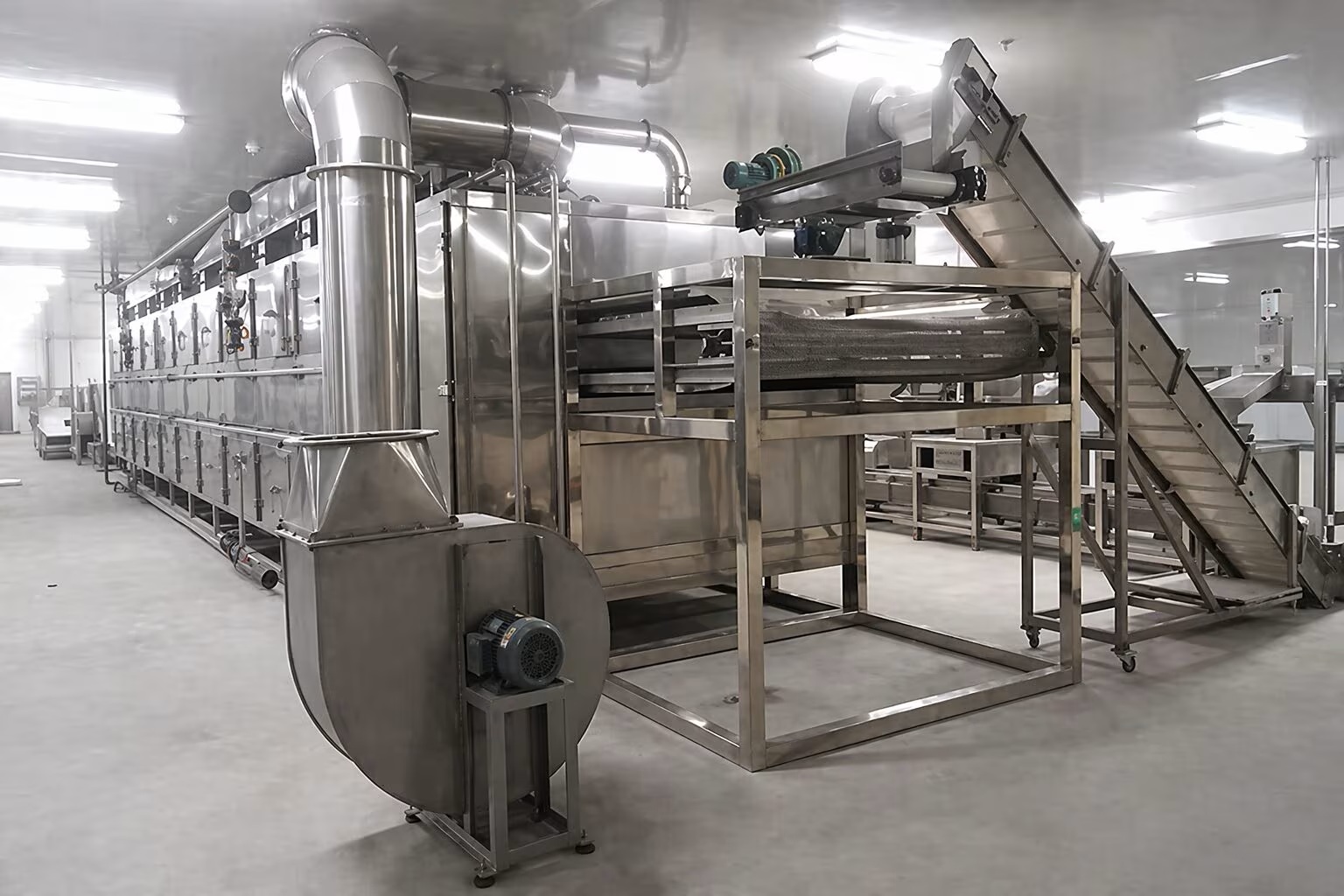
CTC black tea drying at Kerone uses fluid bed dryers for primary firing combined with multi-pass conveyor secondary dryers, or alternatively continuous vibro-fluid bed systems that combine both drying stages in a single piece of equipment with independently controlled temperature zones. Orthodox black tea drying uses ECP chain-and-tray primary dryers followed by secondary multi-pass belt conveyor finishing dryers. For estate factories requiring maximum processing flexibility, Kerone offers combined CTC-orthodox capable drying lines with switchable conveyor and airflow configurations. Both CTC and orthodox systems are available with indirect steam heating or direct-fired burner heating depending on the factory’s energy infrastructure, with heat recovery exchangers standard on all new designs.
Key Features
Dedicated CTC fluid bed primary dryer with short residence time (5–10 min) for high-throughput pellet drying at 110–130°C
ECP multi-pass primary dryer for orthodox black tea with 20–25 minute residence time and bottom-to-top airflow
Independent temperature zone control in secondary finishing dryers for precise final moisture and colour development
Stainless steel construction throughout, with CTC-specific anti-static provisions to manage electrostatic build-up in dry tea fines
Adjustable fan speed and damper controls for airflow optimisation across variable CTC or orthodox product loading conditions
Integrated weighing and automatic belt speed adjustment for consistent throughput and moisture target achievement
Vibro-conveyor secondary dryer option for orthodox black tea with gentle leaf advancement without mechanical damage
Full dust extraction and collection system capturing sub-250-micron tea fines at all transfer and discharge points
Powered by AI, ML & IoT
Future-Ready Engineering Driven by AI & IoT
Our advanced AI, ML, and IoT technologies, this solution delivers smarter automation, real-time insights, and predictive intelligence to enhance efficiency and drive future-ready growth.
Real-Time Monitoring & Control
Continuous tracking of process parameters with instant adjustments.
Predictive Maintenance
Intelligent fault detection to prevent failures before they occur.
Adaptive Process Optimization
Dynamic tuning of operations for maximum output and efficiency.
Cloud Dashboards & Analytics
Unified access to real-time insights and performance trends.
Energy & Resource Savings
Smarter utilization of energy to cut costs and reduce waste.
Secure IoT Connectivity
Encrypted data flow with seamless integration across plant systems.
Applications of Black Tea (CTC & Orthodox) Drying
Kerone’s Black Tea (CTC & Orthodox) Drying systems are extensively used in large estate tea factories, commercial tea processing plants, and bought-leaf manufacturing operations globally. Typical applications include:
High-capacity primary and secondary firing of CTC black tea in large commercial tea factories in Assam, Kenya, and Sri Lanka
Two-stage drying of orthodox black tea in Darjeeling, Nilgiri, and single-origin estate factory operations
Grade-specific secondary drying of BOP, BOPF, and dust grades in CTC operations with different moisture and colour requirements
Bought-leaf factory drying where variable inlet quality and moisture from multiple smallholders require wide-range parameter flexibility
Blended and flavoured black tea drying where temperature sensitivity of added botanicals or essential oils limits maximum drying temperature
Export-grade black tea finishing drying where final moisture specification of 2.0–2.5% is required for long sea freight shelf life
Seamless Export Connections Global & Local
Our Global Footprint in Industrial Excellence
Delivering world-class industrial and process solutions across countries with precision, innovation, and reliability.
Peru
Chile
Argentina
Mexico
Colombia
Brazil
USA
Canada
United Kingdom
France
Germany
Spain
Italy
Netherlands
Sweden
Switzerland
Poland
Portugal
Ireland
Czechia
Romania
Hungary
Austria
Greece
Kazakhstan
Uzbekistan
Turkmenistan
Algeria
Egypt
Nigeria
Kenya
South Africa
Saudi Arabia
UAE
Israel
Russia
India
China
Japan
South Korea
Thailand
Vietnam
Malaysia
Singapore
Indonesia
Philippines
Australia
New Zealand
Pan-India Presence. Local Expertise.
Raipur
Bilaspur
Panaji
Vasco da Gama
Gandhinagar
Ahmedabad
Surat
Chandigarh
Gurgaon
Shimla
Manali
Bengaluru
Mysore
Kochi
Pune
Mumbai
Thane
Navi Mumbai
Hyderabad
Chennai
Coimbatore
Kolkata
Lucknow
Jaipur
Udaipur
Jodhpur
Dehradun
Haridwar
Bhubaneswar
Product Gallery
Frequently Asked Questions (FAQ)
CTC tea has uniform small pellets suited to fluid bed or vibrating conveyor drying at high temperatures with short residence times. Orthodox tea has irregular whole or broken leaf requiring gentle multi-pass belt drying at lower temperatures with longer residence times to avoid physical leaf damage.
CTC processing creates particles with fractured surfaces and fragile edges that generate fine dust during pneumatic or mechanical handling. Drying at high air velocities exacerbates this. Kerone designs CTC dryers with controlled air velocities and dust extraction to minimise dust generation and grade loss.
Commercial black tea targets 2.0–4.0% final moisture, with export grades typically at the lower end (2.0–2.5%) for extended shelf life during sea freight. Over-drying below 1.5% damages leaf structure and loses volatile aroma.
Firing temperature and duration strongly influence the Maillard browning and caramelisation reactions that develop the characteristic bright copper to red-brown colour of black tea liquors. Under-firing produces dull, greenish liquors; over-firing produces dark, muddy, or black-coloured infusions.
Fuel choice varies by region. In Kenya, natural gas and LPG are common; in India and Sri Lanka, diesel and firewood are traditional; in China, coal and biomass. Kerone offers hot air generators for all these fuel types as standard product options.
Partially, but with limitations. Fluid bed primary dryers designed for CTC pellets are not well-suited to orthodox whole leaf. Kerone offers flexible conveyor dryer configurations that can handle both, though operating parameters and belt loading differ significantly between tea types.
Properly dried CTC tea has a black, even colour with a slight shine on the pellet surface. Over-dried tea appears brownish-grey, loses its characteristic appearance, and produces a thin, less-bright cup. Under-dried tea shows sticky, clumping behaviour in the bag filter and during bagging.
Kerone uses controlled low air velocities at transfer points, enclosed belt transition chutes with soft-landing geometry, and strategically placed cyclonic dust extractors at all product-handling junctions, collectively reducing fines content generation versus open-transfer designs.
CTC factories are typically designed for green leaf throughputs of 10–200 tonnes per day. Made tea production ratios of 4–5 kg green leaf per kg made tea translate to 2–40+ tonnes/day of made tea, requiring primary dryer systems sized from 500 kg/hr to 3,000+ kg/hr made tea capacity.
Both modes are used. Small estate orthodox factories may operate semi-continuous batch drying cycles aligned with rolling and fermentation scheduling. Large orthodox operations use fully continuous ECP dryers with belt speed modulation to match primary dryer output with upstream rolling room production.
Yes. Kerone designs multi-product factories with shared infrastructure (hot air generation, controls) and dedicated dryer modules for different tea types, with appropriate cleaning and sanitisation protocols between production runs.
Higher ambient temperatures reduce the temperature differential between incoming air and required drying temperature, increasing the energy demand on the hot air generator. Kerone sizes generators with adequate capacity margins for worst-case summer ambient conditions.
Key sizing parameters are tonnes of made tea per hour (throughput), inlet moisture content (% wb), target outlet moisture (% wb), and the required evaporative load (kg water/hr). Kerone uses these parameters along with psychrometric modelling to define all equipment sizing.
No. Kerone's industrial black tea dryers are designed for continuous multi-shift operation, with operator changeover procedures that maintain set-point conditions without product interruption. Shutdown is typically only required for weekly cleaning and scheduled maintenance.
Dryer exhaust from black tea processing contains water vapour, tea volatile compounds, and occasional fine dust particles. Kerone can integrate wet scrubbers or bio-filters on the exhaust stream for odour and particulate compliance where required by local environmental regulations.
Kerone’s custom-designed heating and processing solutions are built to meet the demands of your growing operations. Whether you’re upgrading equipment, expanding production, or need a tailor-made solution

 Peru
Peru Chile
Chile Argentina
 Mexico
 Colombia
 Brazil
 USA
USA Canada
 United Kingdom
 France
 Germany
 Spain
Spain Italy
Italy Netherlands
 Sweden
 Switzerland
 Poland
 Portugal
 Ireland
 Czechia
 Romania
 Hungary
 Austria
 Greece
 Kazakhstan
 Uzbekistan
 Turkmenistan
 Algeria
 Egypt
Egypt Nigeria
 Kenya
Kenya South Africa
 Saudi Arabia
 UAE
UAE Israel
 Russia
 India
India China
China Japan
Japan South Korea
 Thailand
 Vietnam
 Malaysia
 Singapore
 Indonesia
 Philippines
 Australia
 New Zealand