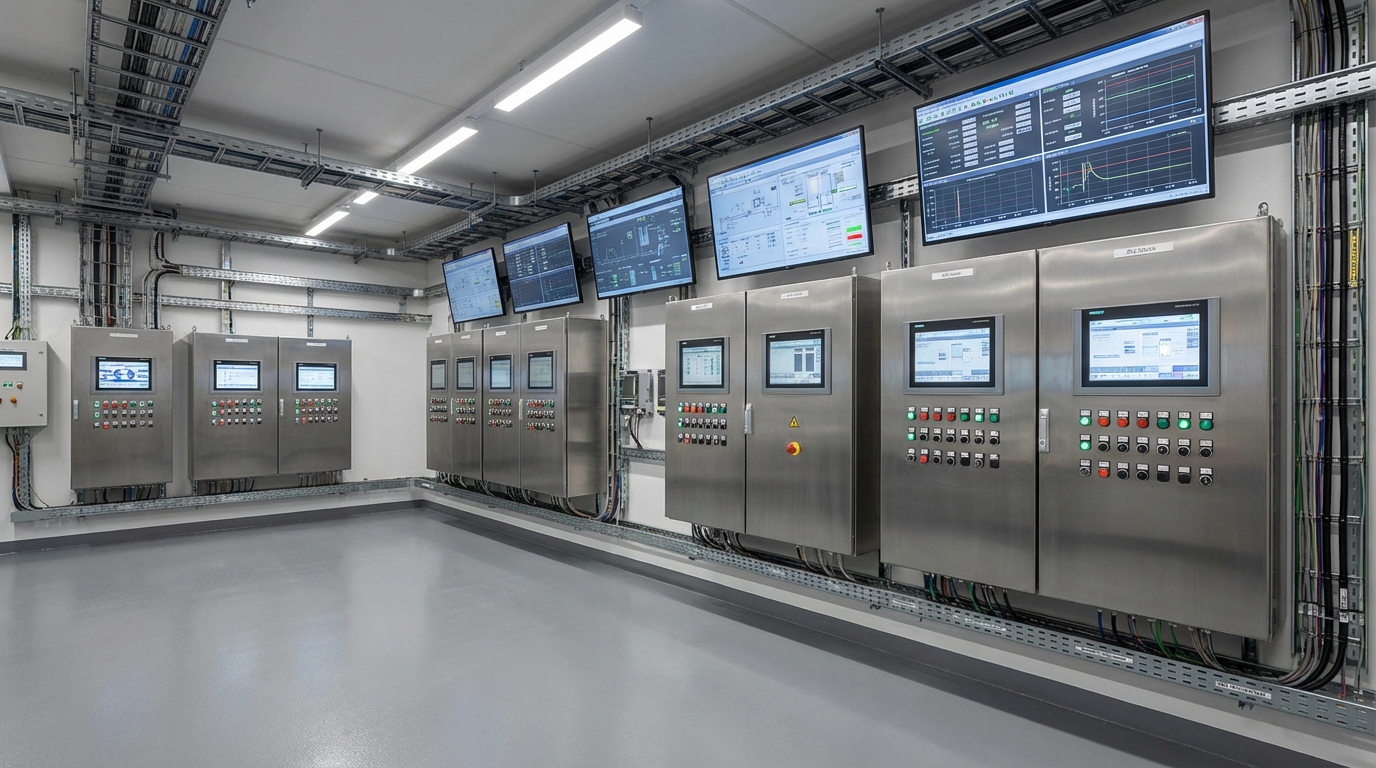
Kerone’s Digital, AI & Smart Engineering Solutions represent the fusion of advanced artificial intelligence, machine learning, digital simulation, and data analytics with deep industrial engineering expertise. These solutions go beyond automation to deliver intelligent systems that learn, adapt, and optimize continuously—turning raw operational data into actionable engineering insights. From AI-driven process optimization and quality prediction models to advanced simulation tools and intelligent design systems, Kerone empowers engineers and plant managers with digital technologies that dramatically improve process performance, product quality, and decision-making speed across the entire industrial value chain.
Why Choose Kerone Digital, AI & Smart Engineering Solutions
Kerone’s Digital, AI & Smart Engineering Solutions are differentiated by the rare combination of genuine industrial process knowledge and advanced data science capability within a single team. Many AI vendors lack deep understanding of the physical processes they are modelling, resulting in black-box solutions that are unreliable in real industrial conditions. Kerone’s engineers understand both the underlying process physics and the data science techniques, enabling them to develop AI models that are physically meaningful, robust, and reliable. This domain-grounded approach to AI ensures that Kerone’s digital solutions deliver real operational value rather than just impressive demonstrations.
Types and Features of Digital, AI & Smart Engineering Solutions
Kerone’s digital and AI offerings include AI-powered process optimization systems, machine learning-based quality prediction and defect detection models, advanced process control (APC) using model predictive control (MPC), computational fluid dynamics (CFD) and finite element analysis (FEA) simulation services, digital twin platforms for real-time process mirroring, smart alarm management systems, AI-based energy optimization, and natural language processing interfaces for intuitive plant operation. Solutions are delivered as cloud-based SaaS platforms, on-premise edge installations, or hybrid architectures based on client data governance requirements.
Key Features
Physics-informed machine learning models for robust and reliable process optimization
Real-time AI quality prediction and defect detection integrated with production lines
Model Predictive Control (MPC) for advanced multi-variable process optimization
CFD and FEA simulation for equipment design validation and performance prediction
Digital twin platforms enabling real-time process monitoring, simulation, and what-if analysis
AI-driven energy optimization with continuous learning from operational patterns
Secure cloud, edge, and hybrid deployment architectures for data privacy and low latency
Powered by AI, ML & IoT
Future-Ready Engineering Driven by AI & IoT
Our advanced AI, ML, and IoT technologies, this solution delivers smarter automation, real-time insights, and predictive intelligence to enhance efficiency and drive future-ready growth.
Real-Time Monitoring & Control
Continuous tracking of process parameters with instant adjustments.
Predictive Maintenance
Intelligent fault detection to prevent failures before they occur.
Adaptive Process Optimization
Dynamic tuning of operations for maximum output and efficiency.
Cloud Dashboards & Analytics
Unified access to real-time insights and performance trends.
Energy & Resource Savings
Smarter utilization of energy to cut costs and reduce waste.
Secure IoT Connectivity
Encrypted data flow with seamless integration across plant systems.
Applications of Digital, AI & Smart Engineering Solutions
Kerone’s Digital, AI & Smart Engineering Solutions are extensively used in process manufacturing, energy management, quality control, product development, and advanced engineering design.
Typical applications include:
AI-based process optimization for drying, heating, and thermal processing systems
Real-time defect detection and quality classification using machine vision and deep learning
Energy management optimization using AI to minimize consumption while maintaining output
CFD simulation for industrial dryer, oven, and reactor design and performance validation
Predictive quality modeling in pharmaceutical and food production for batch release optimization
Digital twin-based operator training simulations for complex industrial processes
Kerone’s Digital, AI & Smart Engineering Solutions bring the power of advanced data science and artificial intelligence to industrial engineering in a way that is practical, trustworthy, and deeply aligned with the real-world challenges of manufacturing. By combining AI capability with engineering wisdom, Kerone delivers digital solutions that genuinely transform operational performance, accelerate innovation, and build lasting competitive advantage for forward-thinking industrial organizations.
Seamless Export Connections Global & Local
Our Global Footprint in Industrial Excellence
Delivering world-class industrial and process solutions across countries with precision, innovation, and reliability.
Peru
Chile
Argentina
Mexico
Colombia
Brazil
USA
Canada
United Kingdom
France
Germany
Spain
Italy
Netherlands
Sweden
Switzerland
Poland
Portugal
Ireland
Czechia
Romania
Hungary
Austria
Greece
Kazakhstan
Uzbekistan
Turkmenistan
Algeria
Egypt
Nigeria
Kenya
South Africa
Saudi Arabia
UAE
Israel
Russia
India
China
Japan
South Korea
Thailand
Vietnam
Malaysia
Singapore
Indonesia
Philippines
Australia
New Zealand
Pan-India Presence. Local Expertise.
Raipur
Bilaspur
Panaji
Vasco da Gama
Gandhinagar
Ahmedabad
Surat
Chandigarh
Gurgaon
Shimla
Manali
Bengaluru
Mysore
Kochi
Pune
Mumbai
Thane
Navi Mumbai
Hyderabad
Chennai
Coimbatore
Kolkata
Lucknow
Jaipur
Udaipur
Jodhpur
Dehradun
Haridwar
Bhubaneswar
Frequently Asked Questions (FAQ)
Kerone develops supervised learning models for quality prediction, reinforcement learning for process optimization, deep learning for computer vision inspection, and physics-informed neural networks for process simulation.
Yes, Kerone offers on-premise and edge deployment options for AI systems, ensuring that sensitive production data remains within the client's own infrastructure.
MPC is an advanced control strategy that uses a process model to predict future system behavior and compute optimal control actions. Kerone deploys MPC to optimize multi-variable industrial processes in real time.
Kerone builds digital twins using a combination of physics-based models, historical process data, and real-time sensor feeds. The twin is continuously updated to maintain accuracy as the physical system evolves.
Yes, Kerone's AI and digital solutions integrate with existing SCADA, DCS, MES, and ERP platforms via standard APIs, OPC-UA, and database connectors.
A typical AI optimization system deployment takes 8 to 20 weeks, depending on data availability, process complexity, and integration requirements.
Kerone's solutions can work with existing SCADA or historian data. Kerone also assists clients in building the necessary data infrastructure including sensors, edge nodes, and time-series databases.
CFD simulation can replace many physical tests during the design phase, reducing time and cost. However, for critical applications, Kerone recommends validating CFD results with targeted physical trials.
Industrial processes drift over time due to equipment wear, raw material variation, and seasonal effects, which means AI models trained on historical data gradually lose accuracy if left static. Kerone builds ongoing model monitoring into deployed systems, tracking prediction accuracy against actual outcomes and flagging when performance degrades beyond an acceptable threshold. Periodic retraining using recent operating data keeps models aligned with current process conditions, and physics-informed model architectures tend to degrade more gracefully than purely data-driven models when conditions shift outside the original training range. Establishing a clear ownership structure for ongoing model maintenance, whether handled internally by the client's data team or through an ongoing service agreement with Kerone, is essential, since a deployed AI system without an ongoing maintenance plan typically becomes unreliable within months as the underlying process evolves.
Traditional PID and rule-based control excel at maintaining stable setpoints for well-understood, single-variable relationships, but struggle with complex, multi-variable processes where the optimal control action depends on interactions between many parameters simultaneously. AI-based approaches like Model Predictive Control can account for these interactions and anticipate future process behavior rather than only reacting to current deviation, often achieving tighter control and better energy or yield optimization in genuinely multi-variable processes. However, traditional control remains entirely appropriate and more cost-effective for simpler control loops where multi-variable optimization offers little additional benefit. The decision isn't AI versus traditional control as a blanket choice, but rather identifying which specific control loops in a plant have enough complexity and interaction to benefit from advanced techniques, while leaving simpler loops on proven traditional control.
Cloud-based AI deployments offer easier scalability and centralized model management but require transmitting potentially sensitive production data outside the client's own infrastructure, which raises concerns for companies with strict data governance policies or competitively sensitive process information. Edge deployments keep all data processing within the client's own network, eliminating this exposure but requiring more substantial local computing infrastructure and more hands-on maintenance by the client's own IT team. Hybrid architectures, where sensitive raw data stays on-premise while only aggregated or anonymized insights move to the cloud, offer a middle path that many manufacturers find acceptable. Kerone supports all three architectures and works with the client's IT and security teams to determine which approach satisfies their specific data governance requirements before finalizing the deployment architecture for an AI project.
Yes, once a model architecture and data pipeline are validated for one process or plant, the underlying framework typically transfers to similar processes at other locations with retraining on the new site's specific data rather than building an entirely new system from scratch. However, each additional plant or product line still requires sufficient historical or newly collected data specific to its own equipment and operating conditions, since models trained on one facility's data don't automatically generalize perfectly to another facility with different equipment vintage, raw materials, or operating practices. Standardizing data collection and tagging conventions across multiple plants in advance significantly accelerates this scaling process. Companies planning a multi-site AI rollout benefit from treating the first deployment partly as a template-building exercise, documenting what worked, what data was needed, and what customization was required for that specific process.
Processes with significant multi-variable complexity and interacting parameters, such as drying and thermal processing where temperature, humidity, airflow, and material properties all interact, benefit substantially from AI-based optimization that traditional control struggles to address. Quality-critical processes in pharmaceutical and food manufacturing benefit from AI-based defect detection and batch release prediction that reduces both quality risk and unnecessary destructive testing. Energy-intensive processes such as furnaces, kilns, and large drying systems benefit from AI-driven energy optimization given the direct cost impact of even modest efficiency gains at scale. Processes with rich existing historian data and a track record of operational variability that hasn't yet been systematically addressed represent the best near-term opportunities, since both the data foundation and the improvement potential already exist, reducing the time needed to demonstrate measurable value.
Kerone’s custom-designed heating and processing solutions are built to meet the demands of your growing operations. Whether you’re upgrading equipment, expanding production, or need a tailor-made solution

 Peru
Peru Chile
Chile Argentina
 Mexico
 Colombia
 Brazil
 USA
USA Canada
 United Kingdom
 France
 Germany
 Spain
Spain Italy
Italy Netherlands
 Sweden
 Switzerland
 Poland
 Portugal
 Ireland
 Czechia
 Romania
 Hungary
 Austria
 Greece
 Kazakhstan
 Uzbekistan
 Turkmenistan
 Algeria
 Egypt
Egypt Nigeria
 Kenya
Kenya South Africa
 Saudi Arabia
 UAE
UAE Israel
 Russia
 India
India China
China Japan
Japan South Korea
 Thailand
 Vietnam
 Malaysia
 Singapore
 Indonesia
 Philippines
 Australia
 New Zealand