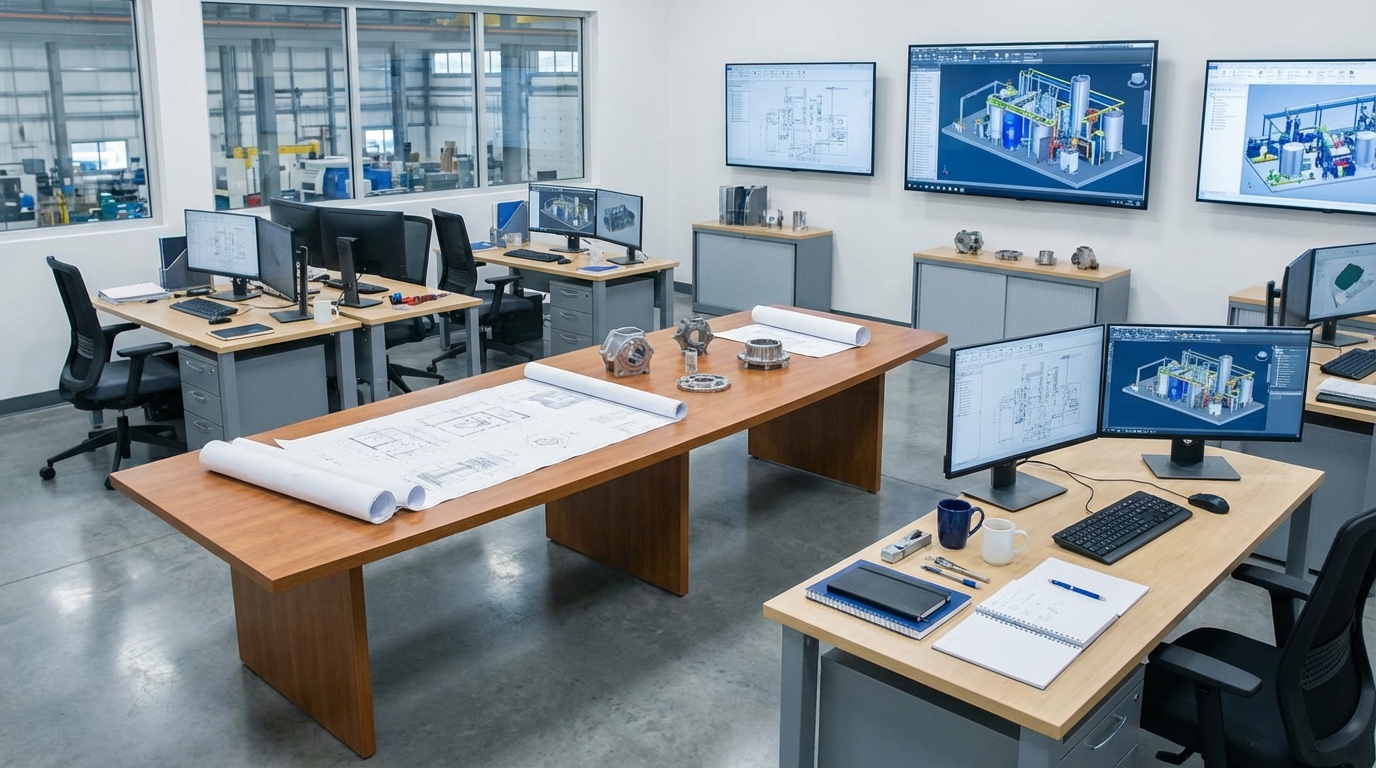
Kerone’s Engineering Capability Overview & Design Philosophy reflects decades of experience in delivering world-class industrial processing solutions across a diverse range of industries and technologies. At its core, Kerone’s engineering approach is built on the principles of precision, innovation, sustainability, and customer-centric design. Kerone’s multi-disciplinary engineering teams—comprising process engineers, mechanical designers, electrical and instrumentation engineers, and software developers—collaborate seamlessly to translate complex customer requirements into reliable, efficient, and future-proof engineering solutions. From the first conceptual sketch to the final commissioning test, every Kerone project is executed with rigor, expertise, and a commitment to excellence.
Choosing Kerone as an engineering partner means gaining access to an organization that genuinely understands both the science of industrial processes and the art of practical engineering. Kerone’s design philosophy prioritizes life-cycle value over initial cost—every system is engineered for durability, ease of maintenance, energy efficiency, and adaptability to future production changes. Kerone’s engineers are encouraged to challenge conventional approaches and apply innovative solutions when they offer superior outcomes, creating a culture of continuous improvement that benefits every client project. With an established track record of over decades delivering complex engineering projects across global markets, Kerone brings both experience and ambition to every new challenge.
Types and Features of Engineering Capability Overview & Design Philosophy
Kerone’s engineering capabilities span process design and simulation, mechanical engineering and 3D CAD design, materials selection and testing, electrical and instrumentation design, PLC/SCADA/DCS programming, civil and structural engineering, project management, quality assurance, and regulatory compliance documentation. Design tools include CFD, FEA, dynamic process simulation, HAZOP, SIL assessment, and digital twin modeling. Kerone holds ISO 9001 certification and employs engineering standards from ASME, IEC, IS, ATEX, CE, GMP, and EHEDG as applicable to each project.
Key Features
Multi-disciplinary in-house engineering across process, mechanical, electrical, and software disciplines
Advanced design tools including CFD, FEA, 3D CAD, and dynamic process simulation
ISO 9001 certified quality management system with rigorous design review and approval processes
Application of international standards: ASME, IEC, ATEX, CE, GMP, EHEDG, and IS codes
Life-cycle engineering philosophy prioritizing durability, maintainability, and energy efficiency
HAZOP and SIL assessment capability for safe design of hazardous industrial processes
Integrated project management with milestone tracking, risk management, and client reporting
Post-commissioning support including performance validation, operator training, and continuous improvement
Powered by AI, ML & IoT
Future-Ready Engineering Driven by AI & IoT
Our advanced AI, ML, and IoT technologies, this solution delivers smarter automation, real-time insights, and predictive intelligence to enhance efficiency and drive future-ready growth.
Real-Time Monitoring & Control
Continuous tracking of process parameters with instant adjustments.
Predictive Maintenance
Intelligent fault detection to prevent failures before they occur.
Adaptive Process Optimization
Dynamic tuning of operations for maximum output and efficiency.
Cloud Dashboards & Analytics
Unified access to real-time insights and performance trends.
Energy & Resource Savings
Smarter utilization of energy to cut costs and reduce waste.
Secure IoT Connectivity
Encrypted data flow with seamless integration across plant systems.
Applications of Engineering Capability Overview & Design Philosophy
Kerone’s Engineering Capability & Design Philosophy underpins every solution it delivers across food, pharma, chemical, energy, environmental, and advanced manufacturing sectors.
Typical applications include:
Design and delivery of custom industrial dryers, ovens, and thermal processing systems
Complete process plant engineering for chemical, pharmaceutical, and food industries
Smart factory and Industry 4.0 solution engineering for manufacturing modernization projects
Environmental engineering for pollution control, waste treatment, and sustainability programs
Biochar and renewable energy system engineering for carbon-neutral processing
Advanced material and surface engineering system design for high-performance applications
Kerone’s Engineering Capability and Design Philosophy represent more than a methodology they embody a deep commitment to creating engineering solutions that stand the test of time, perform to the highest standards, and deliver genuine value to clients and society. By combining technical expertise with innovative thinking, collaborative relationships, and unwavering quality standards, Kerone continues to earn its reputation as one of the most trusted and capable industrial engineering organizations in the field.
Seamless Export Connections Global & Local
Our Global Footprint in Industrial Excellence
Delivering world-class industrial and process solutions across countries with precision, innovation, and reliability.
Peru
Chile
Argentina
Mexico
Colombia
Brazil
USA
Canada
United Kingdom
France
Germany
Spain
Italy
Netherlands
Sweden
Switzerland
Poland
Portugal
Ireland
Czechia
Romania
Hungary
Austria
Greece
Kazakhstan
Uzbekistan
Turkmenistan
Algeria
Egypt
Nigeria
Kenya
South Africa
Saudi Arabia
UAE
Israel
Russia
India
China
Japan
South Korea
Thailand
Vietnam
Malaysia
Singapore
Indonesia
Philippines
Australia
New Zealand
Pan-India Presence. Local Expertise.
Raipur
Bilaspur
Panaji
Vasco da Gama
Gandhinagar
Ahmedabad
Surat
Chandigarh
Gurgaon
Shimla
Manali
Bengaluru
Mysore
Kochi
Pune
Mumbai
Thane
Navi Mumbai
Hyderabad
Chennai
Coimbatore
Kolkata
Lucknow
Jaipur
Udaipur
Jodhpur
Dehradun
Haridwar
Bhubaneswar
Frequently Asked Questions (FAQ)
Kerone has in-house expertise in process engineering, mechanical design, electrical and instrumentation engineering, civil and structural engineering, software and automation development, and project management.
Kerone uses industry-leading software including AutoCAD, SolidWorks, ANSYS (CFD and FEA), Aspen Plus for process simulation, MATLAB, and various PLC/SCADA programming environments.
Yes, Kerone operates under an ISO 9001 certified quality management system that governs all engineering, procurement, fabrication, and project delivery activities.
Kerone employs formal risk management methodologies including HAZOP, Failure Mode Effects Analysis (FMEA), and risk registers updated throughout the project lifecycle.
Sustainability is embedded in Kerone's design philosophy through energy efficiency optimization, waste minimization, use of renewable energy sources, and environmental compliance in every project.
Yes, Kerone designs to ASME, IEC, ATEX, CE, EHEDG, GMP, FDA, CPCB, IS, and other applicable international and regional standards depending on project location and industry.
Kerone uses an integrated project management framework with a dedicated project manager, cross-discipline coordination meetings, and digital collaboration tools to ensure seamless execution of complex projects.
Kerone provides post-commissioning performance validation, operator training, spare parts supply, preventive maintenance support, and ongoing process optimization consulting for all delivered projects.
Client process knowledge is essential input that Kerone's engineers cannot fully replicate independently, including material behavior quirks, operational constraints from existing facility layout, and lessons learned from previous equipment that should inform the new design. Design review meetings at key milestones give clients the opportunity to validate that the engineering direction matches their actual operational needs before detailed design and fabrication commitment lock in those decisions. Clients providing representative material samples for testing, when available, significantly improves design confidence compared to relying solely on written material specifications. Active client involvement during commissioning, including operator participation in performance validation testing, also improves the smoothness of the handover to routine production operation. Projects with engaged, responsive client technical contacts throughout the design phase consistently experience fewer late-stage surprises than projects where client involvement is minimal until commissioning.
Kerone maintains proven design platforms for core equipment categories like dryers, ovens, and microwave systems, then customizes specific aspects such as capacity, materials of construction, automation level, and process-specific features around that proven base rather than designing every project entirely from a blank sheet. This approach captures much of the cost and lead-time benefit of standardization for the well-understood aspects of equipment design while still delivering genuine customization where the client's process actually requires it. Fully custom engineering is reserved for genuinely novel applications where no proven platform exists as a starting point. Clients benefit from understanding which aspects of their requirement are truly unique versus which could use a proven base design, since pursuing full customization on every aspect of a project, even where standardization would work fine, unnecessarily increases both cost and schedule risk.
Kerone designs civil foundations, utility connections, and structural layouts with reserved space and capacity margin for anticipated future expansion phases, even when only the initial phase is being built immediately. Modular equipment architecture, where additional process trains or capacity modules can be added alongside existing equipment, is preferred over monolithic designs that would require complete replacement to expand. Control system architecture is specified with headroom for additional I/O points and equipment integration rather than sized exactly to initial scope. This forward-looking approach requires clients to share their growth projections during the initial design phase, even if uncertain, since incorporating expansion flexibility into the original design is substantially cheaper than retrofitting it later. Projects where future capacity needs were not discussed upfront often face more expensive and disruptive expansion paths than projects where this consideration was built into the original engineering.
Value engineering means systematically reviewing a design to identify where specification requirements exceed what the actual process genuinely needs, then adjusting the design to deliver the required performance at lower cost without compromising functionality, safety, or quality outcomes. Examples include right-sizing equipment capacity to match realistic throughput rather than oversized margins, standardizing on proven component platforms instead of fully custom designs where standardization doesn't compromise process requirements, and optimizing materials of construction to match the actual process chemistry rather than defaulting to premium materials beyond what's needed. Value engineering is most effective when conducted collaboratively between the client's process knowledge and Kerone's equipment design expertise, since cost reduction decisions need to be evaluated against actual process risk rather than made in isolation by either party without full visibility into the tradeoffs involved.
Kerone supports international projects through a combination of remote engineering collaboration during the design phase, factory acceptance testing conducted at Kerone's manufacturing facilities with client representatives able to attend in person or remotely, and on-site installation and commissioning support delivered through Kerone's own teams or regional partner offices across Europe, Southeast Asia, the Middle East, Africa, and the Americas. Equipment is engineered to comply with the destination market's applicable codes and standards, such as CE marking for Europe or specific regional electrical and safety codes, determined during the design phase rather than retrofitted after fabrication. Logistics planning accounts for shipping, customs, and any site-specific installation constraints unique to the destination. Local language and time zone coordination during commissioning is typically handled through Kerone's regional offices or established local partners to ensure responsive support throughout project execution.
An integrated engineering partner like Kerone takes responsibility for how process, mechanical, electrical, and automation elements work together as a single system, whereas sourcing equipment from multiple specialized suppliers requires the client to manage interface compatibility, control system integration, and accountability when something doesn't perform as expected across supplier boundaries. With a single integrated provider, performance guarantees apply to the complete system rather than individual components, and troubleshooting issues that span multiple disciplines, such as a quality problem traced to interaction between heating profile and material handling, is resolved by one team rather than requiring coordination across separate vendors who may each blame the other's equipment. The tradeoff is that an integrated approach may cost more upfront than assembling a system from the cheapest available component suppliers, but it substantially reduces the risk of integration failures and unclear accountability during commissioning and operation.
Kerone’s custom-designed heating and processing solutions are built to meet the demands of your growing operations. Whether you’re upgrading equipment, expanding production, or need a tailor-made solution
 Peru
Peru Chile
Chile Argentina
 Mexico
 Colombia
 Brazil
 USA
USA Canada
 United Kingdom
 France
 Germany
 Spain
Spain Italy
Italy Netherlands
 Sweden
 Switzerland
 Poland
 Portugal
 Ireland
 Czechia
 Romania
 Hungary
 Austria
 Greece
 Kazakhstan
 Uzbekistan
 Turkmenistan
 Algeria
 Egypt
Egypt Nigeria
 Kenya
Kenya South Africa
 Saudi Arabia
 UAE
UAE Israel
 Russia
 India
India China
China Japan
Japan South Korea
 Thailand
 Vietnam
 Malaysia
 Singapore
 Indonesia
 Philippines
 Australia
 New Zealand