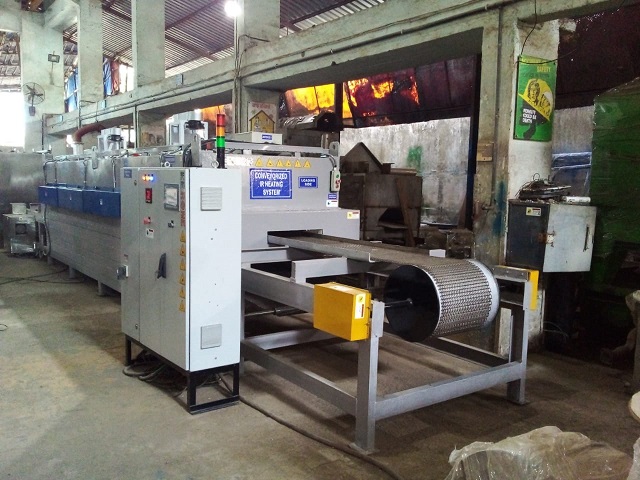
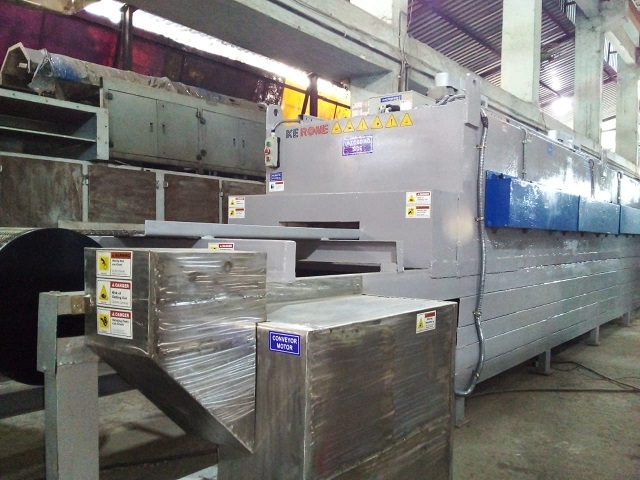
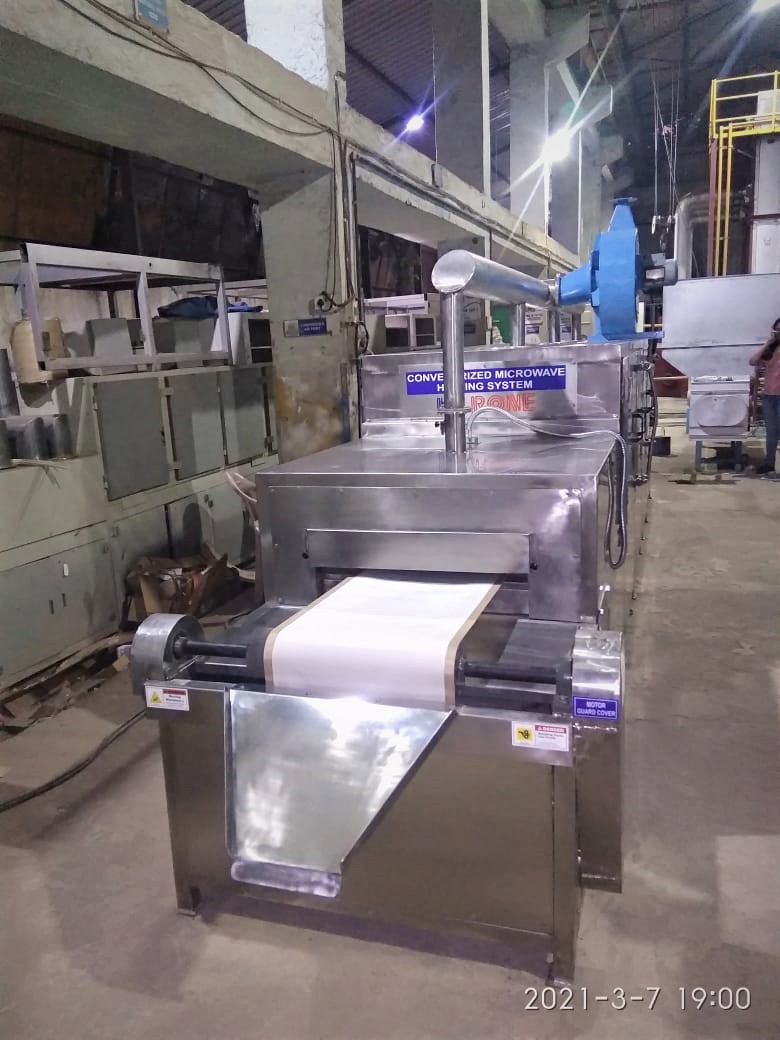
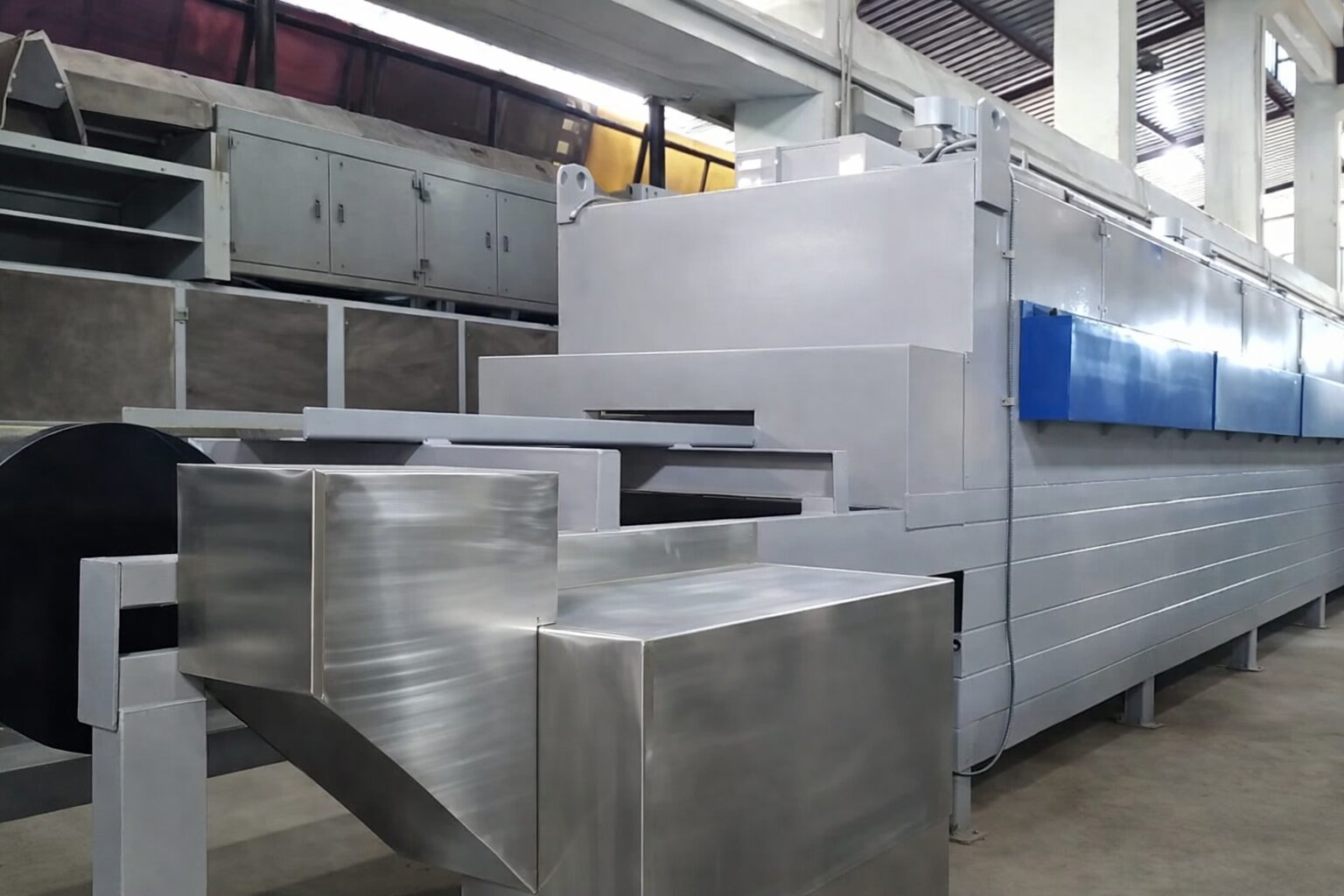
Continuous Microwave Heating Systems are industrial-scale processing equipment that apply microwave energy to products moving continuously through the heating zone on conveyors, in tubes, or via pneumatic transport, enabling high-throughput, consistent, and energy-efficient thermal processing without the batch-to-batch variability of discontinuous systems. Products enter the microwave tunnel continuously, receive precisely controlled thermal treatment as they travel through multiple independently controlled microwave zones, and exit in a continuously processed and ready-to-pack or ready-to-use state. Kerone’s continuous microwave heating systems are designed for food processing, chemical production, drying, pasteurization, and industrial material processing applications requiring high throughput, process consistency, and minimal manual intervention.
Why Choose Kerone Continuous Microwave Heating System
Kerone’s continuous microwave heating systems are engineered for reliable, high-throughput industrial production with minimal downtime and maximum process consistency. Our multi-zone tunnel designs allow precise temperature profiling along the treatment path, ensuring each product unit receives exactly the required thermal treatment regardless of production rate variations. Kerone provides complete conveyor, product handling, and cooling system integration for a full production line solution. Our systems are designed for easy cleaning, rapid product changeovers, and straightforward integration with upstream and downstream process equipment. Kerone’s expert team provides process optimization support to help clients achieve maximum throughput and product quality from their continuous microwave systems.
Types and Features of Continuous Microwave Heating System
Kerone offers belt conveyor, roller conveyor, tube flow, and pneumatic transport continuous microwave systems depending on the product form and processing requirements. Microwave tunnel lengths from 2 m to over 20 m accommodate different power levels and residence time requirements. Multi-zone microwave applicators with individual power control provide flexible temperature profiling. Product loading and unloading conveyors interface with existing production lines. Microwave choke end sections prevent leakage at product entry and exit ports. Optional steam, water mist, or controlled atmosphere environments within the tunnel enhance specific heating applications. Advanced SCADA-based control systems provide recipe management, real-time monitoring, and production data logging for quality assurance.
Key Features
High thermal and processing efficiency
Low maintenance and easy operation
Suitable for heat-sensitive materials
Fully adjustable and customizable process parameters
Available in batch and continuous configurations
Uniform processing and consistent product quality
Powered by AI, ML & IoT
Future-Ready Engineering Driven by AI & IoT
Our advanced AI, ML, and IoT technologies, this solution delivers smarter automation, real-time insights, and predictive intelligence to enhance efficiency and drive future-ready growth.
Real-Time Monitoring & Control
Continuous tracking of process parameters with instant adjustments.
Predictive Maintenance
Intelligent fault detection to prevent failures before they occur.
Adaptive Process Optimization
Dynamic tuning of operations for maximum output and efficiency.
Cloud Dashboards & Analytics
Unified access to real-time insights and performance trends.
Energy & Resource Savings
Smarter utilization of energy to cut costs and reduce waste.
Secure IoT Connectivity
Encrypted data flow with seamless integration across plant systems.
Applications of Continuous Microwave Heating System
Kerone’s Continuous Microwave Heating Systems are extensively used in food processing, chemical, and industrial manufacturing industries. Typical applications include:
Continuous drying of snacks, pasta, grain, and bakery products
Pasteurization of packaged food products inline with filling and sealing lines
Continuous heating and tempering of chocolate, fats, and confectionery
Industrial chemical and mineral drying and calcination processes
Rubber and polymer continuous heating and curing applications
Agricultural product drying including grains, seeds, and pulses
Kerone’s Continuous Microwave Heating System solutions are engineered to deliver maximum efficiency, long-term reliability and excellent operational stability. Our focus on innovation and customization ensures superior industrial results.
By enabling continuous, inline microwave processing, Kerone helps manufacturers eliminate batch processing bottlenecks, reduce product handling, improve quality consistency, and lower operational costs. Our experience across food, chemical, rubber, and industrial applications ensures that every continuous microwave system is optimized for the specific product and process requirements of each client, delivering maximum production value from day one.
Seamless Export Connections Global & Local
Our Global Footprint in Industrial Excellence
Delivering world-class industrial and process solutions across countries with precision, innovation, and reliability.
Peru
Chile
Argentina
Mexico
Colombia
Brazil
USA
Canada
United Kingdom
France
Germany
Spain
Italy
Netherlands
Sweden
Switzerland
Poland
Portugal
Ireland
Czechia
Romania
Hungary
Austria
Greece
Kazakhstan
Uzbekistan
Turkmenistan
Algeria
Egypt
Nigeria
Kenya
South Africa
Saudi Arabia
UAE
Israel
Russia
India
China
Japan
South Korea
Thailand
Vietnam
Malaysia
Singapore
Indonesia
Philippines
Australia
New Zealand
Pan-India Presence. Local Expertise.
Raipur
Bilaspur
Panaji
Vasco da Gama
Gandhinagar
Ahmedabad
Surat
Chandigarh
Gurgaon
Shimla
Manali
Bengaluru
Mysore
Kochi
Pune
Mumbai
Thane
Navi Mumbai
Hyderabad
Chennai
Coimbatore
Kolkata
Lucknow
Jaipur
Udaipur
Jodhpur
Dehradun
Haridwar
Bhubaneswar
Product Gallery
Frequently Asked Questions (FAQ)
Food, chemical, pharma, biomass, rubber, textile and more.
Continuous processing eliminates loading and unloading time, provides consistent product treatment, integrates directly with production lines, and achieves higher throughput with fewer personnel.
Solid pieces, granules, powders, pastes, liquids in containers, and packaged products can be handled in continuous microwave systems with appropriate conveyor or flow design.
Kerone's continuous systems can handle throughput from tens of kg per hour for specialty products to many tonnes per hour for high-volume industrial applications.
Microwave choke structures are designed at the product entry and exit openings to suppress microwave propagation along the product path, ensuring safe operation without physical barriers.
Continuous microwave drying systems use conveyor or tunnel configurations to process materials at high throughput rates, making them suitable for industrial-scale production. Kerone's continuous microwave dryers feature modular design for scalability, stainless steel construction, adjustable belt speeds, integrated moisture sensors with feedback control, and energy-efficient magnetron configurations. They are used in food processing, ceramics, pharmaceuticals, chemicals, and wood products. Continuous systems are significantly more productive and energy-efficient than batch microwave systems for large-scale applications.
Continuous microwave tunnels typically divide the treatment path into multiple independently controlled zones, each with its own power setting, rather than applying a single uniform power level along the entire tunnel length. This zoning allows higher power early in the tunnel where bulk heating is needed, tapering to lower power in later zones for fine temperature control as the product approaches target temperature, which avoids overheating the product's leading edge while still achieving adequate treatment by the time it exits. Without independent zone control, operators would need to compromise between underheating the product exit point and overheating the entry point, since a single power setting can rarely satisfy both requirements simultaneously across products with any meaningful residence time in the tunnel.
Throughput is fundamentally a function of conveyor speed and the cross-sectional loading of product on the belt, but the tunnel length and number of zones constrain how much total energy can be delivered within the available residence time at a given speed. Increasing conveyor speed to raise throughput reduces residence time per unit of product, which must be compensated for by either increasing total power or extending tunnel length to maintain the same total energy delivery; simply speeding up the belt without one of these adjustments under-treats the product. This is why tunnel lengths from 2 meters to over 20 meters are offered across different system models, since the required combination of speed, power, and length depends on the specific product's mass, moisture content, and target temperature rise.
Pneumatic transport moves product through the microwave treatment zone suspended in an air or gas stream within enclosed tubing, which works well for free-flowing powders and small granules where even, all-around microwave exposure is desirable and where a solid conveyor belt would create uneven heating on the product's underside facing the belt. Belt conveyor systems instead move product on a stationary support surface through the microwave zone, which suits larger or irregularly shaped items, packaged products, or materials prone to settling or clumping if pneumatically conveyed. Pneumatic systems also tend to achieve more uniform particle-to-particle heating for fine powders since each particle is more individually exposed, while belt systems can experience some shadowing effect in densely packed product layers.
Uneven width-wise heating typically results from standing wave patterns within the microwave cavity creating zones of higher and lower field intensity, or from uneven product distribution across the belt width causing thicker sections to underheat relative to thinner sections. Mode stirrers or rotating elements within the cavity help disrupt standing wave patterns to even out field distribution, while multiple smaller magnetrons distributed across the tunnel width rather than a single large source also improve uniformity compared with single-source designs. On the product side, ensuring consistent layer thickness and even distribution across the belt width through proper infeed design addresses the product-side contribution to uneven heating, which is just as often the root cause as the microwave field distribution itself.
Microwave choking refers to specialized waveguide structures positioned at the openings where product enters and exits the microwave cavity, designed to suppress microwave energy propagation along the product path beyond the treatment zone while still allowing the physical product to pass through freely. Without effective choking, microwave energy could leak out through these openings, creating both a safety hazard for nearby personnel and an efficiency loss as energy escapes rather than being absorbed by the product. Choke design needs to account for the specific opening size and shape required by the product being processed, since a choke effective for thin sheet products may not provide adequate suppression for a larger opening needed to accommodate bulkier items.
Uniform products like grains or pellets heat relatively predictably since their consistent size and shape allow process parameters to be validated once and applied reliably across the full batch. Irregularly shaped or variably sized products, such as mixed vegetable pieces or non-uniform meat cuts, present more of a challenge because thinner sections heat faster than thicker sections under the same microwave exposure, risking either underheated thick spots or overheated thin spots if treated uniformly. Processing variable-shape products successfully often requires either pre-sorting to reduce size variation, accepting a wider target temperature tolerance band, or combining microwave with a finishing step using another heating method to even out any temperature differential remaining after the microwave stage.
Increasing throughput by raising conveyor speed while holding power constant reduces the energy delivered per unit of product, which works only if the product requires less total energy than originally budgeted, otherwise the product simply exits under-treated. Increasing power while holding speed constant raises energy delivery per unit but also raises peak instantaneous power density, which can increase the risk of localized overheating or scorching in sensitive products even though average treatment improves. The more sustainable path to higher throughput is usually extending tunnel length or adding zones to maintain adequate residence time at higher speed, rather than relying solely on either speed or power adjustments independently, since both have practical ceilings before quality degrades.
Continuous microwave systems are typically designed with standard infeed and outfeed conveyor interfaces matching common industrial conveyor heights and speeds, allowing them to be inserted into an existing production line between, for example, a washing or sizing stage upstream and a packaging or cooling stage downstream. Control system integration usually involves the microwave system's PLC communicating production rate and status signals with the broader line's master control system, so the microwave stage can automatically adjust or pause in coordination with upstream feed rate changes rather than operating as an isolated island within the line. Successful integration depends on confirming conveyor speed compatibility and control signal protocols during the design phase rather than discovering mismatches during installation.
Microwave heating effectiveness depends heavily on a material's dielectric properties, particularly its loss factor, which determines how readily it converts absorbed microwave energy into heat; materials with higher moisture content generally couple with microwave energy more effectively than very dry materials, since water is a strong microwave absorber. Materials with very low moisture content or low dielectric loss factor may heat slowly or unevenly under microwave exposure alone, making them less suited to microwave-only processing without a complementary heating method. Suppliers typically test a representative sample of the specific material in question rather than relying on generic dielectric data for a broad material category, since composition variations within the same general material type can meaningfully affect microwave absorption behavior.
Kerone’s custom-designed heating and processing solutions are built to meet the demands of your growing operations. Whether you’re upgrading equipment, expanding production, or need a tailor-made solution


 Peru
Peru Chile
Chile Argentina
 Mexico
 Colombia
 Brazil
 USA
USA Canada
 United Kingdom
 France
 Germany
 Spain
Spain Italy
Italy Netherlands
 Sweden
 Switzerland
 Poland
 Portugal
 Ireland
 Czechia
 Romania
 Hungary
 Austria
 Greece
 Kazakhstan
 Uzbekistan
 Turkmenistan
 Algeria
 Egypt
Egypt Nigeria
 Kenya
Kenya South Africa
 Saudi Arabia
 UAE
UAE Israel
 Russia
 India
India China
China Japan
Japan South Korea
 Thailand
 Vietnam
 Malaysia
 Singapore
 Indonesia
 Philippines
 Australia
 New Zealand