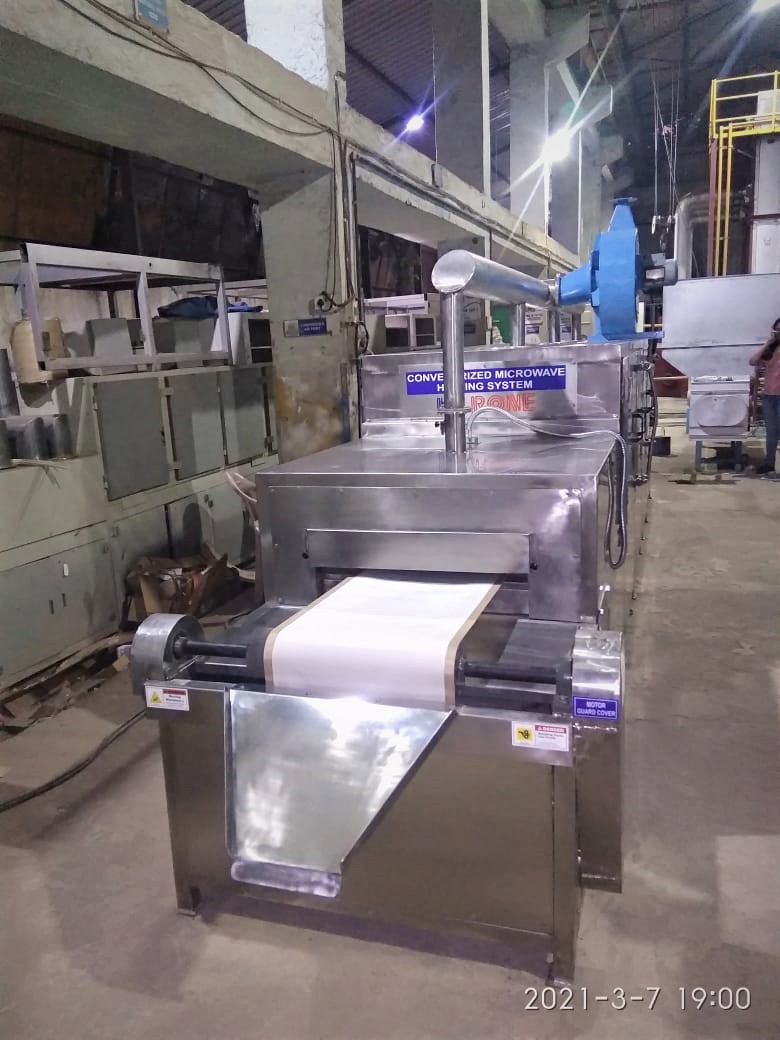
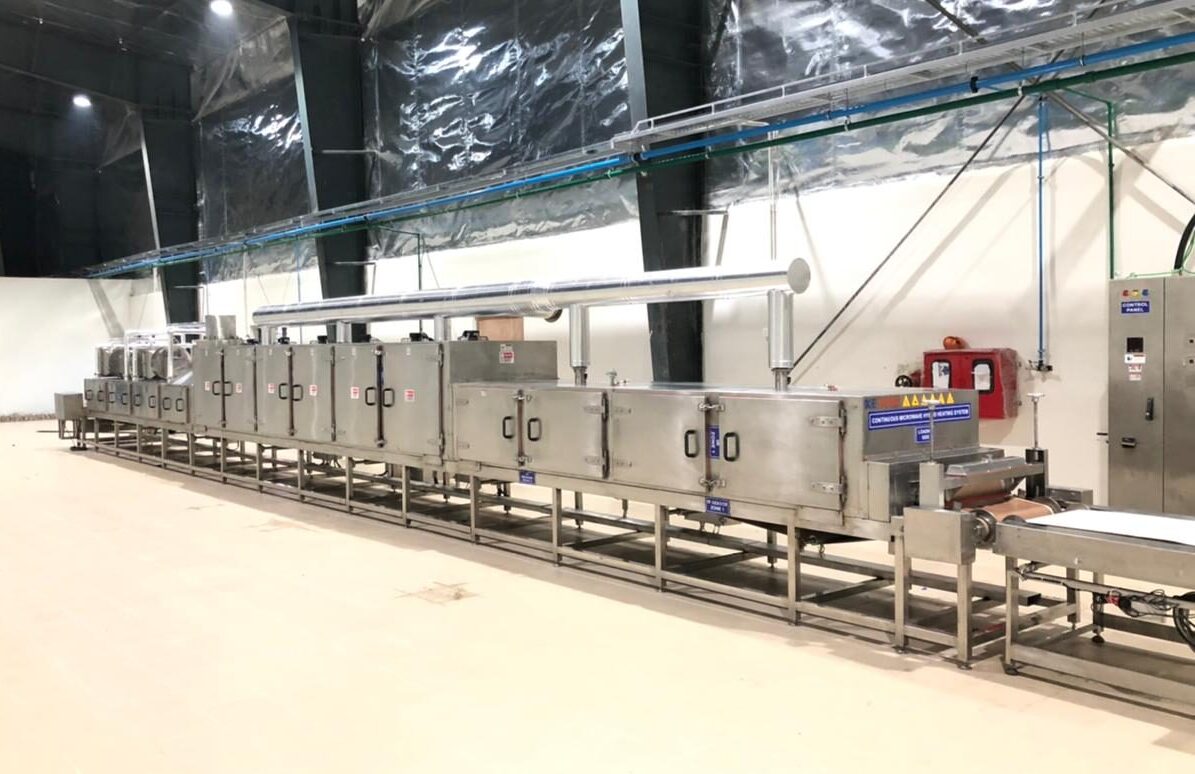
Continuous Microwave Hybrid Heating Systems represent a breakthrough in industrial thermal processing technology, seamlessly combining microwave energy with conventional heating methods — such as hot air, infrared, or steam — to deliver unmatched heating uniformity, speed, and energy efficiency in a single, integrated production line. Unlike conventional batch heating systems, these advanced solutions operate on a fully continuous conveyor-based mechanism, enabling round-the-clock processing without interruption. By coupling microwave’s deep volumetric penetration with the surface-finishing capability of supplementary heat sources, the hybrid system eliminates the common challenges of uneven heating, case hardening, and thermal runaway that often plague standalone microwave setups. Engineered for demanding industrial environments, Kerone’s Continuous Microwave Hybrid Heating Systems offer precise temperature control, programmable power profiles, and real-time monitoring, making them the preferred choice for food processing, pharmaceuticals, chemicals, ceramics, rubber, and advanced material manufacturing across global industries.
Why Choose Kerone Continuous Microwave Hybrid Heating Systems
Kerone has been a trusted name in industrial heating and drying technology for decades, and its Continuous Microwave Hybrid Heating Systems are a testament to that legacy of engineering excellence. What sets Kerone apart is its ability to design and deliver fully customised hybrid systems tailored precisely to a client’s product characteristics, production throughput, and regulatory requirements. Kerone’s in-house team of thermal engineers uses advanced simulation and modelling tools to optimise the microwave frequency, power distribution, and auxiliary heat integration before a single component is manufactured — ensuring that every system performs exactly as designed from day one. Beyond the hardware, Kerone provides end-to-end support: from feasibility studies and pilot trials to installation, commissioning, operator training, and long-term after-sales service. With an unwavering commitment to energy efficiency, food-grade and pharmaceutical-grade construction standards, and compliance with international safety norms, Kerone’s Continuous Microwave Hybrid Heating Systems deliver measurable ROI through lower energy consumption, reduced process times, and consistently superior product quality.
Types and Features of Continuous Microwave Hybrid Heating Systems
Kerone’s Continuous Microwave Hybrid Heating Systems are available across several configurations to address a wide range of industrial applications: Microwave + Hot Air Hybrid Systems, which are ideal for drying and baking applications where surface browning and moisture removal must occur simultaneously; Microwave + Infrared Hybrid Systems, designed for thin-film drying, surface curing, and coating applications requiring rapid surface activation combined with deep internal heating; Microwave + Steam Hybrid Systems, suited to food sterilisation, pasteurisation, and tempering where moisture retention is critical alongside pathogen control; and Microwave + Vacuum Hybrid Systems, used in heat-sensitive pharmaceutical and nutraceutical drying where low-temperature, oxygen-free processing is mandatory. Each configuration features a modular conveyor design with adjustable belt speeds, stainless steel food-grade or industrial-grade construction, multi-zone independent power control, SCADA-compatible PLC automation, integrated exhaust and vapour management, and fail-safe interlock systems — all engineered to meet CE, ATEX, and GMP standards as required by the application.
Key Features
Continuous conveyor-based operation enabling 24/7 uninterrupted high-throughput industrial production with minimal human intervention
Multi-zone independent microwave power control allowing precise customisation of heat profiles across different sections of the processing tunnel
Advanced SCADA and PLC automation with real-time temperature monitoring, data logging, and remote diagnostics for Industry 4.0 readiness
Stainless steel GMP/food-grade construction with hygienic belt design, easy clean-in-place (CIP) access, and full IP65-rated enclosures
Energy-efficient microwave magnetrons with solid-state power supply options, reducing energy consumption by up to 40–60% versus conventional heating alone
Integrated exhaust, moisture management, and vapour extraction systems ensuring safe, compliant, and consistent processing environments
Powered by AI, ML & IoT
Future-Ready Engineering Driven by AI & IoT
Our advanced AI, ML, and IoT technologies, this solution delivers smarter automation, real-time insights, and predictive intelligence to enhance efficiency and drive future-ready growth.
Real-Time Monitoring & Control
Continuous tracking of process parameters with instant adjustments.
Predictive Maintenance
Intelligent fault detection to prevent failures before they occur.
Adaptive Process Optimization
Dynamic tuning of operations for maximum output and efficiency.
Cloud Dashboards & Analytics
Unified access to real-time insights and performance trends.
Energy & Resource Savings
Smarter utilization of energy to cut costs and reduce waste.
Secure IoT Connectivity
Encrypted data flow with seamless integration across plant systems.
Applications of Continuous Microwave Hybrid Heating Systems
Kerone’s Continuous Microwave Hybrid Heating Systems are extensively used across process-intensive industries wherever speed, uniformity, and energy efficiency are non-negotiable. Typical applications include:
Food Industry
Drying fruits, vegetables, powders, and herbs.
Chemical Industry
Processing pigments, catalysts, and polymers.
Pharmaceutical
Drying granules, herbal extracts, and formulations.
Industrial
Surface treatment, coatings, and composite material drying.
Continuous Microwave Hybrid Heating Systems from Kerone stand at the forefront of modern industrial thermal processing, offering a technologically superior alternative to conventional heating methods that struggle to meet today’s demands for speed, energy efficiency, product quality, and regulatory compliance. By intelligently combining the deep volumetric heating power of microwaves with the proven surface control of complementary heat sources, these systems unlock a unique combination of benefits that neither technology can achieve alone. Whether you are processing temperature-sensitive pharmaceuticals, high-volume food products, advanced ceramics, or specialty chemicals, Kerone’s hybrid systems are designed and built to maximise your production efficiency while minimising your energy footprint and operational costs. With decades of thermal engineering expertise, a global installation base, and a full lifecycle service commitment, Kerone is the partner of choice for industries that cannot afford to compromise on performance, safety, or reliability. Invest in a Continuous Microwave Hybrid Heating System from Kerone and experience the measurable difference that precision engineering makes to your bottom line.
Seamless Export Connections Global & Local
Our Global Footprint in Industrial Excellence
Delivering world-class industrial and process solutions across countries with precision, innovation, and reliability.
Peru
Chile
Argentina
Mexico
Colombia
Brazil
USA
Canada
United Kingdom
France
Germany
Spain
Italy
Netherlands
Sweden
Switzerland
Poland
Portugal
Ireland
Czechia
Romania
Hungary
Austria
Greece
Kazakhstan
Uzbekistan
Turkmenistan
Algeria
Egypt
Nigeria
Kenya
South Africa
Saudi Arabia
UAE
Israel
Russia
India
China
Japan
South Korea
Thailand
Vietnam
Malaysia
Singapore
Indonesia
Philippines
Australia
New Zealand
Pan-India Presence. Local Expertise.
Raipur
Bilaspur
Panaji
Vasco da Gama
Gandhinagar
Ahmedabad
Surat
Chandigarh
Gurgaon
Shimla
Manali
Bengaluru
Mysore
Kochi
Pune
Mumbai
Thane
Navi Mumbai
Hyderabad
Chennai
Coimbatore
Kolkata
Lucknow
Jaipur
Udaipur
Jodhpur
Dehradun
Haridwar
Bhubaneswar
Product Gallery
Frequently Asked Questions (FAQ)
A Continuous Microwave Hybrid Heating System is an industrial-grade processing line that combines microwave energy with one or more conventional heat sources — such as hot air, infrared, or steam — operating continuously via a conveyor belt. Unlike a conventional microwave oven, which is a batch-mode device designed for small volumes, a hybrid system processes material at scale without stopping, delivers multi-mode heating for superior uniformity, and is fully automated with industrial control systems suitable for 24/7 manufacturing environments.
Kerone's systems are available in both 915 MHz and 2450 MHz microwave frequencies. The 915 MHz frequency offers deeper penetration and is preferred for thicker, denser materials such as meat blocks or large ceramic components. The 2450 MHz frequency is better suited for thin or moisture-rich products like snack foods, grains, and pharmaceutical granules. Kerone's engineers recommend the appropriate frequency — or a switchable dual-frequency configuration — based on your product's dielectric properties and required penetration depth.
In most industrial applications, Kerone's Continuous Microwave Hybrid Heating Systems deliver energy savings of 40–60% compared to purely conventional heating methods such as hot air ovens or steam tunnels. This saving arises because microwaves heat the product volumetrically and directly — not the surrounding air or chamber — resulting in dramatically lower heat losses. The exact saving depends on the product type, moisture content, throughput, and the specific hybrid configuration deployed.
Yes. Kerone designs and manufactures Continuous Microwave Hybrid Heating Systems to comply with GMP (Good Manufacturing Practice), FDA guidelines, and food-grade hygiene standards. All product-contact surfaces are constructed from 304 or 316L stainless steel, with hygienic conveyor belts, CIP-compatible (clean-in-place) designs, and full IP65 enclosures to prevent contamination. Systems for pharmaceutical applications can additionally be supplied with 21 CFR Part 11-compliant data logging and audit trail capabilities.
Safety is a fundamental design criterion for every Kerone system. Continuous Microwave Hybrid Heating Systems incorporate multiple layers of protection including microwave leakage suppression chokes at conveyor entry and exit points, interlock switches that instantly cut microwave power if a door or panel is opened, over-temperature and over-power protection circuits, earthing and shielding to international EMC standards, and integrated fire suppression readiness. All systems are CE-marked and can be supplied with ATEX certification for use in potentially explosive atmospheres.
Timeline varies with system complexity and customization level, but the general sequence includes initial process consultation and feasibility assessment, pilot trial runs on representative product samples if dielectric or thermal behavior is not already well characterized, detailed engineering design, fabrication, factory testing, shipping, and on-site installation and commissioning. Standard or near-standard configurations move through this sequence faster than fully custom multi-zone systems requiring extensive trial work. Customers with urgent capacity needs should engage Kerone's engineering team early in their capital planning process, since pilot trials and detailed design typically represent the largest variable in overall project timeline.
Case hardening occurs when the product surface dries and forms a dense, low-permeability layer before the core has finished releasing moisture, trapping internal moisture and slowing the remainder of the drying process while creating an inconsistent final product. In standalone microwave systems, this can happen if internal moisture migrates to the surface faster than it evaporates, especially with thick or dense products. Hybrid systems address this by using the conventional heat source, typically hot air, to actively manage surface conditions and promote consistent evaporation at the boundary layer while microwave energy continues driving moisture from the core outward, keeping the surface from forming an impermeable barrier before the interior is fully processed.
Line speed is calculated backward from the required residence time in the heating tunnel, which itself depends on product thickness, target moisture or temperature change, and the combined heating contribution from both the microwave and conventional heat zones. Thicker or denser products require longer residence time and therefore slower line speed for a given tunnel length, while thin or highly microwave-responsive products can be processed at higher speeds. Kerone's process engineers typically run pilot trials measuring temperature and moisture profiles at several line speeds before finalizing the production-scale conveyor speed and corresponding tunnel length needed to hit target throughput.
A multi-zone system divides the heating tunnel into independently controllable sections, each with its own power setting, allowing the heating profile to be shaped along the length of the tunnel rather than applying uniform energy throughout. This is valuable because optimal heating intensity often differs between the initial moisture removal phase and the final temperature equalization phase of a process. Single fixed-power tunnels apply the same energy density throughout, which can work for simple, uniform products but limits the ability to fine-tune the process for materials that need a different energy profile at different stages of treatment, such as products requiring gentle initial heating followed by a more intensive finishing zone.
SCADA and PLC connectivity allows production data, including temperature profiles, power consumption, and line speed, to be logged automatically and made available for remote monitoring rather than relying on manual operator logs. This data supports faster root-cause analysis when a quality deviation occurs, since engineers can review the exact process conditions for the affected batch rather than reconstructing events after the fact. Remote diagnostics also allow Kerone's service team to review system performance data and flag developing issues, such as gradually increasing reflected power indicating a component nearing end of life, before they cause an unplanned production stoppage.
Variable incoming moisture is managed primarily through adaptive power control, where temperature or moisture sensors positioned along the tunnel feed real-time data back to the control system, which adjusts microwave power in response rather than running a fixed program regardless of input variation. This closed-loop approach prevents underprocessing high-moisture batches or overprocessing drier ones, both of which would otherwise create inconsistent finished product quality. For products with highly variable raw material characteristics, such as seasonal agricultural inputs, this adaptive capability is often a more important specification than peak throughput, since consistent output quality depends on the system's ability to respond to incoming variability rather than just its rated capacity.
With proper maintenance, the structural and conveyor components of a hybrid system commonly remain in service for fifteen to twenty years or more, while microwave generation components such as magnetrons have a defined operating-hour lifespan and are treated as scheduled replacement items rather than structural components. System lifespan is most influenced by duty cycle intensity, the corrosiveness or abrasiveness of the product being processed, and how consistently scheduled maintenance is performed on seals, bearings, and electrical components. Facilities that follow Kerone's recommended preventive maintenance schedule and address minor component wear before it cascades into bigger failures typically extend useful equipment life well beyond facilities that defer maintenance until a breakdown forces action.
Kerone’s custom-designed heating and processing solutions are built to meet the demands of your growing operations. Whether you’re upgrading equipment, expanding production, or need a tailor-made solution


 Peru
Peru Chile
Chile Argentina
 Mexico
 Colombia
 Brazil
 USA
USA Canada
 United Kingdom
 France
 Germany
 Spain
Spain Italy
Italy Netherlands
 Sweden
 Switzerland
 Poland
 Portugal
 Ireland
 Czechia
 Romania
 Hungary
 Austria
 Greece
 Kazakhstan
 Uzbekistan
 Turkmenistan
 Algeria
 Egypt
Egypt Nigeria
 Kenya
Kenya South Africa
 Saudi Arabia
 UAE
UAE Israel
 Russia
 India
India China
China Japan
Japan South Korea
 Thailand
 Vietnam
 Malaysia
 Singapore
 Indonesia
 Philippines
 Australia
 New Zealand