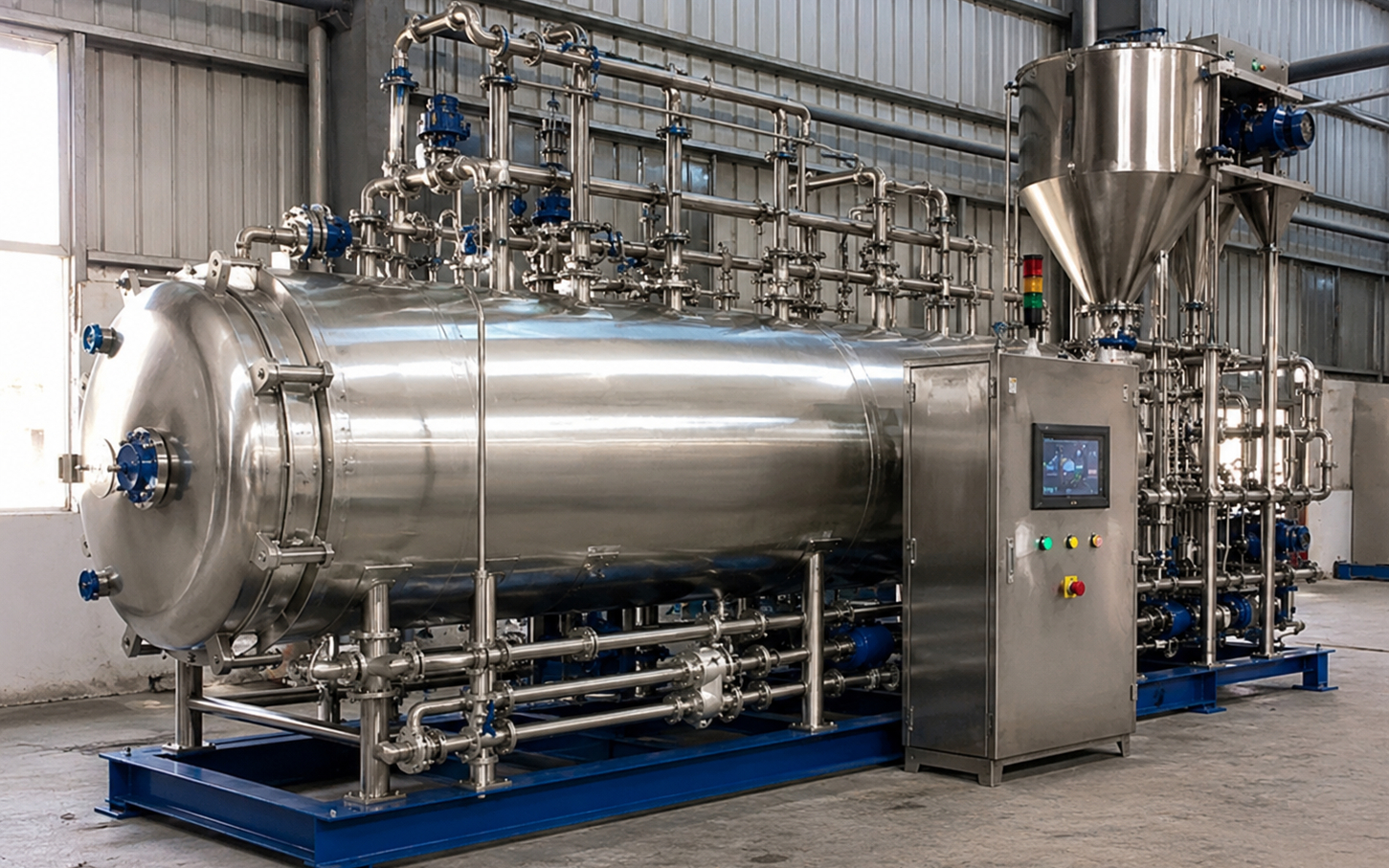
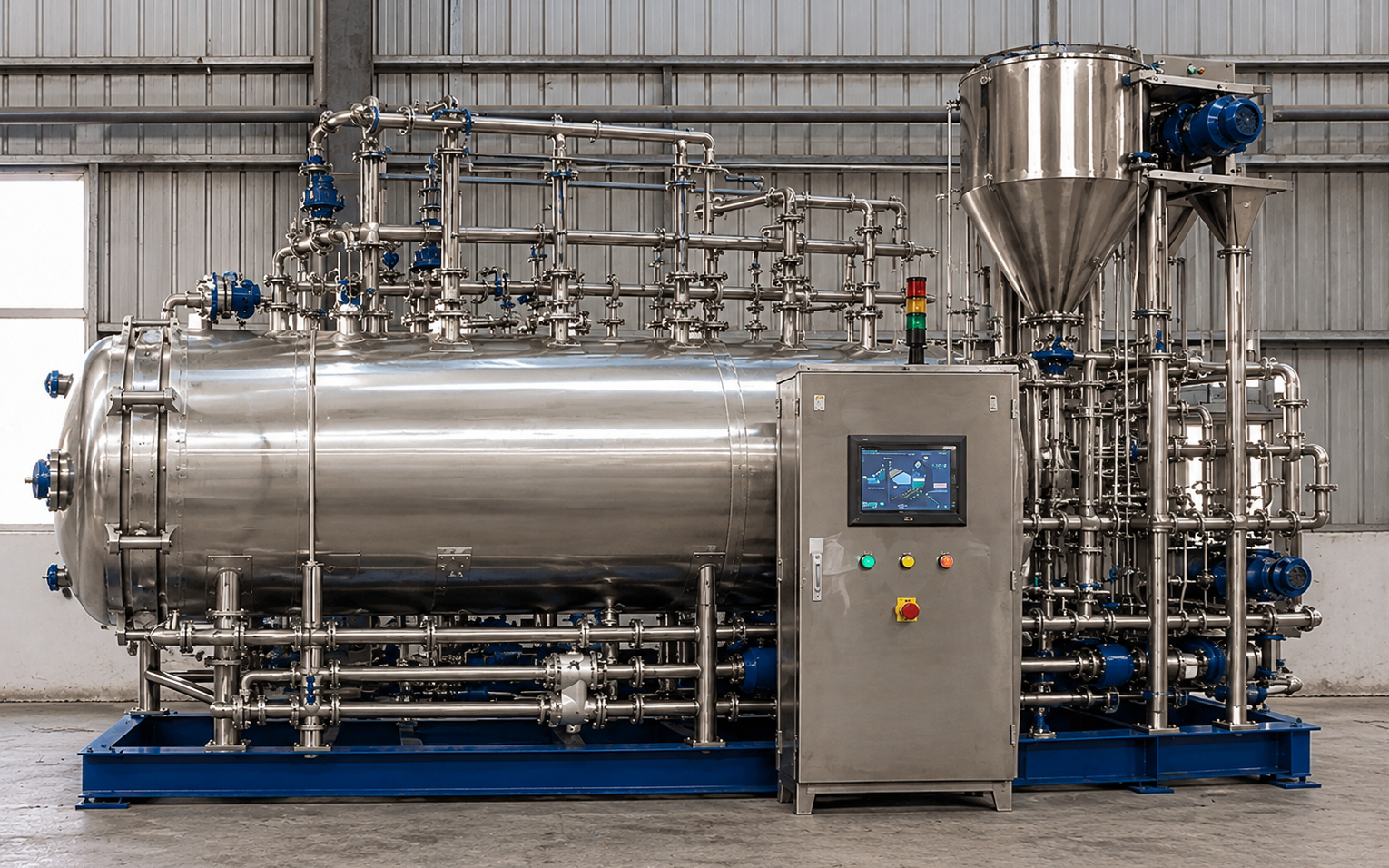
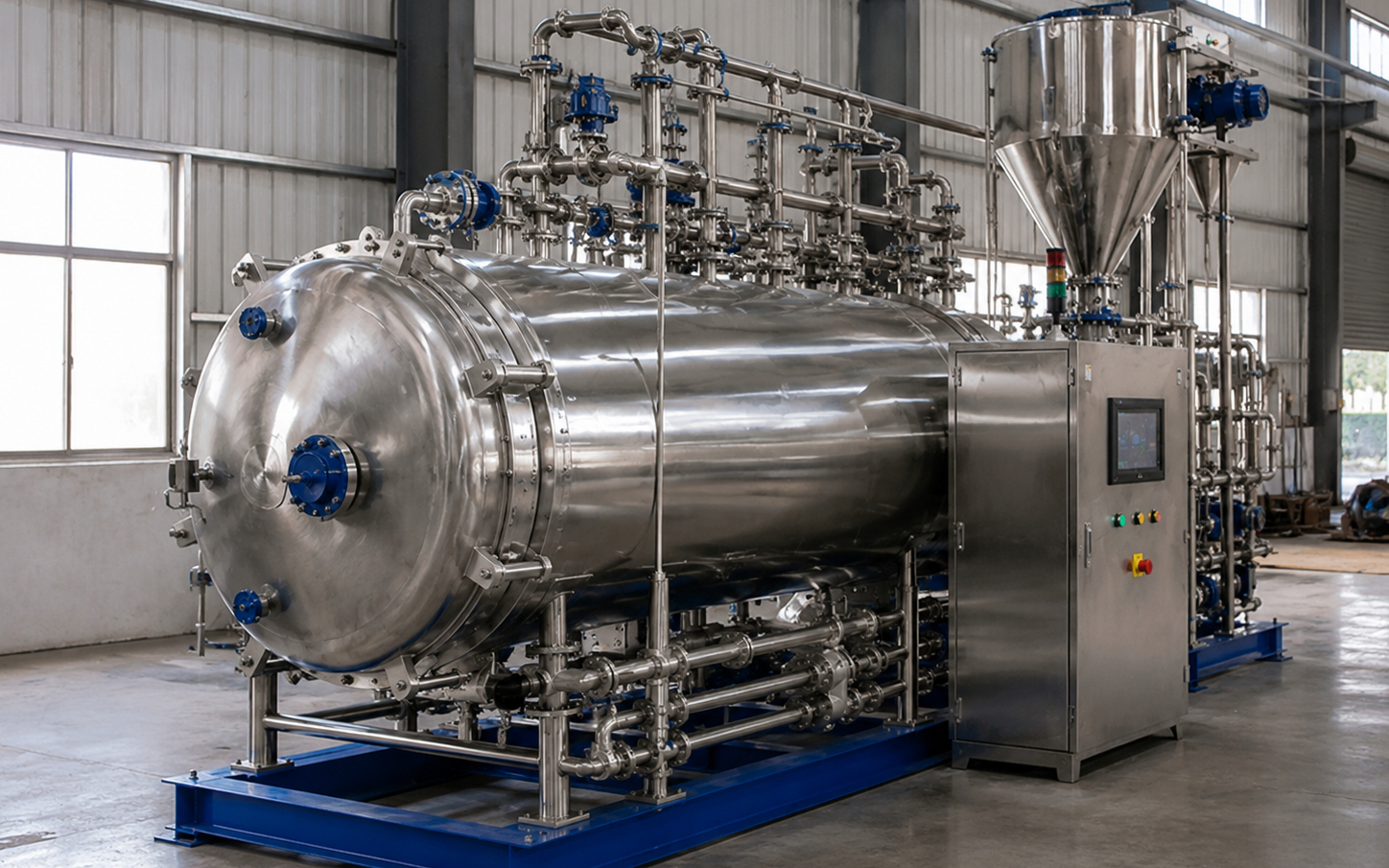
Kerone’s Continuous High Pressure Steam Sterilization System is engineered to deliver reliable, uninterrupted sterilization of bulk materials, containers, and waste streams using saturated steam under controlled pressure. Unlike conventional batch autoclaves that process one load at a time, this system is built around a continuous feed and discharge mechanism, allowing material to move through a sealed pressure chamber in a steady flow while steam at elevated temperature and pressure destroys bacteria, viruses, spores and other microorganisms. The system finds its core strength in industries where large volumes of material need to be sterilized consistently, without the downtime associated with repeated batch loading and unloading. Every unit is designed around the specific throughput, material characteristics and sterility assurance level required by the client, ensuring the sterilization cycle is neither under processed nor unnecessarily prolonged.
Why Choose Kerone Continuous High Pressure Steam Sterilization System
Kerone brings decades of process engineering experience to the design of its sterilization systems, and every plant is built after a detailed study of the client’s material, capacity requirement and site conditions rather than offered as a fixed, generic unit. The pressure vessels are fabricated using appropriate grades of stainless steel with welding and thickness calculations that meet recognized pressure vessel codes, and the steam distribution, safety interlocks and control philosophy are all worked out to suit the actual duty cycle of the plant. Clients choose Kerone because the technical specification sheet, general arrangement drawing and process logic are finalized well before manufacturing begins, which removes ambiguity from the purchase order and gives the client full clarity on what is being built, how it performs and how it will be installed at their facility. Backed by in house fabrication capability, a dedicated engineering team and after sales service across regions, our sterilization systems are built to run for years with predictable maintenance and consistent output quality.
Types and Features of Continuous High Pressure Steam Sterilization System
Continuous high pressure steam sterilization systems are generally offered in a few configurations depending on the nature of material being processed, including horizontal chain conveyor types for packaged goods, rotary drum types for loose or granular waste, and tunnel type systems where trolleys or trays move through a series of pressure zones in sequence. Some systems use a single continuous pressure zone while others use a pre vacuum pulsing arrangement to remove trapped air pockets before steam is admitted, which is particularly important for porous loads or irregularly shaped items where air entrapment can prevent steam from reaching every surface. Depending on the application, the vessel may be single walled or jacketed, may include jet condensers or shell and tube condensers for condensate handling, and may be built with single door or double door pass through arrangements so that unsterilized and sterilized material never cross paths. Regardless of configuration, the underlying feature across all types remains the same: a validated combination of steam pressure, temperature and residence time that achieves the required sterility outcome on a continuous, repeatable basis.
Key Features
Continuous feed and discharge design that eliminates load and unload downtime seen in batch autoclaves
Pressure vessel fabricated in SS304 or SS316 grade stainless steel as per material compatibility and hygiene requirement
PLC based control panel with recipe storage for pressure, temperature and residence time parameters
Pre vacuum pulsing option to remove air pockets and ensure uniform steam penetration in porous loads
Safety interlocks on doors, pressure relief valves and rupture discs to prevent operation outside safe limits
Jacketed vessel option for faster heat up and reduced steam consumption during the sterilization cycle
Condensate recovery system to reduce fresh water and steam demand and lower running cost
Dedicated ports for biological indicators and temperature probes to support cycle validation
Corrosion resistant gaskets, seals and door mechanisms suited for repeated high pressure, high temperature cycles
Insulated vessel and piping to minimize heat loss, reduce surface temperature and improve operator safety
Powered by AI, ML & IoT
Future-Ready Engineering Driven by AI & IoT
Our advanced AI, ML, and IoT technologies, this solution delivers smarter automation, real-time insights, and predictive intelligence to enhance efficiency and drive future-ready growth.
Real-Time Monitoring & Control
Continuous tracking of process parameters with instant adjustments.
Predictive Maintenance
Intelligent fault detection to prevent failures before they occur.
Adaptive Process Optimization
Dynamic tuning of operations for maximum output and efficiency.
Cloud Dashboards & Analytics
Unified access to real-time insights and performance trends.
Energy & Resource Savings
Smarter utilization of energy to cut costs and reduce waste.
Secure IoT Connectivity
Encrypted data flow with seamless integration across plant systems.
Applications of Continuous High Pressure Steam Sterilization System
Kerone’s Continuous High Pressure Steam Sterilization Systems are extensively used across industries where reliable microbial destruction of bulk material is a regulatory or operational necessity. Typical applications include:
Biomedical and hospital waste treatment prior to landfill disposal or further processing
Sterilization of pharmaceutical vials, ampoules and containers before or after filling
Retort sterilization of packaged food and beverage products for extended shelf life
Sterilization of laboratory glassware, instruments and reusable equipment
Sterilization of cosmetic and personal care product packaging
Treatment of textile, fabric and non-woven material requiring microbial reduction
Quarantine and phytosanitary treatment of agricultural and horticultural produce
Sterilization support for research institutions, testing laboratories and pilot facilities
A Continuous High Pressure Steam Sterilization System delivers the best results when its design matches the material, throughput, and compliance requirements of the application. Kerone custom engineers every system using detailed process analysis and technical design, ensuring reliable sterilization, safe operation, and long-term performance. Whether for biomedical waste, pharmaceuticals, or food processing, we provide dependable, efficient, and cost-effective sterilization solutions.
Seamless Export Connections Global & Local
Our Global Footprint in Industrial Excellence
Delivering world-class industrial and process solutions across countries with precision, innovation, and reliability.
Peru
Chile
Argentina
Mexico
Colombia
Brazil
USA
Canada
United Kingdom
France
Germany
Spain
Italy
Netherlands
Sweden
Switzerland
Poland
Portugal
Ireland
Czechia
Romania
Hungary
Austria
Greece
Kazakhstan
Uzbekistan
Turkmenistan
Algeria
Egypt
Nigeria
Kenya
South Africa
Saudi Arabia
UAE
Israel
Russia
India
China
Japan
South Korea
Thailand
Vietnam
Malaysia
Singapore
Indonesia
Philippines
Australia
New Zealand
Pan-India Presence. Local Expertise.
Raipur
Bilaspur
Panaji
Vasco da Gama
Gandhinagar
Ahmedabad
Surat
Chandigarh
Gurgaon
Shimla
Manali
Bengaluru
Mysore
Kochi
Pune
Mumbai
Thane
Navi Mumbai
Hyderabad
Chennai
Coimbatore
Kolkata
Lucknow
Jaipur
Udaipur
Jodhpur
Dehradun
Haridwar
Bhubaneswar
Product Gallery
Frequently Asked Questions (FAQ)
The choice depends on whether the load traps air. Simple, unwrapped, solid items can be sterilized using gravity displacement, where incoming steam naturally pushes air out of the chamber. Wrapped, porous, or bundled loads trap air inside, preventing steam from reaching all surfaces. In these cases, pre-vacuum pulsing removes trapped air before steam enters, ensuring uniform steam penetration and effective sterilization. Loads with internal air pockets should generally use a pre-vacuum design.
This starts with understanding the bioburden the material is likely to carry and the resistance of the toughest organism expected in it, expressed through an F0 or D value target. Denser and thicker loads need longer holding time because heat has to penetrate further to reach the coldest point inside the load. Before finalizing the cycle, a heat penetration study is run using thermocouples placed at the slowest heating point of an actual or simulated load, and the cycle parameters are set based on what that coldest point actually experiences, not just the chamber reading.
A single sensor near the steam inlet can show the correct temperature while another zone of the chamber is still lagging behind. To rule this out, multiple calibrated sensors are placed at different points along the chamber, typically near the inlet, mid-section and discharge end, and a temperature distribution study is carried out on an empty chamber before commissioning. Once that baseline is confirmed, a second study with actual load verifies that every zone still reaches the required temperature under real operating conditions.
This is managed through a double door, pass through arrangement, where the loading door on the unsterilized side and the discharge door on the sterilized side are mechanically or electrically interlocked so that both can never be open at the same time. The chamber physically sits within a wall separating the dirty and clean zones, so material only ever moves in one direction and operators on either side never need to cross into the opposite zone.
It is generally advisable to segregate loads by material type wherever practical. When different materials are mixed in one cycle, the parameters have to be set for the most resistant or most difficult item in that mix, which risks either under processing dense items or overexposing heat sensitive ones. For facilities that regularly handle mixed waste or product streams, it is worth programming separate recipe sets in the control panel for each material category rather than relying on one compromise cycle for everything.
The system does not continue on assumption. A pressure or temperature deviation during the cycle triggers an alarm and either holds or aborts the cycle, since allowing it to proceed on incomplete conditions would risk releasing under sterilized material as if it were sterile. The deviation is logged for review, and the affected load has to be run through a fresh, complete cycle before it can be released, with no partial credit given for the interrupted run.
As steam contacts cooler surfaces and load material, some of it condenses continuously through the cycle. If this condensate is not drained away, it collects at low points, waterlogs the load and can trap air pockets that block steam from reaching the material properly, sometimes leaving the load damp at the end of the cycle. Steam traps, selected by type based on the expected condensate load, are positioned at chamber low points and along the steam lines to keep draining this condensate throughout the process.
Yes. Liquid loads such as culture media or aqueous waste need a slower, controlled depressurization at the end of the cycle, because a sudden pressure drop can cause the liquid to flash into steam and boil over inside the chamber. Solid loads without free liquid can usually be vented faster without this risk. If a facility expects to process both solid and liquid loads, this should be discussed early so the appropriate exhaust program is included.
Reaching the set temperature is necessary but not sufficient proof on its own. Biological indicators, typically spore strips of a resistant organism such as Geobacillus stearothermophilus, are placed at the hardest to sterilize location within the load and incubated after the cycle to confirm there is no growth. Chemical indicators that change colour once correct conditions are reached are often used alongside this as a quick visual check, but the biological indicator result is what actually demonstrates microbial kill.
A single door, where material is loaded and unloaded from the same side, can be acceptable in smaller laboratory or low risk settings where strict separation between contaminated and sterile zones is not mandated. In biomedical waste treatment and pharmaceutical facilities, however, double door pass through design is generally required, since regulations in most regions call for a physical barrier between the dirty and clean sides of the operation.
In a continuous system, dwell time is a function of chamber length or volume divided by the speed at which material moves through it, whether by conveyor, drum rotation or trolley movement. The required holding time is first established from bioburden and heat penetration studies, and the conveyor or feed speed is then set so that even the slowest moving, coldest part of the material spends at least that minimum time at sterilization temperature. This speed is verified through an actual heat penetration trial before the general arrangement drawing is finalized.
Yes, considerably. Loosely packed, small or shredded material allows steam to penetrate easily and sterilizes faster, while large or densely packed items slow down heat penetration and reduce achievable throughput for the same chamber size. Throughput figures should always be based on the actual bulk density and packing pattern of the client's material, so sharing real waste or product characterization data during the specification stage leads to a far more accurate design than working off theoretical chamber volume alone.
Yes. If a facility already segregates its waste or product streams, for example separating sharps from plastics, or dense items from loose ones, the cycle for each category can be optimized individually rather than designed around the worst-case mix. This is worth discussing during the specification stage, since existing segregation practice directly affects how tightly the cycle parameters can be tuned for each stream.
Confirmation relies on a combination of factors: the cycle completing without any deviation alarm, biological and chemical indicator results confirming the parameters were met, and in many biomedical waste applications, a physical check that treated waste has been rendered unrecognizable, often through integrated shredding, so it cannot be mistaken for untreated material or reused. Together these give a verifiable basis for releasing the material onward.
The most useful starting information includes the type of material or waste to be sterilized, its typical bulk density and packing form, required throughput per hour or per shift, any regulatory sterility assurance level that applies, available steam source and utility conditions at site, and space constraints at the installation location. Having this on hand allows the process design, chamber sizing and cycle parameters to be worked out accurately in the specification sheet from the outset, rather than being revised repeatedly later.
Kerone’s custom-designed heating and processing solutions are built to meet the demands of your growing operations. Whether you’re upgrading equipment, expanding production, or need a tailor-made solution


 Peru
Peru Chile
Chile Argentina
 Mexico
 Colombia
 Brazil
 USA
USA Canada
 United Kingdom
 France
 Germany
 Spain
Spain Italy
Italy Netherlands
 Sweden
 Switzerland
 Poland
 Portugal
 Ireland
 Czechia
 Romania
 Hungary
 Austria
 Greece
 Kazakhstan
 Uzbekistan
 Turkmenistan
 Algeria
 Egypt
Egypt Nigeria
 Kenya
Kenya South Africa
 Saudi Arabia
 UAE
UAE Israel
 Russia
 India
India China
China Japan
Japan South Korea
 Thailand
 Vietnam
 Malaysia
 Singapore
 Indonesia
 Philippines
 Australia
 New Zealand