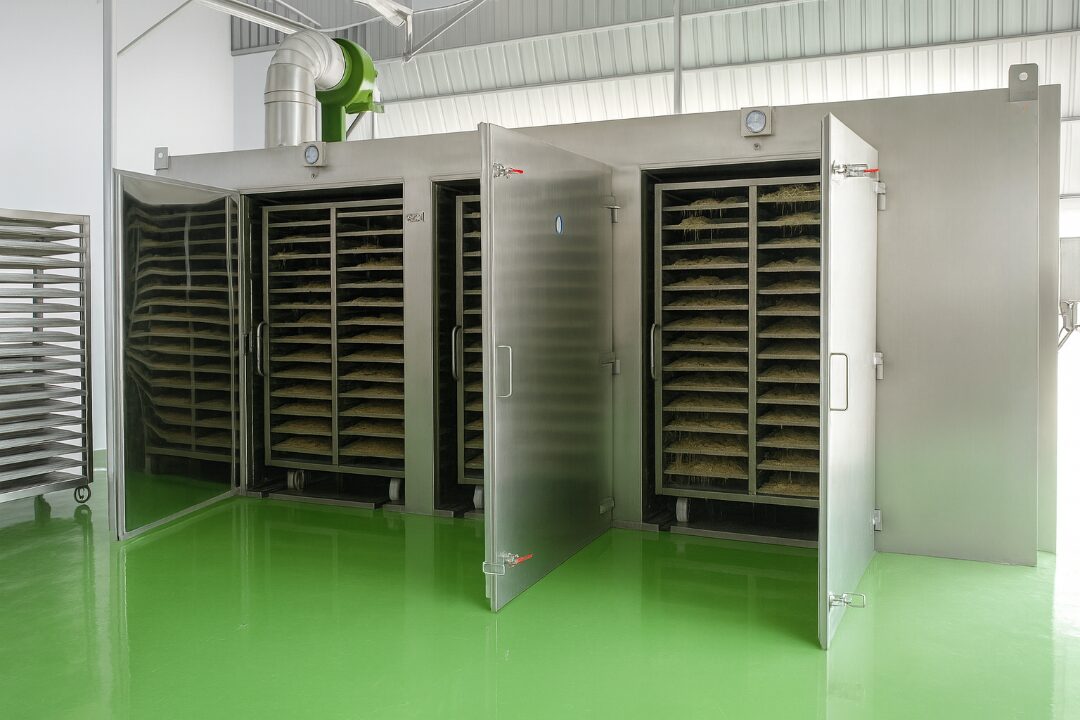
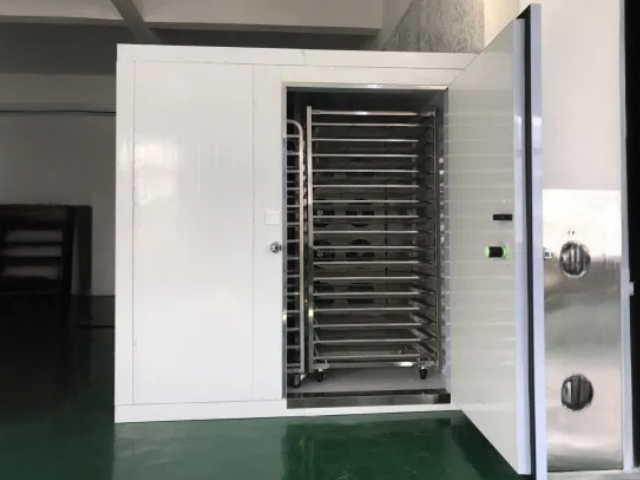
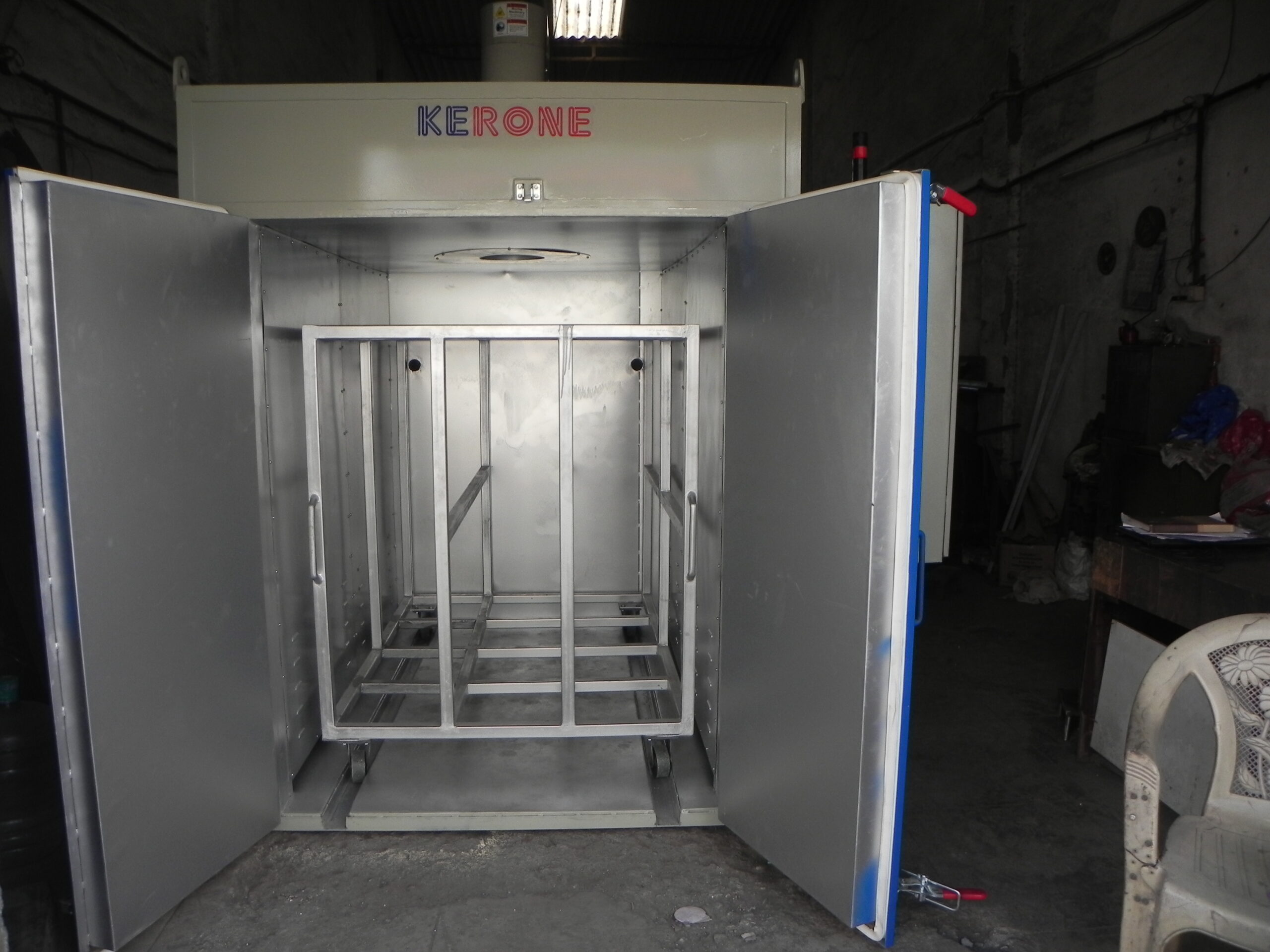
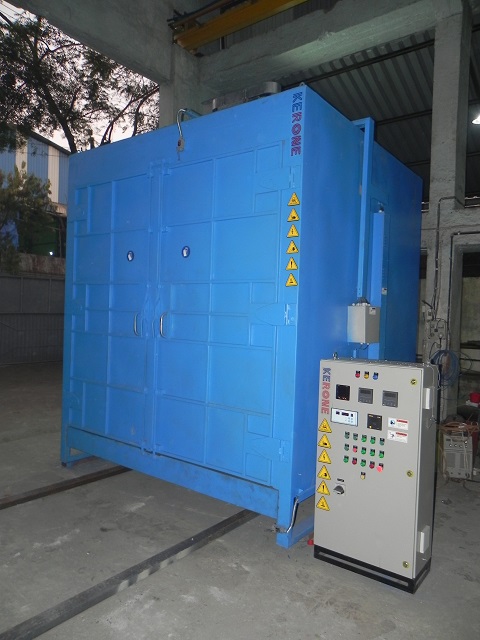
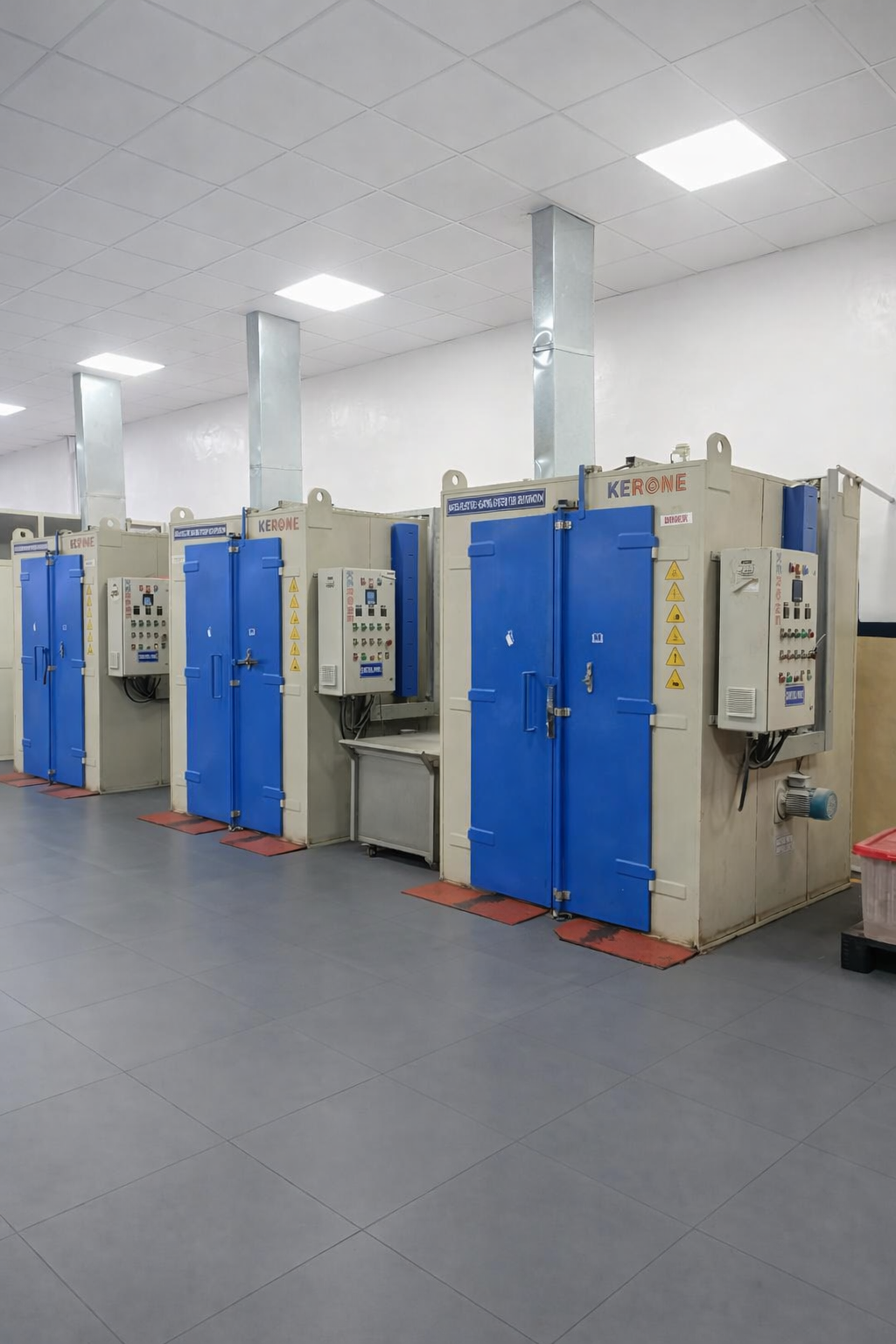
The Trolley Type Heat Pump Dryer is a batch drying system in which product-laden trolleys — wheeled rack frames fitted with multiple tray levels — are loaded externally and rolled directly into the drying chamber on floor-level rails, eliminating the time-consuming manual loading of trays into fixed chamber racks and significantly reducing the total handling time per batch. Kerone Engineering Solutions designs trolley-type heat pump dryers for industries where product handling efficiency, batch cycle time, and the ability to prepare the next trolley load while the current batch is drying are important operational priorities. The heat pump conditioning system maintains the drying chamber at the specified temperature and humidity throughout the cycle, recovering and recycling latent heat from evaporated moisture in the same closed-loop configuration as all Kerone heat pump dryer systems. The trolley frame design ensures that all product trays are positioned within the chamber’s engineered air circulation pattern, delivering the same drying uniformity as a fixed rack system while providing the loading convenience of a wheeled format.
Why Choose Kerone Trolley Type Heat Pump Dryer
A critical but often overlooked aspect of trolley dryer design is the sealing of the gap between the wheeled trolley frame and the chamber wall air distribution plenum — a gap that, if not properly addressed, creates bypass air flow around the product stack rather than through it, resulting in dramatically reduced drying rates for the outer tray positions and poor within-batch uniformity. Kerone’s trolley dryer design incorporates a positive-contact sealing system between the trolley frame and the chamber’s internal plenum walls, ensuring that essentially all of the circulating air is forced through the product stack on every recirculation pass. This seemingly technical detail has a profound effect on drying uniformity and cycle time, and is one of the distinguishing features of Kerone’s trolley dryers compared with basic alternatives that omit this engineering detail.
Types and Features of Trolley Type Heat Pump Dryer
Kerone supplies Trolley Type Heat Pump Dryers as single-trolley, double-trolley, and multi-trolley chamber configurations. Single-trolley designs are suited for laboratories and small production facilities; double-trolley designs allow one trolley to be loading or unloading outside while the other remains in the drying chamber, maximising equipment utilisation; multi-trolley designs are used in high-volume bakery, pharmaceutical, and food manufacturing operations where throughput requirements demand multiple batch loads to be processed simultaneously. Trolley frames are fabricated in SS-304 with adjustable tray pitch, and rail systems are designed for smooth, straight-line trolley entry without jamming or misalignment.
Key Features
Roll-in trolley loading format dramatically reduces chamber loading and unloading time compared to fixed-rack tray dryers, improving batch throughput
Positive-contact plenum sealing system between trolley frame and chamber walls forces all recirculating air through the product stack, not around it
Multiple trolley capacity options: single, double, and multi-trolley chambers for scalable production batch sizes
Standardised trolley frame dimensions compatible with upstream baking, moulding, or coating equipment of the same trolley format for direct transfer
Adjustable tray pitch on trolley frame to accommodate product layer depths from 20 mm to 200 mm on standard trays
Stainless steel chamber interior with smooth floor, floor-flush entry rails, and hygienic drain points for washdown cleaning
Programmable drying cycles with automatic record of trolley ID, cycle start, batch data, and endpoint parameters via barcode or RFID trolley identification
Chamber heating by heat pump primary system with optional electric or steam boost heater for rapid warm-up during cold start or winter operation
Powered by AI, ML & IoT
Future-Ready Engineering Driven by AI & IoT
Our advanced AI, ML, and IoT technologies, this solution delivers smarter automation, real-time insights, and predictive intelligence to enhance efficiency and drive future-ready growth.
Real-Time Monitoring & Control
Continuous tracking of process parameters with instant adjustments.
Predictive Maintenance
Intelligent fault detection to prevent failures before they occur.
Adaptive Process Optimization
Dynamic tuning of operations for maximum output and efficiency.
Cloud Dashboards & Analytics
Unified access to real-time insights and performance trends.
Energy & Resource Savings
Smarter utilization of energy to cut costs and reduce waste.
Secure IoT Connectivity
Encrypted data flow with seamless integration across plant systems.
Applications of Trolley Type Heat Pump Dryer
Kerone’s Trolley Type Heat Pump Dryers are extensively used in baking, food processing, pharmaceutical, and ceramics industries where batch handling efficiency is critical.
Typical applications include:
Bakery and biscuit manufacturing where standard trolleys interface directly with proving ovens, depositors, and packaging lines without product re-racking
Pharmaceutical manufacturing facilities where validated, trolley-based product transfer between upstream granulation and downstream drying operations is required
Ceramics and porcelain manufacturing for pre-kiln drying of moulded greenware on production trolleys to remove forming moisture before firing
Drying of painted, coated, or printed flat-panel products and sheet-form materials that are handled on production trolleys throughout the manufacturing process
Drying of fresh pasta, bread, and baked snack products in food manufacturing operations shared with conventional hot-air trolley dryers being replaced for energy reasons
Leather, footwear upper, and textile component drying where trolley-based product handling is the established industry practice
Kerone Engineering Solutions’ Trolley Type Heat Pump Dryer integrates the operational convenience of industry-standard trolley-based product handling with the thermal efficiency and process control of a closed-loop heat pump drying system. The result is a drying platform that reduces both the energy cost per batch and the labour cost per batch, while maintaining the product quality consistency that repeat customers and quality-audited supply chains demand. For manufacturers already using trolleys in their production workflow, Kerone’s trolley dryer offers a seamless upgrade path from conventional hot-air systems with minimal disruption to established handling practices.
Seamless Export Connections Global & Local
Our Global Footprint in Industrial Excellence
Delivering world-class industrial and process solutions across countries with precision, innovation, and reliability.
Peru
Chile
Argentina
Mexico
Colombia
Brazil
USA
Canada
United Kingdom
France
Germany
Spain
Italy
Netherlands
Sweden
Switzerland
Poland
Portugal
Ireland
Czechia
Romania
Hungary
Austria
Greece
Kazakhstan
Uzbekistan
Turkmenistan
Algeria
Egypt
Nigeria
Kenya
South Africa
Saudi Arabia
UAE
Israel
Russia
India
China
Japan
South Korea
Thailand
Vietnam
Malaysia
Singapore
Indonesia
Philippines
Australia
New Zealand
Pan-India Presence. Local Expertise.
Raipur
Bilaspur
Panaji
Vasco da Gama
Gandhinagar
Ahmedabad
Surat
Chandigarh
Gurgaon
Shimla
Manali
Bengaluru
Mysore
Kochi
Pune
Mumbai
Thane
Navi Mumbai
Hyderabad
Chennai
Coimbatore
Kolkata
Lucknow
Jaipur
Udaipur
Jodhpur
Dehradun
Haridwar
Bhubaneswar
Product Gallery
Frequently Asked Questions (FAQ)
Guide rails and positive-stop end stops ensure accurate trolley positioning within the chamber. Inflatable or spring-loaded side seals then contact the trolley frame perimeter, creating an airtight seal between the trolley and the chamber plenum walls.
Yes. Kerone's PLC recipe system includes a trolley fill level parameter that adjusts the fan speed and heat pump capacity proportionally when a partial trolley load is processed, maintaining correct drying performance without over-drying or wasting energy.
Compared to a gas-fired hot-air trolley dryer, Kerone's heat pump trolley dryer typically achieves energy cost savings of 35–55% per tonne of product dried, depending on gas price, electricity tariff, product type, and initial moisture content.
The smooth stainless steel chamber floor and walls, floor-level entry for cleaning equipment, and hinged side access panels allow full chamber wash-down. Trolleys themselves are cleaned outside the chamber in a separate wash area.
Yes. Kerone offers RFID or barcode trolley identification as an option that links each batch cycle to a specific trolley and product lot, with data export to ERP or MES systems via OPC-UA, Modbus TCP, or custom data formats.
For a chamber temperature setpoint of 60°C, Kerone's trolley dryer typically reaches the operating setpoint within 20–35 minutes from a cold start with the heat pump primary system. The optional auxiliary boost heater reduces this to 10–15 minutes for time-critical production starts.
Yes. Kerone supplies matched production trolleys as part of the complete system, fabricated in SS-304 with perforated or solid shelves to the client's product specification, and tested for alignment and sealing compatibility before dispatch.
Kerone designs flush-mounted floor rails with chamfered edges and sealed joints to the chamber floor, eliminating pockets where product or cleaning water can accumulate. The rail surface is polished stainless steel to facilitate floor scrubbing and ensure trolley wheels roll smoothly even after wet cleaning.
The trolley dryer is not designed as a sterilisation autoclave, but Kerone can programme a validated terminal heat treatment phase at the end of the drying cycle. for example, 15 minutes at 85°C for certain food products with time-temperature logging suitable for food safety validation documentation.
Kerone sizes the evaporator coil and condensate drain system for the maximum moisture load scenario, all trolleys fully loaded with the highest-moisture product. A large-bore drain line and condensate collection tank are provided, with a high-level sensor alarm to alert operators if drainage is impeded.
We uses a shaped internal plenum with variable outlet area along the height of the trolley position, providing higher air velocity compensation at the lower tray levels where the path resistance is greatest. This engineering detail is validated during commissioning with a tray-by-tray air velocity mapping procedure.
Kerone recommends annual calibration of all temperature sensors and humidity transmitters against NABL-certified reference standards for production equipment, and six-monthly calibration for GMP-regulated pharmaceutical applications. Calibration records are maintained in the equipment logbook and linked to the batch record system.
This depends on cycle time for your product and how many trolleys are available for rotation, but with a double or multi trolley setup, one chamber can typically process several batches across a working shift without long idle gaps.
The chamber and rail system are built around a specific trolley footprint, so mixing significantly different trolley sizes is not recommended. Kerone standardises trolley dimensions across a client's production line to avoid this issue.
Yes, most control systems allow a cycle to be paused and resumed, though for heat sensitive products it is best to avoid unnecessary pauses since extended idle time at partial dryness can sometimes affect final quality.
Kerone’s custom-designed heating and processing solutions are built to meet the demands of your growing operations. Whether you’re upgrading equipment, expanding production, or need a tailor-made solution
 Peru
Peru Chile
Chile Argentina
 Mexico
 Colombia
 Brazil
 USA
USA Canada
 United Kingdom
 France
 Germany
 Spain
Spain Italy
Italy Netherlands
 Sweden
 Switzerland
 Poland
 Portugal
 Ireland
 Czechia
 Romania
 Hungary
 Austria
 Greece
 Kazakhstan
 Uzbekistan
 Turkmenistan
 Algeria
 Egypt
Egypt Nigeria
 Kenya
Kenya South Africa
 Saudi Arabia
 UAE
UAE Israel
 Russia
 India
India China
China Japan
Japan South Korea
 Thailand
 Vietnam
 Malaysia
 Singapore
 Indonesia
 Philippines
 Australia
 New Zealand