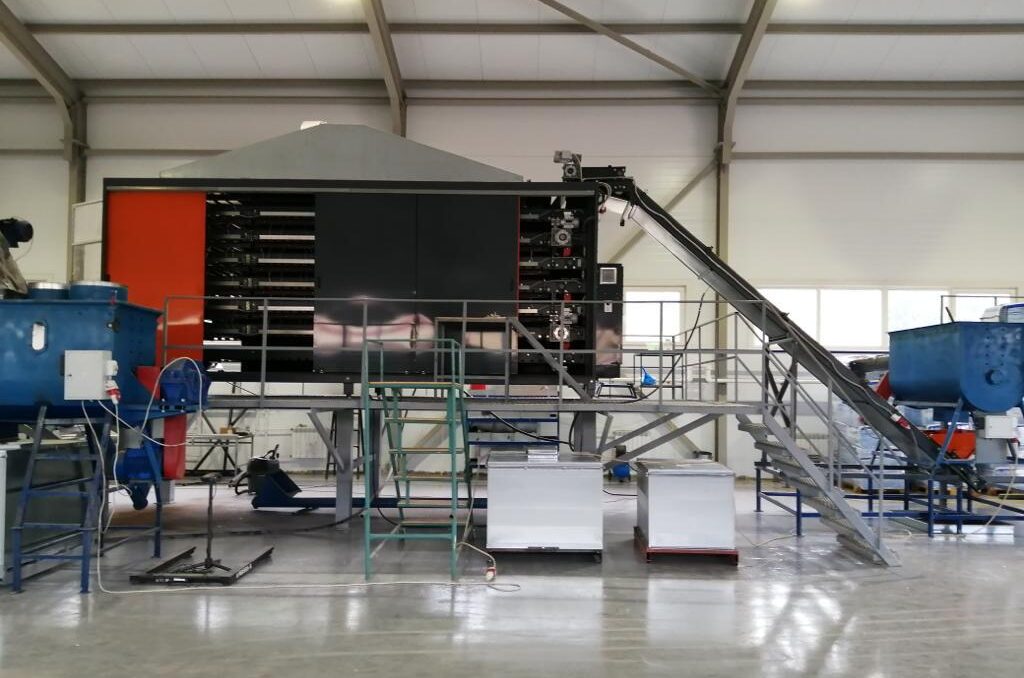
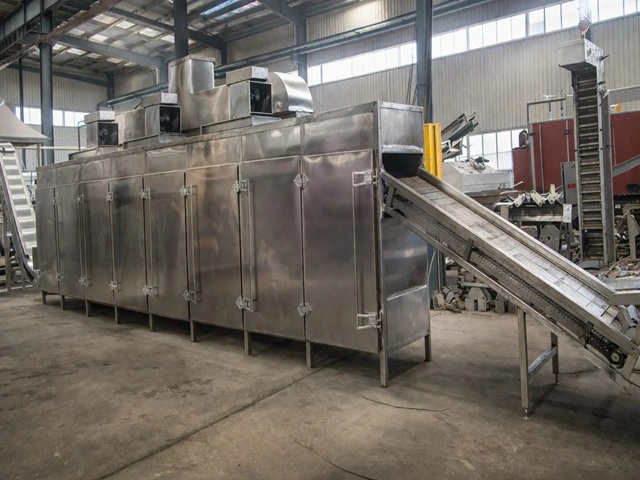
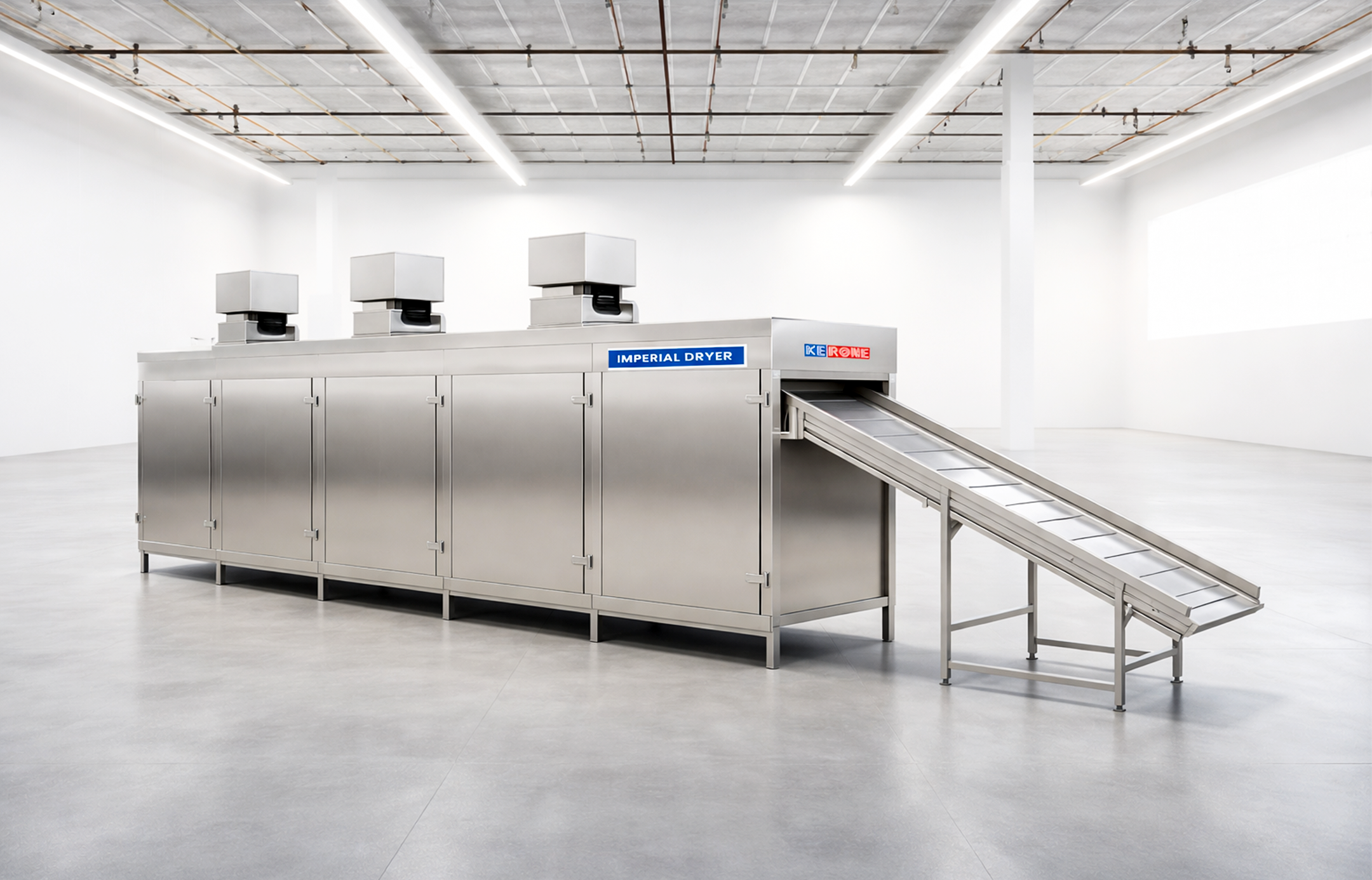
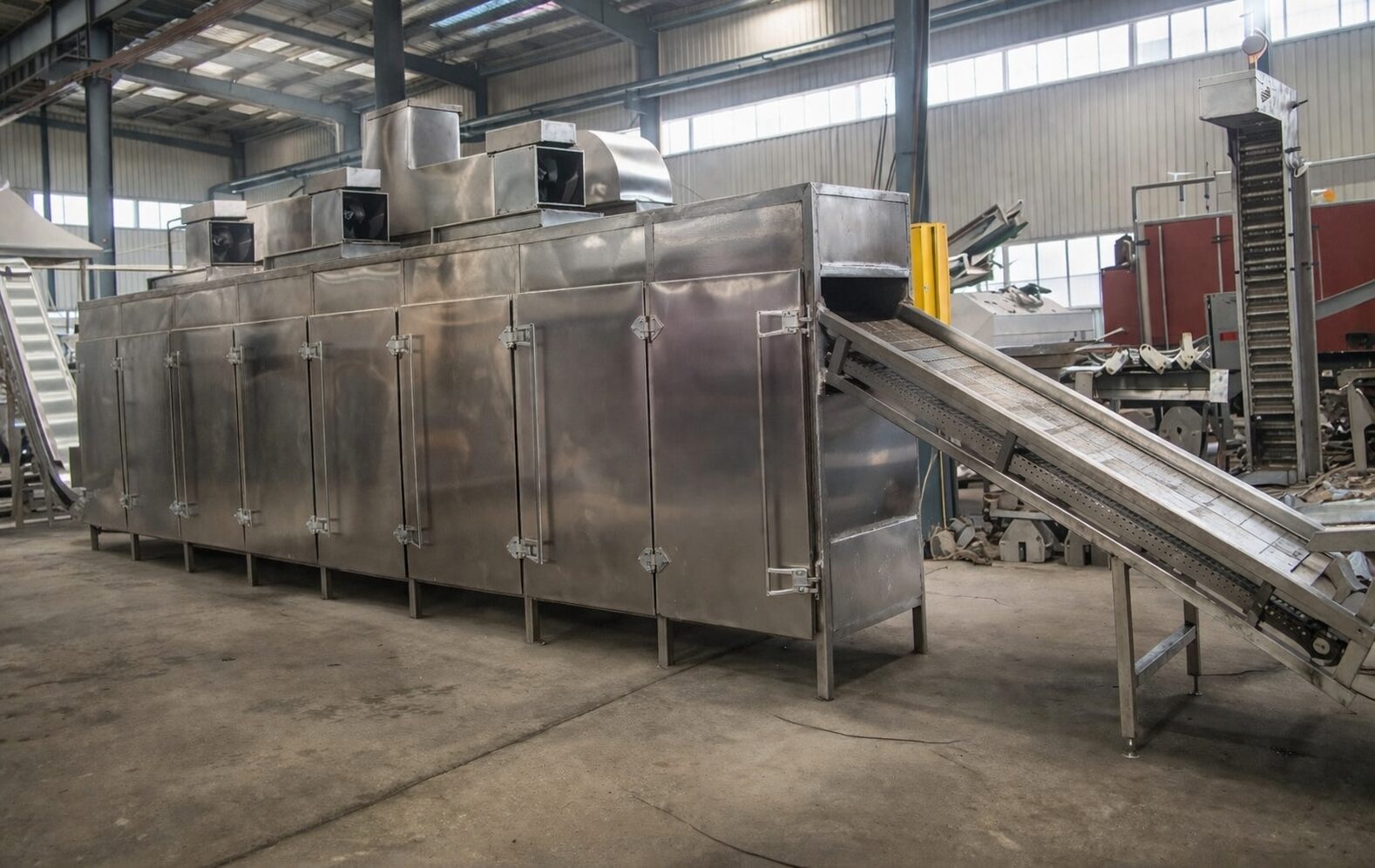
Kerone’s continuous belt dryer are engineered with decades of expertise to provide reliable, efficient, and precise drying solutions for food processing, chemical, and pharmaceutical industries. These dryers leverage advanced heat transfer and airflow technologies to ensure consistent drying, improved product quality, and energy savings. Each design is tailored to industrial requirements, offering flexibility, automation, and superior performance.
A Continuous Belt Dryer is an industrial drying system in which the material to be dried is conveyed through a drying chamber on one or more permeable, endless belts, while drying air is circulated through the product bed either in the same direction as product flow (co-current), opposite to it (counter-current), or perpendicularly through the belt (through-circulation). This configuration provides gentle handling of fragile products, controllable residence time, and excellent adaptability to a wide range of product types and forms, including pastes, extrudates, granules, sliced food products, filter cakes, and fibrous materials. Continuous belt dryers are widely used in food processing, pharmaceutical manufacturing, chemical production, biomass drying, and textile finishing.
Why Choose Kerone Continuous Belt Dryer
Kerone’s continuous belt dryer stand out for their process reliability, uniform drying performance, and adaptability to diverse materials. Our dryers are designed after comprehensive process analysis, ensuring optimal balance between drying rate, product quality, and energy consumption. With options for modular design and automatic control, these dryers provide seamless integration into modern production lines.
Belt materials are selected based on the product characteristics, with options including perforated stainless steel, polyester mesh, and PTFE-coated fiberglass for high-temperature or food applications. Kerone provides comprehensive scale-up services from pilot to production scale.
Types and Features of Continuous Belt Dryer
Kerone offers various configurations of continuous belt dryer, including continuous, semi-continuous, and batch models. The systems incorporate intelligent control interfaces, adjustable temperature zones, and multi-stage airflow management to accommodate diverse product characteristics.
Available in stainless steel and mild steel construction, these dryers are designed for hygiene, durability, and consistent operation under demanding industrial conditions.
Kerone manufactures Continuous Belt Dryers in single-pass and multi-pass configurations. Single-Pass Belt Dryers are the simplest design, transporting product on a single horizontal belt through a linear drying chamber; they are suitable for products that can form a stable, permeable bed on the belt without bridging or falling through. Multi-Pass Belt Dryers stack two or more belts in a cascading arrangement within a compact housing, with the product transferring between belts at each stage; they provide a longer residence time in a smaller floor space. Multi-Stage Belt Dryers connect two or more separate belt dryers in series, each optimized for a specific stage of the drying curve. Impingement Belt Dryers direct high-velocity hot air jets directly onto the product surface through nozzle arrays above and below the belt, providing very high heat transfer rates for surface moisture removal in paper, nonwoven fabric, and coated substrate applications. Cooling zones can be incorporated at the dryer exit to reduce product temperature before discharge.
Key Features
Uniform drying with adjustable airflow and temperature control.
Energy-efficient operation reducing overall process costs.
Modular design adaptable for diverse industrial needs.
Continuous or batch processing options for production flexibility.
Compact design for easy installation and maintenance.
High-quality material construction ensuring longevity.
Custom designs for temperature-sensitive or high-moisture materials.
Powered by AI, ML & IoT
Future-Ready Engineering Driven by AI & IoT
Our advanced AI, ML, and IoT technologies, this solution delivers smarter automation, real-time insights, and predictive intelligence to enhance efficiency and drive future-ready growth.
Real-Time Monitoring & Control
Continuous tracking of process parameters with instant adjustments.
Predictive Maintenance
Intelligent fault detection to prevent failures before they occur.
Adaptive Process Optimization
Dynamic tuning of operations for maximum output and efficiency.
Cloud Dashboards & Analytics
Unified access to real-time insights and performance trends.
Energy & Resource Savings
Smarter utilization of energy to cut costs and reduce waste.
Secure IoT Connectivity
Encrypted data flow with seamless integration across plant systems.
Applications of Heat Pump Dryers
Kerone’s continuous belt dryer are widely used across food processing, chemical, and pharmaceutical industries, offering precision drying and enhanced process control. Common applications include:
Food Industry
Drying fruits, vegetables, powders, and herbs.
Chemical Industry
Processing pigments, catalysts, and polymers.
Pharmaceutical
Drying granules, herbal extracts, and formulations.
Industrial
Surface treatment, coatings, and composite material drying.
Kerone’s continuous belt dryer represent innovation, efficiency, and reliability. Built for industries that demand precision and consistency, these dryers help reduce production costs while maintaining product quality. With customizable features, energy optimization, and robust design, Kerone continues to set new benchmarks in industrial drying technology.
Continuous Belt Dryers occupy a central position in industrial drying technology, offering the flexibility, gentleness, and production continuity that makes them irreplaceable for many applications in food, pharmaceutical, and chemical processing. The ability to precisely control residence time, temperature profile, and airflow conditions along the length of the dryer provides unmatched process flexibility for adapting to different products and moisture levels. Kerone’s continuous belt dryer solutions, underpinned by rigorous airflow engineering and broad application experience, deliver reliable, high-quality drying performance across a diverse range of manufacturing environments.
Seamless Export Connections Global & Local
Our Global Footprint in Industrial Excellence
Delivering world-class industrial and process solutions across countries with precision, innovation, and reliability.
Peru
Chile
Argentina
Mexico
Colombia
Brazil
USA
Canada
United Kingdom
France
Germany
Spain
Italy
Netherlands
Sweden
Switzerland
Poland
Portugal
Ireland
Czechia
Romania
Hungary
Austria
Greece
Kazakhstan
Uzbekistan
Turkmenistan
Algeria
Egypt
Nigeria
Kenya
South Africa
Saudi Arabia
UAE
Israel
Russia
India
China
Japan
South Korea
Thailand
Vietnam
Malaysia
Singapore
Indonesia
Philippines
Australia
New Zealand
Pan-India Presence. Local Expertise.
Raipur
Bilaspur
Panaji
Vasco da Gama
Gandhinagar
Ahmedabad
Surat
Chandigarh
Gurgaon
Shimla
Manali
Bengaluru
Mysore
Kochi
Pune
Mumbai
Thane
Navi Mumbai
Hyderabad
Chennai
Coimbatore
Kolkata
Lucknow
Jaipur
Udaipur
Jodhpur
Dehradun
Haridwar
Bhubaneswar
Product Gallery
Frequently Asked Questions (FAQ)
Through-circulation airflow, where air passes directly through the product bed rather than across its surface, gives the fastest and most uniform drying and is the preferred configuration whenever the product can form a stable, air-permeable bed on the belt. Counter-current airflow, where the driest air meets the driest product near the discharge end, is well suited to heat-sensitive materials needing a gentle finishing stage. Co-current configurations apply the hottest air to the wettest incoming product, which speeds initial moisture removal but risks case hardening on delicate surfaces. The choice should follow the product's specific drying curve and heat sensitivity rather than defaulting to whichever configuration the supplier offers as standard, since the wrong airflow pattern can quietly limit achievable throughput or product quality regardless of how well-built the rest of the dryer is.
A continuous belt dryer is designed to dry materials efficiently through controlled heat transfer and airflow mechanisms.
It operates by circulating heat or energy uniformly over materials, ensuring quick and consistent drying.
It provides uniform drying, high efficiency, and reduced energy consumption.
Industries such as food processing, chemical, and pharmaceutical industries rely on these dryers for process improvement.
Yes, Kerone offers tailor-made designs for specific materials and processes.
The system is designed to minimize energy loss while maximizing heat utilization.
Yes, advanced control panels and PLC systems allow full process automation.
Kerone’s dryers are constructed from high-quality materials for long operational life and consistent performance.
Continuous drying systems are best suited for large-volume, consistent-feed-rate production environments where throughput and energy efficiency are priorities. They offer lower labour costs, uniform product quality, and easier automation. Batch drying systems are preferred for small-volume, multi-product operations, R&D, or when strict cleaning validation between campaigns is required (as in pharmaceutical manufacturing). Kerone provides both continuous systems (rotary, tunnel, conveyor, fluid bed) and batch systems (tray, vacuum, shelf) to match specific production requirements.
Materials that cannot form a stable, permeable bed, because they are too fine and fall through the belt mesh, too wet and form a sealed sludge layer that blocks airflow, or prone to bridging into clumps, generally perform poorly on a standard single-pass belt. These products often need pre-treatment such as extrusion or granulation to create a more uniform particle size before belt drying, or may be better suited to a different dryer type such as fluidized bed or paddle drying entirely. Buyers should request a process trial with their actual material before committing to a belt dryer purchase if the product has any of these characteristics, since visual inspection of the wet material alone often does not reveal bed permeability problems.
Belt material is not a minor specification detail, perforated stainless steel offers the best durability and cleanability but adds rigidity that can be harsh on fragile products, polyester mesh provides a gentler, more flexible bed surface suited to delicate items but has a shorter service life and lower temperature tolerance, and PTFE-coated fiberglass handles very high temperatures and sticky products but at a higher replacement cost. Selecting the wrong belt material for the product's stickiness or fragility profile is a common cause of both inconsistent drying quality and unexpectedly short belt life, making this one specification worth discussing in detail with the equipment supplier rather than accepting a default.
Uneven loading depth across the belt width is the most frequent cause, since even a well-designed airflow system cannot fully compensate for product that is piled higher on one side than the other. This often stems from a poorly maintained or improperly adjusted feed distributor rather than a fundamental dryer design flaw. The second common cause is airflow distribution drift over time as filters clog or duct dampers shift from vibration, which gradually narrows the effective drying zone without any single dramatic failure point. Scheduled inspection of both the feed distributor and airflow balance, rather than waiting for visible quality complaints, catches these issues while they are still minor adjustments.
Connecting two or more belt dryers in series, each tuned to a specific portion of the drying curve, allows much more precise control than trying to achieve the same result on one continuous belt with zone heaters alone. A first-stage dryer optimized for aggressive constant-rate drying can run hotter and faster, while a second-stage unit dedicated to the gentler falling-rate finishing phase protects color, texture, or bioactive content without slowing down the entire line to accommodate the slowest phase. This staged approach typically costs more in capital and footprint than a single dryer, so it is most often chosen for high-value products where the quality improvement justifies the added investment.
Continuous belt drying achieves its cost advantage through consistent, uninterrupted operation, so its economics improve the closer a facility runs to steady, predictable feed rates around the clock. Operations with frequent product changeovers, smaller production runs, or strict batch-to-batch segregation requirements, common in pharmaceutical and some specialty food manufacturing often find that the cleaning validation and flexibility of batch drying outweigh the throughput efficiency of continuous operation, even at moderate volume. There is no fixed volume threshold that applies universally; the right answer depends on changeover frequency and validation requirements as much as raw throughput.
Kerone’s custom-designed heating and processing solutions are built to meet the demands of your growing operations. Whether you’re upgrading equipment, expanding production, or need a tailor-made solution
 Peru
Peru Chile
Chile Argentina
 Mexico
 Colombia
 Brazil
 USA
USA Canada
 United Kingdom
 France
 Germany
 Spain
Spain Italy
Italy Netherlands
 Sweden
 Switzerland
 Poland
 Portugal
 Ireland
 Czechia
 Romania
 Hungary
 Austria
 Greece
 Kazakhstan
 Uzbekistan
 Turkmenistan
 Algeria
 Egypt
Egypt Nigeria
 Kenya
Kenya South Africa
 Saudi Arabia
 UAE
UAE Israel
 Russia
 India
India China
China Japan
Japan South Korea
 Thailand
 Vietnam
 Malaysia
 Singapore
 Indonesia
 Philippines
 Australia
 New Zealand