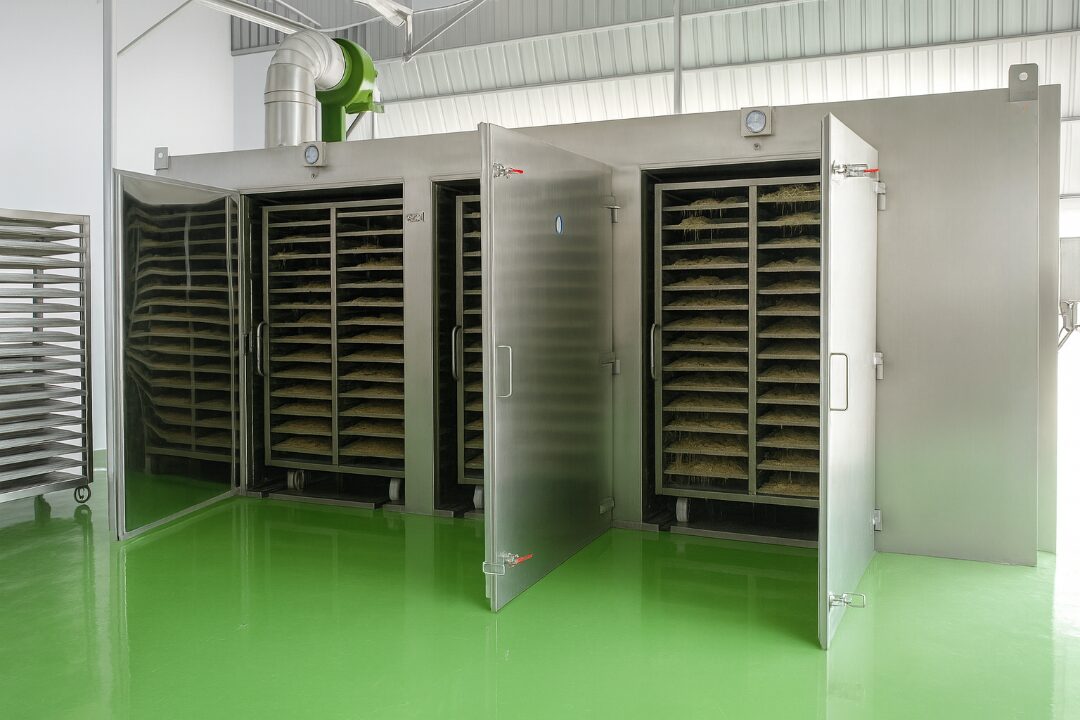
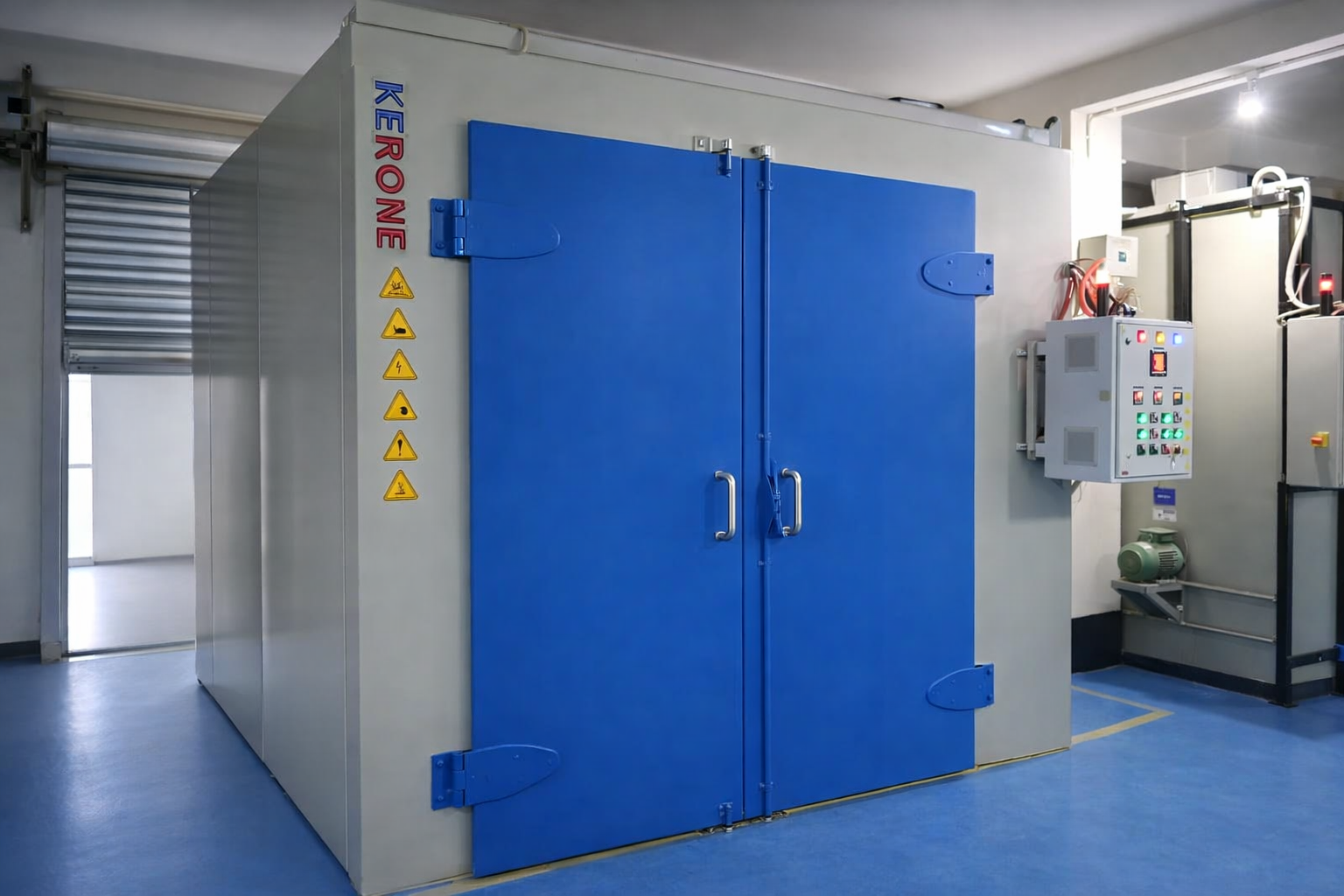
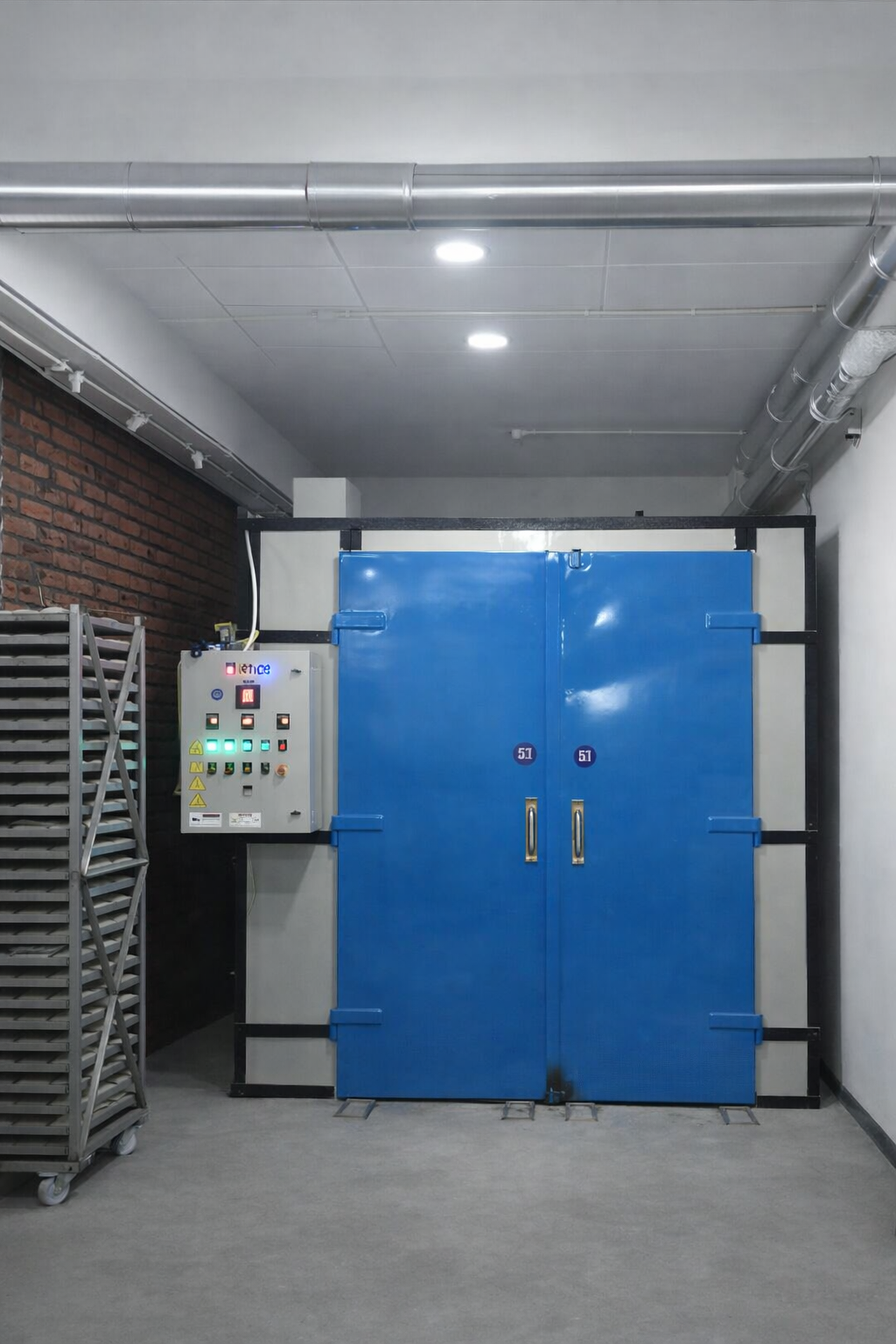
The Heat Pump Tray Dryer is a versatile closed-chamber batch drying system in which the product is loaded on shallow perforated or solid trays that are arranged on racks within the drying chamber, and conditioned air, temperature and humidity managed by a heat pump dehumidification circuit is circulated over and through the product layers to progressively reduce moisture content. Kerone Engineering Solutions engineers the tray dryer configuration specifically for products that cannot be subjected to mechanical handling, loose-particle transport, or any contact with moving surfaces during the drying process making it the standard choice for fragile lumps, wet cakes, slab-form materials, coated products, and any application where maintaining the physical form of the product throughout drying is a commercial necessity. The heat pump circuit in Kerone’s tray dryer operates in a closed recirculation mode, continuously dehumidifying and reheating the chamber air, which eliminates the thermal losses associated with the exhaust air discharge of conventional hot-air tray dryers and reduces energy consumption by 40% to 60% compared with those systems.
Why Choose Kerone Heat Pump Tray Dryer
Kerone’s application engineers work closely with clients to determine the optimal tray design, loading density, air velocity, and drying programme for each specific product. For pharmaceutical filter cakes, for example, the tray perforation pattern and layer depth are specified to maximise air penetration while preventing cake cracking or channelling. For food slabs, the tray surface finish and stacking arrangement are chosen to promote even drying without product sticking. This level of product-specific engineering detail distinguishes Kerone’s tray dryers from commodity equipment and is the reason our clients consistently report improved batch uniformity and reduced rework rates after commissioning. Kerone also offers tray dryer chambers with HEPA-filtered supply air for pharmaceutical applications requiring cleanroom-compatible drying environments.
Types and Features of Heat Pump Tray Dryer
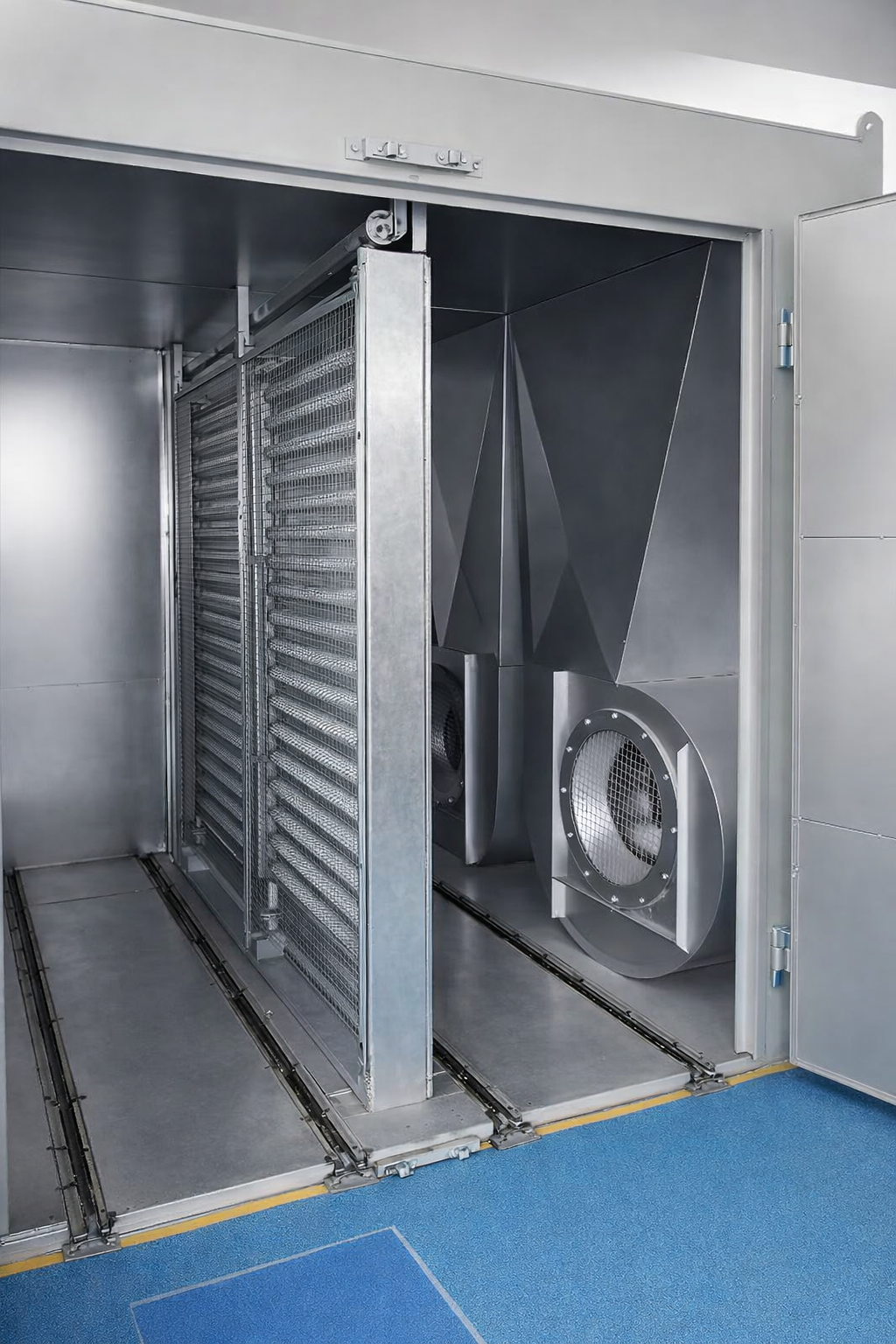
Kerone’s Heat Pump Tray Dryers are built in static rack, roll-in trolley, and exchange rack configurations. The static rack design is economical for smaller batch sizes, while the roll-in trolley format allows pre-loaded trolleys to be prepared in an adjacent clean room or upstream processing area and wheeled directly into the dryer, minimising product handling time and contamination risk. Air circulation is achieved by axial or centrifugal fans mounted above or beside the rack stack, with baffles and guides engineered to produce uniform horizontal or vertical air flow across all tray levels.
Key Features
Tray-based product containment preserves product shape and form integrity throughout the entire drying cycle
Adjustable tray spacing accommodates products of varying layer thickness from 10 mm to 150 mm on perforated or solid stainless steel trays
Uniform inter-tray air velocity distribution through engineered lateral baffles, eliminating the top-dry bottom-wet gradient common in poorly designed tray dryers
Closed-loop heat pump air circuit with integral dehumidification achieving chamber relative humidity control to ±3% RH
Programmable recipe system with multiple temperature stages for products requiring a phased drying approach including initial high-humidity phase
Heavy-duty stainless steel tray construction with bevelled edges and anti-corrosion surface treatment for long service life
Chamber door with observation window, internal illumination, and pressure-equalising vent for safe opening after high-temperature cycles
Optional in-chamber product weighing system providing real-time moisture loss data and automatic endpoint detection by weight
Powered by AI, ML & IoT
Future-Ready Engineering Driven by AI & IoT
Our advanced AI, ML, and IoT technologies, this solution delivers smarter automation, real-time insights, and predictive intelligence to enhance efficiency and drive future-ready growth.
Real-Time Monitoring & Control
Continuous tracking of process parameters with instant adjustments.
Predictive Maintenance
Intelligent fault detection to prevent failures before they occur.
Adaptive Process Optimization
Dynamic tuning of operations for maximum output and efficiency.
Cloud Dashboards & Analytics
Unified access to real-time insights and performance trends.
Energy & Resource Savings
Smarter utilization of energy to cut costs and reduce waste.
Secure IoT Connectivity
Encrypted data flow with seamless integration across plant systems.
Applications of Heat Pump Tray Dryer
Kerone’s Heat Pump Tray Dryers are extensively used in pharmaceutical, food, and fine chemical industries where product form preservation is critical.
Typical applications include:
Pharmaceutical wet granule drying for tablet manufacturing, where uniform final moisture across all trays is essential for consistent tablet hardness
Drying of herbal plant material, botanical leaves, flower heads, and chopped roots for phytopharmaceutical and nutraceutical extract manufacturing
Food product drying including mushroom slices, ginger pieces, and dried fruit segments for retail and industrial food ingredient supply
Chemical intermediate and API cake drying where solvent-wet filter cakes must be dried to tight moisture specifications before further processing
Ceramic and refractory material pre-drying before kiln firing, preventing steam explosion of residual moisture during the sintering cycle
Drying of painted, coated, or surface-treated components in specialty manufacturing where forced conveying would damage the coating
Kerone Engineering Solutions’ Heat Pump Tray Dryer is the definitive choice for industries that require gentle, uniform batch drying without compromising product integrity or energy efficiency. The combination of tray-based product containment, closed-loop heat pump thermodynamics, and Kerone’s precise air distribution engineering delivers consistently high product quality with a significantly lower energy cost per batch than conventional tray dryers. As a partner to pharmaceutical manufacturers, food processors, and specialty chemical producers, Kerone provides not just the equipment but the process expertise and validation support that turns a drying specification into a reliably performing production asset.
Seamless Export Connections Global & Local
Our Global Footprint in Industrial Excellence
Delivering world-class industrial and process solutions across countries with precision, innovation, and reliability.
Peru
Chile
Argentina
Mexico
Colombia
Brazil
USA
Canada
United Kingdom
France
Germany
Spain
Italy
Netherlands
Sweden
Switzerland
Poland
Portugal
Ireland
Czechia
Romania
Hungary
Austria
Greece
Kazakhstan
Uzbekistan
Turkmenistan
Algeria
Egypt
Nigeria
Kenya
South Africa
Saudi Arabia
UAE
Israel
Russia
India
China
Japan
South Korea
Thailand
Vietnam
Malaysia
Singapore
Indonesia
Philippines
Australia
New Zealand
Pan-India Presence. Local Expertise.
Raipur
Bilaspur
Panaji
Vasco da Gama
Gandhinagar
Ahmedabad
Surat
Chandigarh
Gurgaon
Shimla
Manali
Bengaluru
Mysore
Kochi
Pune
Mumbai
Thane
Navi Mumbai
Hyderabad
Chennai
Coimbatore
Kolkata
Lucknow
Jaipur
Udaipur
Jodhpur
Dehradun
Haridwar
Bhubaneswar
Product Gallery
Frequently Asked Questions (FAQ)
Depending on chamber size, Kerone's tray dryers are configured with 12 to 192 trays per chamber, with tray dimensions typically 600×800 mm or 800×1000 mm for production units and smaller dimensions for laboratory and pilot systems.
Kerone supplies SS-316L trays with mirror-polished internal surfaces (Ra ≤ 0.8 micron) for pharmaceutical applications, with perforated bases for granule drying or solid bases for wet cake applications.
Drying cycle time depends heavily on product type, layer depth, and moisture load. Typical pharmaceutical granule drying cycles run 4 to 8 hours, while agricultural products may require 8 to 24 hours for complete drying to storage moisture levels.
Yes. By swapping tray types perforated for granules, solid or shallow-rimmed for cakes and adjusting the loading depth and air velocity recipe, the same chamber can be used for both product types.
Kerone provides stainless steel-smooth internal surfaces with rounded corners and access panels for manual cleaning. For validated pharmaceutical changeovers, Kerone can supply wash-down spray systems and advise on swab and rinse testing protocols.
Yes. For products with residual organic solvents, Kerone supplies ATEX-rated electrical components, inert gas purge capability, and solvent vapour concentration monitoring with automatic shutdown to prevent explosive atmosphere formation.
Standard instrumentation includes chamber dry-bulb and wet-bulb temperature sensors, supply and return air humidity transmitters, differential pressure indicators across the filter and heat exchanger, and a PLC with a touchscreen HMI displaying all parameters with trend logging.
Yes. Kerone engineers systems where the solvent-laden exhaust air is directed through a condenser or carbon adsorption unit before recirculation, allowing solvent recovery and preventing solvent vapour release, important for both environmental compliance and product cost recovery.
Uniformity testing involves loading reference product samples on every tray position and measuring final moisture content across all trays after the cycle. Kerone targets final moisture uniformity within ±0.5% absolute moisture for pharmaceutical granule applications and ±1.0% for food products, validated during operational qualification.
Yes, though this is not recommended during the active heat pump dehumidification phase as door opening introduces ambient humidity. Kerone provides a timed sampling port on the chamber wall for taking small product samples via a glove port during the cycle without compromising the chamber environment for critical applications.
Kerone's standard SS-316L tray frames are designed for a maximum uniform load of 8 to 12 kg per tray depending on tray dimensions and pitch. Tray deflection under product weight is considered during design, and reinforced trays or reduced pitch are specified for high-density products.
Significant product shrinkage is accommodated by selecting solid-base trays with raised rim profiles that retain the product within the tray footprint as it contracts. Perforated trays are generally used for granular products where shrinkage is not an issue but airflow through the bed is required.
Yes. Kerone's PLC systems can be configured with GSM alarm modules or Ethernet-based remote monitoring that sends email or SMS notifications to designated personnel when cycle alarms occur, allowing unattended overnight operation with confidence that deviations will be promptly flagged.
Kerone recommends starting with a development run using representative product at half-capacity loading to establish the drying curve, then conducting three full-scale validation runs to confirm batch uniformity and cycle reproducibility before incorporating the product recipe into the validated recipe library.
Yes. Kerone can programme a post-drying heat-hold phase at a specified temperature for a defined time, which can serve as a thermal treatment step for microbial reduction. The time-temperature log from the PLC provides documentation for the heat treatment record alongside the drying batch record.
Kerone’s custom-designed heating and processing solutions are built to meet the demands of your growing operations. Whether you’re upgrading equipment, expanding production, or need a tailor-made solution


 Peru
Peru Chile
Chile Argentina
 Mexico
 Colombia
 Brazil
 USA
USA Canada
 United Kingdom
 France
 Germany
 Spain
Spain Italy
Italy Netherlands
 Sweden
 Switzerland
 Poland
 Portugal
 Ireland
 Czechia
 Romania
 Hungary
 Austria
 Greece
 Kazakhstan
 Uzbekistan
 Turkmenistan
 Algeria
 Egypt
Egypt Nigeria
 Kenya
Kenya South Africa
 Saudi Arabia
 UAE
UAE Israel
 Russia
 India
India China
China Japan
Japan South Korea
 Thailand
 Vietnam
 Malaysia
 Singapore
 Indonesia
 Philippines
 Australia
 New Zealand