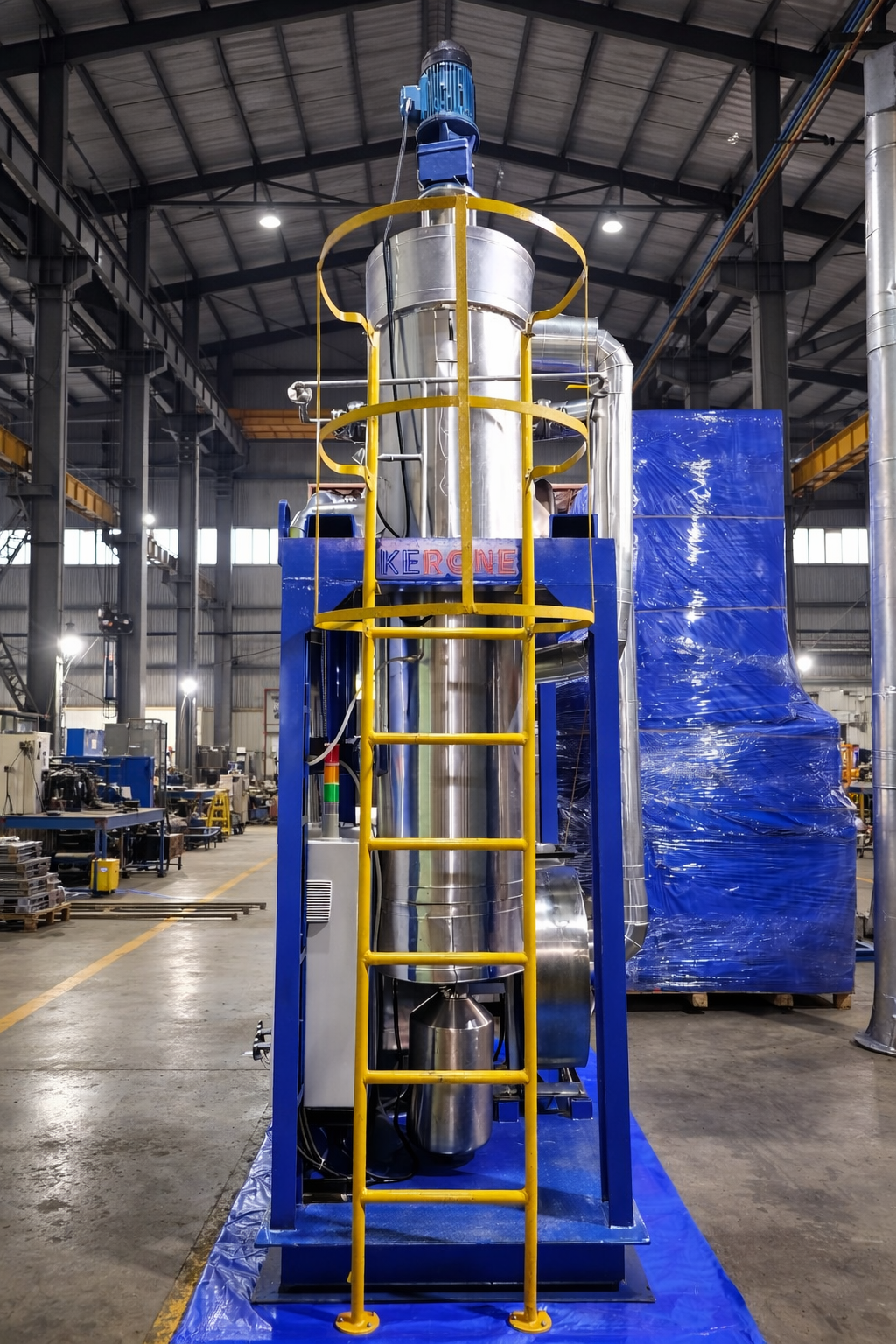
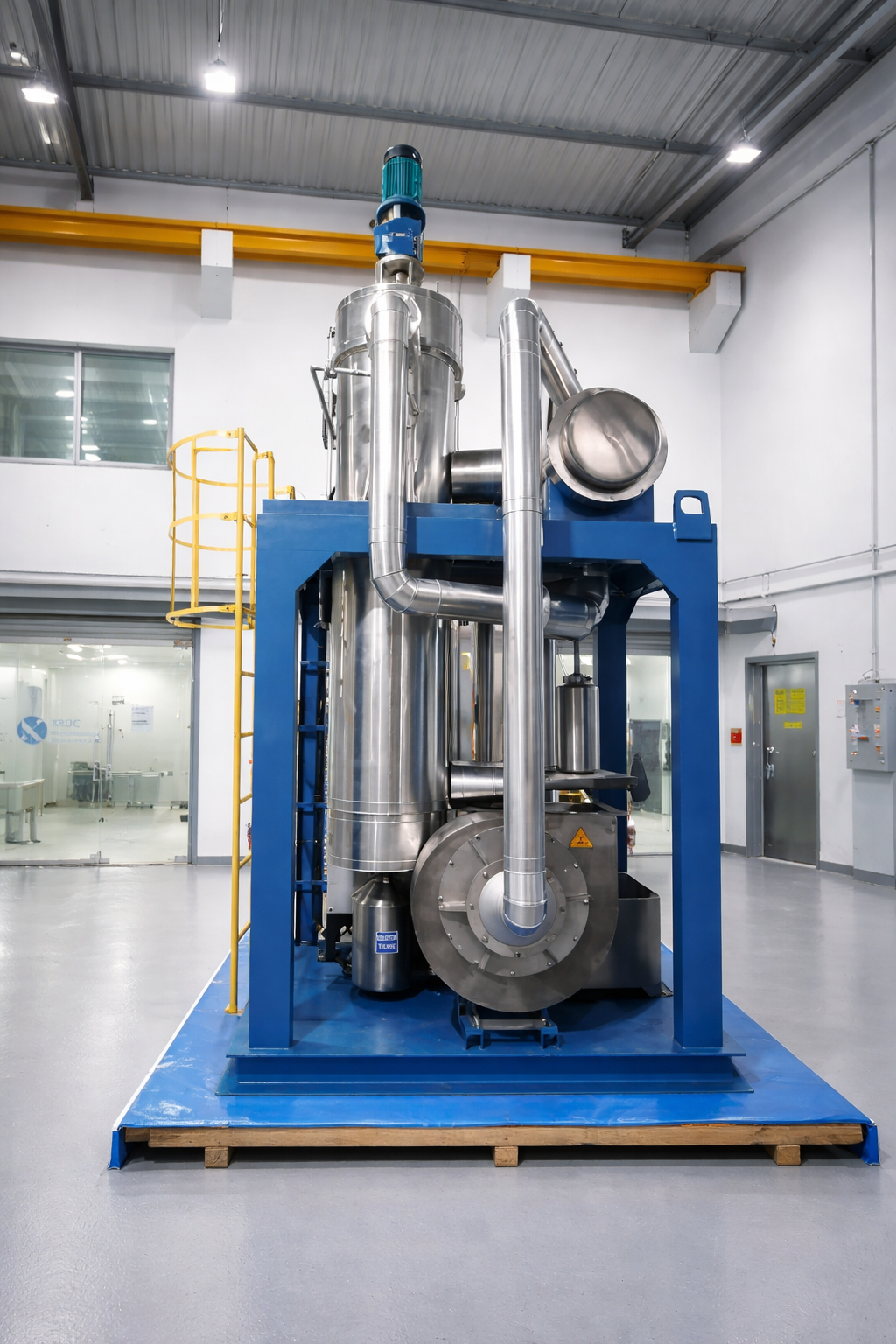
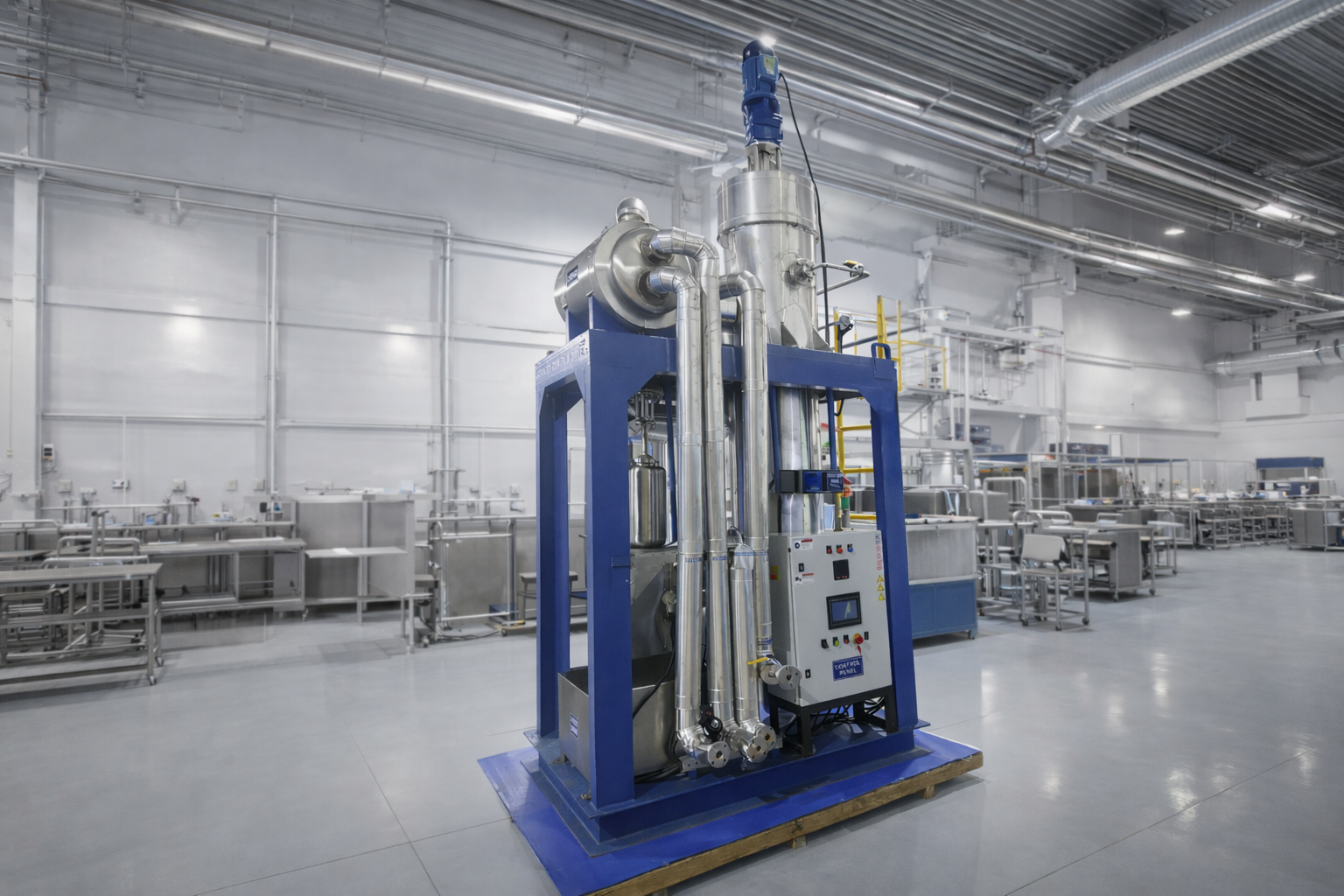
Agitated Thin Film Dryer (ATFD) by Kerone is an advanced, high-efficiency drying system engineered for handling heat-sensitive, high-viscosity, and solvent-rich materials. In this technology, a thin film of product is continuously formed and agitated on a heated surface, ensuring rapid moisture or solvent evaporation under atmospheric or vacuum conditions. Kerone designs ATFDs with precise control over film thickness, residence time, and heat transfer to deliver consistent drying performance, even for complex rheological materials. With robust engineering, corrosion-resistant materials of construction, and optimized rotor design, Kerone’s agitated thin film dryers are ideal for demanding applications in chemical, pharmaceutical, effluent treatment, and specialty industries where conventional dryers fail to meet performance or quality standards.
Why Choose Kerone Agitated Thin Film Dryer
Kerone’s ATFDs are developed with a process-centric approach, where every design parameter—from heat transfer surface area to rotor configuration and vapour handling system—is tailored to the product characteristics and end-quality requirements. Decades of experience in thermal and mass transfer systems allow Kerone to offer dryers that achieve low final moisture content, high solvent recovery, and minimal product degradation. The systems are designed for continuous or batch operation, with options for high vacuum, explosion-proof design, solvent recovery integration, and clean-in-place (CIP) arrangements. Customers benefit from lower operating costs, reduced footprint, and stable performance even under fluctuating feed conditions, making Kerone ATFDs a reliable choice for critical drying duties.
Types and Features of Agitated Thin Film Dryer
Kerone offers agitated thin film dryers in vertical and horizontal configurations, with single or multi-stage operation depending on the evaporation load and product behaviour. Systems can be designed for water-based, solvent-based, or mixed feeds with varying viscosities, including slurries, pastes, and near-solid concentrates. Execution options include atmospheric, high-vacuum, steam-heated, thermal fluid–heated, or electrically heated jackets. The internal rotor can be fitted with hinged, rigid, or segmented blades to maintain uniform film formation and prevent fouling or scaling on the heating surface. Material of construction ranges from carbon steel with special linings to stainless steel grades and high-alloy materials for corrosive or high-purity applications.
Key Features
High heat transfer efficiency through formation of a continuously renewed thin product film.
Capable of handling highly viscous, sticky, or crystallizing products without severe fouling.
Vacuum-compatible design for low-temperature drying of heat-sensitive materials.
Modular construction with configurable heating media, surface area, and rotor types.
Integrated vapour–liquid separation and solvent recovery options for safe and efficient operation.
Optimized residence time and film thickness for consistent final moisture and product quality.
Robust mechanical design with easy access for inspection, maintenance, and optional CIP.
Powered by AI, ML & IoT
Future-Ready Engineering Driven by AI & IoT
Our advanced AI, ML, and IoT technologies, this solution delivers smarter automation, real-time insights, and predictive intelligence to enhance efficiency and drive future-ready growth.
Real-Time Monitoring & Control
Continuous tracking of process parameters with instant adjustments.
Predictive Maintenance
Intelligent fault detection to prevent failures before they occur.
Adaptive Process Optimization
Dynamic tuning of operations for maximum output and efficiency.
Cloud Dashboards & Analytics
Unified access to real-time insights and performance trends.
Energy & Resource Savings
Smarter utilization of energy to cut costs and reduce waste.
Secure IoT Connectivity
Encrypted data flow with seamless integration across plant systems.
Applications of Agitated Thin Film Dryer
Kerone’s agitated thin film dryers are extensively used in industries requiring efficient removal of water or solvents from challenging feedstocks. Typical applications include:
Chemical
Drying of resins, polymers, plasticizers, intermediates, and high-viscosity chemical masses.
Pharmaceutical
Concentration and drying of APIs, intermediates, and solvent-rich reaction masses.
Effluent & Waste Treatment
Concentration and drying of ETP/RO reject, brine solutions, and mother liquors.
Food & Nutraceuticals
Drying of extracts, herbal concentrates, and thermally sensitive food ingredients.
Agro & Fertilizer
Drying of agrochemicals, suspensions, and specialty fertilizer slurries.
Kerone’s Agitated Thin Film Dryer is a specialised solution for industries that require high-performance drying of difficult-to-handle products. By combining advanced thermal design, mechanical reliability, and application-specific customization, Kerone delivers ATFD systems that help customers improve product quality, reduce operating costs, and enhance process sustainability. Whether for solvent recovery, effluent minimization, or high-value product drying, Kerone’s ATFDs offer a dependable and efficient answer to complex drying challenges.
Seamless Export Connections Global & Local
Our Global Footprint in Industrial Excellence
Delivering world-class industrial and process solutions across countries with precision, innovation, and reliability.
Peru
Chile
Argentina
Mexico
Colombia
Brazil
USA
Canada
United Kingdom
France
Germany
Spain
Italy
Netherlands
Sweden
Switzerland
Poland
Portugal
Ireland
Czechia
Romania
Hungary
Austria
Greece
Kazakhstan
Uzbekistan
Turkmenistan
Algeria
Egypt
Nigeria
Kenya
South Africa
Saudi Arabia
UAE
Israel
Russia
India
China
Japan
South Korea
Thailand
Vietnam
Malaysia
Singapore
Indonesia
Philippines
Australia
New Zealand
Pan-India Presence. Local Expertise.
Raipur
Bilaspur
Panaji
Vasco da Gama
Gandhinagar
Ahmedabad
Surat
Chandigarh
Gurgaon
Shimla
Manali
Bengaluru
Mysore
Kochi
Pune
Mumbai
Thane
Navi Mumbai
Hyderabad
Chennai
Coimbatore
Kolkata
Lucknow
Jaipur
Udaipur
Jodhpur
Dehradun
Haridwar
Bhubaneswar
Product Gallery
Frequently Asked Questions (FAQ)
An Agitated Thin Film Dryer is a high-efficiency drying system in which a rotating rotor spreads and agitates feed material as a thin film over a heated surface, enabling rapid evaporation of water or solvent under controlled conditions.
The feed enters the dryer and is distributed onto the heated wall by a rotor equipped with blades. As the rotor agitates and renews the thin film, moisture or solvent evaporates and is removed as vapour, while the dried product is discharged continuously or in batches.
Key benefits include high heat transfer rates, suitability for viscous and heat-sensitive materials, compact footprint, low residence time, efficient solvent recovery, and reduced fouling compared to conventional dryers.
Industries such as chemicals, pharmaceuticals, effluent treatment, food, nutraceuticals, and specialty chemicals rely on ATFDs for critical drying and concentration processes.
Yes, Kerone designs ATFDs based on feed properties, evaporation load, operating pressure, solvent type, material of construction, and integration with upstream and downstream equipment.
The thin film mechanism ensures rapid heat and mass transfer, resulting in lower specific energy consumption. Energy efficiency can be further enhanced by optimizing heating media, vapour condensation, and heat recovery strategies.
Important considerations include feed viscosity, solids content, thermal sensitivity, type of solvent or water, desired final moisture, operating pressure, and required throughput.
Regular inspection of rotor blades, seals, bearings, heating surfaces, and vapour handling components is recommended. Kerone can provide CIP provisions, access ports, and maintenance guidelines to ensure long-term performance.
ATFDs are specifically engineered for feeds that conventional evaporators struggle with: highly viscous materials, products that crystallize or solidify as they concentrate, slurries and pastes with high solids content, and feeds prone to fouling or scaling on heat transfer surfaces. As these materials concentrate during conventional evaporation, they often become too viscous to circulate through pumps and tube bundles, or they deposit scale that quickly degrades heat transfer efficiency. The ATFD's continuously renewed thin film, mechanically maintained by a rotating blade rather than relying on liquid circulation, allows it to keep processing material right through to a near-solid or solid discharge consistency that would stall a conventional evaporator long before reaching that point.
Kerone offers hinged, rigid, or segmented rotor blades, and the choice significantly affects how the dryer handles different feed behaviors. Hinged blades flex slightly against the heated wall, which helps maintain consistent film contact and scraping action even if minor deposits begin to form, making them suitable for feeds with some fouling tendency. Rigid blades provide more consistent, predictable film thickness for feeds that don't tend to foul but need precise film control. Segmented blades can combine characteristics of both along the rotor's length, useful when feed viscosity changes substantially as the material concentrates from inlet to outlet. Selecting the wrong blade type for a given feed's fouling tendency is one of the more common causes of reduced ATFD performance over time.
Atmospheric operation is simpler and lower in capital cost, suitable for feeds that can tolerate the higher temperatures associated with boiling at atmospheric pressure without thermal degradation. High-vacuum operation lowers the boiling point of the solvent or water in the feed, allowing evaporation to occur at significantly reduced temperatures â essential for heat-sensitive pharmaceutical intermediates, certain specialty chemicals, or solvent-rich reaction masses where elevated temperature would cause decomposition, discoloration, or loss of active compound potency. The tradeoff is that vacuum systems add complexity through sealing requirements and vacuum-generation equipment. Kerone evaluates the feed's thermal degradation threshold to determine whether vacuum operation is necessary or whether atmospheric operation can meet quality requirements at lower cost.
Because ATFDs are frequently used to remove solvents from reaction masses, intermediates, or process streams rather than just water, Kerone integrates vapor-liquid separation and solvent recovery options directly into the system design. As solvent evaporates from the thin film on the heated rotor surface, the vapor is captured and routed to condensation equipment that recovers the solvent for reuse rather than venting it to atmosphere or treating it as waste. This is particularly valuable in pharmaceutical and specialty chemical manufacturing, where solvent costs are significant and environmental regulations increasingly restrict solvent emissions. The recovery system's design depends on the specific solvent's boiling point and condensation characteristics, which Kerone configures per application.
Low hold-up volume means there is very little material retained inside the dryer at any given time relative to its processing capacity, since the thin film mechanism by design keeps only a small amount of product on the heated surface during operation rather than holding a large batch volume. This matters significantly for manufacturers who switch between different products or formulations on the same equipment, since less retained material means less product loss during changeover and a faster, more thorough purge between batches â both important for regulatory compliance in pharmaceutical settings where cross-contamination between products must be tightly controlled. It also reduces the risk of degradation in any single batch of sensitive material sitting in the equipment for extended periods.
Regular inspection of rotor blades for wear or damage is essential since blade condition directly determines film thickness consistency and how effectively the heated wall is kept clean of deposits. Seals and bearings need periodic checks given the continuous rotation the rotor undergoes during operation, and any seal degradation risks vacuum loss in vacuum-operated systems. The heating surface itself should be inspected for scale or fouling buildup that reduces heat transfer efficiency over time, particularly for feeds known to have some fouling tendency despite blade design mitigation. Kerone's designs include access ports specifically to support this inspection routine, and clean-in-place provisions where specified reduce the labor and downtime associated with routine cleaning between maintenance cycles.
Kerone’s custom-designed heating and processing solutions are built to meet the demands of your growing operations. Whether you’re upgrading equipment, expanding production, or need a tailor-made solution

 Peru
Peru Chile
Chile Argentina
 Mexico
 Colombia
 Brazil
 USA
USA Canada
 United Kingdom
 France
 Germany
 Spain
Spain Italy
Italy Netherlands
 Sweden
 Switzerland
 Poland
 Portugal
 Ireland
 Czechia
 Romania
 Hungary
 Austria
 Greece
 Kazakhstan
 Uzbekistan
 Turkmenistan
 Algeria
 Egypt
Egypt Nigeria
 Kenya
Kenya South Africa
 Saudi Arabia
 UAE
UAE Israel
 Russia
 India
India China
China Japan
Japan South Korea
 Thailand
 Vietnam
 Malaysia
 Singapore
 Indonesia
 Philippines
 Australia
 New Zealand