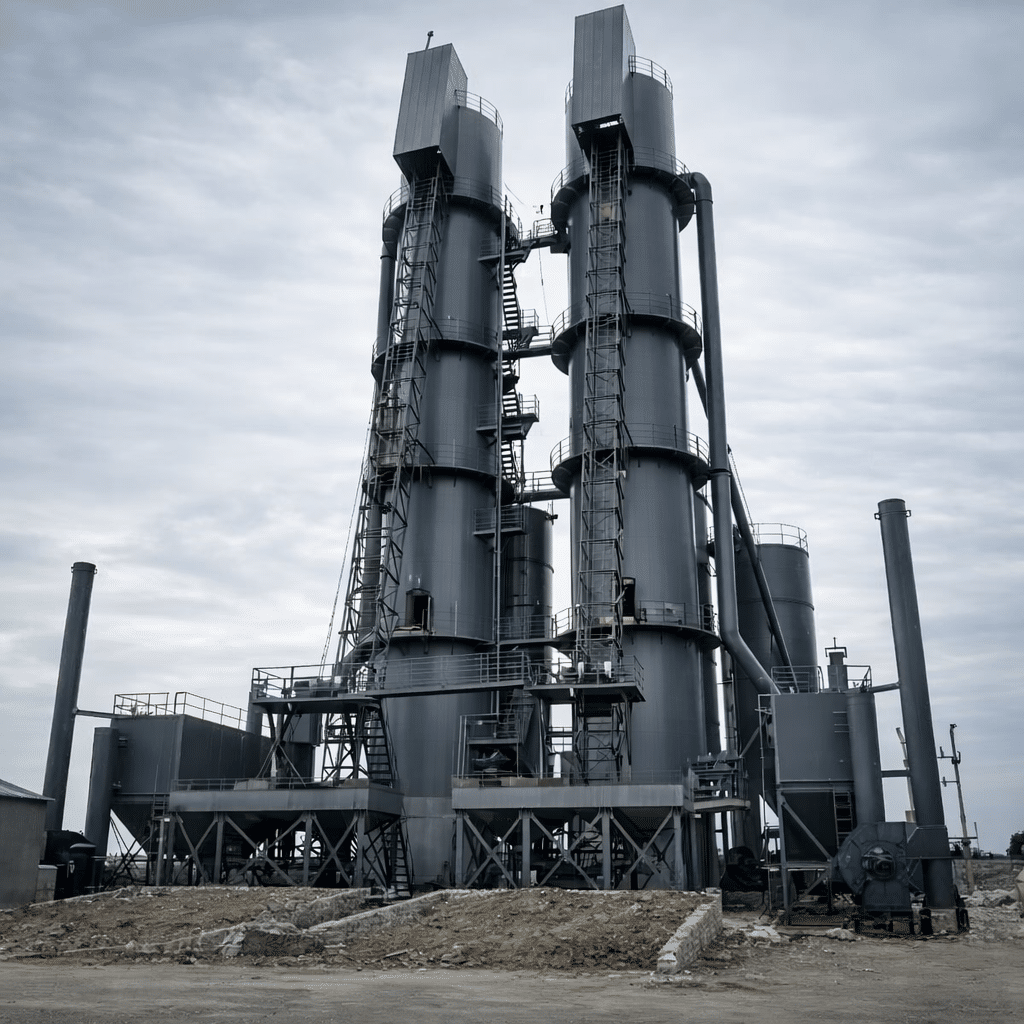
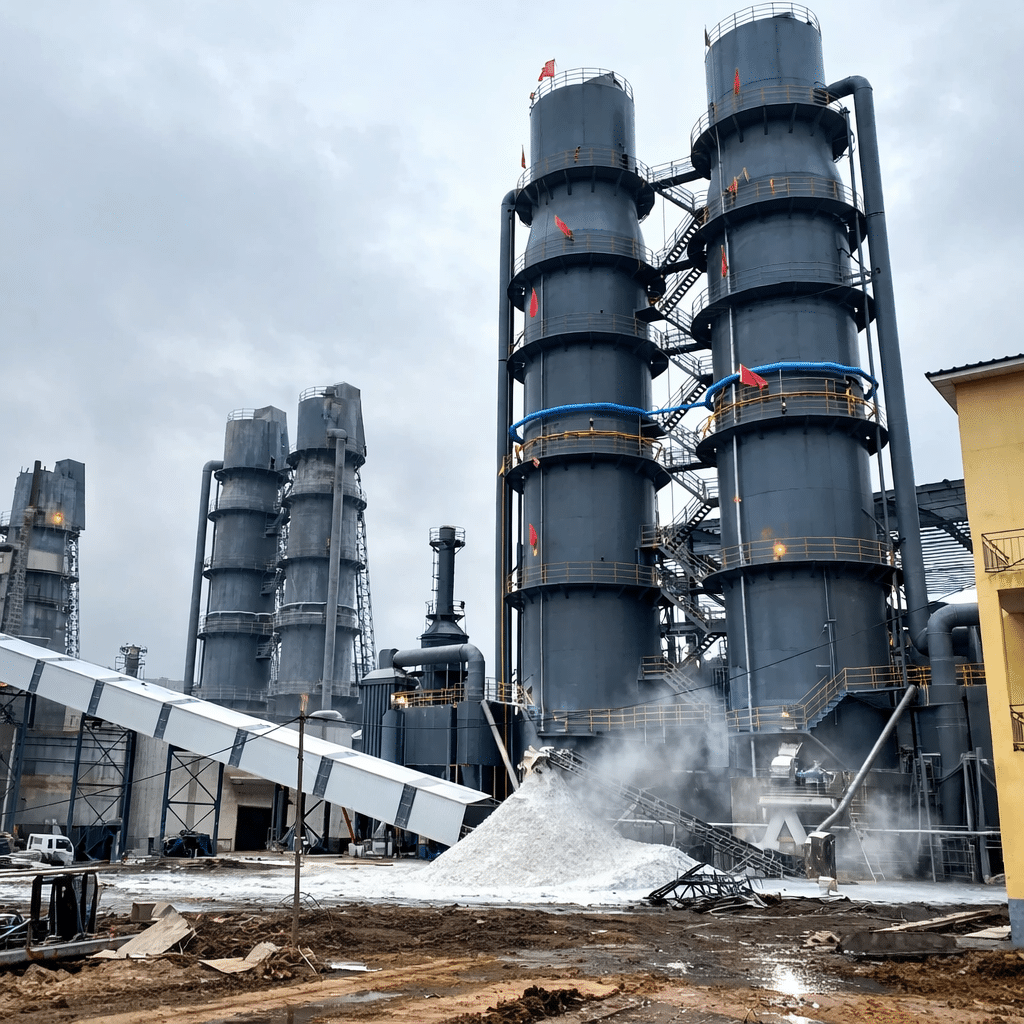
Kerone’s Flash Calciners are high-efficiency, continuous thermal processing systems in which very fine powders or slurries are rapidly calcined in a matter of seconds by direct suspension in a high-velocity stream of hot combustion gases. Unlike conventional kilns where the material must spend minutes or hours at temperature in a bed or charge column, Flash Calciners achieve the required calcination reaction almost instantaneously by maximizing the exposed surface area of each particle and the heat and mass transfer driving forces between the hot gas stream and the suspended fine particles. Kerone engineers Flash Calciners for the calcination of aluminium trihydrate (Bayer alumina), clay minerals, calcium carbonate, and various fine mineral and chemical feed materials where extremely fine feed particle sizes, high production rates, and compact process layouts are required. The technology achieves superior product quality with minimum specific energy consumption compared to traditional rotary kiln processing of fine powders.
Why Choose Kerone Flash Calciners
Kerone brings advanced chemical engineering and combustion process expertise to Flash Calciner design, ensuring that each installation achieves the required calcination conversion, product specific surface area, and crystal structure development within the flash calcination reactor. Kerone’s Flash Calciners are designed with computational fluid dynamic (CFD) modelling of the suspension calcination process, ensuring optimum gas-solid contact, uniform temperature distribution, and controlled product residence time throughout the reactor system. The highly energy-efficient design — enabled by the short retention times, efficient combustion systems, and multi-stage heat recovery — makes Kerone’s Flash Calciners among the most economical thermal processing systems available for fine powder calcination. Comprehensive after-sales support, including process optimization assistance and spare parts supply, protects your production performance throughout the equipment life cycle.
Types and Features of Flash Calciners
Kerone’s Flash Calciner range includes Single-Stage Flash Calciners for straightforward calcination of reactive materials; Multi-Stage Flash Calciners with preheating cyclone circuits for maximum energy recovery in large-scale alumina and aluminium hydroxide calcination; Circulating Fluidized Bed (CFB) Flash Calciners for materials requiring slightly longer gas-solid contact times; Flash Calciner-Cooler Combinations incorporating integrated product cooling after calcination; and Retrofit Flash Calciners designed for integration with existing rotary kiln or conventional calcination systems to increase capacity. All models include explosion protection systems, refractory-lined reactor vessels, cyclone separators, and baghouse or ESP gas cleaning.
Key Features
Extremely short gas-solid contact time (0.5–5 seconds) enables high-throughput compact installations
Maximum particle surface area exposure in suspension achieves very high calcination conversion rates
High thermal efficiency with multi-stage cyclone preheating recovering exhaust gas heat
Precise calcination temperature control to produce targeted crystal structure and reactivity in product
Compact process layout requiring significantly less plot area than rotary kiln alternatives
Low NOx combustion systems compatible with environmental emission regulations
Automated feed rate control integrated with combustion system for consistent product quality
Suitable for high-moisture feed with integrated drying in the lower temperature preheating stages
Powered by AI, ML & IoT
Future-Ready Engineering Driven by AI & IoT
Our advanced AI, ML, and IoT technologies, this solution delivers smarter automation, real-time insights, and predictive intelligence to enhance efficiency and drive future-ready growth.
Real-Time Monitoring & Control
Continuous tracking of process parameters with instant adjustments.
Predictive Maintenance
Intelligent fault detection to prevent failures before they occur.
Adaptive Process Optimization
Dynamic tuning of operations for maximum output and efficiency.
Cloud Dashboards & Analytics
Unified access to real-time insights and performance trends.
Energy & Resource Savings
Smarter utilization of energy to cut costs and reduce waste.
Secure IoT Connectivity
Encrypted data flow with seamless integration across plant systems.
Applications of Flash Calciners
Kerone’s Flash Calciners are extensively used in industries requiring efficient, high-capacity thermal calcination of fine powder materials.
Typical applications include:
Calcination of aluminum trihydrate (ATH) to produce smelter-grade alumina for electrolytic reduction
Dehydroxylation of kaolin clay to produce metakaolin for cement supplementary materials and geopolymers
Flash calcination of calcium carbonate and chalk for high-reactivity lime powder production
Thermal treatment of gypsum and calcium sulfate for production of calcium sulfate hemihydrate (plaster)
Calcination of iron ore concentrate fines for pelletizing and direct reduction processes
Thermal activation of clay minerals for production of supplementary cementitious materials (SCMs)
Kerone’s Flash Calciners deliver unmatched throughput, energy efficiency, and product quality for the calcination of fine powder materials. The innovative suspension calcination technology, combined with multi-stage heat recovery and precise combustion control, enables flash calciners to process large volumes of fine-grained feedstocks with minimum energy consumption and maximum conversion efficiency. From alumina refineries to clay activation plants, Kerone’s Flash Calciners are the enabling technology for economical, high-quality, large-scale fine powder calcination. Partner with Kerone to implement flash calcination technology that transforms your production economics and product quality simultaneously.
Seamless Export Connections Global & Local
Our Global Footprint in Industrial Excellence
Delivering world-class industrial and process solutions across countries with precision, innovation, and reliability.
Peru
Chile
Argentina
Mexico
Colombia
Brazil
USA
Canada
United Kingdom
France
Germany
Spain
Italy
Netherlands
Sweden
Switzerland
Poland
Portugal
Ireland
Czechia
Romania
Hungary
Austria
Greece
Kazakhstan
Uzbekistan
Turkmenistan
Algeria
Egypt
Nigeria
Kenya
South Africa
Saudi Arabia
UAE
Israel
Russia
India
China
Japan
South Korea
Thailand
Vietnam
Malaysia
Singapore
Indonesia
Philippines
Australia
New Zealand
Pan-India Presence. Local Expertise.
Raipur
Bilaspur
Panaji
Vasco da Gama
Gandhinagar
Ahmedabad
Surat
Chandigarh
Gurgaon
Shimla
Manali
Bengaluru
Mysore
Kochi
Pune
Mumbai
Thane
Navi Mumbai
Hyderabad
Chennai
Coimbatore
Kolkata
Lucknow
Jaipur
Udaipur
Jodhpur
Dehradun
Haridwar
Bhubaneswar
Product Gallery
Frequently Asked Questions (FAQ)
Flash Calcination is ideal for fine powder materials with particle sizes below 200 microns that undergo endothermic thermal decomposition reactions (dehydration, decarbonation, dehydroxylation). Primary applications include aluminum trihydrate, kaolin, chalk, gypsum, and other fine mineral raw materials with fast reaction kinetics.
Flash Calcination achieves rapid reaction by suspending individual particles in a high-velocity, high-temperature gas stream. At suspension, every particle is surrounded by hot gas on all sides, maximizing heat and mass transfer. The extremely high surface-to-volume ratio of fine particles means that heat penetrates the particle and the calcination reaction is complete in fractions of a second.
Flash Calciner gas temperatures typically range from 750°C to 1100°C depending on the material and required product properties. The high gas temperature provides the rapid heat transfer required for instantaneous calcination, while the short contact time prevents overburning of the product.
Product residence time in the hot zone is controlled by the gas velocity (which determines particle transport velocity), the height of the suspension calcination reactor, and cyclone collection efficiency. Kerone designs these parameters to achieve the target conversion and product properties for each specific material.
Well-designed Flash Calciners with multi-stage preheating achieve specific energy consumption of 1000–1300 kcal/kg of calcined product for alumina calcination, compared to 1500–2200 kcal/kg for rotary kilns — a saving of 20–40% in fuel costs for equivalent production capacity.
Flash Calciners require fine feed material (typically 90% below 100–200 microns for most applications). Wet feed can be handled if moisture content is below about 15%; higher moisture feed requires pre-drying to prevent agglomeration and flow problems in the feed system.
Yes. Kerone can design Flash Calciner modules that replace or supplement existing rotary kilns, allowing phased capacity expansion or energy efficiency improvement of existing facilities. The flash calciner can be integrated with existing preheating, cooling, and gas cleaning infrastructure to minimize capital investment.
Flash Calciners generate a product in suspension which must be separated from the gas stream using high-efficiency cyclone separators. Final gas cleaning is accomplished using fabric filter baghouses or electrostatic precipitators to meet dust emission standards. SO₂ and NOx control systems are incorporated based on fuel type and local regulations.
Since particles are suspended in a fast moving gas stream for only a few seconds, larger particles simply do not have enough time for heat to reach their core. Fine, uniform particle size keeps every grain reacting evenly within that short window.
Blended feeds are possible if both components react within a similar temperature and residence time band. Kerone tests blended samples in pilot trials first, since uneven reaction behaviour between the two materials can affect final product uniformity.
Excess moisture absorbs extra heat for evaporation before calcination even starts, which can drop the reactor temperature and reduce conversion. Kerone designs moisture buffers and drying stages to handle normal variation, with alarms if levels go beyond the safe range.
Flash calciners are generally most efficient at higher throughput because of the fixed costs of gas handling and cyclone systems. For smaller volumes, Kerone often recommends comparing against a fluidized bed or batch calciner design instead.
Because residence time in the reactor is only seconds, flash calciners respond very fast to changes in feed rate or gas velocity. Control systems can adjust output within minutes, which is much quicker than rotary kilns that hold material for much longer.
Since many flash calciner feeds are fine, dry powders that can be explosive in the right conditions, Kerone includes explosion venting panels, inert gas purging, and spark detection as standard on suitable installations.
Variation usually traces back to inconsistent feed moisture, uneven particle size distribution, or fluctuating gas temperature. Kerone builds in automated feed and combustion controls specifically to minimize these swings.
Kerone’s custom-designed heating and processing solutions are built to meet the demands of your growing operations. Whether you’re upgrading equipment, expanding production, or need a tailor-made solution

 Peru
Peru Chile
Chile Argentina
 Mexico
 Colombia
 Brazil
 USA
USA Canada
 United Kingdom
 France
 Germany
 Spain
Spain Italy
Italy Netherlands
 Sweden
 Switzerland
 Poland
 Portugal
 Ireland
 Czechia
 Romania
 Hungary
 Austria
 Greece
 Kazakhstan
 Uzbekistan
 Turkmenistan
 Algeria
 Egypt
Egypt Nigeria
 Kenya
Kenya South Africa
 Saudi Arabia
 UAE
UAE Israel
 Russia
 India
India China
China Japan
Japan South Korea
 Thailand
 Vietnam
 Malaysia
 Singapore
 Indonesia
 Philippines
 Australia
 New Zealand