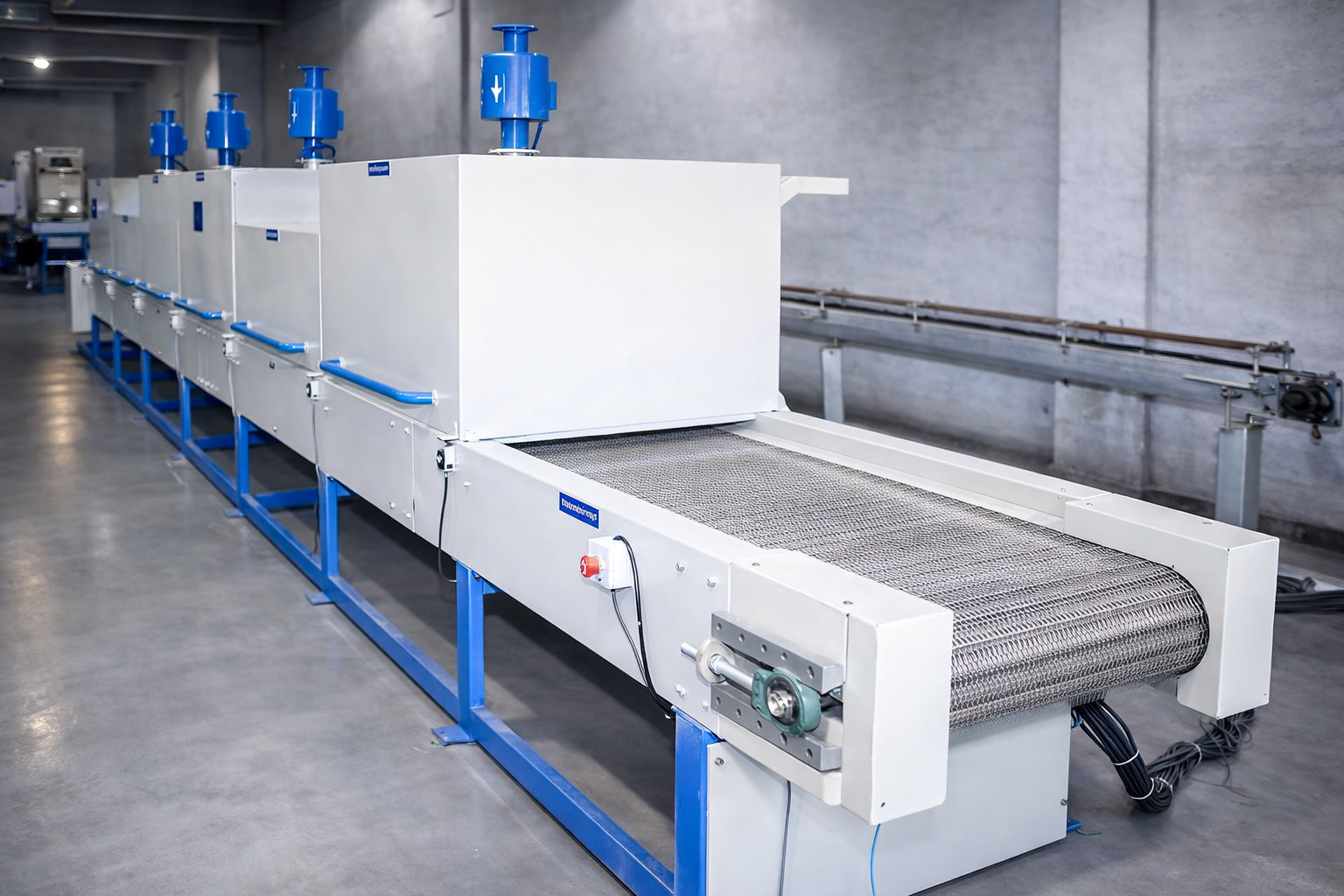
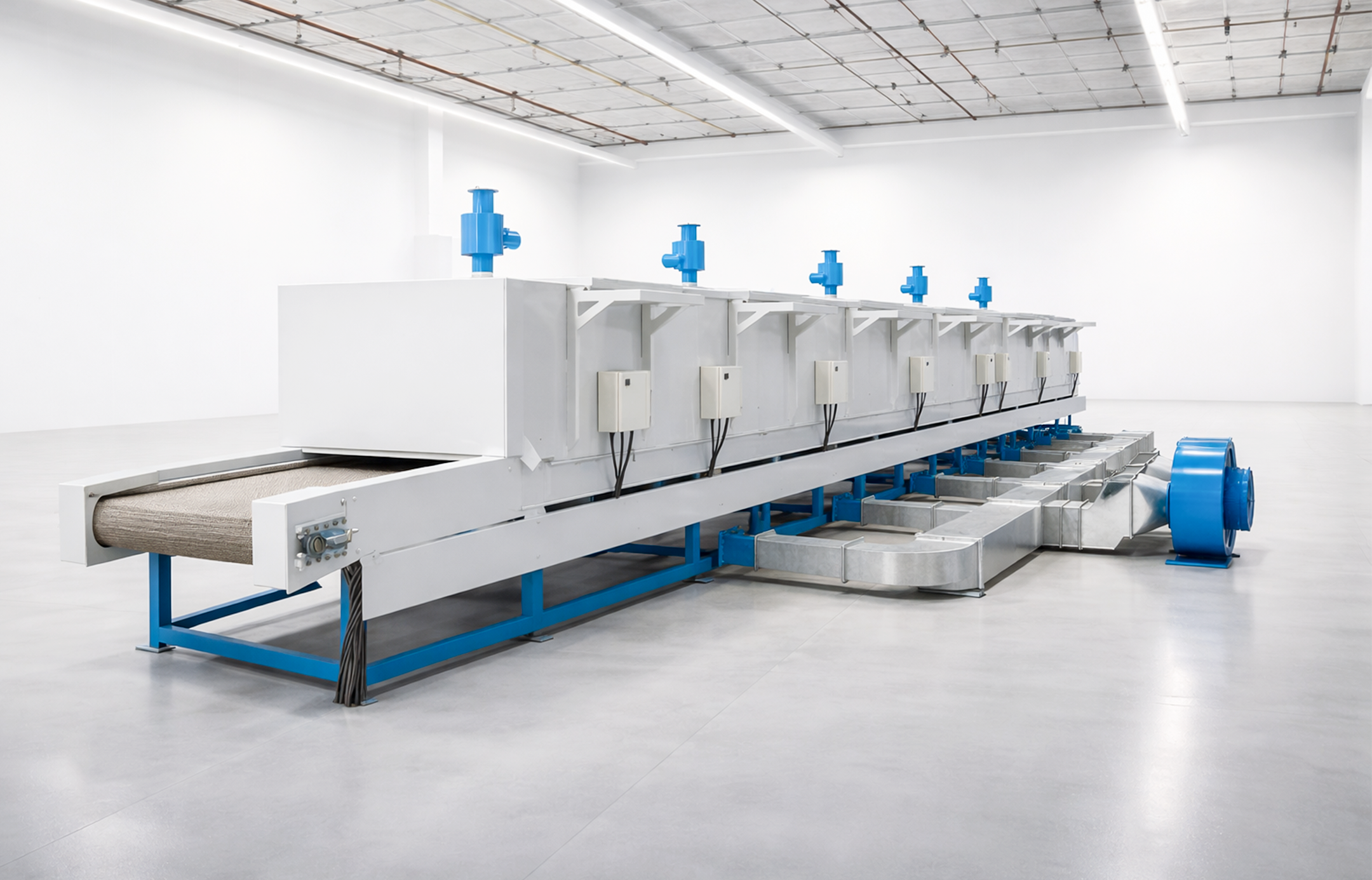
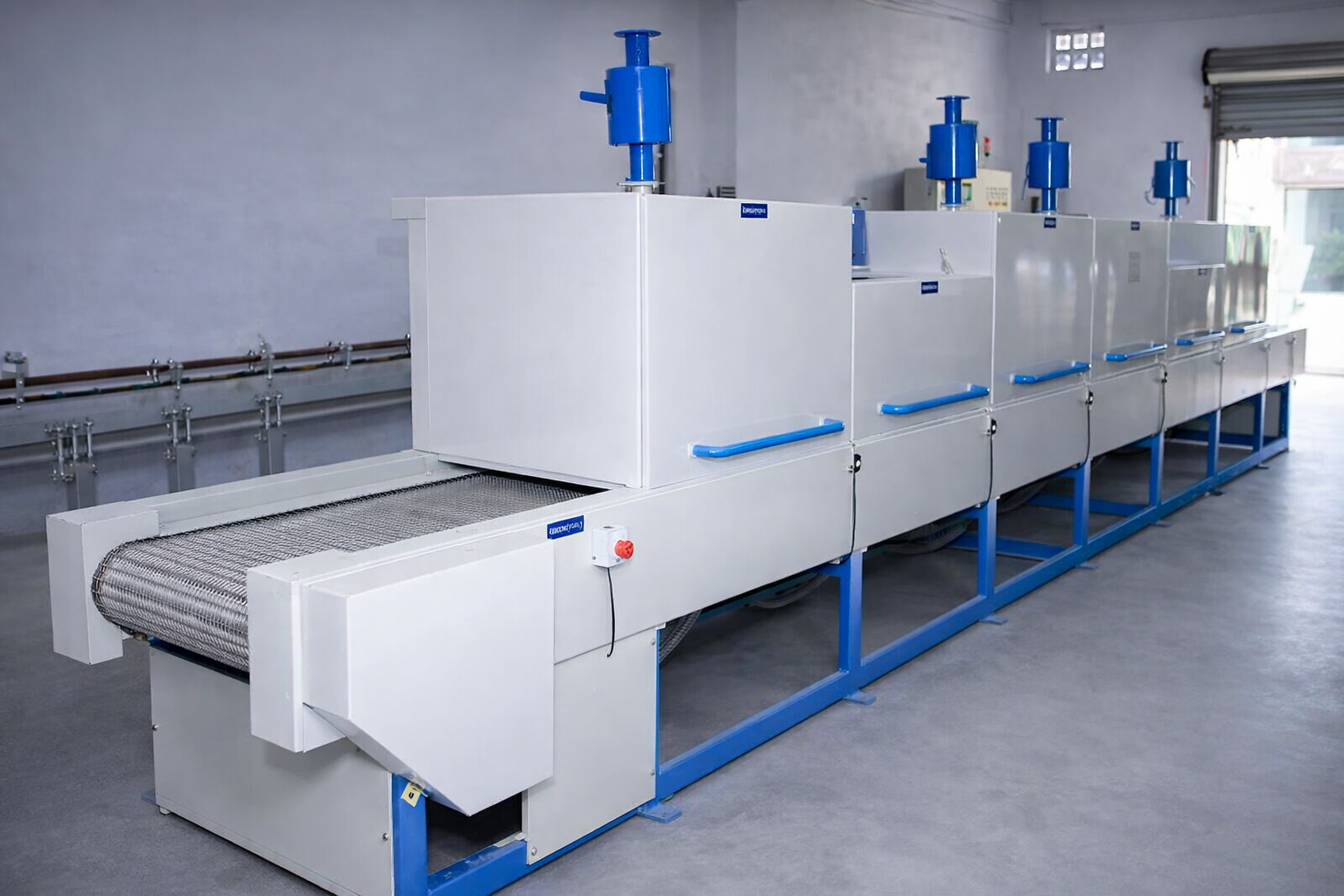
Kerone’s Flat Belt Ovens are continuous thermal processing systems where products are carried through the oven on a flat, low-profile conveyor belt, ensuring stable transport and uniform exposure to the thermal environment. The flat belt design is ideal for products that need to lie flat during processing, such as coated sheets, printed boards, loose components, food products, and materials undergoing drying, curing, or heat treatment. Kerone’s Flat Belt Ovens are engineered for high throughput, energy efficiency, and precise temperature control, making them a production workhorse across many industrial sectors.
Why Choose Kerone Flat Belt Ovens
Kerone’s Flat Belt Ovens offer a practical and efficient solution for continuous processing of flat or small three-dimensional products. The flat belt provides a stable, non-tilting transport surface that ensures products do not shift or deform during processing, which is critical for coated, printed, or dimensionally sensitive materials. Kerone’s engineering team designs the oven airflow system to deliver uniform top and bottom heat to the product, ensuring consistent processing regardless of product position across the belt width.
Types and Features of Flat Belt Ovens
Kerone manufactures Flat Belt Ovens with belt widths from 300 mm to 2000 mm and oven lengths from 2 m to over 30 m, allowing a wide range of throughputs and dwell times. Belt materials include stainless steel mesh, solid stainless steel, PTFE-coated glass fibre, and high-temperature silicone belts, each suited to specific product types and temperatures. Heating options include electric resistance, gas-fired, and infrared systems, with forced hot air recirculation as standard for temperature uniformity.
Key Features
Flat, stable conveyor belt for consistent product transport
Available belt widths from 300 mm to 2000 mm
Multiple belt material options: stainless mesh, solid SS, PTFE, silicone
Top and bottom heating for uniform product exposure
Adjustable belt speed for variable dwell time control
Forced hot air recirculation for uniform temperature distribution
Multiple temperature zones for complex process profiles
Available with electric, gas, or infrared heating systems
Powered by AI, ML & IoT
Future-Ready Engineering Driven by AI & IoT
Our advanced AI, ML, and IoT technologies, this solution delivers smarter automation, real-time insights, and predictive intelligence to enhance efficiency and drive future-ready growth.
Real-Time Monitoring & Control
Continuous tracking of process parameters with instant adjustments.
Predictive Maintenance
Intelligent fault detection to prevent failures before they occur.
Adaptive Process Optimization
Dynamic tuning of operations for maximum output and efficiency.
Cloud Dashboards & Analytics
Unified access to real-time insights and performance trends.
Energy & Resource Savings
Smarter utilization of energy to cut costs and reduce waste.
Secure IoT Connectivity
Encrypted data flow with seamless integration across plant systems.
Applications of Flat Belt Ovens
Kerone’s Flat Belt Ovens are extensively used in electronics, printing, food processing, and industrial coating industries. Typical applications include:
Food, chemical, pharmaceutical, and mineral industries
Biomass, renewable fuels, and environmental systems
Packaging, paper, and pulp processing
Industrial drying, heating, curing, and material transformation
High-temperature and precision-controlled processes
Smart manufacturing with automation and AI integration
Kerone’s flat belt ovens solutions deliver unmatched quality, safety, and operational performance. Each system is tailored to meet production targets while ensuring energy savings, reliability, and long-term industrial value.
The combination of flexible belt configuration, precise temperature control, and durable construction makes these ovens adaptable to a wide range of applications across diverse industries. Kerone’s commitment to engineering excellence and customer support ensures that every Flat Belt Oven installation delivers the expected performance and value throughout its service life.
Seamless Export Connections Global & Local
Our Global Footprint in Industrial Excellence
Delivering world-class industrial and process solutions across countries with precision, innovation, and reliability.
Peru
Chile
Argentina
Mexico
Colombia
Brazil
USA
Canada
United Kingdom
France
Germany
Spain
Italy
Netherlands
Sweden
Switzerland
Poland
Portugal
Ireland
Czechia
Romania
Hungary
Austria
Greece
Kazakhstan
Uzbekistan
Turkmenistan
Algeria
Egypt
Nigeria
Kenya
South Africa
Saudi Arabia
UAE
Israel
Russia
India
China
Japan
South Korea
Thailand
Vietnam
Malaysia
Singapore
Indonesia
Philippines
Australia
New Zealand
Pan-India Presence. Local Expertise.
Raipur
Bilaspur
Panaji
Vasco da Gama
Gandhinagar
Ahmedabad
Surat
Chandigarh
Gurgaon
Shimla
Manali
Bengaluru
Mysore
Kochi
Pune
Mumbai
Thane
Navi Mumbai
Hyderabad
Chennai
Coimbatore
Kolkata
Lucknow
Jaipur
Udaipur
Jodhpur
Dehradun
Haridwar
Bhubaneswar
Product Gallery
Yes, Kerone offers fully customized engineering based on capacity, temperature, and industry needs.
PLC, SCADA, IoT, AI/ML predictive systems, and remote monitoring.
Yes, Kerone designs systems that significantly reduce operational energy consumption.
Manufacturing, food, chemicals, biomass, pharma, packaging, and advanced materials.
Yes, from installation to lifetime service support, Kerone provides complete assistance.
Yes, food-grade models with stainless steel construction, hygienic design, and CIP compatibility are available.
Yes, independent top and bottom heating zones allow the heat distribution to be tailored to the specific product and process requirement.
Yes, many belt types can be cleaned, and Kerone can supply integrated belt washing systems where required for food or pharmaceutical applications.
Flat belt ovens are excellent for products that lie flat and tolerate contact with a moving belt surface, but they're a poor fit for tall, irregularly shaped, or easily tipped items, since these can shift, fall, or jam against side guides during transport. Powders and very fine granular materials also pose challenges unless the belt is enclosed or the material is contained in trays. For products with these constraints, a mesh-belt tunnel oven with side containment, a tray-based conveyor system, or a rotary or vibratory processing line is usually a better match. Kerone's engineering review during the quotation stage typically flags these mismatches early, since selecting the wrong conveyor format leads to handling problems that are expensive to correct after installation.
Moisture control in a flat belt oven depends on the balance between air temperature, airflow velocity across the product, and dwell time, rather than temperature alone. Too much airflow on a wet surface can cause case hardening — a dry outer layer that traps moisture inside — while too little airflow extends drying time unnecessarily. Kerone designs zone-specific airflow profiles so that early zones use gentler conditions to avoid surface sealing, while later zones increase airflow as the product dries. Verification typically involves periodic moisture content testing with a calibrated moisture analyzer on samples pulled at set intervals, combined with logged temperature and humidity data from in-oven sensors, giving operators a documented basis for quality assurance rather than relying on visual inspection alone.
Beyond the initial equipment cost, the largest recurring expense is energy — electricity for electric models, or gas plus electricity for hybrid configurations — which scales with oven length, insulation quality, and operating temperature. Belt replacement is the next significant line item, since belts are a wear component with a finite service life depending on material and duty cycle. Routine maintenance costs include bearing lubrication, drive chain inspection, and periodic recalibration of temperature sensors. Many buyers underestimate the cost of unplanned downtime more than any single line item; a documented preventive maintenance schedule, which Kerone provides with each installation, is usually more cost-effective than reactive repairs after a failure interrupts production.
Yes, integration with upstream and downstream equipment is one of the main reasons manufacturers choose conveyorised systems over standalone batch units. Successful integration depends on matching belt speed and infeed/outfeed heights with adjacent machinery, and on synchronizing the oven's PLC with the broader line control system so that jams, stoppages, or speed changes propagate correctly across stations. Kerone designs control architecture to support standard industrial communication protocols, allowing the oven to report status and receive speed commands from a central line controller. Buyers integrating into an existing line should share full mechanical drawings and control system specifications during the design phase, since retrofitting communication compatibility after fabrication is far more costly than designing it in from the start.
Day-to-day maintenance — visual belt inspection, cleaning debris from rollers, checking for unusual noise, and confirming temperature readings match setpoints — can be handled by trained in-house technicians on a daily or weekly basis. More technical tasks, such as burner combustion tuning, PLC firmware updates, control loop recalibration, and belt tracking adjustment, are best performed by qualified service personnel on a quarterly or semi-annual schedule, depending on duty cycle. Kerone recommends an annual comprehensive inspection covering insulation integrity, electrical connections, and drive train wear regardless of how lightly the oven is used, since insulation degradation and electrical fatigue progress gradually and are easy to miss during routine in-house checks.
Many buyers assume that equal top and bottom heat automatically produces uniform drying or curing, but the product itself often absorbs heat asymmetrically depending on its composition, color, and thickness. A coated product with a dark top surface, for example, can absorb radiant heat faster from above than a lighter-colored underside reflects from below, even with identical heater output on both sides. This means optimal top-to-bottom ratios are usually product-specific and determined through trial runs rather than assumed from oven specifications. Kerone's pilot trial facility lets buyers test their actual product under adjustable top/bottom ratios before finalizing the production oven's control settings, which avoids costly trial-and-error after installation.
Flat belt ovens handle variable batch sizes reasonably well because belt speed and zone temperatures can be adjusted within the equipment's rated range without mechanical changeover, unlike fixed-cycle batch ovens that require a new program for each load configuration. The practical limit is utilization: running a long oven at low loading density for a small batch wastes energy relative to output, since the heated zones consume similar power whether the belt is fully or partially loaded. For operations with highly variable batch sizes, Kerone can design multiple independently controlled zones that allow partial shutdown of unused sections, improving energy efficiency during lighter production runs without sacrificing flexibility for larger batches.
Kerone’s custom-designed heating and processing solutions are built to meet the demands of your growing operations. Whether you’re upgrading equipment, expanding production, or need a tailor-made solution

 Peru
Peru Chile
Chile Argentina
 Mexico
 Colombia
 Brazil
 USA
USA Canada
 United Kingdom
 France
 Germany
 Spain
Spain Italy
Italy Netherlands
 Sweden
 Switzerland
 Poland
 Portugal
 Ireland
 Czechia
 Romania
 Hungary
 Austria
 Greece
 Kazakhstan
 Uzbekistan
 Turkmenistan
 Algeria
 Egypt
Egypt Nigeria
 Kenya
Kenya South Africa
 Saudi Arabia
 UAE
UAE Israel
 Russia
 India
India China
China Japan
Japan South Korea
 Thailand
 Vietnam
 Malaysia
 Singapore
 Indonesia
 Philippines
 Australia
 New Zealand