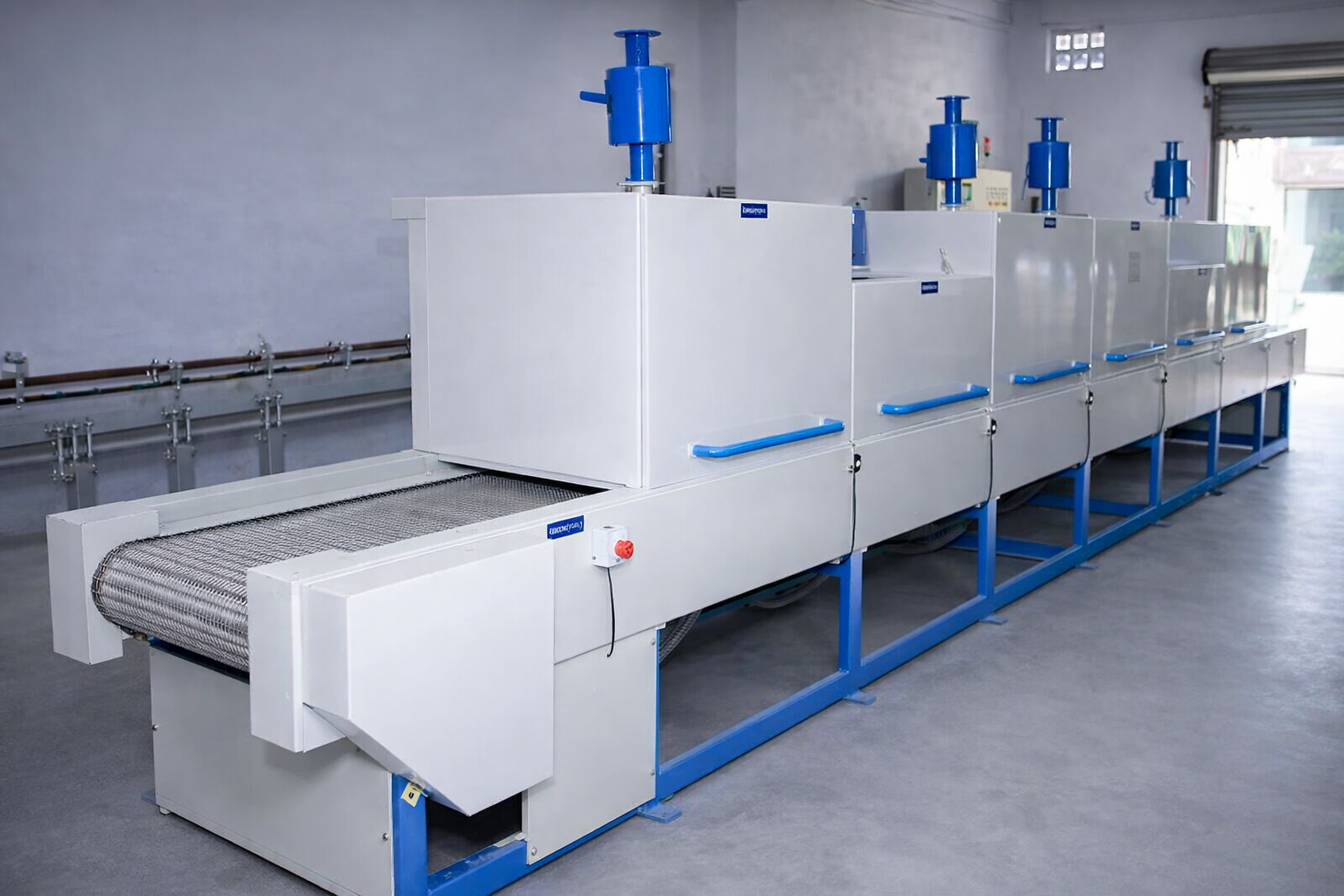
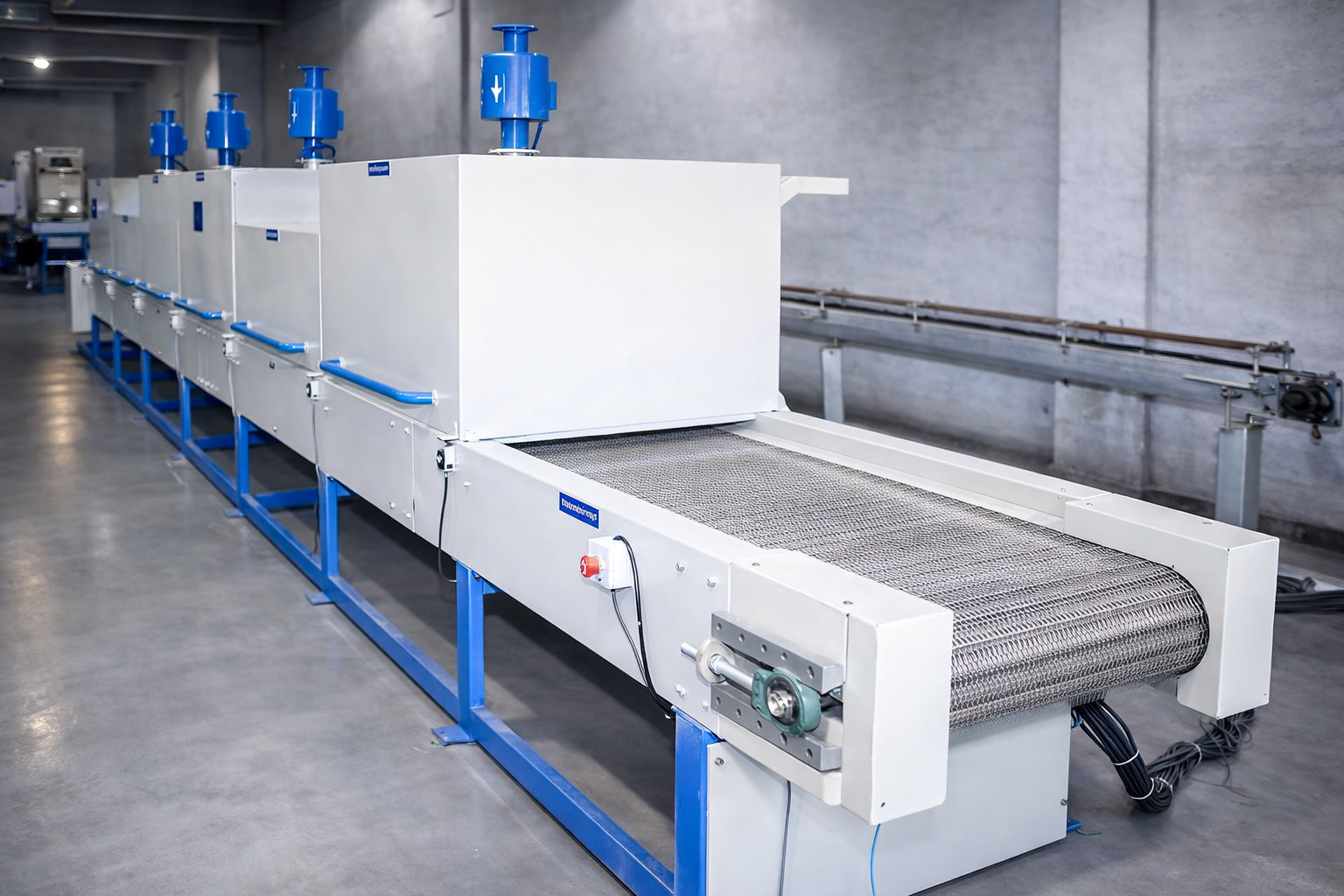
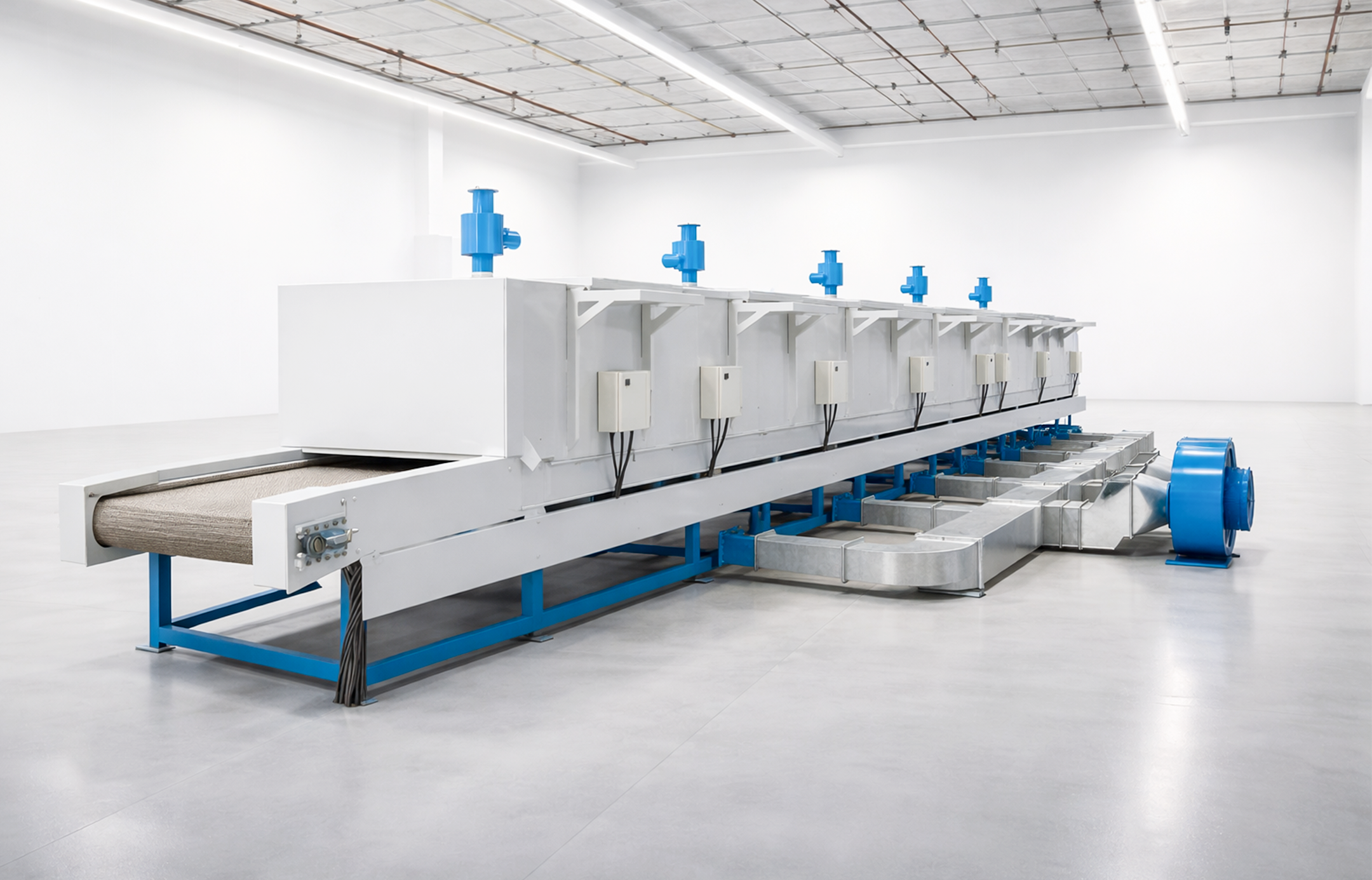
Kerone provides advanced conveyor oven engineered to deliver high efficiency, precision, and industrial-grade reliability. With over 50 years of expertise across thermal, infrared, RF, microwave, and mechanical engineering, Kerone develops customized systems tailored to industry-specific requirements, ensuring maximum productivity and operational stability.
The conveyor design enables continuous, uninterrupted production flow, eliminating the loading and unloading time associated with batch processing and significantly increasing throughput. Kerone’s Conveyor Ovens are custom-engineered for each application, with a wide range of heating technologies, conveyor types, and process zone configurations available to meet the specific requirements of each industry and product.
Why Choose Kerone Conveyor Oven
Kerone’s Conveyor Ovens are designed to integrate seamlessly into production lines, offering the reliability, throughput, and consistency demanded by modern manufacturing operations. The company’s engineering capability spans the full range of conveyor oven technologies — from simple single-zone electric ovens for light drying applications to complex multi-zone gas-fired systems for demanding curing and heat treatment processes. Kerone provides a complete turnkey service including engineering design, manufacture, installation, commissioning, and ongoing support.
Types and Features of Conveyor Oven
Conveyor Ovens from Kerone are available with mesh belt, slat, roller hearth, or chain-on-edge conveyors, each suited to specific product types. Heating can be by electric resistance, gas-fired, infrared, or steam, with forced convection as standard for temperature uniformity. Multi-zone temperature control allows independent management of the pre-heat, processing, and cool-down zones. Oven widths range from 300 mm to 3000 mm and lengths from 3 m to 50 m.
Key Features
High operational efficiency with uniform processing
Adjustable temperature, airflow, or RF/IR power settings
Batch and continuous configurations available
Low maintenance with long service life
Custom material flow and heating patterns
Safety interlocks and advanced control systems
Powered by AI, ML & IoT
Future-Ready Engineering Driven by AI & IoT
Our advanced AI, ML, and IoT technologies, this solution delivers smarter automation, real-time insights, and predictive intelligence to enhance efficiency and drive future-ready growth.
Real-Time Monitoring & Control
Continuous tracking of process parameters with instant adjustments.
Predictive Maintenance
Intelligent fault detection to prevent failures before they occur.
Adaptive Process Optimization
Dynamic tuning of operations for maximum output and efficiency.
Cloud Dashboards & Analytics
Unified access to real-time insights and performance trends.
Energy & Resource Savings
Smarter utilization of energy to cut costs and reduce waste.
Secure IoT Connectivity
Encrypted data flow with seamless integration across plant systems.
Applications of Conveyor Oven
Kerone’s Conveyor Ovens are extensively used across a broad range of manufacturing industries. Typical applications include:
Curing of powder and liquid coatings on metal and plastic components
Continuous drying of printed and coated substrates in converting lines
Heat treatment and annealing of metal components in automotive production
Continuous cooking, baking, and sterilization in food processing
Drying and sintering of ceramic components in continuous kilns
Reflow soldering and component curing in electronics assembly lines
Kerone’s conveyor oven solutions deliver unmatched quality, safety, and operational performance. Each system is tailored to meet production targets while ensuring energy savings, reliability, and long-term industrial value. With an extensive range of conveyor types, heating technologies, and oven configurations available, Kerone can deliver the exact conveyor oven solution required for any application. The combination of robust construction, intelligent control, and Kerone’s exceptional application knowledge ensures that every installation delivers maximum productivity and quality from day one.
Seamless Export Connections Global & Local
Our Global Footprint in Industrial Excellence
Delivering world-class industrial and process solutions across countries with precision, innovation, and reliability.
Peru
Chile
Argentina
Mexico
Colombia
Brazil
USA
Canada
United Kingdom
France
Germany
Spain
Italy
Netherlands
Sweden
Switzerland
Poland
Portugal
Ireland
Czechia
Romania
Hungary
Austria
Greece
Kazakhstan
Uzbekistan
Turkmenistan
Algeria
Egypt
Nigeria
Kenya
South Africa
Saudi Arabia
UAE
Israel
Russia
India
China
Japan
South Korea
Thailand
Vietnam
Malaysia
Singapore
Indonesia
Philippines
Australia
New Zealand
Pan-India Presence. Local Expertise.
Raipur
Bilaspur
Panaji
Vasco da Gama
Gandhinagar
Ahmedabad
Surat
Chandigarh
Gurgaon
Shimla
Manali
Bengaluru
Mysore
Kochi
Pune
Mumbai
Thane
Navi Mumbai
Hyderabad
Chennai
Coimbatore
Kolkata
Lucknow
Jaipur
Udaipur
Jodhpur
Dehradun
Haridwar
Bhubaneswar
Product Gallery
Frequently Asked Questions (FAQ)
A conveyor oven controls process consistency through multiple independently regulated zones along the conveyor path, each maintaining a set temperature regardless of how much product is currently passing through it. Forced convection air circulation, standard on Kerone's systems, ensures temperature uniformity across the oven width as well as its length, preventing edge effects where products near the oven walls process differently from those in the center. Conveyor speed is synchronized with zone temperatures so that every product spends the same calculated dwell time at each process stage. This combination of zoned temperature control, forced airflow, and speed synchronization is what allows a conveyor oven to deliver repeatable results across a continuous, high-volume production run.
Yes, Kerone designs systems that significantly reduce operational energy consumption.
Conveyor oven sizing starts with the product footprint and required dwell time at process temperature. Oven width must accommodate the widest product plus clearance for airflow, while length is calculated from dwell time multiplied by intended conveyor speed. The number of zones depends on the process: simple drying may need only a single zone, while curing followed by controlled cooling requires at least two independently controlled sections. Buyers should also specify peak hourly throughput, since this determines belt speed and, in turn, minimum oven length for a given dwell time. Kerone's engineering team works from product samples and process specifications to calculate these parameters precisely, avoiding the common pitfall of undersizing an oven that later becomes a production bottleneck.
Manufacturing, food, chemicals, biomass, pharma, packaging, and advanced materials.
Manual or static heating methods are prone to operator-dependent variation, where dwell time and positioning differ from one production run to the next. A conveyor oven removes this variability by mechanically controlling exposure time and temperature for every unit processed, which is particularly important for coating cure, heat treatment, or sterilization processes where under- or over-processing directly affects product performance. Multi-zone temperature control also allows a controlled ramp into and out of peak temperature, reducing thermal shock that can cause cracking, warping, or coating defects. The result is a measurable reduction in rejection rates and a more consistent finished product specification across an entire production shift, not just the first few units after setup.
Yes, from installation to lifetime service support, Kerone provides complete assistance.
Conveyor oven operating cost is driven primarily by heating technology, insulation quality, and how closely zone temperatures are matched to actual process requirements rather than set conservatively high. Electric resistance heating offers precise control but typically costs more per unit of energy than gas-fired systems in regions with lower gas prices. Forced convection with efficient air recirculation reduces the energy needed to maintain zone temperatures compared to open or poorly insulated designs. Conveyor speed also affects cost indirectly: running slower than necessary to achieve dwell time wastes oven capacity and increases per-unit energy consumption. Kerone designs systems with insulated panel construction and zone-specific control to minimize these inefficiencies, and can provide energy consumption estimates during the design phase.
Yes, Kerone designs cool-down zones at the oven exit for controlled cooling before product handling or further processing.
Conveyor ovens require periodic inspection of the conveyor belt or chain for wear, tension, and tracking, since misalignment can cause uneven product spacing and inconsistent dwell time. Heating elements, whether electric, gas burners, or infrared emitters, should be checked for output consistency and replaced proactively before failure rather than reactively. Air circulation fans and ductwork need cleaning to prevent buildup that reduces airflow efficiency, particularly in processes involving coatings, food residue, or particulates. Temperature sensors and zone controllers benefit from annual calibration against a certified reference to catch drift before it affects product quality. Kerone designs conveyor ovens with accessible panels and modular components specifically to make these routine tasks straightforward for in-house maintenance teams.
Installation time depends on size; smaller ovens can be commissioned in days, while large custom systems may take several weeks.
Yes, Kerone provides temperature uniformity surveys and process validation documentation upon request.
One common misconception is that a conveyor oven simply applies a single temperature throughout its length, when in practice most industrial systems use multiple independently controlled zones to deliver a tailored thermal profile rather than uniform heat. Another is assuming that faster conveyor speed always increases throughput, without accounting for the fact that speed and dwell time are directly linked, so increasing speed beyond the process requirement reduces processing quality rather than improving output. Buyers also sometimes underestimate how much oven length is needed for adequate cool-down before product handling, leading to handling difficulties downstream. Clarifying these points early in the design conversation helps ensure the final oven specification matches actual process requirements rather than assumptions.
In many cases, yes. Kerone designs conveyor ovens with modular zone construction, which allows additional heating, cooling, or dwell sections to be added at the entrance, exit, or as an extension of the existing tunnel, provided sufficient floor space is available. This is particularly relevant for manufacturers anticipating new product lines that require additional cure stages or longer dwell times than current production. Retrofitting controls to integrate new zones with the existing control system is more straightforward when the original oven was specified with expansion in mind. Buyers planning future capacity growth should discuss modular expansion options at the initial design stage, since structural and control architecture decisions made early are harder to change later.
Kerone’s custom-designed heating and processing solutions are built to meet the demands of your growing operations. Whether you’re upgrading equipment, expanding production, or need a tailor-made solution

 Peru
Peru Chile
Chile Argentina
 Mexico
 Colombia
 Brazil
 USA
USA Canada
 United Kingdom
 France
 Germany
 Spain
Spain Italy
Italy Netherlands
 Sweden
 Switzerland
 Poland
 Portugal
 Ireland
 Czechia
 Romania
 Hungary
 Austria
 Greece
 Kazakhstan
 Uzbekistan
 Turkmenistan
 Algeria
 Egypt
Egypt Nigeria
 Kenya
Kenya South Africa
 Saudi Arabia
 UAE
UAE Israel
 Russia
 India
India China
China Japan
Japan South Korea
 Thailand
 Vietnam
 Malaysia
 Singapore
 Indonesia
 Philippines
 Australia
 New Zealand