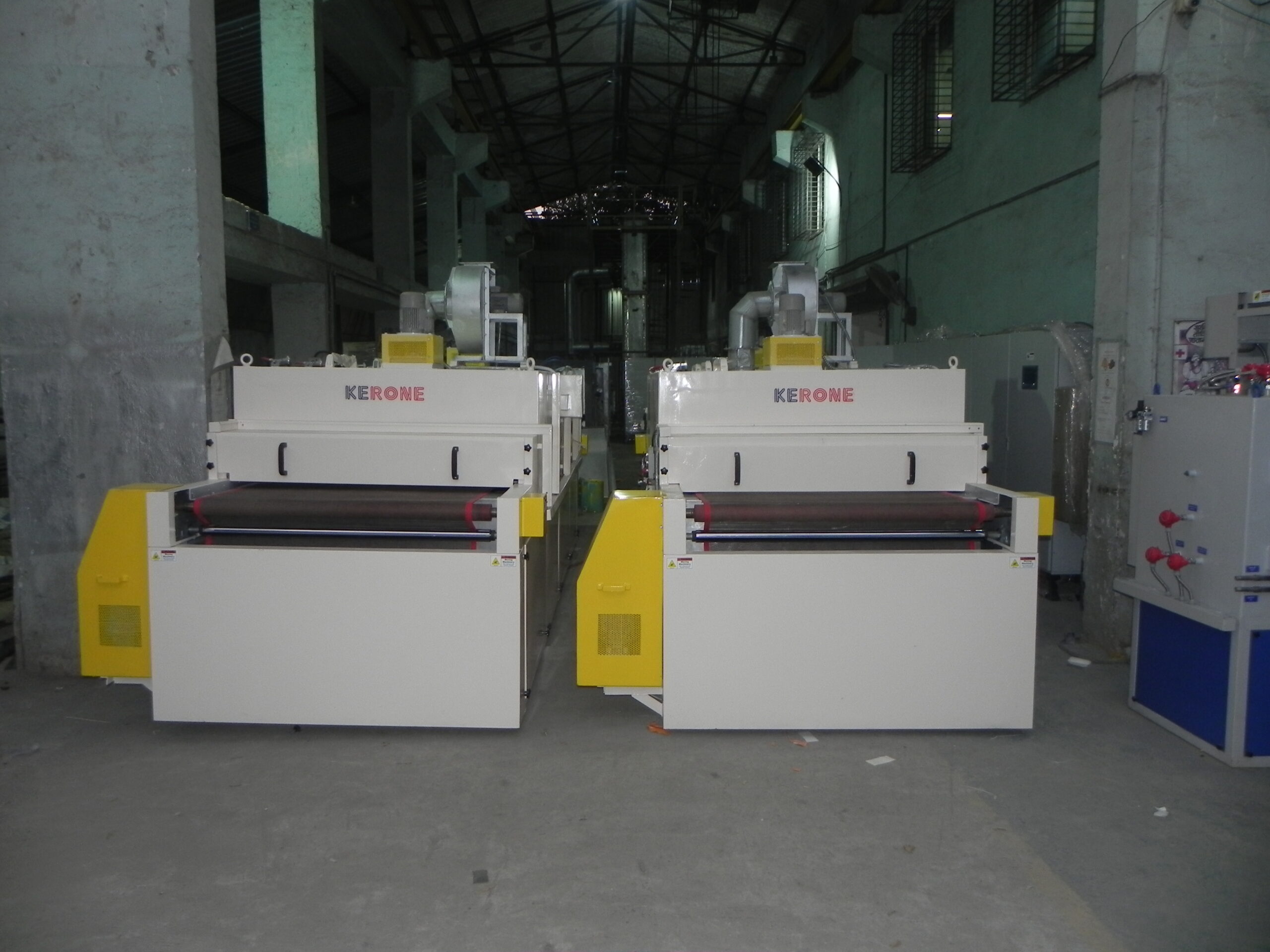
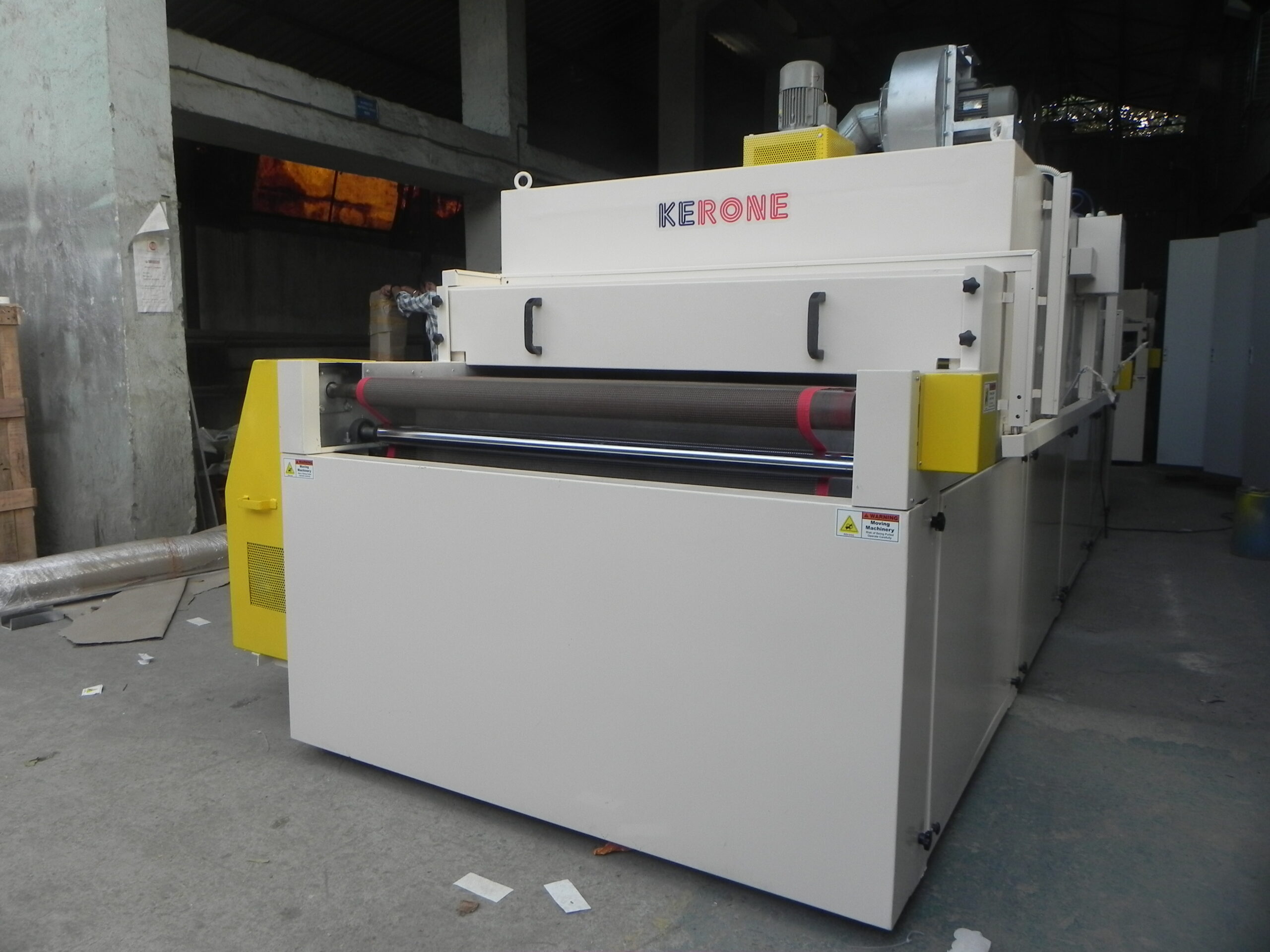
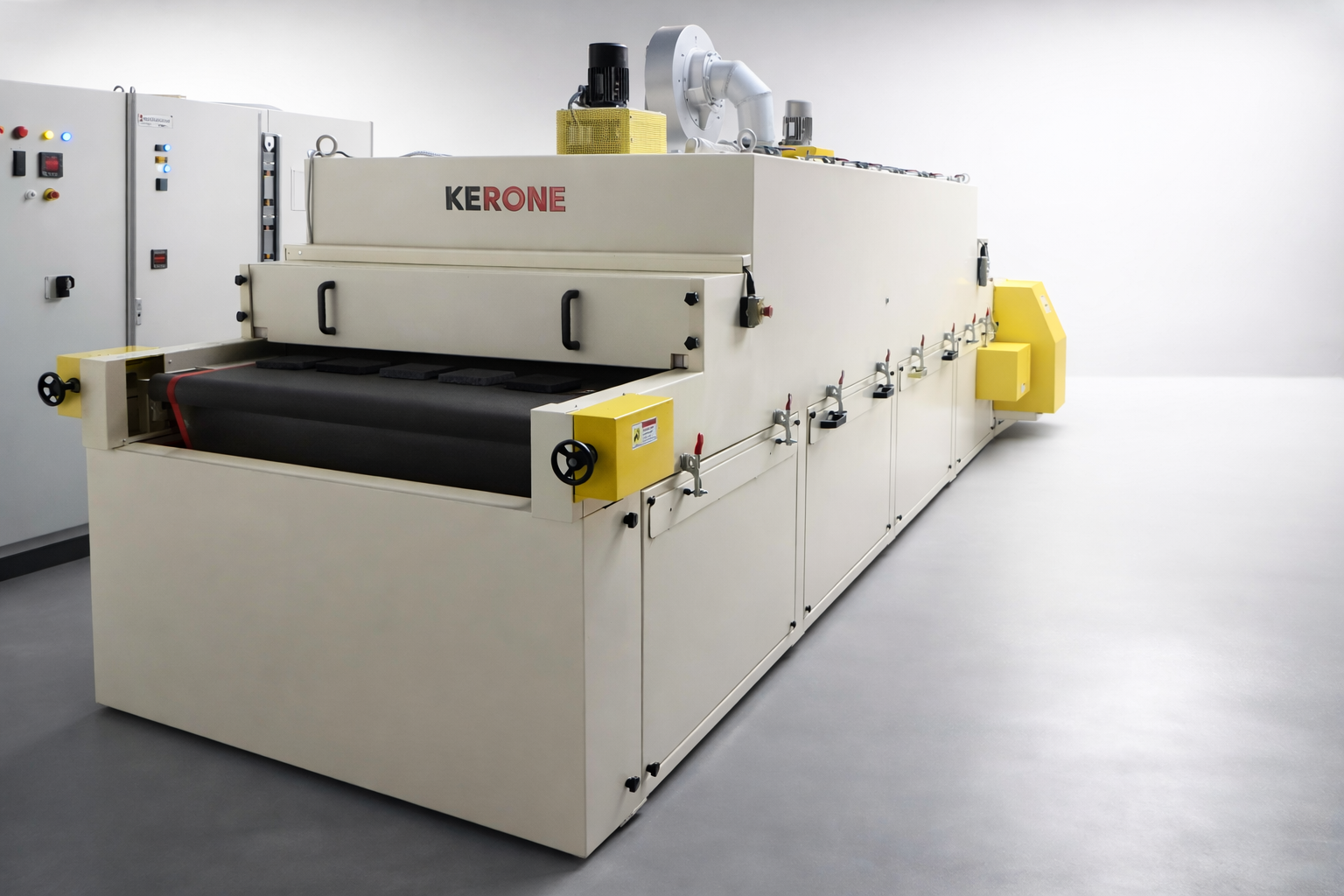
Kerone’s Continuous Type Industrial Oven is a high-performance, automated thermal processing system designed for the continuous, uninterrupted heating, drying, curing, or heat treatment of industrial products in high-volume production environments. Unlike batch ovens that process products in discrete loads, continuous industrial ovens transport products through the thermal environment automatically, enabling constant production flow, consistent product quality, and significantly higher throughput. Kerone manufactures continuous industrial ovens across a comprehensive range of sizes, temperatures, conveyor types, and heating technologies to serve virtually any industrial thermal processing application.
Why Choose Kerone Continuous Type Industrial Oven
Kerone’s Continuous Type Industrial Ovens are the backbone of many high-volume manufacturing operations, providing the combination of reliability, energy efficiency, and process consistency that competitive manufacturers demand. Kerone’s engineering team designs each oven specifically for the client’s product, process, and production rate, ensuring that the oven delivers the required temperature uniformity, throughput, and energy performance from day one. The company’s full-service project delivery approach, from engineering and procurement through installation, commissioning, and training, ensures a smooth and rapid implementation.
Types and Features of Continuous Type Industrial Oven
Kerone’s continuous industrial ovens are available in all major configurations including belt conveyors, roller hearths, pusher furnaces, walking beam systems, and chain-on-edge conveyors. Heating technologies include electric resistance, gas-fired, infrared, and combination systems. Temperature ranges from 50°C for gentle drying to 1200°C for high-temperature sintering and heat treatment. Multi-zone temperature control and atmosphere management are available for demanding process applications.
Key Features
Continuous product transport for uninterrupted high-volume production
Multi-zone temperature control for complex heating and cooling profiles
Available with electric, gas, infrared, or combination heating
Wide range of conveyor systems for diverse product sizes and weights
Advanced PLC control with recipe management and production monitoring
Energy-efficient insulation and optional heat recovery systems
Atmosphere control capability for oxidation-sensitive processes
Custom-engineered for each application and production rate
Powered by AI, ML & IoT
Future-Ready Engineering Driven by AI & IoT
Our advanced AI, ML, and IoT technologies, this solution delivers smarter automation, real-time insights, and predictive intelligence to enhance efficiency and drive future-ready growth.
Real-Time Monitoring & Control
Continuous tracking of process parameters with instant adjustments.
Predictive Maintenance
Intelligent fault detection to prevent failures before they occur.
Adaptive Process Optimization
Dynamic tuning of operations for maximum output and efficiency.
Cloud Dashboards & Analytics
Unified access to real-time insights and performance trends.
Energy & Resource Savings
Smarter utilization of energy to cut costs and reduce waste.
Secure IoT Connectivity
Encrypted data flow with seamless integration across plant systems.
Applications of Continuous Type Industrial Oven
Kerone’s Continuous Type Industrial Ovens are extensively used across heavy manufacturing, automotive, electronics, and food industries. Typical applications include:
Food, chemical, pharmaceutical, and mineral industries
Biomass, renewable fuels, and environmental systems
Packaging, paper, and pulp processing
Industrial drying, heating, curing, and material transformation
High-temperature and precision-controlled processes
Smart manufacturing with automation and AI integration
Kerone’s Continuous Type Industrial Oven represents the pinnacle of thermal processing capability for high-volume industrial manufacturing. By combining precise multi-zone temperature control, robust mechanical construction, and advanced automation, these ovens deliver the consistent, high-quality processing results that demanding manufacturing operations require. Kerone’s comprehensive engineering and project management capability ensures that every continuous oven installation is delivered on time, within budget, and fully optimized for the client’s production requirements.
Seamless Export Connections Global & Local
Our Global Footprint in Industrial Excellence
Delivering world-class industrial and process solutions across countries with precision, innovation, and reliability.
Peru
Chile
Argentina
Mexico
Colombia
Brazil
USA
Canada
United Kingdom
France
Germany
Spain
Italy
Netherlands
Sweden
Switzerland
Poland
Portugal
Ireland
Czechia
Romania
Hungary
Austria
Greece
Kazakhstan
Uzbekistan
Turkmenistan
Algeria
Egypt
Nigeria
Kenya
South Africa
Saudi Arabia
UAE
Israel
Russia
India
China
Japan
South Korea
Thailand
Vietnam
Malaysia
Singapore
Indonesia
Philippines
Australia
New Zealand
Pan-India Presence. Local Expertise.
Raipur
Bilaspur
Panaji
Vasco da Gama
Gandhinagar
Ahmedabad
Surat
Chandigarh
Gurgaon
Shimla
Manali
Bengaluru
Mysore
Kochi
Pune
Mumbai
Thane
Navi Mumbai
Hyderabad
Chennai
Coimbatore
Kolkata
Lucknow
Jaipur
Udaipur
Jodhpur
Dehradun
Haridwar
Bhubaneswar
Product Gallery
Frequently Asked Questions (FAQ)
Yes, Kerone designs systems that significantly reduce operational energy consumption.
Manufacturing, food, chemicals, biomass, pharma, packaging, and advanced materials.
Yes, from installation to lifetime service support, Kerone provides complete assistance.
High-density insulation, heat recovery from exhaust gases, efficient heating elements, and VFD-controlled fans all contribute to energy efficiency.
Kerone's modular design allows additional zones or conveyor length to be added after initial installation to meet increased production demands.
Kerone offers standard warranty periods of 12 months from commissioning, with extended warranty and annual maintenance contracts available.
Continuous oven capacity is expressed as the product mass (kg/hour) or number of pieces per hour that can be processed at the required thermal specification. Capacity is a function of oven length (determining maximum residence time at a given belt speed), oven width (determining how much product can be carried across the belt), and thermal input (determining how fast the product reaches process temperature). Kerone sizes oven length and width based on actual product throughput requirements with a design margin for production growth. For very high production volumes, wider ovens or parallel twin-track conveyors increase capacity without extending oven length. For batch-to-continuous production transitions, a modular continuous oven design allows additional heated zones to be flanged onto the existing oven as capacity requirements grow.
Yes, provided the thermal profiles for both processes are compatible with the oven's zone length and conveyor speed range. Solder reflow typically requires a precise four-stage profile: preheat, soak, reflow (peak temperature of 240–260°C for SAC alloys), and controlled cool-down. Adhesive curing profiles vary widely by adhesive chemistry, some cure at 120°C, others at 180°C or above, for durations from minutes to an hour. If both processes require similar temperatures but different dwell times, the conveyor speed can be adjusted between production runs. If the profiles are significantly different, dedicated ovens for each process are more practical. Kerone analyses both process requirements together during the application engineering phase to determine whether a single oven configuration can accommodate both.
For a continuous oven in 24/7 operation, a structured preventive maintenance programme is essential to avoid unplanned downtime. Daily checks cover belt tension and tracking, conveyor drive chain lubrication, and a visual inspection for product jams or accumulations. Weekly maintenance includes cleaning of air nozzles and ductwork, inspection of heater element resistance, and review of control system alarm logs. Monthly tasks include fan bearing lubrication, conveyor belt splice inspection, and calibration verification of temperature sensors against a reference standard. Semi-annually, the full conveyor belt should be inspected for wear, the insulation panels checked for gaps, and a thermal survey performed to confirm zone temperature uniformity is within specification. A complete oven thermal profile on a representative product sample annually confirms end-to-end process compliance.
Running different product types or sizes on the same continuous oven requires planning around several variables: the thermal profile may differ between products, requiring zone setpoint changes; the conveyor load per metre may vary, affecting airflow distribution; and fixture or tray designs may differ. Kerone implements recipe-based control that stores different zone setpoint configurations for each product type, allowing an operator to switch profiles quickly without manual re-entry of parameters. For physical dimension changes, adjustable height conveyors and modular fixture systems reduce changeover time. A thermal soak period after recipe change to allow all zones to stabilise at their new setpoints, must be factored into the changeover time budget before production restarts.
In a continuous oven operating around the clock, thermal energy costs are the dominant operating expense. Kerone designs energy efficiency into continuous ovens through high-performance mineral wool or ceramic fibre insulation that minimises heat loss through the oven shell; heat recovery systems on the exhaust air that preheat the make-up air using a recuperator or run-around coil; variable-speed fan drives that modulate recirculation airflow based on actual process demand; and aerodynamic entry and exit aperture designs (air curtains or labyrinth seals) that minimise hot air spillage from the open ends of the oven tunnel. The combined effect of these measures can reduce thermal energy consumption by 20–35% compared to a non-optimised baseline design.
A continuous oven is divided into independently controlled temperature zones along its length, each with its own heater, thermocouple, and controller. By setting different temperature setpoints in each zone, the oven can execute a complex time-temperature profile as the product passes through. Typically, the first zones provide a controlled ramp to process temperature, the middle zones maintain the soak temperature, and the final zones may provide a controlled cool-down before the product exits. The number of zones required depends on the complexity of the thermal profile. Kerone's process engineers translate the product thermal specification into an oven zone setpoint map during commissioning, then verify it with thermal profiling on representative product samples.
Continuous ovens are built around various conveyor types, each suited to different products. Flat wire mesh belt conveyors carry small parts, granules, or flat substrates and allow airflow from below through the belt. Chain-on-edge or overhead monorail conveyors hang larger components for all-around heat exposure. Roller hearth conveyors suit heavy flat or tubular products like castings and steel billets. Walking beam conveyors advance large components incrementally without belt contact. The conveyor determines how the product is oriented in the heating zone, which surfaces receive direct airflow or radiation, and how easily the product can be loaded and unloaded. Kerone selects and designs the conveyor system in conjunction with the heating system to ensure both product handling and thermal performance requirements are met.
Continuous ovens are the right choice when products flow through at a consistent rate, cycle time per piece is short relative to the thermal processing requirement, and the overhead of loading and unloading batch equipment becomes a production bottleneck. Automotive paint lines, electronics assembly lines with solder cure or conformal coating operations, metal fabrication with powder coat curing, and food production lines for biscuit baking or snack processing all rely on continuous ovens because the product does not stop. Any interruption to the continuous flow as required by batch equipment, would disrupt the entire upstream and downstream production sequence. Continuous ovens also eliminate operator loading variability, which is a common source of batch-to-batch quality inconsistency.
Kerone’s custom-designed heating and processing solutions are built to meet the demands of your growing operations. Whether you’re upgrading equipment, expanding production, or need a tailor-made solution
 Peru
Peru Chile
Chile Argentina
 Mexico
 Colombia
 Brazil
 USA
USA Canada
 United Kingdom
 France
 Germany
 Spain
Spain Italy
Italy Netherlands
 Sweden
 Switzerland
 Poland
 Portugal
 Ireland
 Czechia
 Romania
 Hungary
 Austria
 Greece
 Kazakhstan
 Uzbekistan
 Turkmenistan
 Algeria
 Egypt
Egypt Nigeria
 Kenya
Kenya South Africa
 Saudi Arabia
 UAE
UAE Israel
 Russia
 India
India China
China Japan
Japan South Korea
 Thailand
 Vietnam
 Malaysia
 Singapore
 Indonesia
 Philippines
 Australia
 New Zealand