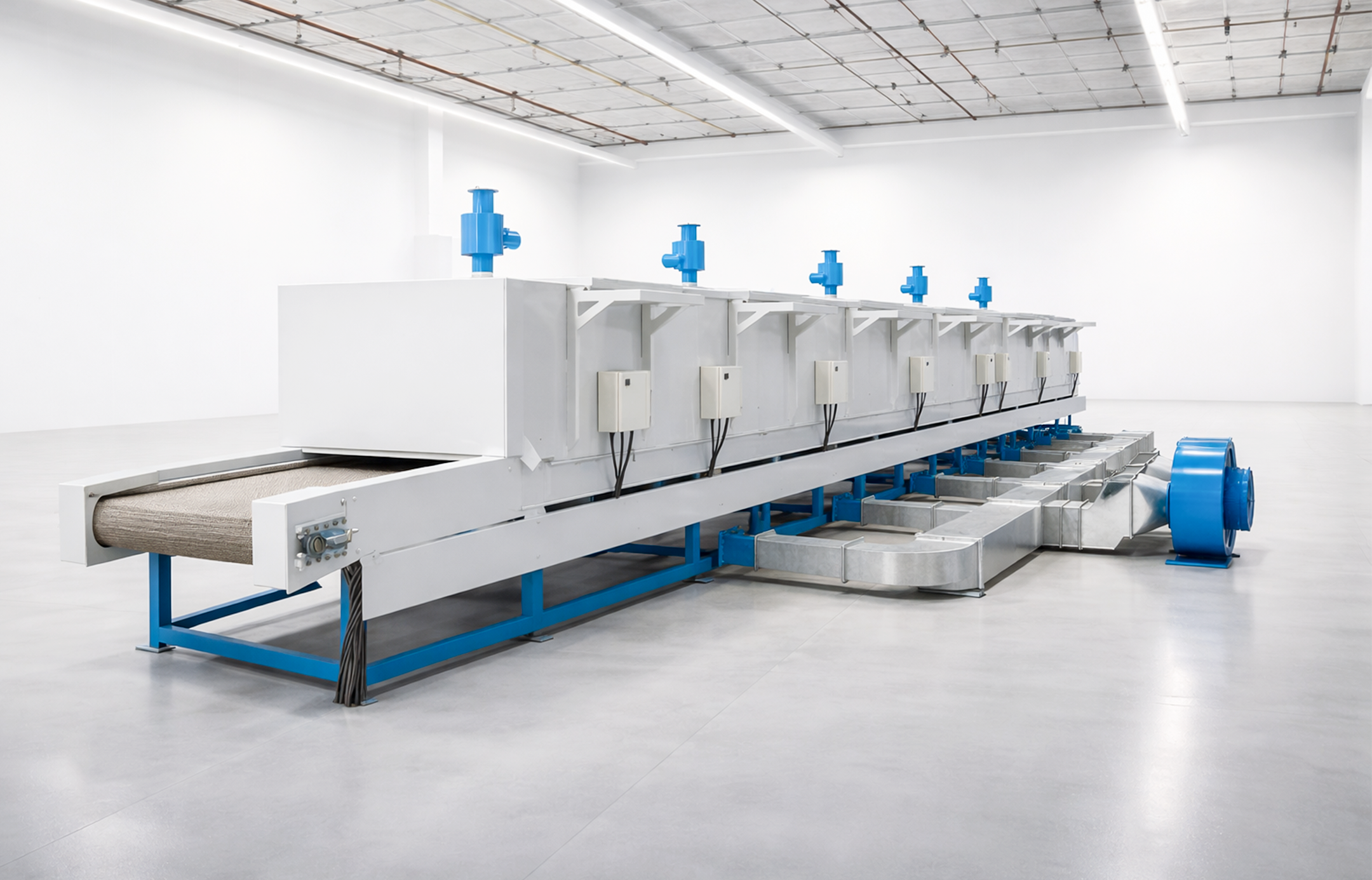
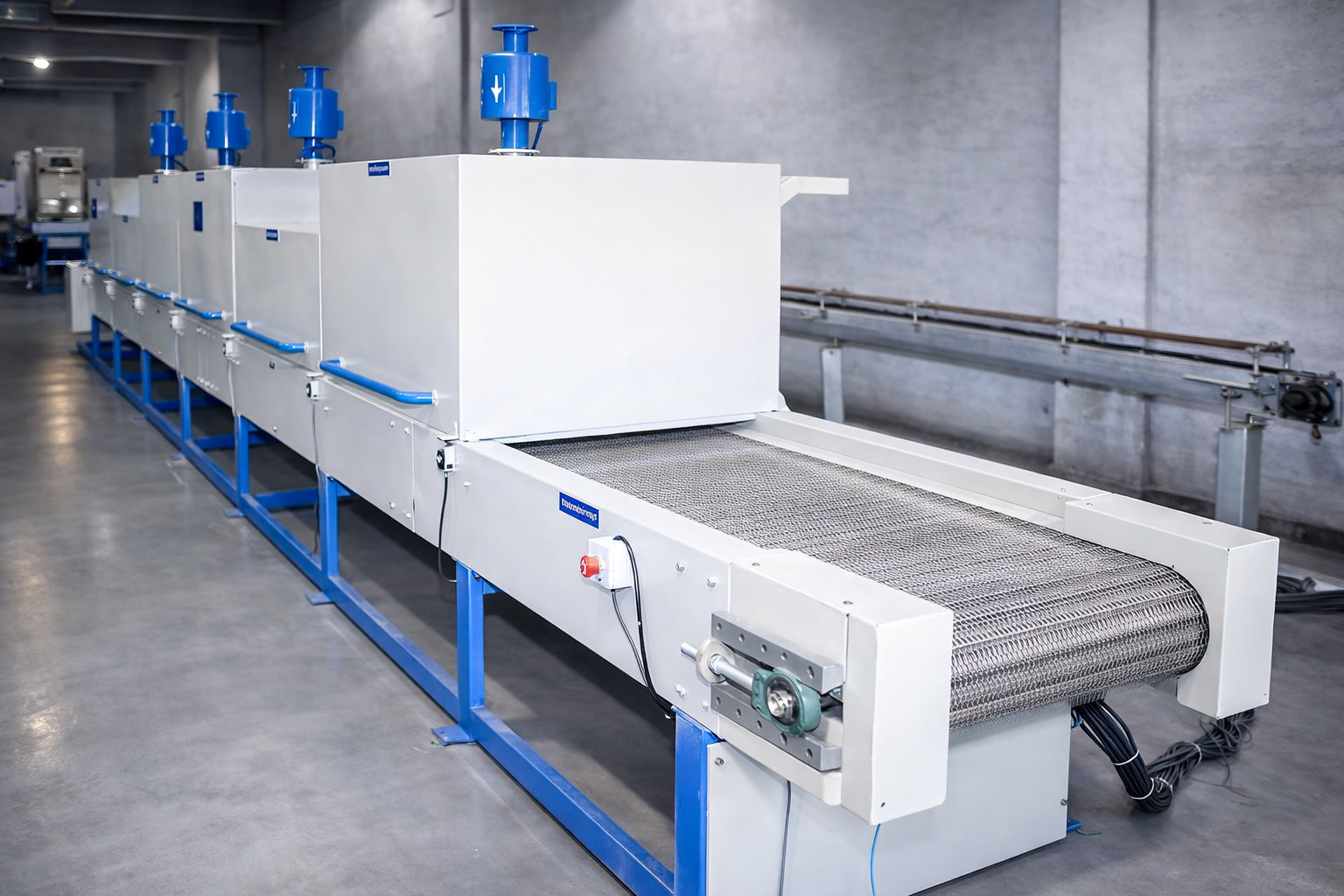
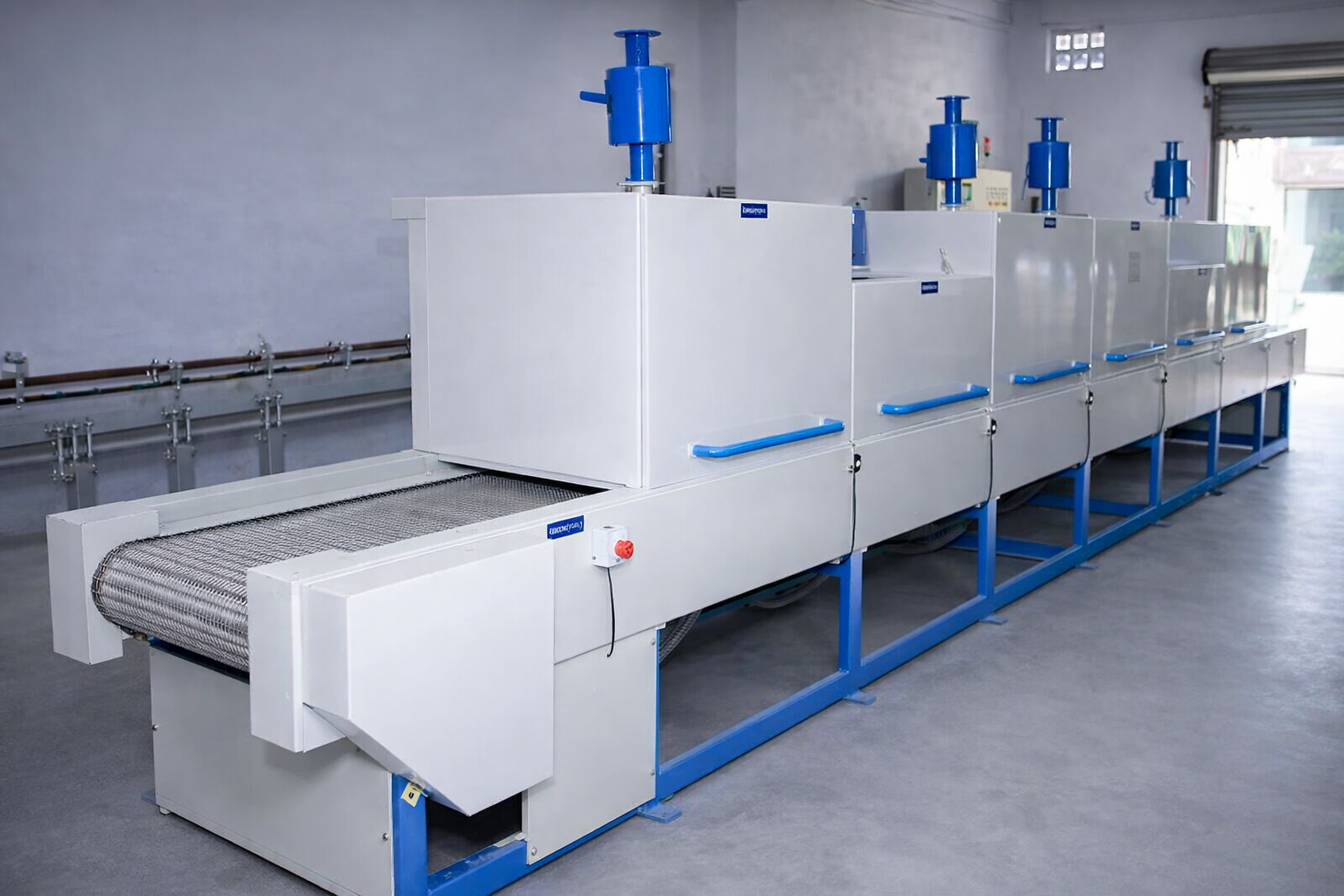
Kerone provides advanced flat belt conveyorised oven engineered to deliver high efficiency, precision, and industrial-grade reliability. With over 50 years of expertise across thermal, infrared, RF, microwave, and mechanical engineering, Kerone develops customized systems tailored to industry-specific requirements, ensuring maximum productivity and operational stability.
Designed for high-volume manufacturing environments, these ovens deliver consistent, repeatable thermal treatment with minimal operator intervention. The flat belt conveyorised configuration is particularly well suited to industries where products need to move through multiple temperature zones in a precisely controlled sequence, such as electronics manufacturing, automotive component production, and food processing.
Why Choose Kerone Flat Belt Conveyorised Oven
Kerone’s Flat Belt Conveyorised Oven is engineered for industrial production demands, offering robust construction, reliable continuous operation, and the flexibility to handle a diverse range of product types. The sophisticated multi-zone control system allows manufacturers to define precise temperature profiles along the conveyor length, enabling complex processes such as pre-heat, cure, and cool-down to be carried out in a single pass. Kerone’s engineering expertise ensures that the oven is designed for easy integration with upstream and downstream equipment, minimizing changeover time and maximizing overall line efficiency.
Types and Features of Flat Belt Conveyorised Oven
These ovens are available in widths from 300 mm to 1500 mm and lengths from 3 m to 25 m, with independent temperature control in up to 10 zones. Heating elements can be electric resistance, gas burners, or infrared, with forced convection as standard. The conveyor drive system uses variable frequency drives for precise, stepless speed control, and the belt is available in multiple materials to suit the product and temperature range.
Key Features
Multi-zone independent temperature control for complex process profiles
Flat belt transport for stable, consistent product positioning
Variable frequency drive for precise belt speed control
Forced hot air recirculation ensuring uniform temperature in each zone
High operational efficiency with uniform processing
Adjustable temperature, airflow, or RF/IR power settings
Batch and continuous configurations available
Low maintenance with long service life
Custom material flow and heating patterns
Safety interlocks and advanced control systems
Powered by AI, ML & IoT
Future-Ready Engineering Driven by AI & IoT
Our advanced AI, ML, and IoT technologies, this solution delivers smarter automation, real-time insights, and predictive intelligence to enhance efficiency and drive future-ready growth.
Real-Time Monitoring & Control
Continuous tracking of process parameters with instant adjustments.
Predictive Maintenance
Intelligent fault detection to prevent failures before they occur.
Adaptive Process Optimization
Dynamic tuning of operations for maximum output and efficiency.
Cloud Dashboards & Analytics
Unified access to real-time insights and performance trends.
Energy & Resource Savings
Smarter utilization of energy to cut costs and reduce waste.
Secure IoT Connectivity
Encrypted data flow with seamless integration across plant systems.
Applications of Flat Belt Conveyorised Oven
Kerone’s Flat Belt Conveyorised Ovens are extensively used in electronics, automotive, and food processing industries. Typical applications include:
Food, chemical, pharmaceutical, and mineral industries
Biomass, renewable fuels, and environmental systems
Packaging, paper, and pulp processing
Industrial drying, heating, curing, and material transformation
High-temperature and precision-controlled processes
Smart manufacturing with automation and AI integration
Kerone’s flat belt conveyorised oven solutions deliver unmatched quality, safety, and operational performance. Each system is tailored to meet production targets while ensuring energy savings, reliability, and long-term industrial value.
Seamless Export Connections Global & Local
Our Global Footprint in Industrial Excellence
Delivering world-class industrial and process solutions across countries with precision, innovation, and reliability.
Peru
Chile
Argentina
Mexico
Colombia
Brazil
USA
Canada
United Kingdom
France
Germany
Spain
Italy
Netherlands
Sweden
Switzerland
Poland
Portugal
Ireland
Czechia
Romania
Hungary
Austria
Greece
Kazakhstan
Uzbekistan
Turkmenistan
Algeria
Egypt
Nigeria
Kenya
South Africa
Saudi Arabia
UAE
Israel
Russia
India
China
Japan
South Korea
Thailand
Vietnam
Malaysia
Singapore
Indonesia
Philippines
Australia
New Zealand
Pan-India Presence. Local Expertise.
Raipur
Bilaspur
Panaji
Vasco da Gama
Gandhinagar
Ahmedabad
Surat
Chandigarh
Gurgaon
Shimla
Manali
Bengaluru
Mysore
Kochi
Pune
Mumbai
Thane
Navi Mumbai
Hyderabad
Chennai
Coimbatore
Kolkata
Lucknow
Jaipur
Udaipur
Jodhpur
Dehradun
Haridwar
Bhubaneswar
Product Gallery
Frequently Asked Questions (FAQ)
Yes, Kerone offers fully customized engineering based on capacity, temperature, and industry needs.
PLC, SCADA, IoT, AI/ML predictive systems, and remote monitoring.
Yes, Kerone designs systems that significantly reduce operational energy consumption.
Manufacturing, food, chemicals, biomass, pharma, packaging, and advanced materials.
Yes, from installation to lifetime service support, Kerone provides complete assistance.
Yes, as long as their process temperatures are compatible, different products can be processed simultaneously on the same belt.
Belt speed is typically adjustable from 0.1 m/min to 10 m/min using variable frequency drives, depending on the drive system specification.
Yes, Kerone provides data logging of temperature, belt speed, and process parameters with time-stamped records for quality assurance.
Belt width and oven length are set by three factors: part size, required dwell time, and target throughput. Start with the dwell time your process needs at the target temperature, then work backward, dwell time equals oven length divided by belt speed. A wider belt increases capacity per pass but raises energy consumption per unit processed, so it only pays off if you can keep the belt loaded across its full width. Kerone's engineering team reviews your part geometry, batch size, and cycle time targets before finalizing dimensions, rather than offering a single standard size. Undersizing the oven is the most common selection mistake, since it forces operators to slow the belt to compensate, cutting daily output below the original production plan.
Uneven heating across belt width usually traces back to airflow distribution, not the heating elements themselves. If recirculation fans and ducting aren't balanced, the center of the belt can run hotter or cooler than the edges, leading to inconsistent curing, drying, or finish quality from one side of the product to the other. Kerone addresses this with zone-specific airflow design and adjustable dampers that let operators fine-tune distribution after installation and during periodic process audits. Belt loading pattern also matters: gaps or uneven product spacing change local airflow resistance, so operators should maintain consistent loading density across trials. Routine thermal mapping with a traveling data logger is the most reliable way to confirm uniformity before running a production batch.
A batch oven processes one full load per cycle, then requires loading and unloading time before the next cycle starts, which makes total throughput dependent on operator speed and cycle scheduling. A flat belt conveyorised oven keeps product moving continuously, so throughput depends only on belt speed and zone length, making output far more predictable and easier to forecast for production planning. The trade-off is flexibility: batch ovens handle small, varied orders more economically, while conveyorised ovens are justified when volume is consistent enough to keep the belt loaded most of the shift. Many manufacturers run both — a conveyorised oven for core production and a batch oven for short runs, prototypes, or rush orders that don't justify continuous-line setup time.
With proper maintenance, the structural shell, insulation, and control cabinet of a flat belt conveyorised oven typically last 15 to 25 years. The belt itself is the component with the shortest service life, generally 3 to 8 years depending on material, operating temperature, and product abrasiveness, since it experiences continuous mechanical flexing and thermal cycling that the frame does not. Heating elements and burners are the next wear items, usually rated for 5 to 10 years of continuous duty before replacement. Lifespan extends meaningfully when operators avoid running zones above their rated temperature to compensate for line speed, since overdriving a zone accelerates insulation degradation and element fatigue well beyond normal wear curves.
Yes, scalability is one of the practical advantages of this configuration, but it depends on how the oven was specified at the outset. Adding zones at either end is straightforward if the original frame and control architecture were designed with spare PLC capacity and matching belt tension hardware. Widening the belt after installation is far more disruptive, since it usually means rebuilding the frame and drive system rather than modifying the existing unit. Buyers anticipating volume growth within five years should specify slightly larger zone capacity and PLC I/O headroom upfront, even if early production doesn't use it, because retrofitting later costs considerably more than designing in the margin from day one.
The most frequent error is sizing the oven around average production volume instead of peak demand, which leaves no margin during order surges and forces overtime or outsourcing during busy periods. A closely related mistake is underestimating dwell time requirements for new product variants, a formulation or coating that cures in 90 seconds in small-scale trials may need significantly longer at full line speed once thermal mass and airflow shadowing are factored in. Buyers also frequently skip a pilot trial on their actual product before finalizing oven specifications, relying instead on data sheets for similar materials. Kerone recommends a trial run at its R&D facility whenever the product, coating, or substrate hasn't previously been processed on a comparable oven.
Belt material directly affects both product contact quality and long-term operating economics. Stainless steel mesh belts offer excellent durability and airflow permeability for drying applications but can mark soft or delicate surfaces. PTFE-coated fiberglass belts provide a smoother, non-stick contact surface ideal for coated or printed products, though they have lower maximum temperature ratings than steel mesh. Silicone belts handle flexible, lightweight materials well but wear faster under abrasive loads. Choosing the wrong belt for the application often shows up as quality defects or premature replacement cycles rather than obvious failure, so Kerone matches belt specification to product characteristics and process temperature during the design phase rather than defaulting to a single standard belt type.
Kerone’s custom-designed heating and processing solutions are built to meet the demands of your growing operations. Whether you’re upgrading equipment, expanding production, or need a tailor-made solution
 Peru
Peru Chile
Chile Argentina
 Mexico
 Colombia
 Brazil
 USA
USA Canada
 United Kingdom
 France
 Germany
 Spain
Spain Italy
Italy Netherlands
 Sweden
 Switzerland
 Poland
 Portugal
 Ireland
 Czechia
 Romania
 Hungary
 Austria
 Greece
 Kazakhstan
 Uzbekistan
 Turkmenistan
 Algeria
 Egypt
Egypt Nigeria
 Kenya
Kenya South Africa
 Saudi Arabia
 UAE
UAE Israel
 Russia
 India
India China
China Japan
Japan South Korea
 Thailand
 Vietnam
 Malaysia
 Singapore
 Indonesia
 Philippines
 Australia
 New Zealand