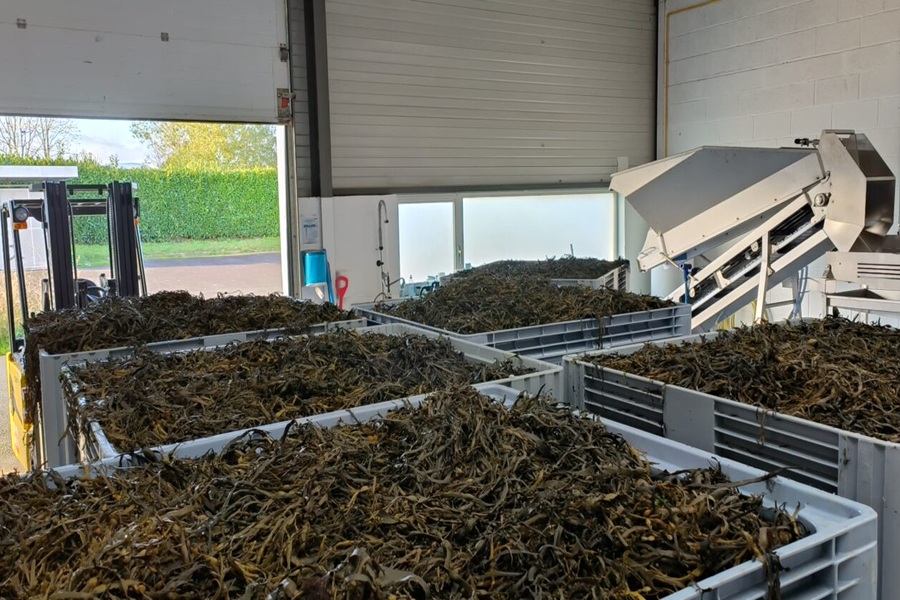
Fresh seaweed is a biologically active material that begins to degrade rapidly after harvest due to endogenous enzymatic activity, microbial proliferation, and oxidative reactions. Without effective stabilization, harvested seaweed loses its phytochemical integrity, organoleptic quality, and market value within hours. Kerone’s Seaweed Preservation and Stabilization Module is a purpose-built processing system designed to arrest biological degradation and extend the shelf life of fresh seaweed biomass through precisely controlled thermal, mechanical, and chemical-free stabilization processes. The module can be integrated immediately post-harvest or as the first step in a seaweed processing line, ensuring that the full nutritional and functional value of the raw material is preserved for downstream processing into food ingredients, extracts, biostimulants, or other high-value products. Kerone’s stabilization technology combines rapid temperature reduction or controlled heat treatment with optimized handling to minimize cell disruption and oxidative degradation while achieving regulatory-compliant microbial inactivation.
Why Choose Kerone Seaweed Preservation and Stabilization Module
Kerone’s Seaweed Stabilization Module is engineered with a deep understanding of the unique biochemistry of marine macroalgae — including the activity profiles of alginases, fucoidanases, chlorophyllases, and polyphenol oxidases — allowing precise process calibration to deactivate the most damaging enzymes while preserving desired bioactives. Unlike generic food stabilization equipment, Kerone’s system is purpose-built for the high-moisture, saline, and biologically complex nature of seaweed biomass. The module supports multiple stabilization pathways including mild heat treatment (blanching-based), rapid chilling or cold chain stabilization, and vacuum or modified atmosphere packaging pre-treatment, giving processors the flexibility to select the optimal approach for their product and market requirements. Kerone’s engineering team works directly with clients to develop and validate stabilization protocols that meet their specific shelf-life, quality, and regulatory targets.
Types and Features of Seaweed Preservation and Stabilization Module
Kerone’s Seaweed Stabilization Module is available in thermal stabilization (hot water or steam), rapid chilling (cold water or glycol-based), and hybrid thermal-chill configurations. Each module is designed for continuous operation and can process fresh seaweed within minutes of harvest, significantly reducing biological degradation. The system features precise temperature monitoring and control, automated material feeding and discharging, residence time control via adjustable belt or screw conveyors, and hygienic SS316 construction throughout. Optional features include vacuum sealing integration for stabilized product packaging, modified atmosphere flushing (nitrogen or CO2) for extended cold storage, and inline colour measurement to verify preservation of pigmentation. The module is compact, skid-mounted, and can be deployed on mobile processing vessels or in land-based shore facilities for rapid post-harvest stabilization.
Key Features
Rapid biological stabilization within minutes of seaweed harvest to arrest enzymatic degradation and color loss
Multiple stabilization modes — thermal, chilling, or hybrid — selectable based on species and target application
Precise temperature and residence time control with automatic PLC-based recipe management
Food-grade SS316 construction with hygienic design principles for marine environment deployment
Optional inline color and NIR quality monitoring for real-time confirmation of stabilization effectiveness
Compact, skid-mounted design for easy deployment on vessels, dockside facilities, or land-based plants
CIP-compatible construction for rapid sanitation and changeover between batches or species
Integration-ready design for seamless connection to downstream blanching, shredding, pressing, and drying modules
Powered by AI, ML & IoT
Future-Ready Engineering Driven by AI & IoT
Our advanced AI, ML, and IoT technologies, this solution delivers smarter automation, real-time insights, and predictive intelligence to enhance efficiency and drive future-ready growth.
Real-Time Monitoring & Control
Continuous tracking of process parameters with instant adjustments.
Predictive Maintenance
Intelligent fault detection to prevent failures before they occur.
Adaptive Process Optimization
Dynamic tuning of operations for maximum output and efficiency.
Cloud Dashboards & Analytics
Unified access to real-time insights and performance trends.
Energy & Resource Savings
Smarter utilization of energy to cut costs and reduce waste.
Secure IoT Connectivity
Encrypted data flow with seamless integration across plant systems.
Applications of Seaweed Preservation and Stabilization Module
Kerone’s Seaweed Preservation and Stabilization Modules are extensively used in seaweed harvesting and processing operations globally.
Typical applications include:
Coastal and offshore seaweed farming operations requiring immediate post-harvest stabilization before transport to processing facilities
Fresh seaweed food product lines — stabilizing Wakame, Nori, and Dulse for direct-to-consumer fresh or chilled retail formats
Bioactive extraction preparation — preserving fucoidan, laminarin, and alginic acid integrity before solvent or water extraction processes
Biostimulant production — stabilizing seaweed biomass to preserve plant-hormone activity (cytokinins, auxins, betaines) in liquid extract products
Research and pilot plant operations — controlled stabilization of harvested biomass for consistent experimental inputs across batch studies
Export supply chain operations — stabilizing seaweed at source for transport to processing facilities in other regions or countries
The biological stability of seaweed biomass from harvest to processing is one of the most critical factors determining product quality and commercial viability. Kerone’s Seaweed Stabilization Module provides the precise, reliable, and scalable stabilization capability that modern seaweed producers and processors need to protect their raw material investment and deliver consistent, high-quality products to market. Whether stabilizing at sea, dockside, or in a land-based facility, Kerone’s module is the trusted first line of defense against quality degradation in the seaweed processing chain.
Seamless Export Connections Global & Local
Our Global Footprint in Industrial Excellence
Delivering world-class industrial and process solutions across countries with precision, innovation, and reliability.
Peru
Chile
Argentina
Mexico
Colombia
Brazil
USA
Canada
United Kingdom
France
Germany
Spain
Italy
Netherlands
Sweden
Switzerland
Poland
Portugal
Ireland
Czechia
Romania
Hungary
Austria
Greece
Kazakhstan
Uzbekistan
Turkmenistan
Algeria
Egypt
Nigeria
Kenya
South Africa
Saudi Arabia
UAE
Israel
Russia
India
China
Japan
South Korea
Thailand
Vietnam
Malaysia
Singapore
Indonesia
Philippines
Australia
New Zealand
Pan-India Presence. Local Expertise.
Raipur
Bilaspur
Panaji
Vasco da Gama
Gandhinagar
Ahmedabad
Surat
Chandigarh
Gurgaon
Shimla
Manali
Bengaluru
Mysore
Kochi
Pune
Mumbai
Thane
Navi Mumbai
Hyderabad
Chennai
Coimbatore
Kolkata
Lucknow
Jaipur
Udaipur
Jodhpur
Dehradun
Haridwar
Bhubaneswar
Product Gallery
Frequently Asked Questions (FAQ)
Ideally, seaweed should be stabilized within 2–4 hours of harvest, as enzymatic degradation and microbial activity begin immediately. Kerone's stabilization modules are designed for rapid deployment and operation to minimize the window of biological activity post-harvest.
Stabilization is a broader pre-treatment process aimed at arresting all forms of biological degradation including enzymatic, microbial, and oxidative. Blanching is a specific thermal sub-process within stabilization that also achieves iodine reduction. Kerone's stabilization module can incorporate blanching as one of its functions.
Yes. Kerone offers compact, skid-mounted stabilization modules designed for deployment on vessels, with corrosion-resistant marine-grade construction and stabilized power supply compatibility.
Properly designed thermal stabilization fixes the natural green color of Chlorophyll-containing seaweeds by inactivating chlorophyllase, and maintains texture within acceptable parameters for downstream processing. Kerone's systems are calibrated to minimize color and texture changes.
All commercially important seaweed species benefit from rapid stabilization, but particularly Undaria (Wakame), Ulva (Sea Lettuce), and Ascophyllum nodosum, which contain high enzymatic activity and degrade quickly after harvest.
Kerone's standard stabilization modules are chemical-free, using only heat, cold water, or modified atmospheres. This makes them compatible with organic certification and clean-label product requirements.
Yes. Kerone designs continuous-feed stabilization modules capable of handling from 500 kg/hour to several tonnes per hour, suitable for commercial-scale seaweed farming and processing operations.
Stabilization effectiveness is verified through enzyme activity assays, microbial plate counts, color measurement, and peroxide value testing. Kerone can assist clients in establishing validation protocols for regulatory and quality management purposes.
Fresh seaweed contains active enzymes including alginases that break down structural alginate, fucoidanases that degrade fucoidan, chlorophyllases that cause the characteristic loss of green color, and polyphenol oxidases that drive browning and oxidative degradation. These enzymes remain biologically active immediately after harvest and accelerate quality loss within hours if untreated. Stabilization works by either denaturing these enzymes through controlled heat application, which permanently deactivates their catalytic function, or by rapidly chilling the biomass to slow enzymatic reaction rates without fully stopping them. Kerone's process calibration targets the specific enzyme activity profile of each species, since different seaweeds carry different dominant degradation pathways requiring slightly different thermal or chilling protocols.
Thermal stabilization permanently deactivates degradative enzymes, making it suitable for products with extended shelf-life requirements or those proceeding to high-temperature downstream processing where enzyme reactivation is not a concern. However, heat treatment causes some unavoidable changes to texture and can affect heat-sensitive bioactive compounds. Rapid chilling slows but does not eliminate enzymatic activity, preserving more of the biomass's native textural and biochemical properties, making it preferable for fresh-format retail products or bioactive extraction applications where heat-labile compounds like certain polysaccharides or pigments must remain intact. Kerone's hybrid thermal-chill configurations allow processors to apply just enough heat to control the most damaging enzymes while minimizing further thermal exposure, balancing shelf stability against bioactive preservation.
Enzymatic degradation, microbial proliferation, and oxidative reactions begin essentially the moment seaweed is removed from seawater, and these processes compound rapidly since enzyme activity, bacterial growth, and oxidation all accelerate each other under ambient post-harvest conditions. Seaweed left unstabilized for several hours can show visible color loss, textural breakdown, off-odor development, and significant reduction in target bioactive compound concentration, all of which reduce market value or render the batch unsuitable for premium applications. Once significant degradation has occurred, no downstream processing step can fully recover lost quality. This is why Kerone designs stabilization modules for rapid deployment immediately at the point of harvest rather than after transport to a centralized facility, wherever logistically feasible.
Vessel-based deployment requires a compact, skid-mounted unit with marine-grade corrosion-resistant construction able to withstand the saline, humid, and motion-exposed environment of a working boat, along with a stabilized power supply compatible with the vessel's electrical system. For smaller harvesting operations, the capital cost of vessel-based stabilization needs to be weighed against the value uplift gained from supplying premium-grade stabilized seaweed versus lower-value unstabilized biomass. Many smaller operators instead opt for dockside stabilization immediately upon landing, accepting a slightly longer post-harvest window in exchange for avoiding onboard equipment costs. Kerone advises on this tradeoff based on harvest-to-shore transit time and the target product's quality requirements.
Verifying that stabilization has achieved its intended effect requires more than visual inspection. Standard validation methods include enzyme activity assays that directly measure residual enzymatic function, microbial plate counts to confirm bacterial load reduction, color measurement using colorimeters to quantify pigment retention, and peroxide value testing to assess oxidative degradation in lipid-containing species. Establishing these validation protocols upfront, rather than relying on subjective visual assessment, gives processors objective, repeatable evidence that their stabilization process is performing consistently batch to batch. Kerone assists clients in setting up these testing protocols, which also become valuable documentation for regulatory compliance or quality certification programs further down the supply chain.
Stabilization arrests the most damaging enzymatic and microbial degradation pathways, but it does not eliminate the general benefit of temperature-controlled storage and transport afterward. Properly stabilized seaweed will hold quality significantly longer than untreated biomass at the same storage temperature, but combining stabilization with appropriate cold chain handling, or with modified atmosphere packaging using nitrogen or CO2 flushing, extends shelf life considerably further than either approach alone. Processors targeting premium fresh or chilled retail formats typically still need refrigerated transport and storage even after stabilization, while stabilization primarily provides a buffer against quality loss during the unavoidable gap between harvest and entry into a controlled cold chain.
Generic food stabilization or blanching equipment is typically designed around terrestrial produce or seafood with different enzymatic profiles, structural characteristics, and salt content than marine macroalgae. Seaweed's unique biochemistry, including its specific enzyme classes, high mucilaginous polysaccharide content, and saline tissue composition, behaves differently under thermal and mechanical processing than conventional food matrices. Equipment not specifically calibrated for this can either under-stabilize the material, leaving damaging enzymes active, or over-process it, destroying valuable bioactive compounds. Kerone's stabilization modules are engineered specifically around documented seaweed enzyme activity profiles and species-specific degradation pathways, which is the core reason purpose-built equipment outperforms adapted generic food processing machinery for this application.
Kerone’s custom-designed heating and processing solutions are built to meet the demands of your growing operations. Whether you’re upgrading equipment, expanding production, or need a tailor-made solution


 Peru
Peru Chile
Chile Argentina
 Mexico
 Colombia
 Brazil
 USA
USA Canada
 United Kingdom
 France
 Germany
 Spain
Spain Italy
Italy Netherlands
 Sweden
 Switzerland
 Poland
 Portugal
 Ireland
 Czechia
 Romania
 Hungary
 Austria
 Greece
 Kazakhstan
 Uzbekistan
 Turkmenistan
 Algeria
 Egypt
Egypt Nigeria
 Kenya
Kenya South Africa
 Saudi Arabia
 UAE
UAE Israel
 Russia
 India
India China
China Japan
Japan South Korea
 Thailand
 Vietnam
 Malaysia
 Singapore
 Indonesia
 Philippines
 Australia
 New Zealand