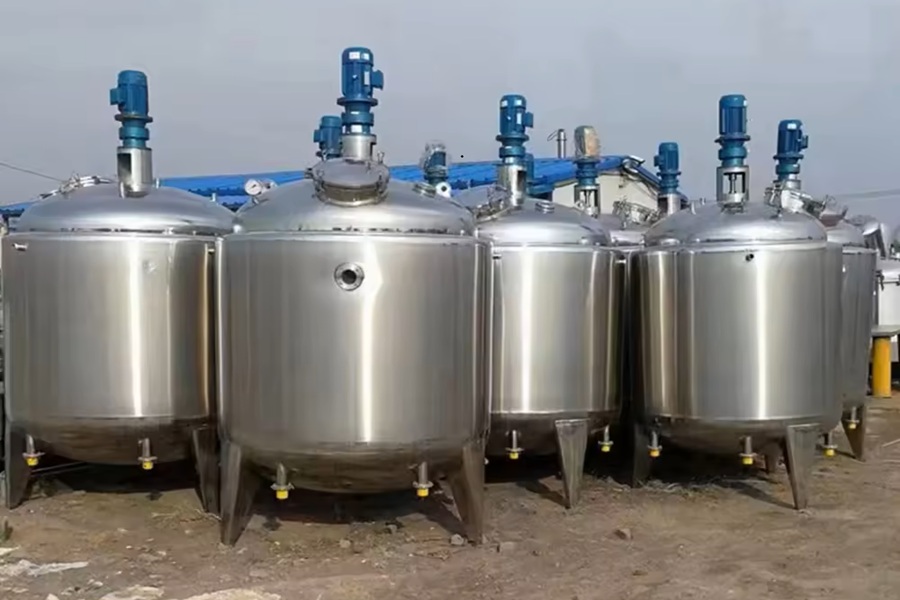
In seaweed and microalgae processing, the effective mixing, homogenization, holding, and conditioning of biomass slurries, extract solutions, and intermediate products between unit operations is critical to maintaining product quality, process consistency, and downstream efficiency. Kerone’s Seaweed Blending and Storage Solutions are purpose-engineered vessels designed to handle the specific challenges of marine algal biomass — including its high viscosity, corrosive salt content, tendency for biological degradation during holding, and the wide range of temperature and pH conditions encountered in different processing steps. From receiving and buffer tanks for fresh seaweed slurries, to conditioning tanks for post-blanching material, extraction vessels for polysaccharide solubilization, and formulation tanks for biostimulant and cosmetic intermediate production, Kerone’s tanks are precision-fabricated stainless steel vessels with optimized agitation, temperature control, and hygienic design for every application in the seaweed processing chain.
Why Choose Kerone Seaweed Blending and Storage Solution
Kerone’s Seaweed Blending and Storage are engineered with a thorough understanding of the complex rheological behavior of seaweed slurries and extracts, which can exhibit highly non-Newtonian, pseudoplastic, or thixotropic flow behavior depending on the polysaccharide concentration and temperature. Kerone’s agitator designs are specifically selected and sized to handle these challenging fluid properties, ensuring uniform mixing without excessive shear that could degrade sensitive bioactives or cause foaming, using swept-blade, anchor, gate, or helical ribbon agitator configurations based on the application. All tanks are fabricated from SS316L stainless steel with electro-polished or bead-blast internal surfaces, full drain and cleanability, and CIP spray ball or jet cleaning systems for the highest hygiene standards. Temperature control is provided by integrated jacket, half-pipe coil, or internal heating/cooling elements, allowing precise thermal management from 4°C (cold storage) to 95°C (hot extraction).
Types and Features of Seaweed Blending and Storage Solution
Kerone’s seaweed processing storage range from compact 500-liter mixing vessels to large 50,000+ liter storage and buffer tanks, in vertical or horizontal configurations with conical, dished, or flat bottom designs based on process requirements. Agitated tanks are available with top-entry, bottom-entry, or side-entry agitators, with variable-speed drives for adjustable mixing intensity. Temperature-controlled tanks include full or half-pipe jacketing with glycol cooling or steam heating, along with insulated outer shells for energy efficiency. All tanks include hygienic manholes, spray balls or jet cleaners for CIP, sight glasses, sample valves, temperature and level instrumentation, and pressure-relief valves. Optional features include inline homogenizers, recirculation pumps with strainers, pH monitoring and dosing systems, dissolved oxygen monitoring, and sanitary butterfly or diaphragm valves throughout.
Key Features
Custom-sized tanks from 500L to 50,000L+ in SS316L stainless steel for all stages of seaweed processing
Agitator designs optimized for non-Newtonian seaweed slurries — anchor, gate, helical ribbon, and swept-blade configurations
Integrated jacketed heating and cooling systems for precise temperature control from 4°C to 95°C
Full CIP compatibility with spray ball or jet cleaning systems for rapid, validated hygienic cleaning
Variable-speed agitator drives for adjustable mixing intensity without product shear damage
Complete instrumentation package including temperature, level, pH, and pressure sensing with PLC integration
Hygienic design with full-drain sloped bottoms, crevice-free welds, and electro-polished internal surfaces
Modular design with standard connection interfaces for rapid integration into existing or new processing lines
Powered by AI, ML & IoT
Future-Ready Engineering Driven by AI & IoT
Our advanced AI, ML, and IoT technologies, this solution delivers smarter automation, real-time insights, and predictive intelligence to enhance efficiency and drive future-ready growth.
Real-Time Monitoring & Control
Continuous tracking of process parameters with instant adjustments.
Predictive Maintenance
Intelligent fault detection to prevent failures before they occur.
Adaptive Process Optimization
Dynamic tuning of operations for maximum output and efficiency.
Cloud Dashboards & Analytics
Unified access to real-time insights and performance trends.
Energy & Resource Savings
Smarter utilization of energy to cut costs and reduce waste.
Secure IoT Connectivity
Encrypted data flow with seamless integration across plant systems.
Applications of Seaweed Blending and Storage Solution
Kerone’s Seaweed Blending and Storage Solutions are extensively used across multiple applications in the seaweed and microalgae processing industry.
Typical applications include:
Fresh seaweed receiving and buffer tanks — holding and conditioning freshly harvested seaweed slurries before primary processing steps
Blanching and conditioning vessels — holding seaweed at controlled temperature and time for enzyme inactivation and iodine reduction
Polysaccharide extraction tanks — hot water or alkali extraction of alginate, carrageenan, and agar from pre-treated seaweed
Biostimulant formulation tanks — blending and conditioning liquid seaweed extract with additives for biostimulant fertilizer production
Microalgae cultivation and harvesting — open raceway pond supplements and closed photobioreactor harvest concentration vessels
Cosmetic and pharmaceutical intermediate storage — holding and mixing seaweed extract intermediates for cosmetic and nutraceutical formulation
Reliable, hygienic, and precisely controlled mixing and storage is a fundamental enabling capability throughout the seaweed processing chain. Kerone’s Seaweed Blending and Storage Solutions are purpose-engineered for the specific demands of marine algal biomass processing, providing the combination of materials quality, agitation performance, thermal control, and hygienic design that seaweed processors need to maintain product integrity across every step of the process. With a Kerone tank at every critical point in your processing line, you can be confident that your product quality is protected from receipt to dispatch.
Seamless Export Connections Global & Local
Our Global Footprint in Industrial Excellence
Delivering world-class industrial and process solutions across countries with precision, innovation, and reliability.
Peru
Chile
Argentina
Mexico
Colombia
Brazil
USA
Canada
United Kingdom
France
Germany
Spain
Italy
Netherlands
Sweden
Switzerland
Poland
Portugal
Ireland
Czechia
Romania
Hungary
Austria
Greece
Kazakhstan
Uzbekistan
Turkmenistan
Algeria
Egypt
Nigeria
Kenya
South Africa
Saudi Arabia
UAE
Israel
Russia
India
China
Japan
South Korea
Thailand
Vietnam
Malaysia
Singapore
Indonesia
Philippines
Australia
New Zealand
Pan-India Presence. Local Expertise.
Raipur
Bilaspur
Panaji
Vasco da Gama
Gandhinagar
Ahmedabad
Surat
Chandigarh
Gurgaon
Shimla
Manali
Bengaluru
Mysore
Kochi
Pune
Mumbai
Thane
Navi Mumbai
Hyderabad
Chennai
Coimbatore
Kolkata
Lucknow
Jaipur
Udaipur
Jodhpur
Dehradun
Haridwar
Bhubaneswar
Product Gallery
Frequently Asked Questions (FAQ)
For high-viscosity seaweed slurries with viscosities above 5,000 mPa·s, Kerone recommends helical ribbon or anchor agitators, which provide effective bulk mixing across the full tank volume without creating high-shear zones that could degrade sensitive bioactives.
Yes. Kerone designs dual-purpose tanks with full jacketing capable of both heating (steam or hot water) for extraction applications and cooling (glycol or chilled water) for cold storage, with insulated outer shells to minimize energy consumption in both modes.
Kerone's tanks are equipped with automated CIP spray ball or jet cleaning systems. A standard CIP cycle of pre-rinse, caustic wash, rinse, acid wash, and final rinse can clean and sanitize a tank in 45–90 minutes without manual entry.
Kerone fabricates tanks from 500 liters to 50,000+ liters in vertical and horizontal configurations, with flat, dished, or conical bottoms. Custom dimensions and configurations are available to suit specific facility layout and process requirements.
Yes. All tanks are fabricated from SS316L stainless steel, which provides excellent corrosion resistance in saline and marine environments. Additional corrosion protection measures such as passivation or electro-polishing are applied where required.
Yes. Kerone offers tanks fabricated to ASME BPE (Bioprocessing Equipment) standards for pharmaceutical and nutraceutical-grade applications, with full documentation including material certificates, surface roughness reports, and pressure vessel certification.
Kerone's agitator designs are optimized to minimize surface agitation and air entrainment. For applications prone to foaming, Kerone can integrate foam detection sensors, mechanical foam breakers, or approved defoamer dosing systems.
Standard instrumentation includes temperature sensors (PT100), level indicators (ultrasonic or differential pressure), pressure relief valves, and agitator speed monitors. Optional instruments include pH probes, conductivity sensors, and inline viscometers for advanced process control.
Tank sizing starts with batch throughput, not headcount or floor space. Engineers calculate the volume from daily wet seaweed intake, the dilution ratio used in blending, and the longest hold time required before the next process step, such as blanching or extraction. A buffer margin of 15–20% is added to absorb harvest variability, since seaweed supply often arrives in irregular volumes depending on tide and season. Getting this number right avoids two costly mistakes: an undersized tank that forces production stoppages during peak harvest, or an oversized vessel that increases capital cost and wastes floor space. Kerone's process engineers review intake data before recommending a working capacity, rather than offering a single standard size.
Seaweed slurries thicken as polysaccharide content rises with temperature and concentration, and a mismatched agitator either fails to achieve bulk turnover or introduces excessive shear. Under-mixing leaves dead zones where biomass settles and degrades unevenly, while over-shearing can break down the very bioactive compounds, alginates, fucoidans, carrageenan precursors that give the extract its commercial value. This is a common selection mistake when buyers default to a standard paddle mixer used for water-based slurries instead of an anchor or helical ribbon design suited to non-Newtonian fluids. Matching agitator geometry to the actual rheology of the seaweed species being processed protects both product yield and bioactive integrity.
Within limits, yes. A correctly specified jacketed tank with variable-speed agitation can handle the transition from a single species' receiving stage to its extraction stage, since both temperature and mixing intensity are adjustable. Switching between very different species, however for example a low-viscosity green algae slurry versus a high-viscosity brown kelp extract, usually calls for either a wider agitator speed range at the design stage or two dedicated vessels in series. Processors planning for seasonal or multi-species intake should specify this flexibility upfront, since retrofitting agitator drives or jacket capacity after fabrication is far more expensive than designing it in from the start.
Hold time tolerance depends heavily on temperature control and the presence of dissolved oxygen, since marine biomass is biologically active and can begin microbial degradation or enzymatic browning within hours at ambient temperature. With proper jacketed cooling to 4–10°C, most slurries remain stable for 24–48 hours without significant quality loss. Without temperature control, degradation markers like odour, color shift and viscosity drop can appear in as little as 4–6 hours depending on species and ambient conditions. This is why buffer and receiving tanks are almost always specified with cooling capability rather than treated as simple static storage vessels.
Recurring costs center on three areas: utility consumption for heating or cooling the jacket, CIP cleaning chemicals and water for the multiple daily cycles a seaweed line typically requires, and agitator drive electricity, which scales with viscosity and batch size. Salt-rich seaweed environments also accelerate wear on seals and valve components compared to freshwater processing, so a realistic budget includes a higher allowance for gasket and seal replacement over the equipment's service life. Processors who size the jacket correctly at the design stage, rather than oversizing for a future capacity that never materializes, typically see the lowest cost per tonne processed.
Export-grade and organic-certified production usually requires tighter documentation rather than fundamentally different hardware: material traceability certificates for the SS316L, surface finish reports confirming the internal roughness needed for cleanability, and validated CIP cycle records showing consistent sanitation. Some export markets, particularly for nutraceutical or cosmetic-grade extract, also require dedicated tanks per product line to avoid cross-contamination claims. Buyers targeting EU, US, or Japanese export markets should confirm certification requirements with their target customer before finalizing tank specification, since retrofitting documentation after fabrication is not possible.
Kerone’s custom-designed heating and processing solutions are built to meet the demands of your growing operations. Whether you’re upgrading equipment, expanding production, or need a tailor-made solution

 Peru
Peru Chile
Chile Argentina
 Mexico
 Colombia
 Brazil
 USA
USA Canada
 United Kingdom
 France
 Germany
 Spain
Spain Italy
Italy Netherlands
 Sweden
 Switzerland
 Poland
 Portugal
 Ireland
 Czechia
 Romania
 Hungary
 Austria
 Greece
 Kazakhstan
 Uzbekistan
 Turkmenistan
 Algeria
 Egypt
Egypt Nigeria
 Kenya
Kenya South Africa
 Saudi Arabia
 UAE
UAE Israel
 Russia
 India
India China
China Japan
Japan South Korea
 Thailand
 Vietnam
 Malaysia
 Singapore
 Indonesia
 Philippines
 Australia
 New Zealand