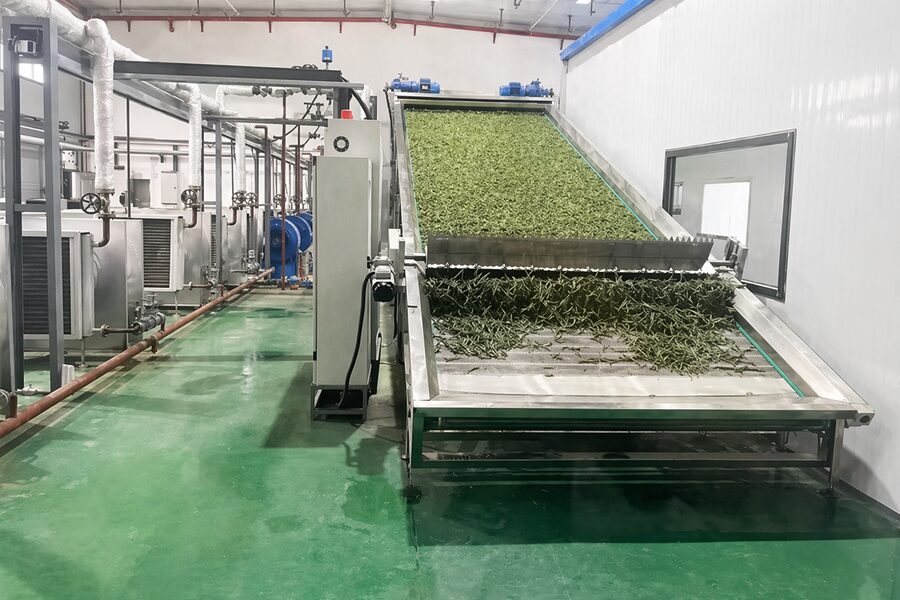
Drying is one of the most critical and energy-intensive operations in seaweed processing, directly determining the final product moisture content, color quality, bioactive retention, microbial safety, and shelf life. For seaweed species that are sensitive to high temperatures — including Porphyra (Nori), Undaria (Wakame), Palmaria (Dulse), and various green algae, the belt dryer is the preferred thermal processing solution, offering the combination of gentle, low-temperature airflow drying, long residence times, and precise temperature zoning that preserves the delicate color, flavor, and nutritional profile demanded by food and pharmaceutical markets. Kerone’s Belt Drying System for Seaweed Applications is a purpose-engineered continuous thermal drying system designed specifically for the high-moisture, salt-laden, and biologically complex nature of marine algal biomass. With decades of experience in industrial belt drying across food, pharma, and chemical sectors, Kerone delivers seaweed belt dryers that consistently achieve optimal drying performance at minimum energy cost.
Why Choose Kerone Belt Drying System for Seaweed Applications
Kerone’s Belt Drying System for Seaweed Applications are distinguished by their precise multi-zone temperature and airflow engineering, which allows independent control of each drying zone to match the characteristic falling-rate drying behavior of seaweed, beginning with aggressive drying in the initial zones where free moisture is removed quickly, and transitioning to gentle low-temperature finishing in the final zones to preserve color, flavor, and bioactive integrity. Kerone’s engineering team uses computational fluid dynamics (CFD) modeling to optimize airflow distribution across the belt width, ensuring uniform drying without wet or over-dried patches. The company’s dryers feature high-efficiency direct-fired or indirect steam-heated air systems, recirculated airflow for energy savings, and advanced humidity control to maximize drying efficiency. All product-contact surfaces are fabricated from food-grade SS316 stainless steel with hygienic design for food and pharmaceutical applications.
Types and Features of Belt Drying System for Seaweed Applications
Kerone’s Belt Drying System for Seaweed Applications are available in single-pass, multi-pass, and multi-deck configurations to match the required residence time and footprint constraints of each application. Belt widths range from 0.5m to 3m, with effective drying lengths from 5m to 30m+ for high-capacity applications. The belt material is food-grade perforated stainless steel mesh or polyester mesh depending on the seaweed particle size and application. Each dryer features multiple independent temperature zones (up to 8 zones), recirculating hot air with fresh air inlet control, adjustable belt speed for residence time management, integrated moisture sensors at the outlet, and automatic humidity exhaust control. Optional features include top-blown and bottom-blown airflow for enhanced through-drying of thick seaweed layers, infrared pre-heating for surface moisture removal, and UV sterilization tunnels for enhanced microbial safety.
Key Features
Multi-zone temperature control (40°C–120°C) with independent airflow management for gentle, uniform drying
Continuous operation with adjustable belt speed for precise control of product residence time and final moisture
Food-grade SS316 perforated stainless steel or polyester mesh belt with hygienic construction throughout
High-efficiency recirculating hot air system with humidity exhaust control for maximum energy efficiency
Single-pass, multi-pass, and multi-deck configurations for flexible capacity and footprint optimization
Belt widths from 0.5m to 3m with effective drying lengths from 5m to 30m+ for all production scales
Integrated outlet moisture sensors and automatic temperature feedback control for consistent final moisture
CIP-compatible dryer enclosure with full washdown access panels for rapid cleaning and sanitation
Powered by AI, ML & IoT
Future-Ready Engineering Driven by AI & IoT
Our advanced AI, ML, and IoT technologies, this solution delivers smarter automation, real-time insights, and predictive intelligence to enhance efficiency and drive future-ready growth.
Real-Time Monitoring & Control
Continuous tracking of process parameters with instant adjustments.
Predictive Maintenance
Intelligent fault detection to prevent failures before they occur.
Adaptive Process Optimization
Dynamic tuning of operations for maximum output and efficiency.
Cloud Dashboards & Analytics
Unified access to real-time insights and performance trends.
Energy & Resource Savings
Smarter utilization of energy to cut costs and reduce waste.
Secure IoT Connectivity
Encrypted data flow with seamless integration across plant systems.
Applications of Belt Drying System for Seaweed Applications
Kerone’s Belt Drying System for Seaweed Applications are extensively used in seaweed food processing, nutraceutical production, and bioactive ingredient manufacturing facilities worldwide.
Typical applications include:
Food-grade seaweed drying — production of dried Nori, Wakame, Dulse, and Kombu flakes and sheets with preserved color, flavor, and texture
Seaweed powder feedstock drying — drying shredded seaweed to target moisture for subsequent grinding and powder production
Nutraceutical ingredient drying — drying Spirulina, Chlorella, and macroalgae biomass for supplement powder and capsule production
Biostimulant and soil conditioner production — drying seaweed meal for solid agricultural biostimulant products
Animal feed ingredient drying — producing dried seaweed meal for incorporation into aquafeed and livestock nutritional products
Cosmetic ingredient drying — gentle drying of seaweed biomass for active ingredient preservation in cosmetic formulations
For seaweed processors demanding the highest standards of color quality, bioactive preservation, and product consistency, the belt dryer remains the gold standard thermal drying technology. Kerone’s Seaweed Belt Dryers combine precision engineering, hygienic design, and energy efficiency to deliver drying performance that meets the exacting requirements of food, nutraceutical, and pharmaceutical seaweed product markets. By choosing Kerone, seaweed processors gain a drying solution that is purpose-built for their specific species and product requirements, backed by comprehensive engineering support and after-sales service.
Seamless Export Connections Global & Local
Our Global Footprint in Industrial Excellence
Delivering world-class industrial and process solutions across countries with precision, innovation, and reliability.
Peru
Chile
Argentina
Mexico
Colombia
Brazil
USA
Canada
United Kingdom
France
Germany
Spain
Italy
Netherlands
Sweden
Switzerland
Poland
Portugal
Ireland
Czechia
Romania
Hungary
Austria
Greece
Kazakhstan
Uzbekistan
Turkmenistan
Algeria
Egypt
Nigeria
Kenya
South Africa
Saudi Arabia
UAE
Israel
Russia
India
China
Japan
South Korea
Thailand
Vietnam
Malaysia
Singapore
Indonesia
Philippines
Australia
New Zealand
Pan-India Presence. Local Expertise.
Raipur
Bilaspur
Panaji
Vasco da Gama
Gandhinagar
Ahmedabad
Surat
Chandigarh
Gurgaon
Shimla
Manali
Bengaluru
Mysore
Kochi
Pune
Mumbai
Thane
Navi Mumbai
Hyderabad
Chennai
Coimbatore
Kolkata
Lucknow
Jaipur
Udaipur
Jodhpur
Dehradun
Haridwar
Bhubaneswar
Product Gallery
Frequently Asked Questions (FAQ)
For most food-grade seaweed species, drying air temperatures of 50–70°C in the initial high-moisture zones, transitioning to 40–55°C in the finishing zones, provide an effective balance of drying efficiency and bioactive preservation. Species-specific temperature profiles are developed during process validation.
Multi-zone control allows the dryer to mimic the natural falling-rate drying curve of seaweed, with higher temperatures and airflows in the initial constant-rate period, and gentler conditions in the falling-rate period, minimizing case hardening, color loss, and bioactive degradation.
Kerone's seaweed belt dryers reliably achieve final moisture contents of 8–12% for food-grade applications, or 5–8% for powder feedstock applications, depending on inlet moisture content and the required drying time.
Seaweed is typically loaded via an oscillating distributor or vibrating spreader to create a uniform layer on the belt. Layer depth is adjusted based on the particle size, inlet moisture, and required residence time — typically 10–50mm for cut seaweed.
Energy consumption depends on the inlet moisture and throughput, but typically ranges from 2.5 to 4.5 GJ per tonne of water evaporated. Kerone's heat recovery and recirculation designs achieve efficiencies at the lower end of this range.
For fine granules and powders, Kerone uses stainless steel mesh belts with reduced aperture size (0.5–2mm) and enclosed dryer construction with integrated dust collection to prevent product loss and maintain air quality
Seaweed's drying curve is unusually long in the falling-rate phase because moisture is bound within cell structures and mucilaginous layers that resist simple surface evaporation. Cutting residence time short to increase throughput often leaves bound moisture trapped inside the product, which then continues to migrate after packaging and causes mold growth or texture softening in storage, a defect that does not show up until weeks later. Buyers comparing belt dryer quotes purely on throughput numbers without checking the assumed residence time per zone risk under-specifying a system that looks fast on paper but produces unstable product.
With food-grade SS316 construction and proper salt-corrosion management, the structural shell and frame routinely last 20–25 years. The components that wear out first are the belt itself, due to constant flexing and salt exposure, and the drive bearings and rollers, due to continuous operation. Belt replacement is typically needed every 5–8 years depending on duty cycle, and is the main planned maintenance cost over the dryer's life. Processors who skip the manufacturer's recommended belt tension and tracking checks tend to see premature belt wear and unscheduled downtime well before the structural equipment shows any sign of aging.
Sun drying is still used for some traditional Nori and Wakame production, but it offers no control over temperature, humidity, or contamination, and output is entirely weather-dependent, a rainy season can halt production for weeks. Belt dryers replicate the gentle, low-temperature character that sun drying is valued for, but with consistent year-round output, microbial safety through controlled humidity exhaust, and traceable process records that export buyers increasingly require. The trade-off is capital investment, which sun drying avoids, but processors scaling beyond small artisan volumes generally find belt drying pays back through consistent, certifiable quality rather than weather-dependent guesswork.
A frequent error is sizing the dryer for current production volume without accounting for the bed depth needed for the specific seaweed format being processed. Whole-leaf or long-strand seaweed requires a shallower bed and therefore a wider belt to hit target throughput, while finely cut seaweed can be loaded deeper on a narrower belt. Buyers who specify dimensions based on a generic throughput figure, rather than working through the actual bed depth and residence time math for their species and cut size, often end up with a dryer that cannot reach rated capacity without compromising final moisture uniformity.
Multi-pass and multi-deck configurations are inherently more scalable than single-pass designs, since additional zones or a parallel deck can sometimes be added within the same building footprint. However, scaling a single-pass belt dryer usually means adding belt length, which requires floor space that may not have been reserved at installation. Processors expecting volume growth within 3–5 years should discuss expansion-ready layout, extra structural bays, utility headroom, additional fan capacity at the original design stage, since retrofitting length into an existing single-pass line is far more disruptive than expanding a modular multi-deck system.
Humidity exhaust control does more than speed up evaporation, it prevents the recirculated air from becoming saturated, which would otherwise allow condensation to form on cooler surfaces inside the dryer and create localized wet spots that support microbial growth. For food-grade seaweed destined for direct human consumption, this is a food safety control point, not just an efficiency feature. Processors targeting HACCP or similar certification should confirm that humidity exhaust setpoints are documented and monitored as part of their process validation, since auditors increasingly ask for this data specifically for high-moisture marine products.
Kerone’s custom-designed heating and processing solutions are built to meet the demands of your growing operations. Whether you’re upgrading equipment, expanding production, or need a tailor-made solution


 Peru
Peru Chile
Chile Argentina
 Mexico
 Colombia
 Brazil
 USA
USA Canada
 United Kingdom
 France
 Germany
 Spain
Spain Italy
Italy Netherlands
 Sweden
 Switzerland
 Poland
 Portugal
 Ireland
 Czechia
 Romania
 Hungary
 Austria
 Greece
 Kazakhstan
 Uzbekistan
 Turkmenistan
 Algeria
 Egypt
Egypt Nigeria
 Kenya
Kenya South Africa
 Saudi Arabia
 UAE
UAE Israel
 Russia
 India
India China
China Japan
Japan South Korea
 Thailand
 Vietnam
 Malaysia
 Singapore
 Indonesia
 Philippines
 Australia
 New Zealand