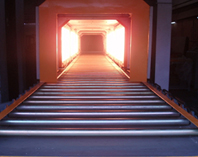
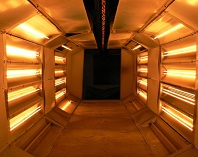
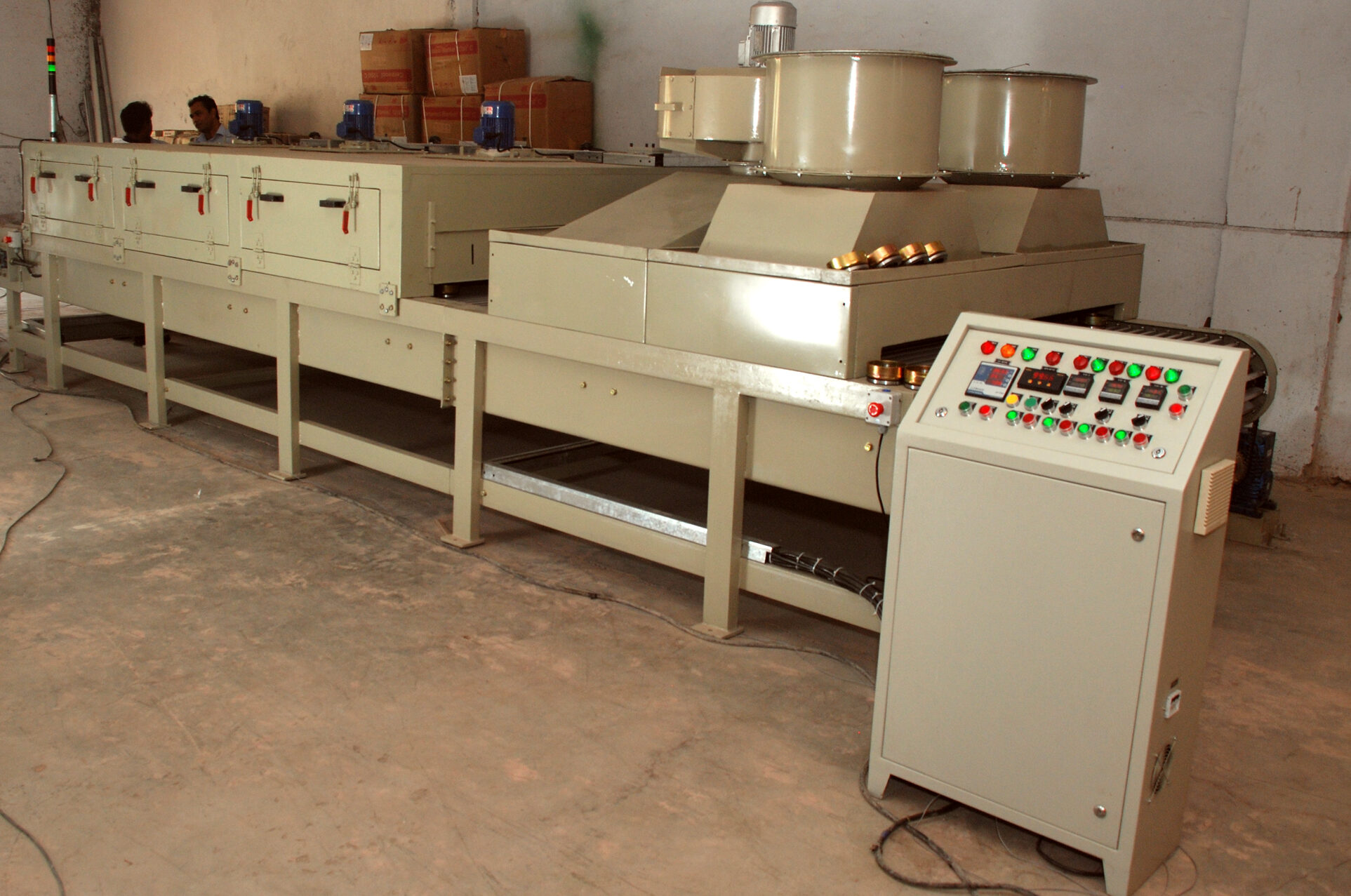
Kerone provides advanced tunnel/clam shell ovens engineered to deliver high efficiency, precision, and industrial-grade reliability. With over 50 years of expertise across thermal, infrared, RF, microwave, and mechanical engineering, Kerone develops customized systems tailored to industry-specific requirements, ensuring maximum productivity and operational stability.
Tunnel ovens provide a straight-through passage for products on a conveyor, while Clam Shell ovens feature a hinged top section that opens for easy product loading and unloading, making them ideal for large, irregular, or heavy components that cannot easily be transported on a conventional conveyor. Both designs are widely used in the automotive, aerospace, composites, and heavy engineering industries for curing, heat treatment, and forming applications.
Why Choose Kerone Tunnel/Clam Shell Ovens
Kerone’s Tunnel and Clam Shell Ovens stand out for their robust construction, flexible design, and ability to handle a wide variety of product sizes and shapes. The Clam Shell design is particularly valued for its ability to process very large components, such as vehicle bodies, large composite parts, and structural assemblies, without requiring overhead crane handling into a conventional box oven. Kerone’s engineering team designs each oven to the specific dimensions and process requirements of the customer, ensuring optimal airflow, temperature uniformity, and structural integrity for the intended load.
Types and Features of Tunnel/Clam Shell Ovens
Tunnel ovens are offered in single-zone and multi-zone configurations for different process stages. Clam Shell ovens feature a hydraulically or electrically operated top section for ease of access. Both types can be heated by electric elements, gas burners, or infrared emitters, with forced hot air recirculation as standard for temperature uniformity. The oven structure is fabricated from heavy-duty structural steel with high-density mineral wool insulation and stainless steel or aluminized steel interior lining.
Key Features
High operational efficiency with uniform processing
Adjustable temperature, airflow, or RF/IR power settings
Batch and continuous configurations available
Low maintenance with long service life
Custom material flow and heating patterns
Safety interlocks and advanced control systems
Powered by AI, ML & IoT
Future-Ready Engineering Driven by AI & IoT
Our advanced AI, ML, and IoT technologies, this solution delivers smarter automation, real-time insights, and predictive intelligence to enhance efficiency and drive future-ready growth.
Real-Time Monitoring & Control
Continuous tracking of process parameters with instant adjustments.
Predictive Maintenance
Intelligent fault detection to prevent failures before they occur.
Adaptive Process Optimization
Dynamic tuning of operations for maximum output and efficiency.
Cloud Dashboards & Analytics
Unified access to real-time insights and performance trends.
Energy & Resource Savings
Smarter utilization of energy to cut costs and reduce waste.
Secure IoT Connectivity
Encrypted data flow with seamless integration across plant systems.
Applications of Tunnel/Clam Shell Ovens
Kerone’s Tunnel and Clam Shell Ovens are extensively used in automotive, aerospace, and heavy manufacturing industries. Typical applications include:
Curing of body-in-white automotive structures and large composite panels
Heat treatment and aging of aerospace structural components
Curing of adhesive bonds in large assemblies such as vehicle frames
Pre-heating of large metal forgings before machining or forming
Processing of wind turbine blades and large composite structures
Drying and curing of protective coatings on large industrial equipment
Kerone’s tunnel/clam shell ovens solutions deliver unmatched quality, safety, and operational performance. Each system is tailored to meet production targets while ensuring energy savings, reliability, and long-term industrial value. Whether used for continuous production through a tunnel or batch processing of individual large components in a Clam Shell format, these ovens deliver the thermal performance and structural robustness needed for the most demanding applications. Kerone’s custom engineering approach ensures that each oven is perfectly matched to the client’s production requirements.
Seamless Export Connections Global & Local
Our Global Footprint in Industrial Excellence
Delivering world-class industrial and process solutions across countries with precision, innovation, and reliability.
Peru
Chile
Argentina
Mexico
Colombia
Brazil
USA
Canada
United Kingdom
France
Germany
Spain
Italy
Netherlands
Sweden
Switzerland
Poland
Portugal
Ireland
Czechia
Romania
Hungary
Austria
Greece
Kazakhstan
Uzbekistan
Turkmenistan
Algeria
Egypt
Nigeria
Kenya
South Africa
Saudi Arabia
UAE
Israel
Russia
India
China
Japan
South Korea
Thailand
Vietnam
Malaysia
Singapore
Indonesia
Philippines
Australia
New Zealand
Pan-India Presence. Local Expertise.
Raipur
Bilaspur
Panaji
Vasco da Gama
Gandhinagar
Ahmedabad
Surat
Chandigarh
Gurgaon
Shimla
Manali
Bengaluru
Mysore
Kochi
Pune
Mumbai
Thane
Navi Mumbai
Hyderabad
Chennai
Coimbatore
Kolkata
Lucknow
Jaipur
Udaipur
Jodhpur
Dehradun
Haridwar
Bhubaneswar
Product Gallery
Frequently Asked Questions (FAQ)
The deciding factor is usually how the product gets into and out of the oven, not just its size. Tunnel ovens suit products that can travel continuously on a conveyor through sequential zones, making them ideal for high-volume, repeatable production runs. Clam Shell ovens, with their hinged top section, are built for products too large, heavy, or irregularly shaped to move easily on a conveyor such as vehicle bodies or large composite assemblies — where crane or forklift loading directly into an open oven is more practical than conveyor transport. If your production mix includes both small repeatable parts and occasional oversized components, some manufacturers operate a tunnel oven for the bulk of production alongside a smaller Clam Shell unit for outliers, rather than trying to force one oven type to handle both extremes.
Yes, Kerone offers fully customized engineering based on capacity, temperature, and industry needs.
Yes, Kerone designs systems that significantly reduce operational energy consumption.
Manufacturing, food, chemicals, biomass, pharma, packaging, and advanced materials.
Yes, from installation to lifetime service support, Kerone provides complete assistance.
Gas-fired systems are most common for large tunnels due to lower energy costs; electric heating is used where gas is unavailable or for clean-room environments.
Yes, composite curing requires precise temperature ramp and soak profiles which Kerone's PLC control system provides.
Lead times vary from 8 to 20 weeks depending on size and complexity; Kerone provides detailed project timelines after design review.
Clam Shell ovens supporting heavy components like vehicle bodies or large composite structures require a reinforced floor and load-bearing frame engineered around the specific weight and footprint of the heaviest expected load, not a generic industrial oven floor rating. Kerone calculates structural requirements based on point loads from fixtures or jigs, not just total product weight, since concentrated loads from support stands can exceed what a uniformly distributed rating would suggest is safe. Buyers should also confirm crane or hoist clearance above the open Clam Shell lid, since insufficient overhead clearance is a common site-planning oversight that surfaces only after the oven arrives. Sharing facility crane capacity and overhead clearance dimensions early in the design phase avoids this entirely.
The hinge mechanism and door seals are the components most exposed to mechanical wear on a Clam Shell oven, since they cycle open and closed with every load and must maintain an airtight seal at operating temperature. Hinges should be inspected for alignment drift and lubricated on a schedule appropriate to cycle frequency — daily-use ovens need more frequent attention than those used a few times per week. Door seals, typically high-temperature gasket material, degrade gradually from repeated thermal cycling and compression, and a worn seal allows heat loss that shows up as longer-than-expected cycle times or uneven temperature readings near the door. Kerone recommends visual seal inspection at every major maintenance interval, since seal failure is one of the more common causes of energy efficiency complaints on Clam Shell installations.
Yes, within limits. Multi-zone Tunnel ovens allow each zone to run at a different temperature setpoint, so a single pass can include a pre-heat zone, a higher-temperature cure zone, and a cool-down zone in sequence. The constraint is that all products moving through the tunnel at a given time share the same zone profile and belt speed, so running two products with very different required dwell times simultaneously on the same line generally isn't practical unless their process windows overlap closely. For genuinely different process temperatures and dwell times, manufacturers typically schedule production in batches by product type rather than mixing them on the same conveyor pass, or use a separate oven dedicated to the outlier product.
Compared to older box-furnace designs that heat an entire enclosed volume regardless of how much product is inside, a multi-zone Tunnel oven with proper insulation only applies the energy needed for the active process stage in each zone, reducing wasted heating capacity. Continuous conveyor operation also avoids the heat-up and cool-down energy losses that come from repeatedly opening and closing a batch furnace door for each load cycle. Heat recovery options, where exhaust air from hotter zones preheats incoming air for cooler zones, can meaningfully cut total energy consumption on longer multi-zone tunnels. These efficiency gains compound over high production volumes, which is why manufacturers replacing older box furnaces with modern Tunnel ovens often see a faster payback period than the equipment cost alone would suggest.
Buyers often size their floor space allocation around the oven's footprint alone, forgetting that the Clam Shell lid needs clear overhead and lateral swing space when opened for loading and unloading. This swing clearance can extend well beyond the oven's closed footprint, and if it's not accounted for in the facility layout, the oven may not be able to fully open once installed, or it may conflict with overhead cranes, ductwork, or adjacent equipment. Another frequently missed factor is access space for maintenance personnel to reach the hinge mechanism and door seals when the lid is open. Kerone requests full facility drawings, including ceiling height and any overhead obstructions, before finalizing Clam Shell oven dimensions, specifically to avoid this kind of post-installation surprise.
Kerone’s custom-designed heating and processing solutions are built to meet the demands of your growing operations. Whether you’re upgrading equipment, expanding production, or need a tailor-made solution

 Peru
Peru Chile
Chile Argentina
 Mexico
 Colombia
 Brazil
 USA
USA Canada
 United Kingdom
 France
 Germany
 Spain
Spain Italy
Italy Netherlands
 Sweden
 Switzerland
 Poland
 Portugal
 Ireland
 Czechia
 Romania
 Hungary
 Austria
 Greece
 Kazakhstan
 Uzbekistan
 Turkmenistan
 Algeria
 Egypt
Egypt Nigeria
 Kenya
Kenya South Africa
 Saudi Arabia
 UAE
UAE Israel
 Russia
 India
India China
China Japan
Japan South Korea
 Thailand
 Vietnam
 Malaysia
 Singapore
 Indonesia
 Philippines
 Australia
 New Zealand