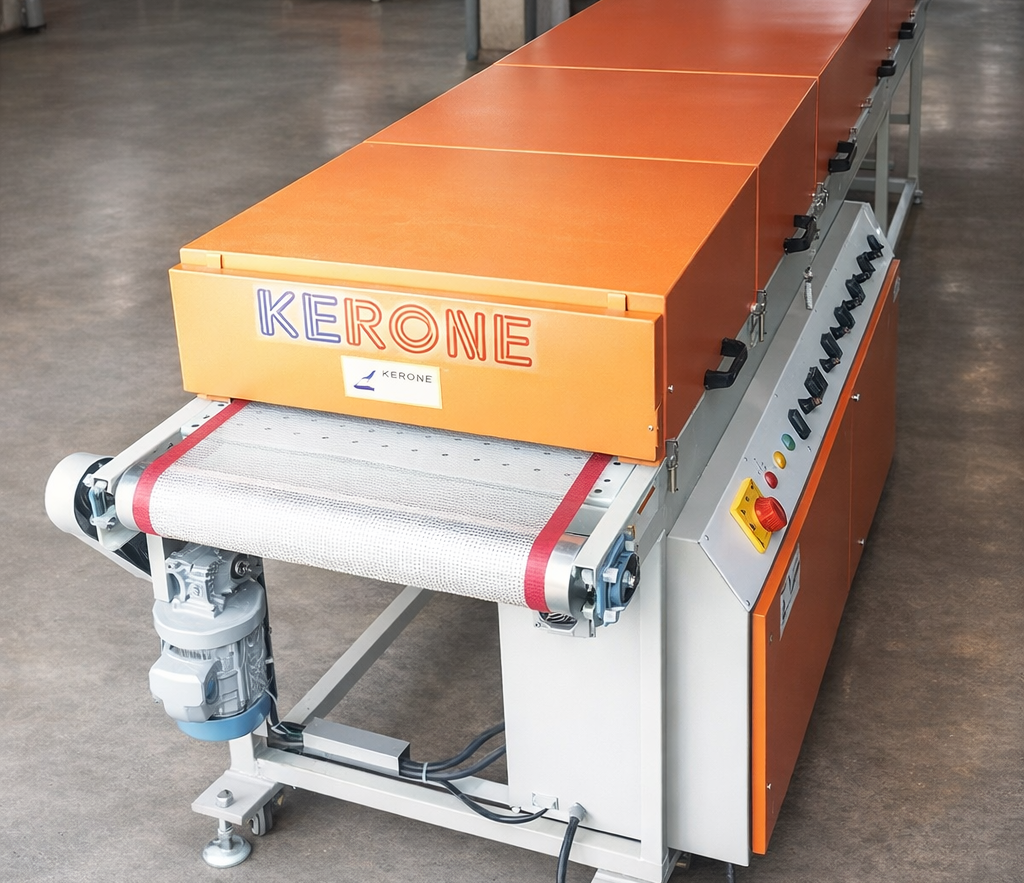
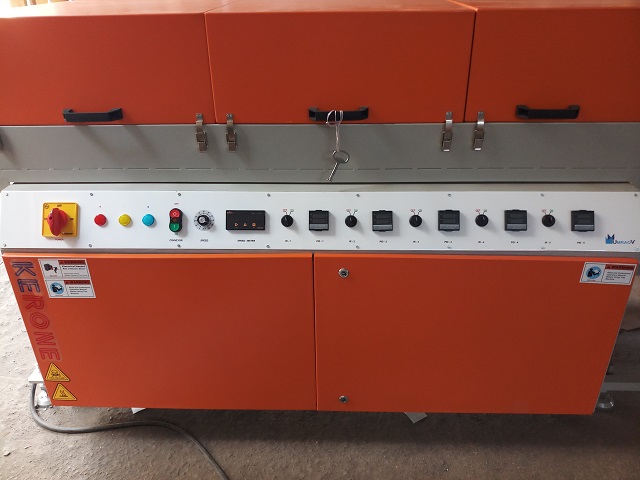
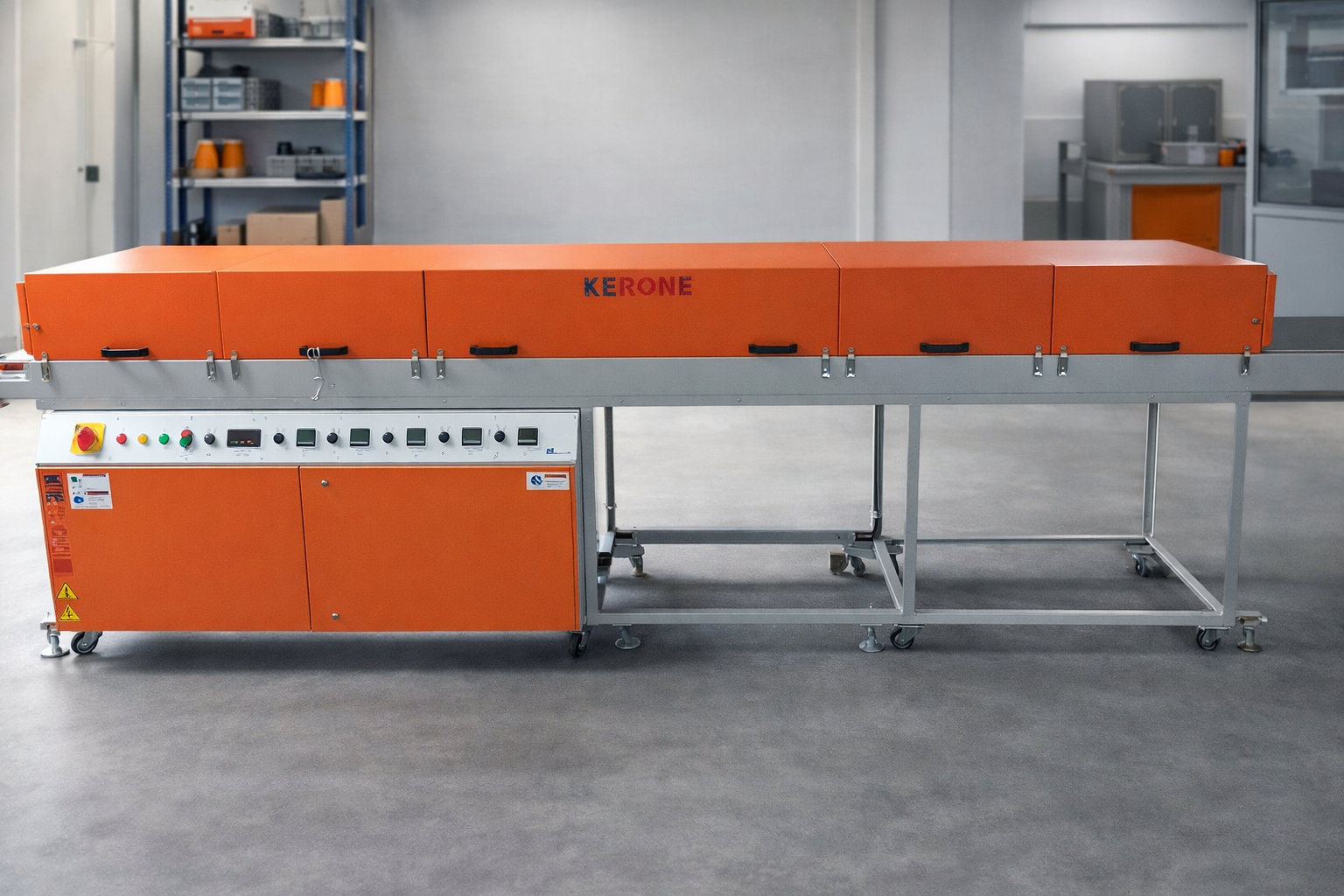
Kerone provides advanced infrared oven engineered to deliver high efficiency, precision, and industrial-grade reliability. With over 50 years of expertise across thermal, infrared, RF, microwave, and mechanical engineering, Kerone develops customized systems tailored to industry-specific requirements, ensuring maximum productivity and operational stability.
This direct energy transfer makes infrared ovens significantly faster and more energy-efficient than conventional convection ovens for many applications, particularly where surface heating, coating curing, or drying of thin layers is required. Kerone’s Infrared Ovens are available in batch and continuous configurations, with a wide choice of infrared wavelengths and emitter technologies to match the thermal absorption characteristics of different products and materials.
Why Choose Kerone Infrared Oven
Kerone’s Infrared Ovens are the preferred choice for applications where rapid, targeted heating is required without the risk of overheating surrounding structures or the product bulk. The ability to tune the infrared wavelength to match the absorption peak of the material being processed allows for maximum energy efficiency and process speed. Kerone’s engineers conduct spectral analysis of client materials where required to determine the optimal emitter type, and design the oven geometry and reflector system to ensure uniform irradiance across the product surface.
Types and Features of Infrared Oven
Kerone manufactures Infrared Ovens with short-wave (near-infrared), medium-wave, and far-infrared emitter configurations. Electric quartz halogen, carbon, and ceramic emitter types are available. Gas-fired catalytic infrared panels are offered as an alternative for large-area heating applications where gas is the preferred energy source. Reflector geometry is optimized for each application to maximize irradiance uniformity.
Key Features
Direct radiant heating for rapid, energy-efficient processing
Available in short-wave, medium-wave, and far-infrared configurations
Electric and gas catalytic infrared options available
Optimized reflector geometry for uniform irradiance distribution
Individual emitter zone control for process flexibility
High operational efficiency with uniform processing
Adjustable temperature, airflow, or RF/IR power settings
Batch and continuous configurations available
Low maintenance with long service life
Custom material flow and heating patterns
Safety interlocks and advanced control systems
Powered by AI, ML & IoT
Future-Ready Engineering Driven by AI & IoT
Our advanced AI, ML, and IoT technologies, this solution delivers smarter automation, real-time insights, and predictive intelligence to enhance efficiency and drive future-ready growth.
Real-Time Monitoring & Control
Continuous tracking of process parameters with instant adjustments.
Predictive Maintenance
Intelligent fault detection to prevent failures before they occur.
Adaptive Process Optimization
Dynamic tuning of operations for maximum output and efficiency.
Cloud Dashboards & Analytics
Unified access to real-time insights and performance trends.
Energy & Resource Savings
Smarter utilization of energy to cut costs and reduce waste.
Secure IoT Connectivity
Encrypted data flow with seamless integration across plant systems.
Applications of Infrared Oven
Kerone’s Infrared Ovens are extensively used in coating, printing, plastics, and food industries. Typical applications include:
Food, chemical, pharmaceutical, and mineral industries
Biomass, renewable fuels, and environmental systems
Packaging, paper, and pulp processing
Industrial drying, heating, curing, and material transformation
High-temperature and precision-controlled processes
Smart manufacturing with automation and AI integration
Kerone’s infrared oven solutions deliver unmatched quality, safety, and operational performance. Each system is tailored to meet production targets while ensuring energy savings, reliability, and long-term industrial value.
Whether used as standalone units or integrated into continuous production lines, Kerone’s Infrared Ovens consistently deliver superior results with lower energy costs and reduced process cycle times. Kerone’s expertise in infrared oven design and its comprehensive range of emitter technologies and configurations ensures the optimal solution for any infrared heating application.
Seamless Export Connections Global & Local
Our Global Footprint in Industrial Excellence
Delivering world-class industrial and process solutions across countries with precision, innovation, and reliability.
Peru
Chile
Argentina
Mexico
Colombia
Brazil
USA
Canada
United Kingdom
France
Germany
Spain
Italy
Netherlands
Sweden
Switzerland
Poland
Portugal
Ireland
Czechia
Romania
Hungary
Austria
Greece
Kazakhstan
Uzbekistan
Turkmenistan
Algeria
Egypt
Nigeria
Kenya
South Africa
Saudi Arabia
UAE
Israel
Russia
India
China
Japan
South Korea
Thailand
Vietnam
Malaysia
Singapore
Indonesia
Philippines
Australia
New Zealand
Pan-India Presence. Local Expertise.
Raipur
Bilaspur
Panaji
Vasco da Gama
Gandhinagar
Ahmedabad
Surat
Chandigarh
Gurgaon
Shimla
Manali
Bengaluru
Mysore
Kochi
Pune
Mumbai
Thane
Navi Mumbai
Hyderabad
Chennai
Coimbatore
Kolkata
Lucknow
Jaipur
Udaipur
Jodhpur
Dehradun
Haridwar
Bhubaneswar
Product Gallery
Frequently Asked Questions (FAQ)
Yes, Kerone offers fully customized engineering based on capacity, temperature, and industry needs.
Yes, Kerone designs systems that significantly reduce operational energy consumption.
Manufacturing, food, chemicals, biomass, pharma, packaging, and advanced materials.
Yes, from installation to lifetime service support, Kerone provides complete assistance.
Yes, when the emitter wavelength and power are correctly matched to the material, infrared heating is gentle and precise without overheating.
Highly reflective surfaces absorb infrared less efficiently; Kerone advises on emitter wavelength and power to optimize heating of reflective substrates.
Yes, individual zone control allows the power to be adjusted across the oven width and length for uniform or profiled heating.
Infrared heating works through electromagnetic radiation that travels directly from the emitter to the product surface and is absorbed as heat, without first having to warm the surrounding air as an intermediate step. This direct energy transfer means infrared heating begins working the moment the emitter reaches operating temperature, rather than waiting for chamber air to reach a set temperature first. The depth of penetration and absorption rate depend on the infrared wavelength matched to the material's absorption characteristics, which is why Kerone selects short-wave, medium-wave, or far-infrared emitters based on the specific product being processed. This targeted, immediate energy transfer is what allows infrared ovens to heat surfaces and thin layers faster than equivalent convection systems.
Material absorption of infrared energy depends on its molecular structure and surface characteristics at specific wavelengths, which is why Kerone conducts spectral analysis of client materials where needed rather than assuming all products respond the same way to a given emitter type. Dark, matte, and water-containing materials generally absorb infrared energy well across most wavelengths, making them well suited to infrared drying and curing. Thin coatings and printed inks typically respond strongly to short and medium-wave infrared due to their composition and surface area relative to volume. Identifying the absorption peak for a given material allows the emitter wavelength to be tuned for maximum energy transfer efficiency, reducing both processing time and energy consumption compared to a generic, unmatched emitter selection.
Yes, infrared ovens are widely used for moisture removal because water molecules absorb infrared energy strongly across most common wavelengths, making infrared drying both fast and energy-efficient for thin or surface-applied coatings, printed substrates, and certain food and chemical products. Unlike convection drying, which removes moisture indirectly by heating surrounding air, infrared drying heats the product directly, driving moisture to the surface where it evaporates more quickly. This is particularly effective for water-based inks, coatings, and adhesives where rapid, controlled moisture removal is needed without excessive heat affecting the substrate underneath. Emitter wavelength and power are tuned to the specific moisture content and substrate sensitivity of each application to avoid over-drying or substrate damage.
Convection ovens heat air, which then transfers heat to the product through contact, requiring time for the chamber air to reach temperature and for that heat to penetrate the product. Infrared ovens transfer energy directly to the product surface through radiation, typically achieving faster process speeds for surface-level applications like coating cure or thin-layer drying. Convection retains an advantage for products requiring deep, even heat penetration through thick or dense materials, since infrared energy is primarily absorbed at the surface. Many of Kerone's systems combine both technologies, using infrared for rapid initial heating followed by convection for even heat distribution through thicker sections, capturing the speed advantage of infrared with the penetration depth of convection.
A common misconception is assuming infrared ovens work equally well on all materials and colors, when absorption efficiency actually varies significantly with surface color, texture, and material composition at a given wavelength. Another is expecting infrared to fully replace convection in every application, when products with significant thickness or low surface-area-to-volume ratio often still need convective heat to achieve consistent core temperature. Buyers sometimes also assume higher emitter power always means faster processing, without accounting for the risk of surface overheating before the product bulk reaches target temperature. Kerone's pre-installation spectral analysis and application engineering exist specifically to address these assumptions with material-specific data rather than generic infrared heating expectations.
Surface scorching in infrared processing typically results from excessive emitter power relative to the product's absorption rate, or from a stationary product remaining under a fixed emitter for too long. Kerone addresses this through individually controllable emitter zones that allow power to be tapered across the oven length, applying higher intensity for initial moisture flash-off and reduced intensity as the product approaches full cure or dryness. Reflector geometry is also engineered to distribute irradiance evenly rather than concentrating energy at a single point. Combined with continuous conveyor movement that prevents prolonged exposure to any single emitter zone, this approach achieves full and uniform cure or drying without the localized overheating that causes surface scorching or discoloration.
Kerone's infrared ovens support PLC-based zone control as standard, with optional IoT connectivity that reports emitter output, zone temperatures, and conveyor speed to plant monitoring systems in real time. This data enables predictive maintenance scheduling based on actual emitter usage hours rather than fixed calendar intervals, and supports automated quality logging that ties processing parameters to specific production batches for traceability. Adaptive control logic can also adjust emitter power automatically in response to upstream changes in product loading or line speed, maintaining consistent cure or dryness without manual operator intervention. For manufacturers building toward Industry 4.0 production environments, this connectivity turns the infrared oven into an integrated, data-reporting component of the line rather than a standalone heating unit.
Kerone’s custom-designed heating and processing solutions are built to meet the demands of your growing operations. Whether you’re upgrading equipment, expanding production, or need a tailor-made solution

 Peru
Peru Chile
Chile Argentina
 Mexico
 Colombia
 Brazil
 USA
USA Canada
 United Kingdom
 France
 Germany
 Spain
Spain Italy
Italy Netherlands
 Sweden
 Switzerland
 Poland
 Portugal
 Ireland
 Czechia
 Romania
 Hungary
 Austria
 Greece
 Kazakhstan
 Uzbekistan
 Turkmenistan
 Algeria
 Egypt
Egypt Nigeria
 Kenya
Kenya South Africa
 Saudi Arabia
 UAE
UAE Israel
 Russia
 India
India China
China Japan
Japan South Korea
 Thailand
 Vietnam
 Malaysia
 Singapore
 Indonesia
 Philippines
 Australia
 New Zealand