Industrial Drying Kinetics – Biomass, Seaweed, and Herbal Materials
Every industrial material behaves differently once it enters a dryer. Two feedstocks can arrive at the same moisture content on paper and still demand completely different residence times, air temperatures, and airflow patterns to reach the same result. Seaweed shrinks and toughens quickly if the heat is too aggressive. Herbs lose the volatile oils that make them valuable in the first few minutes if the process isn’t controlled. Biomass, being fibrous and often unevenly sized, dries in patches; the outside finishes long before the core does.
None of this is random. It comes down to drying kinetics: the study of how moisture actually moves through a material and leaves it and how fast that can happen without damaging the product. For anyone specifying or operating industrial drying equipment, understanding this isn’t academic; it directly affects product quality, throughput, and energy bills. This article walks through the mechanics, the material-specific behaviour and what that means when you’re choosing or tuning a dryer.

What Is Drying Kinetics?
At its core, drying kinetics describes the rate at which moisture leaves a material over time and what governs that rate at each point in the process. Two physical mechanisms are always at work simultaneously: heat transfer, which is how thermal energy gets into the material to convert bound water into vapor, and mass transfer, which is how that vapor (and liquid moisture) actually migrates out of the material and into the surrounding air.
Moisture near the surface of a particle behaves very differently from moisture trapped deep inside. Surface moisture is essentially free water sitting in open pores or on the exterior; it evaporates almost as easily as water from an open dish, limited mainly by how much heat and airflow you’re supplying. Internal moisture is a different problem entirely. It has to migrate through capillaries, cell walls, or fiber structures to reach the surface before it can evaporate at all. That migration is governed by diffusion, and diffusion is slow. This is why drying curves almost always show a fast initial phase followed by a long, gradually slowing tail; the material isn’t being stubborn; it’s obeying the physics of how far the moisture has to travel and how tightly it’s bound to the material’s structure.
The practical consequence: you can’t judge how a dryer will perform on a material just from its starting moisture percentage. You need to know how that moisture is distributed and held.
Why Different Materials Dry at Different Rates
Biomass
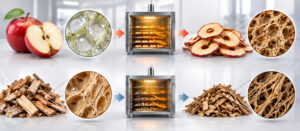
Biomass feedstocks like wood chips, bagasse, rice husk, sawdust and agricultural residues have a structure that is hard to dry evenly. There are reasons for this.
The main problem is that a lot of the moisture is trapped inside the fibre so it takes a time to come out and evaporate.
Also, the wood chips and other biomass feedstocks are not all the same size and weight which makes it hard to dry them all at the same rate.
You can have pieces and big chunks all mixed together in one pile of wood chips and each size takes a different amount of time to dry.
The bigger pieces always take longer to dry than the ones, so by the time the big pieces are dry, the small ones might be too dry and start to fall apart.
Both of these methods try to deal with the fact that biomass feedstocks like wood chips and sawdust do not all dry, at the rate.
Seaweed
Seaweed is a case; if you try to dry it fast with high heat, the tiny parts break and the seaweed shrink really fast. It also loses its colour and the good things that are in it like nutrients and special compounds are damaged.
The salt in seaweed makes things more complicated. The salt that is dissolved in the water affects how easily the water can move and how fast the seaweed dries. When the water evaporates the salt stays near the surface. For seaweed that people are going to eat or use as food for animals or to get things out of it you have to dry it in a gentle and controlled way. You want to remove the water so you do not cook or burn the seaweed.
Herbal Materials
Mint, tulsi, chamomile, and other medicinal or aromatic leaves are dried with a very different success metric in mind: preserving essential oils, active compounds, colour, and aroma. Herbs are thin and have a relatively short internal diffusion path compared to biomass, so surface moisture removal happens quickly, but that speed is exactly the risk. High temperatures applied too early or too aggressively can volatilize the essential oils the product depends on or discolour the leaf through oxidation and thermal degradation.
For herbs, drying kinetics work in the industry’s favour structurally (thin material, fast diffusion) but against it thermally (low tolerance for heat). The engineering challenge is almost entirely about temperature and airflow control rather than getting moisture out of a thick particle.
The Three Stages of Industrial Drying
Nearly every material regardless of category that passes through three recognizable stages during drying, though the duration and difficulty of each stage vary enormously by product.
Stage 1 — Surface Moisture Removal.
This is the fastest stage. Free water on or near the surface evaporates readily, limited mainly by the drying air’s temperature, humidity, and velocity. Drying rate is at its highest here, and this stage is usually the least risky in terms of product damage.
Stage 2 — Internal Moisture Migration.
Once the readily available surface water is gone, the process becomes diffusion-limited. Moisture has to travel from inside the material to the surface before it can evaporate, and that migration rate, not the drying air conditions become the bottleneck. Drying rate drops noticeably here, which is a normal and expected part of the curve, not a sign of an underperforming dryer.
Stage 3 — Bound Moisture Removal.
The final stage deals with moisture that is chemically or physically bound to the material’s structure, the hardest water to remove. This stage is the slowest and most energy-intensive, and it’s also where overdying risk is highest: because the drying rate is already low, it’s easy to keep applying heat well past the point of diminishing returns, degrading product quality for very little additional moisture removal.
Understanding which stage a material is in at any given point tells you what’s actually limiting the process air conditions, internal diffusion, or bound moisture and that determines what adjustment, if any, will actually help.
Factors That Influence Drying Kinetics
Material properties set the baseline behaviour: density, porosity, particle size and shape, and initial moisture content all determine how much moisture is present, how it’s distributed, and how far it has to travel to escape.
Process conditions are what an operator can actually control day to day: air temperature, air velocity, relative humidity of the drying air, residence time in the dryer, and in some processes, pressure (as in vacuum drying). These parameters interact — raising air velocity helps in the surface-moisture stage but does very little once the process becomes diffusion-limited internally.
Equipment design determines how effectively those process conditions actually reach the material: the heat transfer method (convective, conductive, radiant, or volumetric via microwave/RF), how uniformly air is distributed across the bed, conveyor or drum speed, and product thickness on the belt or in the drum. A well-controlled process on poorly designed equipment still produces uneven results, because the material simply isn’t experiencing the conditions uniformly.
Common Industrial Drying Challenges
Uneven Drying — Cause: inconsistent particle size, uneven bed depth, or poor air distribution across the drying chamber. Result: some material overdried and brittle while other portions remain damp, creating quality and storage-stability issues in the same batch. Solution: pre-sizing or screening feedstock, redesigning air distribution, or reducing bed thickness to promote more even exposure.
Product Shrinkage — Cause: rapid moisture loss that collapses cellular structure faster than it can adjust. Result: reduced yield, altered texture, and sometimes reduced rehydration capacity. Solution: staged drying with a gentler initial temperature ramp, particularly important for seaweed and other high-moisture, structurally delicate materials.
Colour Loss — Cause: oxidation and thermal degradation of pigments at elevated temperatures, often worsened by extended exposure time. Solution: lower processing temperatures paired with technologies like heat pump or vacuum drying that reduce oxygen exposure and thermal stress.
Case Hardening — This deserves its own explanation because it’s often misdiagnosed. It happens when the outer layer of a particle dries and hardens rapidly while significant moisture remains trapped inside, forming a shell that then blocks further moisture migration. The product can look and feel dry on the outside while being substantially wetter than spec internally — a real risk for storage stability and downstream processing.
Loss of Nutrients — Especially relevant for herbs and food-grade materials, where excessive heat or prolonged exposure degrades vitamins, bioactive compounds, and other heat-sensitive constituents that define the product’s value.
High Energy Consumption — Frequently traced back to running the wrong drying conditions for the material’s actual kinetics; for example, maintaining high airflow well into the bound-moisture stage, where airflow is no longer the limiting factor and the extra energy simply isn’t accomplishing anything useful.
Choosing the Right Drying Technology Based on Material Behaviour
Matching dryer technology to material behaviour is where drying kinetics stops being theory and starts being a procurement decision.
| Material Type | Main Drying Challenge | Suitable Drying Technology |
| Biomass | Thick particles, uneven moisture distribution | Rotary Dryer, Belt Dryer, Hot Air Dryer |
| Seaweed | Colour retention, shrinkage, nutrient preservation | Heat Pump Dryer, Belt Dryer, Microwave Dryer |
| Herbs | Aroma and active compound preservation | Heat Pump Dryer, Tray Dryer, Microwave Vacuum Dryer |
| Fine powders | Uniform drying across fine particles | Fluidized Bed Dryer |
| High-value materials | Gentle, damage-free drying | Microwave Vacuum Drying |
The logic behind each pairing follows directly from the kinetics discussion above: bulky, uneven biomass benefits from equipment that keeps material moving or spread thin; delicate, heat-sensitive materials benefit from lower-temperature or volumetric heating methods; fine powders need airflow uniformity above all else, which fluidized beds are specifically built to deliver.
How Modern Industrial Dryers Improve Drying Kinetics
Heat Pump Drying
Heat Pump Drying operates at lower temperatures than conventional hot-air systems while recovering and reusing latent heat, which makes it well suited to materials where product quality depends on avoiding thermal stress, seaweed and herbs being good examples, while also improving overall energy efficiency.
Microwave Drying
Microwave Drying heats volumetrically, meaning energy is deposited throughout the material rather than only at the surface. This shortens the internal-diffusion bottleneck described in Stage 2, since moisture doesn’t have to migrate as far relative to where heating is occurring, translating into meaningfully faster overall drying times for suitable materials.
Radio Frequency Drying
Radio Frequency Drying works on a related principle but penetrates more deeply, which makes it particularly useful for thicker products where microwave penetration alone isn’t sufficient to heat the core evenly.
Belt Dryers
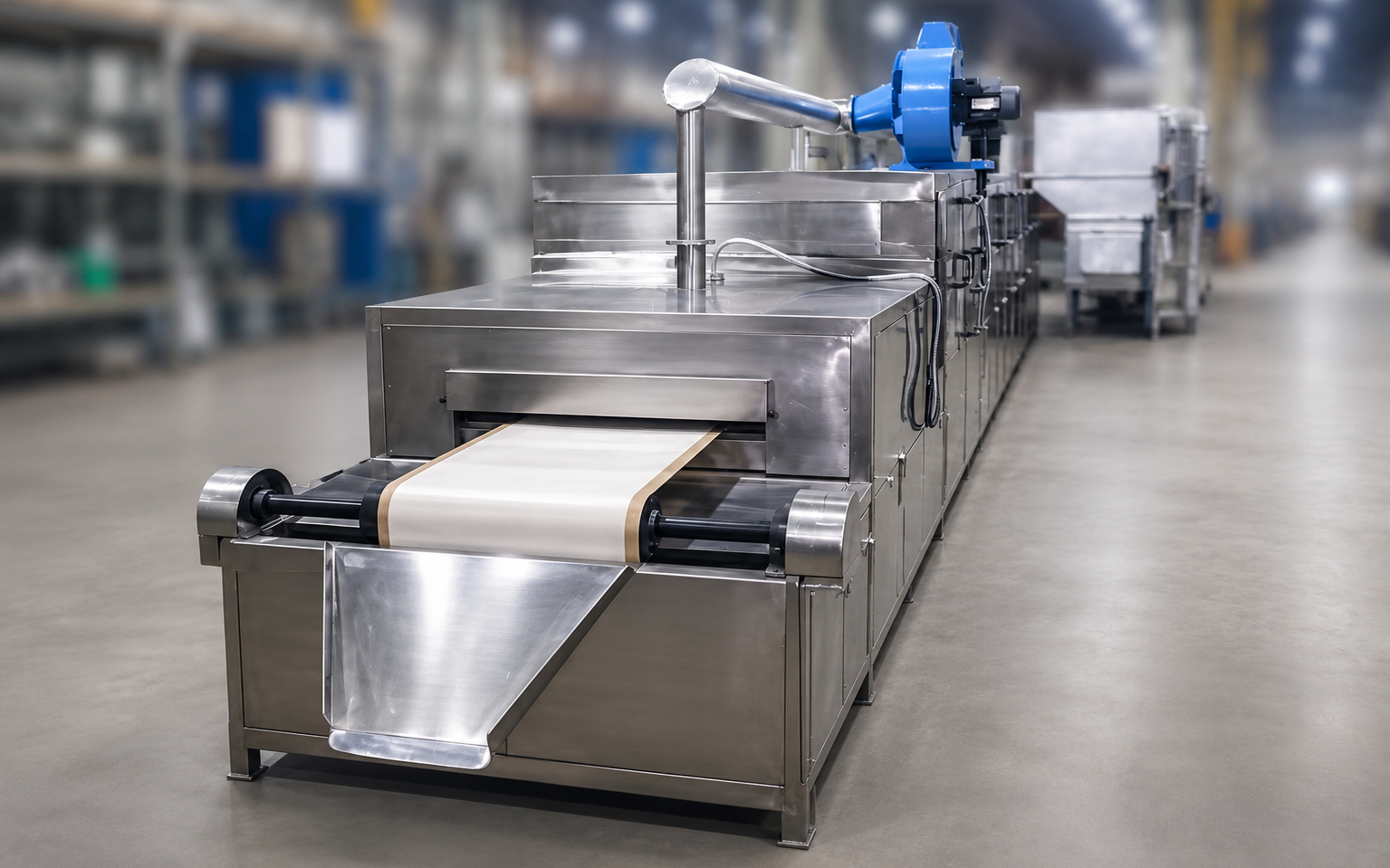
Belt Dryers support continuous production with a thin, well-distributed material bed and controllable airflow, which directly addresses the uneven-drying problem common in fibrous and irregularly sized materials.
Rotary Dryers
Rotary Dryers are built for high-throughput bulk processing, using continuous tumbling to expose fresh material surface to the drying air, a good match for bulk biomass streams like wood chips or bagasse where consistent quality per particle is less critical than overall throughput and moisture reduction.
Process Optimization Tips
A few practices consistently separate well-run drying operations from ones that fight quality and energy problems constantly:
- Measure inlet moisture before assuming a set drying profile will work
- Monitor outlet moisture in real time rather than relying only on residence time
- Avoid excessive drying temperatures, particularly once the process moves into the internal-diffusion or bound-moisture stages
- Match airflow and bed thickness to material size, thick beds starve the lower layers of airflow
- Optimize residence time based on actual drying curve behaviour, not a fixed schedule
- Use staged drying (lower temperature first, higher temperature later, or vice versa depending on material) where the product’s sensitivity warrants it
- Monitor product colour and texture as a practical proxy for quality, not just final moisture number
- Run pilot trials before committing to full-scale production parameters, especially for new feedstocks or product formulations
Real Industrial Applications
Biomass
Biomass drying typically precedes pellet production, gasification, or biochar manufacturing. All processes where consistent moisture content directly affects downstream combustion efficiency or process stability.
Seaweed
Seaweed drying supports food ingredient manufacturing, animal feed production, fertilizer processing, and bioactive compound extraction with applications where both moisture reduction and preservation of the material’s functional properties matter.
Herbs
Herbs are dried ahead of tea processing, pharmaceutical manufacturing, nutraceutical production, and herbal extract preparation, where preserving the active compounds is often the entire point of the process.
Future Trends in Drying Kinetics
Industrial drying is gradually shifting from fixed-recipe operation toward adaptive, data-driven control. AI-based moisture prediction models are being explored to anticipate drying behaviour before a batch even finishes, rather than reacting after the fact. Real-time moisture sensors are making it possible to adjust process parameters mid-run instead of relying solely on scheduled residence times. Digital twins allow engineers to simulate drying behaviour for new materials before running costly physical trials. Smart PLC control and machine learning-based process optimization are being applied to fine-tune temperature and airflow profiles continuously rather than at fixed setpoints. Hybrid systems are combining microwave or RF heating with conventional hot air are gaining traction for materials that need both fast internal heating and effective surface moisture removal. And energy recovery systems are increasingly built into dryer design from the outset, rather than added on afterward, as energy costs remain a persistent pressure across the industry.
Conclusion
Drying is not simply about removing moisture. Every material follows its own drying behaviour, shaped by its structure, its moisture distribution, and its sensitivity to heat. Understanding drying kinetics enables industries to improve product quality, optimize energy use, and select the most suitable drying technology for the job at hand. Whether processing biomass, seaweed, or herbal materials, a scientific approach to drying, rather than a one-size-fits-all setpoint, leads to more efficient, more consistent, and more defensible industrial operations.
Frequently Asked Questions (FAQs)
-
Why does cranking up the heat sometimes result in a product that rots in storage?
When temperatures are aggressively high, the outside of the material dries rapidly and forms a hard, impenetrable shell. This phenomenon, known as “case hardening,” traps internal moisture inside the product. While it feels dry to the touch on the production floor, that trapped water will eventually cause mould or rot during storage.
-
If herbs are thin and shed water quickly, why are they notoriously difficult to dry?
The physical structure of herbs makes moisture removal incredibly fast, but their commercial value relies entirely on delicate volatile oils and pigments. The challenge isn’t getting the water out; it’s getting the water out without vaporizing the active compounds or turning the leaves brown through thermal degradation.
-
How does ocean salt actively fight the drying process in seaweed?
Salt dissolved in the plant’s natural water changes the vapor pressure, making evaporation inherently slower. As the water evaporates, the salt also migrates and crystallizes near the surface. If pushed too hard with high heat, this leads to aggressive cellular collapse, shrinking the seaweed and ruining its nutritional profile.
-
Why is sorting biomass by size just as important as the drying equipment itself?
Drying kinetics dictate that moisture takes longer to escape from a larger mass. If you feed a mixture of sawdust and large wood chips into the same dryer, the sawdust will become over-dried, brittle, and highly combustible long before the core of the larger chips has even begun to properly release its moisture.
-
At what stage of drying do facilities waste the most money on energy?
The third stage (removing bound moisture). In this phase, water is physically or chemically locked into the cellular structure. Pumping massive amounts of hot, high-velocity air into the chamber doesn’t speed this up; it only wastes electricity and fuel, because the limiting factor is now the material’s internal chemistry, not the air surrounding it.
-
Why does the moisture removal rate suddenly flatline halfway through a batch?
This drop-off happens when a material transitions from Stage 1 (evaporating easy surface water) to Stage 2 (internal migration). The machine hasn’t stopped working; rather, the physics have shifted. The process is now entirely bottlenecked by how fast water can naturally diffuse through the product’s internal capillaries to reach the surface.
-
Can drying a material too fast permanently ruin its ability to rehydrate?
Yes. In high-moisture, fragile structures like seaweed or certain foods, aggressive initial heat strips water out faster than the cell walls can adapt. The cellular structure collapses inward and essentially fuses, meaning the product will never properly absorb water again when a consumer tries to reconstitute it.
-
How do microwave industrial dryers “cheat” the standard rules of moisture diffusion?
Traditional dryers rely on heat transferring from the outside in, meaning water must slowly migrate to the surface to escape. Microwave (and Radio Frequency) dryers heat volumetrically, they deposit energy directly into the core of the material, actively pushing internal moisture outward and drastically shortening the diffusion bottleneck.
-
Why is operating a dryer on a strict time schedule considered an outdated practice?
No two loads of raw feedstock are identical. Relying purely on residence time ignores fluctuations in starting moisture, ambient humidity, and particle density. Modern facilities use real-time sensors to measure the actual moisture of the output, adjusting belts and temperatures dynamically rather than sticking to a blind timer.
-
What happens chemically if the material bed on a conveyor dryer is simply too thick?
A thick bed chokes off airflow to the bottom layers. While the top layer gets overexposed to heat (risking oxidation and nutrient loss), the bottom layer sits in a warm, damp, stagnant environment, which is the perfect breeding ground for localized fermentation or bacterial growth before the drying cycle even finishes.
-
Why would a facility invest in a Heat Pump dryer when Hot Air dryers are generally much faster?
Speed isn’t everything. Heat pumps operate at much lower, gentler temperatures while constantly recovering latent heat in a closed loop. For premium products like medicinal herbs or nutraceutical seaweed, this gentle environment preserves heat-sensitive vitamins, essential oils, and bright colours that traditional hot air would destroy.
-
What is the difference between “free water” and “bound moisture” at a cellular level?
Free water sits loosely on the exterior or in open, easily accessible pores; it behaves almost identically to water sitting in a puddle. Bound moisture is physically trapped inside cell walls or chemically bonded to the material’s molecules, requiring significantly more thermal energy to break those bonds before it can vaporize.
-
How do “digital twins” prevent catastrophic product loss in new drying operations?
A digital twin is a virtual software simulation of the physical drying machine. Instead of running tons of expensive, real-world feedstock through a dryer just to see if it burns or shrinks, engineers can use the material’s known kinetic data to simulate the exact thermal and airflow parameters on a computer first.
-
Why are hybrid dryers becoming the industry standard for complex industrial materials?
Because no single technology perfectly addresses all three stages of drying. A hybrid system might use microwaves to aggressively push internal moisture to the surface (solving the Stage 2 bottleneck), while simultaneously using convective hot air to rapidly sweep that newly surfaced moisture away (maximizing Stage 1 efficiency).