How Tray Loading Depth Affects Drying Time, Moisture Removal and Product Quality
Tray loading depth is one of the simplest settings in a hot air tray dryer, yet it is often the one that gets the least attention. When a batch comes out wet, the usual reaction is to raise the set point on the temperature controller or add another hour to the cycle. Quite often the real cause is sitting right on the tray: the material was spread too thick.
In batch drying, the depth of material on each tray decides how fast moisture can escape, how evenly the batch dries and what condition the product is in when it comes out. Below, we look at what happens inside a wet layer, why material layer thickness has such a strong effect on drying time, and how to choose a sensible depth for your product.
What Happens Inside a Tray During Drying
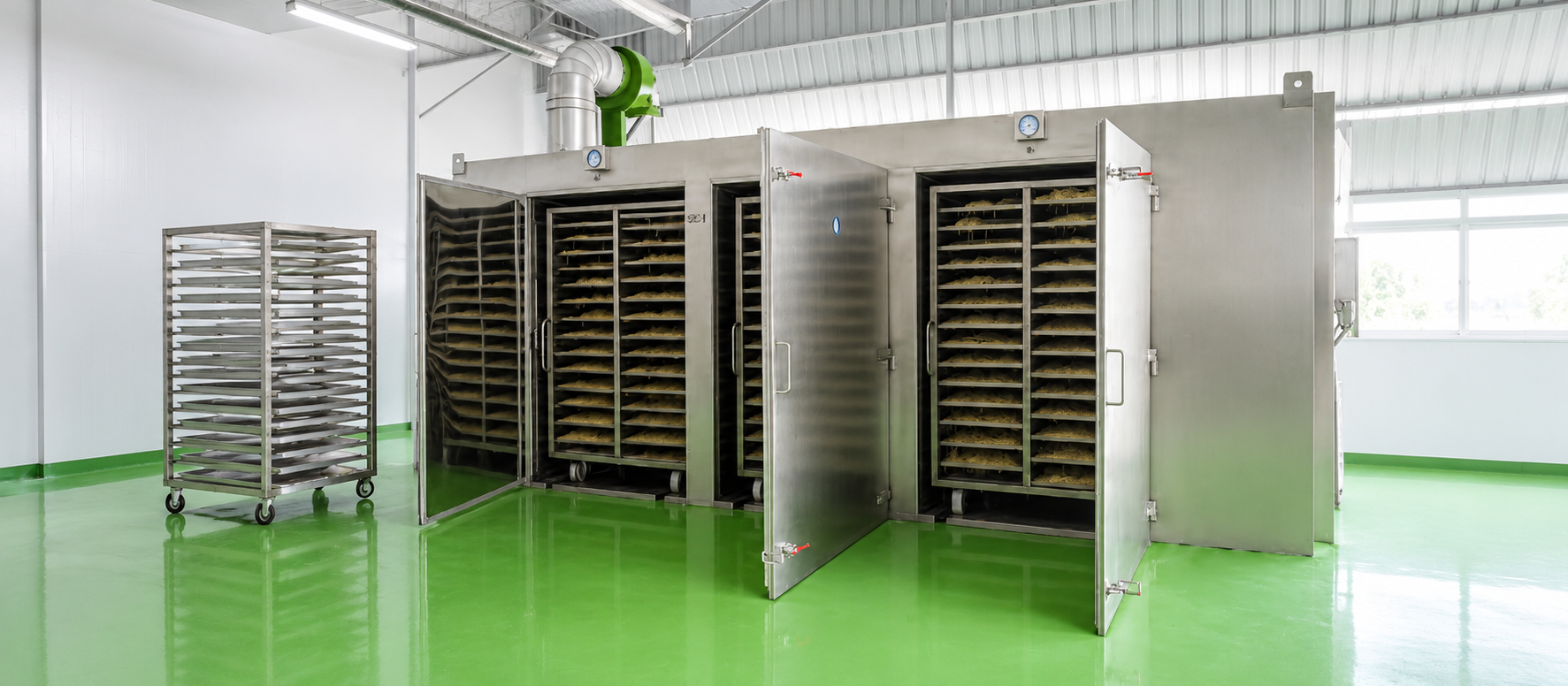
In a typical hot air dryer machine, a fan pushes heated air across stacked trays. Heat transfer to the material happens mainly by convection at the exposed top surface, with a smaller share coming up through the metal tray. The water inside the material has to absorb that heat, move to the surface and then get carried away by the passing air.
Drying usually happens in two broad stages. In the first, called the constant rate period, the surface stays wet and water evaporates almost as it would from an open dish. Speed here depends on air temperature, humidity and air velocity. Once the surface starts drying out, the falling rate period begins. Now moisture has to travel from deep inside the layer to reach the surface, and the material itself, not the air, becomes the main limit on speed.
Why Doubling the Depth Can More Than Double the Drying Time
This is where loading depth starts to matter a lot. During the constant rate period, a layer twice as deep holds twice as much water over the same surface area, while the surface evaporates at roughly the same rate. So that stage takes about twice as long.
The falling rate period is less forgiving. When internal moisture movement controls drying, standard drying theory shows that time rises with roughly the square of the layer thickness. In simple terms, going from 10 mm to 20 mm can make this last stage take close to four times longer, not two. Real materials do not follow theory exactly, so the true figure for your product should be confirmed by trial. The trend, however, holds for most granular and porous solids, which is why a small increase in depth can add hours to a cycle.
How Loading Depth Affects Moisture Removal and Uniformity
A thick layer does not dry all once. The top part dries first while the bottom part remains wet for a time creating a moisture gradient from top to bottom. A sample taken from the surface may pass the moisture test. The bottom of the same tray may still be above the moisture limit. This is a reason for failed loss on drying results on batches that appear dry upon inspection.
Overfilled trays also disturb air circulation. In cross flow designs air travels through the gap that lies between trays. When material is piled above the tray rim that gap shrinks, airflow slows and trays in some positions dry slower than others. The result is variation not within one tray but, across the entire trolley.
The Effect on Product Quality
Drying time is not only a production issue. Every extra hour in the dryer is extra time at elevated temperature. In pharmaceuticals, heat sensitive active ingredients can degrade, and food products can lose colour, aroma and nutrients.
Thick layers can also cause case hardening. The surface dries quickly and forms a hard skin that traps moisture inside. The product feels dry but carries wet pockets, which can lead to lumps, mould in storage or poor tablet compression in the case of granules. Deep beds of wet granules also tend to bind together, need more milling afterwards and can shift the particle size distribution.
Very shallow loading has its own problems. Throughput drops, so you need more trays or more batches for the same output. Fine, light material can be lifted by the air stream and lost as dust. Energy use per kilogram of water removed can also rise, because much of the hot air passes over the trays without picking up much moisture.
How to Choose the Right Material Layer Thickness
No single depth works for every material. The right depth depends on the starting moisture the moisture, the particle size, the porosity, how heat sensitive the material is and how air flows inside the drying equipment you are using. As a rule, pharmaceutical granules are usually loaded shallow often one to two centimetres deep. Open textured materials like vegetable slices can sometimes handle deeper layers. These are only starting points, don’t take them as fixed rules.
The best way to find the depth is to run a short trial. Load trays at two or three depths. Keep the temperature. Airflow exactly the same across all trays. Sample the top, middle and bottom of each layer at time intervals. Then plot moisture content over time, for each depth. This will show where the drying process slows down and were increasing the batch size no longer gives you returns. You’ll see clearly where the extra time isn’t worth the volume. At Kerone, the process team usually asks for the loading depth used in a client’s lab trials before sizing a tray dryer, because the tray count and cycle time both follow from that one number.
Practical Tips for Day to Day Operation
Once a depth is chosen consistency is the important thing. Weigh the material for each tray of guessing by eye and write the weight for each tray into the batch instructions. Spread it out evenly with a scraper so there are no high spots or areas that are too thin and make sure it stays below the edge of the tray so the air gap remains clear.
If the product allows it turning the material partway through the process helps the bottom layer dry. Check that the temperature controller probe is measuring the air that actually reaches the trays not just the air coming out of the heater. In industries that are strictly regulated such as pharmaceuticals, the way the material is loaded is part of the process that has been proven to work so any change, in depth must go through the change control process.
Getting the Depth Right
Loading depth is easy to overlook because it costs nothing to change. Yet it shapes drying time, moisture uniformity and final quality more directly than most other settings on a hot air tray dryer. A few well-planned trials and a fixed weight per tray will often solve problems that higher temperatures and longer cycles only hide.
Frequently Asked Questions
-
What is the ideal tray loading depth in a hot air tray dryer?
There is no single ideal depth. It depends on the material, its starting moisture, the target moisture and how heat sensitive it is. Many pharmaceutical granules are loaded around one to two centimetres deep, but the right value for your product should come from drying trials at two or three depths.
-
Why does my batch dry on top but stay wet at the bottom?
The layer is usually too thick for the airflow and temperature being used. The top surface dries quickly while moisture at the bottom has a longer path to escape. Reducing the depth, spreading the material more evenly or turning it partway through the cycle normally fixes this.
-
Can I raise the temperature to make up for thicker loading?
Only partly. Higher air temperature speeds up the early stage of drying, but the later stage is limited by how fast moisture moves inside the material. Pushing temperature too high can damage heat sensitive products and cause case hardening, where a dry skin traps moisture inside.
-
How do I check that moisture removal is even across the batch?
Take samples from the top, middle and bottom of the layer, and from trays at different positions on the trolley, such as top, bottom, front and back. Test each one for loss on drying. Large differences point to uneven loading or poor air circulation.
-
Does material layer thickness affect energy consumption?
Yes, in both directions. Very thick layers stretch the cycle and keep heaters and fans running longer. Very thin layers let a lot of hot air pass without picking up much moisture, so energy per kilogram of water removed goes up. A balanced depth confirmed by trials usually gives the best result.