Microstructural Changes During Drying: What Happens Inside Food and Biomass
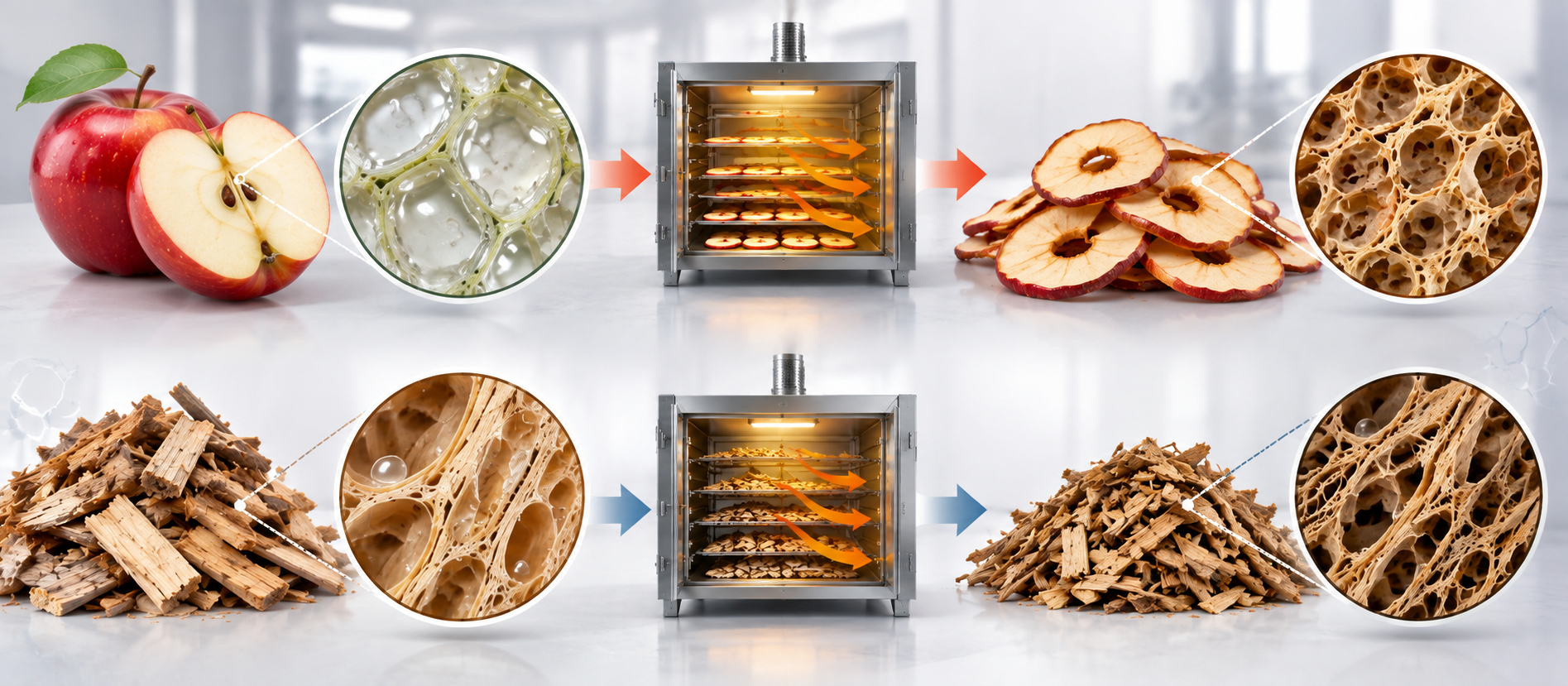
Microstructural changes during drying decide most of what we see and feel in a dried product. A dried mango slice that is leathery, a vegetable piece that will not soften in hot water, or a wood chip that cracks and turns dusty all come from what happened inside the material while water was leaving it.
Drying is often treated as a simple job of removing moisture to a target value. Two samples can reach the same final moisture and still behave very differently. One may rehydrate in minutes, while the other stays hard. One may grind easily, while the other forms fines. The difference sits at the level of cells, pores and cell walls.
This article explains what these changes are, the main types, where they matter, the factors that control them, and how to think about them when choosing a drying method.
What Are Microstructural Changes During Drying?
Microstructure means the internal structure of a material that you usually need a microscope to see. In fruits and vegetables, it includes cells, cell walls, the middle lamella that holds cells together, intercellular air spaces and the liquid inside cells. In biomass such as wood, straw, husk or seaweed, it includes fibre cells, lignocellulosic cell walls, vessels and natural pore channels.
Fresh plant tissue is mostly water. In many vegetables, water is 80 to 95 percent of the weight. This water keeps cells swollen and pressed against each other, a condition called turgor. When drying starts, water moves from inside the cells to the surface and then evaporates. As it leaves, cells lose turgor, walls come under stress, and the structure starts to shrink, fold, crack or collapse.
These physical changes come with chemical and physical changes too. Starch can gelatinise if the product is hot and still wet. Proteins can denature. Sugars can move towards the surface with the water. Cellulose fibres can bond more tightly to each other. All of these leave a mark on the final structure.
Researchers usually study these changes with scanning electron microscopy (SEM), light microscopy, X-ray micro computed tomography and mercury porosimetry. In a plant or pilot setting, the same changes show up as bulk density, rehydration ratio, colour, texture and grindability.
Types of Microstructural Changes During Drying
Shrinkage and Cell Collapse
When the water drains out, the space is not necessarily filled with air, causing the material to contract. When the product is soft and flexible, the volume loss is sometimes very close to the volume of water removed during the early stage of drying. The cells become flattened and the walls bend at the cellular level. In extreme cases, the entire cell structure is destroyed. This results in a tough, slow rehydrating product. The shrinkage in food drying is closely related to the glass transition of the product. At high temperatures, above its glass transition temperature, the product will be rubbery and free to shrink. If below this temperature, it becomes glassy and rigid and the shrinkage slows down, so that more pores are created.
Pore Formation and Porosity Development
The percentage of air in the product is called porosity. Certain drying conditions result in a relatively rigid solid matrix as the liquid is removed, creating empty spaces. Other conditions develop an internal vapour pressure that pushes the structure outwards leading to the formation of new pores. There are several effects of the dried food’s porosity: determining the rehydration rate; bulk density and storage stability; and crispness. A highly porous product has a quicker rehydration rate, but absorbs oxygen and moisture from air rapidly, which makes packaging important. Typically, high porosity is obtained from freeze-dry and microwave vacuum dry. Low porosity is typically the result of slow hot air-drying of soft tissue.
Case Hardening and Crust Formation
Case hardening in drying happens when the outer layer dries much faster than the inside. The surface becomes dry, stiff and less permeable, while the core is still wet. Water from the centre then struggles to escape. Drying slows down, the core stays moist, and the product may develop internal stress.
High air temperature, low air humidity and high air velocity at the start of drying are the usual causes. Products rich in sugar or soluble solids are more prone, because solutes move to the surface with water and form a sticky film that then dries into a skin. In wood and thick biomass pieces, the same effect leads to surface checking and internal splits.
Cracking, Fissuring and Cell Wall Rupture
When moisture falls unevenly across a piece, some regions shrink more than others. The stress that builds up can exceed the strength of the material, and cracks appear. Rice grains, pasta, wood chips and thick vegetable slices are common examples.
Cell walls can also rupture. This can happen from fast internal vapour generation, as in microwave drying, or from ice crystals in freezing before freeze drying. Some rupture is useful, for example to make a product puff or to open pathways for extraction. Too much rupture leads to fragile products and loss of cell contents.
Applications Where Microstructure Matters
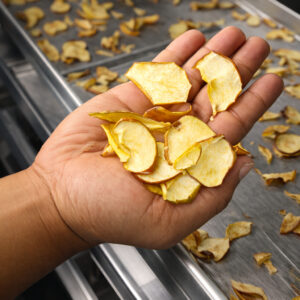 In fruit and vegetable drying, microstructure controls texture, adjust moisture and appearance. Dried onion, garlic, carrot and leafy greens used in soups and ready meals must rehydrate quickly. A collapsed structure fails this test even when moisture is on specification.
In powders, the structure of the dried particle affects flowability, solubility and bulk density. Spray dried milk, coffee and fruit powders can have hollow, wrinkled or smooth particles depending on the drying conditions.
In grains and pulses, fissures formed during drying increase breakage during milling. This is a known quality issue in paddy drying, where too fast drying raises broken rice percentage.
In biomass and solid fuels, biomass drying microstructure affects grinding energy, pellet quality and how the material behaves in later thermal processes. Dried biomass with more open pore channels generally releases volatiles more easily during pyrolysis or gasification, while overdried and brittle material can produce excess fines during handling.
In pulp and cellulose fibres, repeated drying causes hornification. Fibres bond to each other and close their pores, so they swell less when wetted again. This is important in recycled fibre and in cellulose based materials.
In seaweed and algae, the cell wall contains gel-forming polysaccharides. Drying conditions change how easily these can later be extracted or how well the dried seaweed rehydrates.
Factors to Consider
Drying temperature
Higher temperature speeds up drying, but it also keeps the material above its glass transition for longer in the early stage, which increases shrinkage. It also raises the chance of case hardening and heat damage to proteins and pigments.
Air humidity and velocity
Very dry, fast-moving air at the start of drying pulls moisture from the surface faster than the inside can supply it. Controlled humidity in the first stage helps keep the surface open.
Initial moisture and composition
Sugar rich fruits, starch rich tubers, protein rich meat and fibre rich biomass all respond differently. Sugars lower the glass transition temperature, which makes collapse more likely. Fibre gives a stiffer frame that resists shrinkage.
Piece size and shape
Thick pieces build steeper moisture gradients, which leads to more stress and cracking. Thin slices dry more evenly.
Pretreatment
Blanching softens cell walls and changes permeability. Osmotic dehydration adds solids that can support the structure. Freezing before drying forms ice crystals that create pores. Pulsed electric field treatment opens cell membranes and can reduce drying time.
Energy delivery mode
Heat from hot air enters from the surface. Microwave and radio frequency energy heat the water inside the product. Infrared heats the surface layer. Conduction heats from a contact surface. Each of these sets up a different moisture and temperature profile inside the piece.
Pressure
Vacuum lowers the boiling point of water, so drying can happen at lower temperature. Under vacuum, internal vapour escapes more easily and often expands the structure.
Drying profile over time
Many products benefit from a staged profile, with gentler conditions at the start and different conditions near the end. A single fixed condition from start to finish is rarely the best for structure.
Benefits of Controlling Microstructural Changes
When microstructural changes during drying are understood and controlled the quality of the product becomes more predictable from one batch to the next. Rehydration of the product improves, which is important for foods and ingredient mixes. The texture of the product can be tuned, from crisp and porous to chewy and dense depending on what the market wants.
Controlling case hardening can shorten the drying time because the surface stays permeable and the falling rate stage does not linger. This can reduce the energy used per kilogram of water removed.
For biomass a uniform structure can mean fewer fines, steadier feeding into downstream equipment and more consistent behaviour during grinding and pelletising.
Good control of changes also helps shelf life. Products without wet pockets are less likely to develop mould and products with known porosity can be packed with the right barrier level.
Hot Air Drying vs. Freeze Drying: How the Microstructure Differs
Hot air drying and freeze drying are the two extremes of the scale when it comes to structure.
In hot air-drying water leaves as moves toward the surface and evaporates. The product stays warm and often rubbery for most of the process. Cells. Collapse the surface can harden and the final product is usually dense with low porosity. Rehydration of the product is slower and often incomplete. On the hand-hot air drying is simple well understood and has much lower capital and running cost. For products such as grains, spices, biomass and some vegetables the structure it gives is fully acceptable.
In freeze drying the product is frozen first. Water leaves by sublimation from ice to vapour under vacuum. The frozen matrix holds its shape while ice leaves so the product keeps its original volume. The spaces where ice crystals sat become pores. The result is a highly porous product that rehydrates fast and holds colour and aroma well. The drawbacks are cycle time, high energy use and high equipment cost. The size of the ice crystals, which is set by the rate controls pore size so freezing is as important as drying.
Between these two there are options. Vacuum drying, microwave vacuum drying heat pump drying at temperatures and combined methods such, as hot air followed by microwave finishing can give structures that sit in between. The choice depends on what the product needs and what the process can afford.
How to Select the Right Drying Method to Control Microstructure
Start with the product requirement, not the dryer. Ask what the end user will do with the dried material. Rehydration ratio and speed are important if it is to be rehydrated. When it’s meant to be eaten as a crunchy snack, this is important. Brittleness and fines generation is important if it will be ground or pelletised. If it goes to thermal conversion, moisture uniformity and particle integrity may matter more than appearance.
Next, understand the raw material. Measure initial moisture, soluble solids, piece size and, where possible, the glass transition behaviour at different moisture levels. A sugar rich fruit and a fibrous husk will not need the same approach.
Then match the energy mode to the target structure. Low temperature convective drying with humidity control can reduce case hardening. Vacuum or microwave assisted drying can increase porosity. Freeze drying gives the most open structure where the product value justifies it. Contact drying suits pastes and sludges where the structure is not a quality factor in the same way.
Run trials. Structure is hard to predict from calculations alone, because it depends on the specific raw material and its variety, maturity and pretreatment. Small scale trials with measurement of bulk density, rehydration ratio, colour and, if possible, microscope images give much better guidance than assumptions.
Finally, consider scale-up. Conditions on a tray in a laboratory may not be the same on a belt and/or a drum because different configurations of bed depth, airflow distribution and residence time are employed. When scaling up, maintain the same key drying conditions as before (product temperature history, surface humidity, etc.) and not only the same air temperature.
Frequently Asked Questions
Why does dried fruit shrink so much during drying?
Fresh fruit is mostly water held inside cells under pressure. When this water leaves, the cells lose that pressure and the walls fold inward. Fruit also contains a lot of sugar, which keeps it soft and rubbery for most of the drying process, so it can shrink freely instead of holding its shape.
How can case hardening be prevented in food drying?
Case hardening can be reduced by using moderate temperature at the start, keeping some humidity in the drying air during the first stage, using thinner pieces and, in some cases, applying pretreatments such as blanching. The aim is to keep the surface moist enough that the inside can keep supplying water to it.
Does drying method affect rehydration of dried vegetables?
Yes. Rehydration depends largely on how much of the original cell structure and pore network survives drying. Freeze dried and microwave vacuum dried vegetables usually rehydrate faster and more completely than those dried slowly in hot air, because their structure is more open and less collapsed.
How does drying change the structure of biomass such as wood chips or agricultural residues?
Drying shrinks the cell walls and can cause cracks, especially in larger pieces. Fibres may bond more tightly and close some pores, which makes the material less able to absorb water again. Overdrying can make biomass brittle, which increases dust and fines during handling, while uneven drying leaves wet cores that affect grinding and downstream processing.
Conclusion
Microstructural changes during drying are not a side effect to ignore. They shape texture, rehydration, density, grindability and shelf life, and they explain why two products with the same moisture content can perform very differently.
Shrinkage, porosity development, case hardening and cracking all follow from how fast water leaves, where heat enters, and whether the material is rubbery or glassy at each stage. By understanding the raw material, choosing the right energy mode and drying profile, and confirming choices with trials, it becomes possible to design a drying process around the structure the final product actually needs.