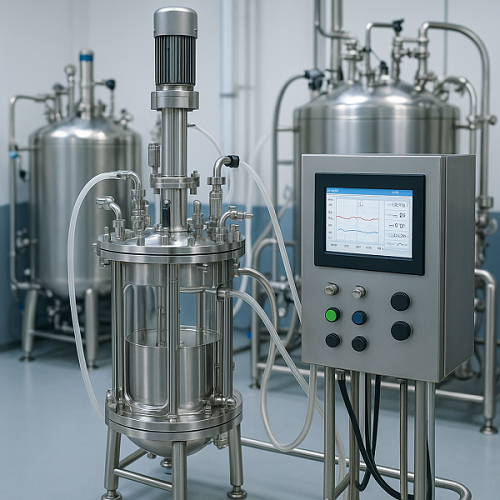
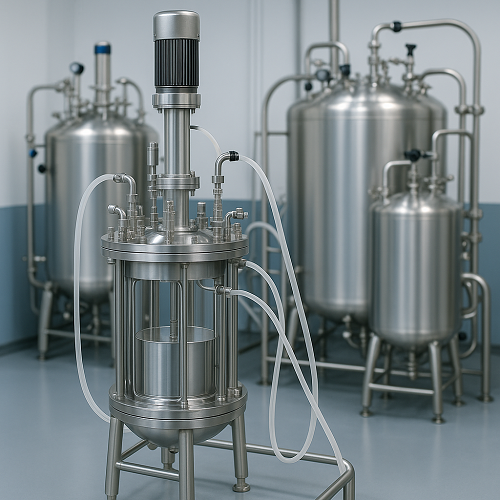
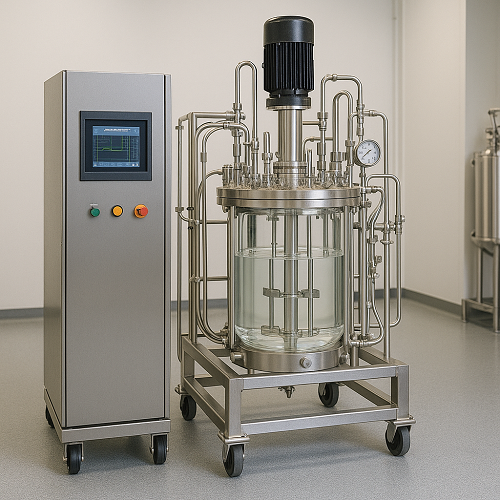
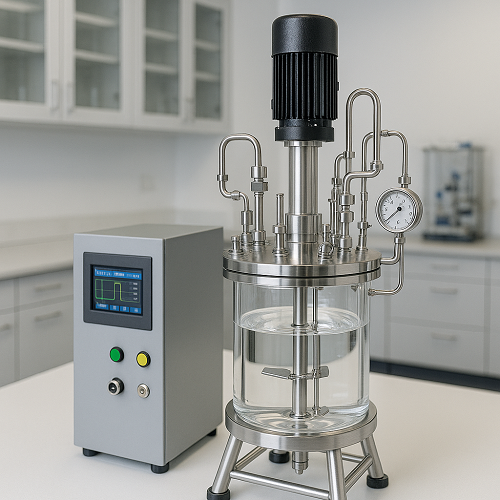
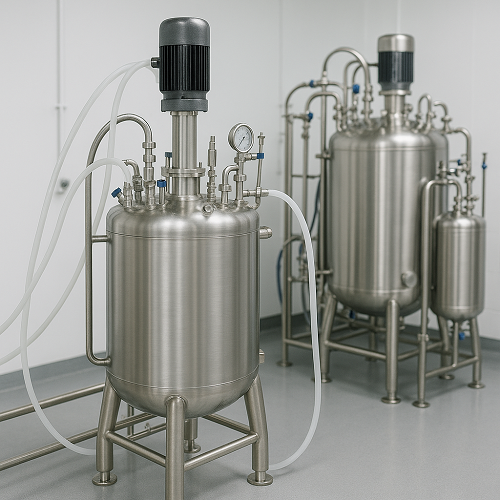
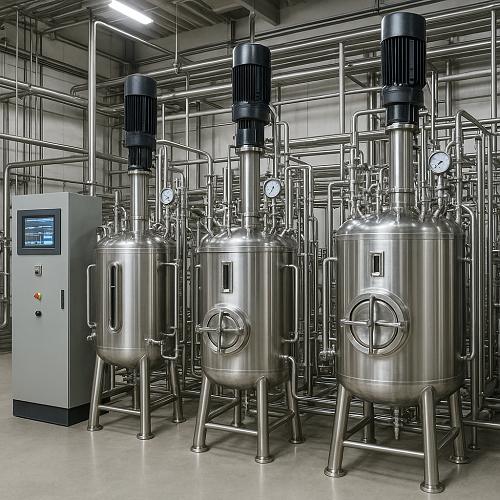
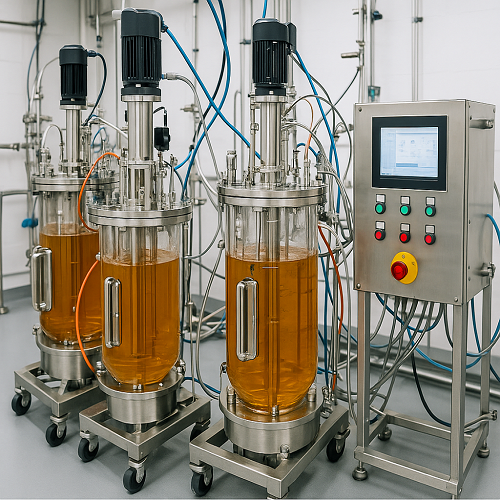
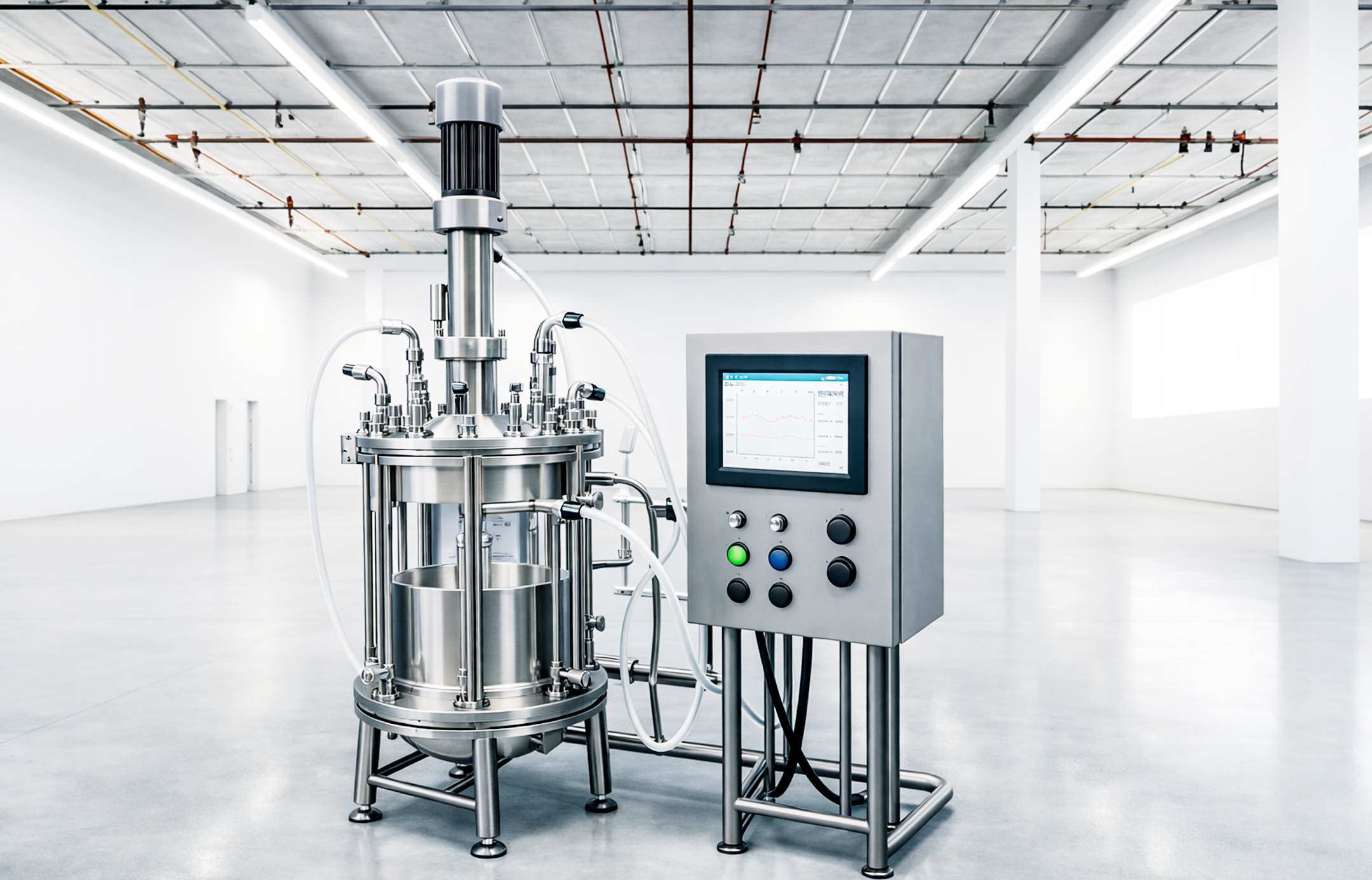
Kerone specializes in advanced pilot-scale bioreactors & fermenters solutions designed for precise thermal processing, controlled chemical reactions, and high-efficiency industrial operations. With decades of engineering expertise, Kerone builds customized systems that ensure uniform heating, reliable performance, and seamless integration into diverse industrial applications.
Kerone Pilot-Scale Bioreactors & Fermenter Systems are designed to replicate laboratory process conditions on a larger scale, enabling efficient process optimization, validation, and technology transfer. Engineered for scalability, flexibility, and reliability, these systems support the transition from bench-scale innovation to commercial manufacturing.
Pilot-scale bioreactors are a critical step in transforming lab discoveries into viable industrial processes. Our systems are engineered to mimic large-scale performance while allowing for the flexibility needed during development. With our robust and customizable solutions, you can reduce development timelines, improve reproducibility, and streamline your path to commercialization.
Kerone’s engineering team collaborates directly with bioprocess scientists and engineers to tailor agitation systems, aeration strategies, and sensor configurations for each specific application. Our systems incorporate advanced multi-loop control for dissolved oxygen, pH, temperature, and agitation enabling precise process control critical for biologics and pharmaceutical fermentation. With a strong track record in serving pharmaceutical, biotechnology, and food-grade fermentation industries, Kerone is the preferred partner for scale-up success.
Types and Features of Pilot-Scale Bioreactors & Fermenters
Volumes: 30L to 500L
Designed for process optimization and scale-up
Modular design with advanced automation options
CIP/SIP capabilities for clean operations
Scalable volumes
Precision process control
Robust construction
Flexible configurations
Sterilization options
Data management integration
Key Features
Pharmaceutical-grade 316L stainless steel construction with electropolished internal surfaces for superior cleanability
Validated CIP and SIP systems ensuring full sterility and compliance with GMP bioprocess standards
Multi-loop automated control of dissolved oxygen (DO), pH, temperature, agitation speed, and foam level
Versatile impeller configurations (Rushton, pitched blade, marine) for both aerobic and anaerobic fermentation
Integrated sparger systems with mass flow controllers for precise aeration and gas blending
PLC/SCADA control with 21 CFR Part 11-compliant data logging for pharmaceutical-grade documentation
Scalable design architecture ensuring smooth and validated process scale-up to production-scale bioreactors
Wide capacity range from 20L to 2,000L with customizable vessel geometry for varied bioprocess applications
Powered by AI, ML & IoT
Future-Ready Engineering Driven by AI & IoT
Our advanced AI, ML, and IoT technologies, this solution delivers smarter automation, real-time insights, and predictive intelligence to enhance efficiency and drive future-ready growth.
Real-Time Monitoring & Control
Continuous tracking of process parameters with instant adjustments.
Predictive Maintenance
Intelligent fault detection to prevent failures before they occur.
Adaptive Process Optimization
Dynamic tuning of operations for maximum output and efficiency.
Cloud Dashboards & Analytics
Unified access to real-time insights and performance trends.
Energy & Resource Savings
Smarter utilization of energy to cut costs and reduce waste.
Secure IoT Connectivity
Encrypted data flow with seamless integration across plant systems.
Applications of Pilot-Scale Bioreactors & Fermenters
Kerone’s Pilot-Scale Bioreactors & Fermenters are extensively used in pharmaceutical, biotechnology, food, and industrial bioprocessing industries worldwide.
Typical applications include:
Pilot-scale and laboratory research applications
Process Development & Optimization
Scale-Up Studies for Biopharma & Biotech
Pilot Production of Vaccines, Enzymes, and Proteins
Kerone’s advanced pilot-scale bioreactors & fermenters systems deliver consistent performance, high thermal efficiency, and maximum reliability. With fully customizable engineering and intelligent automation, Kerone ensures long-term operational stability and superior output quality.
Seamless Export Connections Global & Local
Our Global Footprint in Industrial Excellence
Delivering world-class industrial and process solutions across countries with precision, innovation, and reliability.
Peru
Chile
Argentina
Mexico
Colombia
Brazil
USA
Canada
United Kingdom
France
Germany
Spain
Italy
Netherlands
Sweden
Switzerland
Poland
Portugal
Ireland
Czechia
Romania
Hungary
Austria
Greece
Kazakhstan
Uzbekistan
Turkmenistan
Algeria
Egypt
Nigeria
Kenya
South Africa
Saudi Arabia
UAE
Israel
Russia
India
China
Japan
South Korea
Thailand
Vietnam
Malaysia
Singapore
Indonesia
Philippines
Australia
New Zealand
Pan-India Presence. Local Expertise.
Raipur
Bilaspur
Panaji
Vasco da Gama
Gandhinagar
Ahmedabad
Surat
Chandigarh
Gurgaon
Shimla
Manali
Bengaluru
Mysore
Kochi
Pune
Mumbai
Thane
Navi Mumbai
Hyderabad
Chennai
Coimbatore
Kolkata
Lucknow
Jaipur
Udaipur
Jodhpur
Dehradun
Haridwar
Bhubaneswar
Product Gallery
Frequently Asked Questions (FAQ)
Kerone's pilot-scale bioreactors are available in working volumes ranging from 20 liters to 2,000 liters, with custom sizes available based on specific process and facility requirements.
The bioreactors support aerobic and anaerobic fermentation, submerged fermentation, cell culture (microbial, mammalian, and plant), and enzyme production processes across pharmaceutical, biotechnology, and food industries.
Yes, Kerone's pilot-scale bioreactors are designed and manufactured in compliance with cGMP, ASME BPE, and FDA 21 CFR Part 11 standards for pharmaceutical and biopharmaceutical applications.
The automated control system manages dissolved oxygen (DO), pH, temperature, agitation speed, airflow rate, foam level, and pressure, ensuring stable and reproducible bioprocess conditions.
Yes, Kerone's bioreactors feature PLC/SCADA integration with support for 21 CFR Part 11-compliant electronic data recording, trending, and reporting for regulatory submissions.
Kerone offers Rushton turbine, pitched blade turbine (PBT), marine impeller, and custom configurations to suit specific mixing requirements for microbial, mammalian, or shear-sensitive cell cultures.
Yes, Kerone provides complete CIP and SIP validation protocols, qualification documents (IQ/OQ/PQ), and technical data packages to support regulatory submissions and facility audits.
Kerone provides installation, commissioning, operator training, process optimization support, preventive maintenance contracts, and spare parts supply for all pilot-scale bioreactor systems.
A lab-scale bioreactor, typically under 10 liters, is built for screening and early process development where speed of iteration matters more than representativeness of large-scale conditions. A pilot-scale unit, generally in the tens to low thousands of liters, is specifically engineered to replicate the mixing, aeration, and heat transfer characteristics present at commercial scale, even though absolute volume is much smaller. A full commercial fermenter prioritizes throughput and operating cost efficiency over the flexibility needed for process development. The pilot stage exists because process behavior, oxygen transfer rate, mixing time, foam control that doesn’t always scale linearly from lab to commercial volume, and skipping pilot validation are some of the more common causes of failed technology transfer.
The most frequent error is assuming that agitation speed and aeration rate optimized at lab scale can simply be proportionally adjusted for pilot volume, when in reality oxygen transfer coefficient and shear profile change non-linearly with vessel geometry. Teams also sometimes underestimate how foam behavior changes at larger scale, leading to overflow or contamination issues that never appeared in small lab vessels with proportionally larger headspace. Another common issue is treating sterilization validation as a formality rather than re-verifying it at the new scale, since heat penetration during sterilize-in-place cycles behaves differently in a larger vessel. Building dedicated time for these scale-dependent variables into pilot trials, rather than assuming direct scale-up, is what actually prevents costly surprises at commercial scale.
Beyond standard electrical supply, pilot bioreactors typically need clean steam for sterilize-in-place cycles, process and cooling water at controlled temperature and quality, and compressed air or gas supply for aeration and instrumentation. Drainage capacity matters more than it initially appears, since CIP cycles generate intermittent but significant wastewater flow that needs proper handling, particularly for biologically active or chemically treated effluent. Facility layout also needs to accommodate the vessel’s full-service envelope, space for maintenance access, sensor calibration, and sampling – not just its footprint when idle. Underestimating these utility and space requirements during facility planning is a common reason pilot installations face delays after the equipment itself has already arrived on site.
Running enough lab-scale trials to build confidence before committing to commercial design often requires many repeated small batches, each consuming culture media, specialty reagents, and analytical testing resources. A well-instrumented pilot trial can generate more representative, scale-relevant data from fewer total runs because it more closely mirrors actual production conditions, reducing the number of iterations needed to reach a validated process. This also reduces water and energy consumption associated with running excessive lab-scale repeats, and lowers the volume of biological waste requiring specialized disposal. For development programs under cost or timeline pressure, a properly designed pilot program is often more resource-efficient overall than attempting to substitute extensive lab-scale-only validation in its place.
Lower-cost pilot bioreactor builds often use standard 304 stainless steel rather than 316L, simpler instrumentation with fewer redundant sensors, and manual or semi-automated control rather than full PLC/SCADA integration. These differences matter less for early-stage, non-regulated process screening but become significant for pharmaceutical or food-grade pilot work intended to generate data for regulatory submission, where material traceability and instrumentation validation records are directly scrutinized. Premium builds also typically include more comprehensive qualification documentation packages and tighter surface finish tolerances that affect long-term cleanability. Buyers should match build quality to the actual regulatory and data-integrity requirements of their program, since data generated on an inadequately specified pilot system may not be accepted for later regulatory submissions.
Single-use bioreactors eliminate CIP/SIP cycle time and cross-contamination risk between different product campaigns, which makes them attractive for multi-product contract development facilities running frequent campaign changes. Stainless steel stirred-tank systems, by contrast, offer a wider range of agitation and aeration configurations, generally support higher working volumes economically, and avoid the recurring consumable cost of replacing single-use bags for every batch. For organizations running one or two well-established processes repeatedly, a validated stainless system often proves more cost-effective over time. For contract development organizations juggling many different client programs with infrequent repeat runs, the changeover speed of single-use systems can outweigh the higher per-batch consumable cost. The right choice depends more on production pattern than raw technical performance.
Heat transfer area needs careful re-evaluation, since commercial vessels have a lower surface-area-to-volume ratio than pilot units, which can limit achievable cooling rates during exothermic fermentation phases unless heat exchanger capacity is properly scaled. Aeration and agitation systems also need re-engineering rather than simple proportional scaling, since impeller tip speed and gas-liquid mass transfer don’t scale linearly with vessel volume. Utility capacity, steam, cooling water, compressed gas, needs to be sized for commercial throughput from the start rather than incrementally expanded later, since utility infrastructure retrofits are disruptive to ongoing production. Engaging the eventual commercial equipment supplier during the later stages of pilot trials typically produces a smoother and more accurately sized commercial transition.
Kerone’s custom-designed heating and processing solutions are built to meet the demands of your growing operations. Whether you’re upgrading equipment, expanding production, or need a tailor-made solution


 Peru
Peru Chile
Chile Argentina
 Mexico
 Colombia
 Brazil
 USA
USA Canada
 United Kingdom
 France
 Germany
 Spain
Spain Italy
Italy Netherlands
 Sweden
 Switzerland
 Poland
 Portugal
 Ireland
 Czechia
 Romania
 Hungary
 Austria
 Greece
 Kazakhstan
 Uzbekistan
 Turkmenistan
 Algeria
 Egypt
Egypt Nigeria
 Kenya
Kenya South Africa
 Saudi Arabia
 UAE
UAE Israel
 Russia
 India
India China
China Japan
Japan South Korea
 Thailand
 Vietnam
 Malaysia
 Singapore
 Indonesia
 Philippines
 Australia
 New Zealand