
Common Causes of Food Spoilage and How Industries Prevent Them
Every year, approximately one-third of all food produced globally is lost or wasted, and a significant share of that loss happens during manufacturing, processing, and storage. For food producers, processors, and manufacturers, understanding the causes of food spoilage in the food industry is not just an academic exercise; it directly impacts product quality, profitability, compliance, and customer trust.
This guide breaks down the primary spoilage mechanisms, explains how each manifest in a processing environment, and shows how modern industrial dehydration systems can eliminate or dramatically reduce spoilage risk. If you are evaluating equipment options, the sections on tray dryers, conveyor dryers, and infrared drying systems will help you match your product type to the right technology.
1. Microbial Spoilage of Food in Processing Plants
Microbial spoilage is the leading cause of food loss in virtually every segment of the food industry. Bacteria such as Pseudomonas, Listeria, and Salmonella, along with moulds like Aspergillus and Penicillium and spoilage yeasts, all require one essential resource to colonise a food product: available water.
In a processing plant environment, microbial contamination can enter through raw materials, equipment surfaces, air handling systems, and human contact. Once established, microorganisms multiply exponentially at water activity (aw) values above 0.85, which corresponds to moisture contents typical of fresh produce, meat, dairy, and grains.
What this means for manufacturers
If your intermediate or finished product exceeds safe moisture thresholds, shelf life drops to days rather than months. Regulatory recalls, batch write-offs, and brand reputation damage follow. Reducing water activity through controlled industrial dehydration is the most reliable intervention available.
2. Enzymatic Spoilage and How to Prevent It
Enzymes are biological catalysts present in every raw food material. Polyphenol oxidase causes the browning seen in cut apples and potatoes. Lipase breaks down fats to produce rancid off-flavours. Protease degrades protein structure, causing texture collapse in meat and fish.
Unlike microbial spoilage, enzymatic spoilage does not require live organisms; it occurs even in refrigerated or frozen products if the enzymes have not been inactivated. Enzymatic spoilage prevention in the food industry, therefore, requires either heat treatment (blanching or pasteurisation) or moisture reduction to slow reaction rates, or a combination of both.
Industrial approach to enzymatic control
- Blanching before drying inactivates oxidative enzymes in vegetables and fruits.
- Infrared drying provides rapid surface heating that denatures enzymes without the extended thermal exposure that degrades heat-sensitive nutrients.
- Controlled low-temperature drying (vacuum drying) reduces moisture to safe levels without enzyme-activating heat peaks.
3. Oxidation and Lipid Rancidity
When unsaturated fats and oils in food are exposed to oxygen, they undergo autoxidation, producing aldehydes, ketones, and free radicals responsible for the characteristic rancid smell and flavour in stale snacks, nuts, and oilseed products. Oxidation also degrades colour pigments (carotenoids and chlorophyll) and destroys fat-soluble vitamins A, D, E, and K.
In industrial processing, oxidative spoilage is controlled by removing oxygen through vacuum drying or modified atmosphere packaging, limiting heat exposure during drying, and ensuring the product reaches low enough moisture levels to inhibit catalytic reactions. Infrared drying technology for food processing is particularly effective here because short dwell times at elevated surface temperatures reduce both moisture and oxidative degradation simultaneously.
4. Temperature Abuse During Processing and Storage
Temperature is a co-factor in every spoilage mechanism. The ‘danger zone’ for microbial growth (5°C to 60°C) is well established, but temperature abuse also accelerates Maillard browning, vitamin loss, and enzyme activity. In continuous production environments, inconsistent temperature control during drying is a common and underappreciated cause of variable product quality.
Modern industrial dryers from manufacturers like Kerone Engineering Solutions address this through PLC-controlled temperature zoning, where different sections of a conveyor dryer or tray dryer can be set to precise temperatures suited to different product stages, initial rapid moisture removal, intermediate equilibration, and final conditioning.
5. Physical Damage and Cross-Contamination
Bruising, cutting, or mechanical stress on raw materials breaks cell walls, releasing moisture and enzymes into the surrounding tissue and providing microbial entry points. In processing lines, conveying systems that use high-impact drops or metal-on-metal contact significantly accelerate surface spoilage in soft fruits and root vegetables.
Cross-contamination from allergens, cleaning chemicals, or pathogenic microorganisms from adjacent processing lines adds a regulatory and safety dimension that goes beyond quality alone. Industrial dehydration equipment designed for food applications uses food-grade stainless steel construction, smooth-surface conveyor belts, and hygienic enclosures to minimise these risks.
How Industrial Drying Prevents Food Spoilage
The dehydration process for food spoilage prevention works by reducing free water in the product to levels where microbial growth, enzymatic activity, and chemical reactions are thermodynamically constrained. The process steps for industrial dehydrated food production are as follows:
- Raw material preparation: washing, size reduction and blanching where applicable.
- Loading: Product placed on trays, perforated belts, or fed into continuous feed systems.
- Thermal processing: hot air, infrared radiation, or vacuum-assisted heat removes moisture.
- Moisture monitoring: inline sensors or sample testing ensures the target aw is reached.
- Cooling and conditioning: product brought to ambient temperature before packaging.
- Hygienic packaging: sealed, moisture-barrier packaging maintains achieved shelf life.
Each step has specific equipment implications, and selecting the wrong dryer type for a given product is itself a spoilage risk; under-drying leaves unsafe moisture levels, while over-drying degrades quality, increases energy cost, and creates crumbling that promotes reabsorption.
Industrial Dryer Technologies for Food Spoilage Prevention
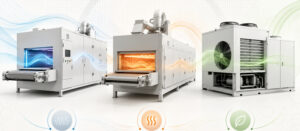
Tray Dryer – Controlled Batch Drying for Spices, Herbs, and Specialty Products
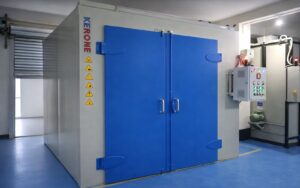 A tray dryer for food preservation in industry provides controlled hot-air circulation across product-loaded trays arranged on racks within an insulated chamber. Because each batch is processed identically, tray dryers are suited to high-value, mixed-product, or low-volume continuous production scenarios such as spice drying, herbal product processing, and laboratory-scale dehydration trials.
Kerone’s tray dryers for the spice drying industry are built with stainless steel interiors, uniform airflow distribution systems, and digital temperature and humidity control to ensure consistent moisture reduction across all tray positions. The result is homogeneous water activity reduction that reliably extends shelf life without heat damage to volatile aromatic compounds.
Continuous Conveyor Dryer – High-Volume Vegetable and Fruit Processing
 For industrial-scale operations, a continuous conveyor dryer for vegetable processing offers the throughput necessary to handle several hundred kilograms per hour without batch interruptions. Product moves through successive heated zones on a perforated conveyor belt, with each zone independently temperature-controlled for optimal moisture removal at each drying stage.
How a conveyor dryer improves food production efficiency: it eliminates the loading and unloading downtime of batch systems, provides consistent product-to-product uniformity across large runs, and integrates directly with upstream washing and blanching lines and downstream packaging conveyors.
Infrared Dryer – Surface Drying and Enzyme Inactivation for Fruits and Vegetables
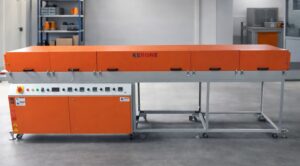 Infrared drying technology works by emitting electromagnetic radiation in the 2.5-to-10-micron wavelength range, which is directly absorbed by water molecules on the product surface. Because the energy is deposited within the product rather than transferred from heated air, infrared dryers achieve faster surface drying rates at lower air temperatures, a significant advantage for heat-sensitive products such as dried berries, sliced tropical fruits, and vegetable crisps.
An infrared dryer for fruit and vegetable drying also provides effective surface pasteurisation because the radiated surface temperature is sufficient to inactivate pathogens and denature oxidative enzymes without the extended dwell times that cause colour or texture degradation.
Vacuum Dryer – Preserving Heat-Sensitive Compounds
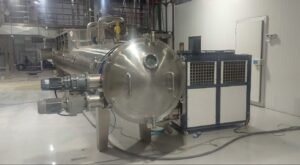 Vacuum drying uses a sub-atmospheric pressure to lower the boiling point of water, thus allowing the moisture to evaporate at temperatures as low as 40°-50°C. This makes the vacuum dryer the preferred technology for food ingredients where thermal degradation of vitamins, enzymes, probiotics, or bioactive compounds must be minimised, including mushroom extracts, powdered dairy ingredients, and nutraceutical products.
Which Dryer Is Right for Your Product?
| Product / Application | Recommended Dryer System |
| Whole spices, mixed herbs, seeds (batch) | Batch Tray Dryer with PLC control |
| Sliced vegetables, diced fruits (high volume) | Continuous Conveyor Dryer |
| Berries, tropical fruits, vegetable crisps | Infrared Dryer |
| Heat-sensitive extracts, dairy powders | Vacuum Dryer |
| Grains, pulses, oilseeds | Rotary / Fluidised Bed Dryer |
| By-products, pomace, food waste valorisation | Paddle / Disc Dryer |
How to Increase the Shelf Life of Dehydrated Food
Reaching the correct water activity through drying is necessary but not sufficient for maximum shelf life. The following practices, implemented alongside industrial dehydration, determine the final shelf life outcome:
- Target aw below 0.60 for truly shelf-stable products; verify with calibrated aw meters, not moisture content alone.
- Use moisture-barrier, oxygen-barrier packaging (multi-layer laminates and metallised pouches) immediately after cooling.
- Incorporate food-grade oxygen absorbers or nitrogen flushing for lipid-rich products such as nuts and whole grains.
- Maintain cold chain for intermediate storage even for dried products when re-humidification risk is present.
- Conduct periodic aw monitoring during storage, not just at point of packing.
- Use hygienic dryer designs to prevent in-equipment recontamination.
Reducing Food Waste in Manufacturing with Industrial Dehydration
Beyond product preservation, industrial dehydration systems play an expanding role in food waste valorisation, converting what would otherwise be processing by-products (fruit pomace, vegetable trimmings, spent grain and citrus peel) into dried ingredients with commercial value as animal feed, food ingredients, or functional additives.
Manufacturers who invest in industrial dehydration systems for fruits and vegetables report measurable reductions in raw material waste, improved batch yields, and new revenue streams from by-product valorisation. From an ESG and sustainability reporting perspective, documented reductions in food waste also contribute positively to Scope 3 emission calculations and customer sustainability commitments.
About Kerone Engineering Solutions
Kerone Engineering Solutions has been designing and manufacturing industrial thermal processing equipment since 1976. Based in India and serving customers across the globe, our food-grade drying and dehydration systems are in active use across spice processing, fruit and vegetable dehydration, grain drying, and food by-product valorisation applications.
As a food drying equipment manufacturer in India, it combines in-house engineering capability with process knowledge accumulated across decades of food industry installations. All food-contact equipment is manufactured in stainless steel grades appropriate to food-safety requirements, with process guarantees backed by pilot-scale testing where required.
For product-specific consultations, throughput calculations, or to request a quotation, contact the Kerone engineering team.
Conclusion
The causes of food spoilage in the food industry are well understood: microbial growth, enzymatic reactions, moisture-driven chemical activity, oxidation, temperature abuse, and physical damage. What separates high-performing food manufacturers from those experiencing persistent quality and waste problems is systematic application of technologies that address these root causes, not workarounds.
Industrial drying and dehydration, when correctly specified and operated, removes the water activity that underpins the majority of spoilage mechanisms. Whether you process spices in batch tray dryers, high-volume vegetables on continuous conveyor lines, or heat-sensitive extracts under vacuum, the right Kerone dryer system can extend product shelf life, reduce waste, and improve manufacturing yield.
Frequently Asked Questions (FAQ)
Q1. What are the main causes of food spoilage in industrial food production?
The main causes of food spoilage in industrial food production include excess moisture, microbial contamination from bacteria, moulds and yeast, enzymatic reactions, oxidation of lipids and fats, improper temperature control, and physical damage during handling. Of these, moisture is the most critical factor because it directly supports microbial growth and chemical reactions that degrade food quality and safety.
Q2. How does industrial drying prevent food spoilage?
Industrial drying removes moisture from food products to levels where microbial growth is inhibited, typically reducing the water activity value below 0.6. When water activity is sufficiently low, bacteria, moulds, and yeast cannot reproduce effectively. Equipment such as tray dryers, conveyor dryers, vacuum dryers, and infrared dryers are used to achieve precise and uniform moisture removal while preserving nutritional quality.
Q3. What is the difference between a tray dryer and a conveyor dryer for food processing?
A tray dryer is a batch-type system where food is placed on stacked trays inside a chamber and dried using hot air circulation. It is ideal for small to medium production volumes and diverse product types. A conveyor dryer is a continuous system where food moves along a belt through drying zones, making it suitable for high-volume, uniform production runs in industries like snack foods, vegetables, and grains.
Q4. Which industrial dryer is best for heat-sensitive food products?
Vacuum dryers are the preferred choice for heat-sensitive food products. By operating under reduced pressure, vacuum dryers lower the boiling point of water, allowing moisture to be removed at significantly lower temperatures. This protects heat-sensitive nutrients, flavours, aromas, and colours. They are commonly used for drying dairy powders, herbal extracts, fruit concentrates, and pharmaceutical food ingredients.
Q5. What is water activity and how does it relate to food spoilage?
Water activity, or ‘aw’, is a measure of the amount of free (unbound) water available in a food product to support chemical reactions and microbial growth. It is measured on a scale of 0 to 1. Most bacteria require an aw above 0.91 to grow, while moulds can grow at aw values as low as 0.70. Reducing water activity through industrial drying is one of the most effective methods for preventing spoilage.
Q6. How does infrared drying technology preserve food quality?
Infrared drying uses electromagnetic radiation in the infrared spectrum to penetrate the surface of food and generate heat within the product itself, rather than relying on hot air convection alone. This results in faster and more uniform drying at lower temperatures, which helps retain colour, nutritional content, and sensory properties. Infrared dryers are particularly effective for fruits, vegetables, nuts, seeds, and spice powders.
Q7. What role does temperature play in causing food spoilage?
Temperature is one of the most critical factors in food spoilage. Most spoilage microorganisms thrive between 5 degrees Celsius and 60 degrees Celsius, a range often referred to as the temperature danger zone. Enzymatic reactions that degrade texture, colour, and flavour also accelerate at higher temperatures. Industrial thermal processing, controlled drying, and proper storage temperatures are essential for slowing or stopping spoilage mechanisms.
Q8. What are the benefits of using industrial food drying equipment for food exporters?
For food exporters, industrial drying equipment offers several critical advantages. Dried food products have significantly extended shelf lives, reducing spoilage-related losses during long-distance transport. Dehydrated products are lighter in weight, lowering shipping costs. They are also easier to package and store without cold chain infrastructure. Additionally, properly dried food that meets international moisture and AW standards helps exporters comply with food safety regulations in target markets.
Q9. What is the difference between food dehydration and food drying?
Food drying and food dehydration are often used interchangeably, but there is a subtle distinction. Drying refers broadly to any process of moisture removal from food, including natural sun drying. Dehydration specifically refers to the controlled industrial or mechanical process of reducing moisture content to a defined level using equipment such as tray dryers, conveyor dryers, or spray dryers. Industrial dehydration is more precise, consistent, and scalable than natural drying.
Q10. How do I choose the right industrial dryer for my food processing operation?
Choosing the right industrial dryer for food processing depends on several factors, including the type of food product and its heat sensitivity; the required final moisture content and water activity level; the production volume and whether batch or continuous processing is needed; available floor space and energy infrastructure and any applicable food safety standards such as HACCP or FSSAI. It is recommended to consult with an industrial drying equipment specialist to evaluate options like tray dryers, conveyor dryers, vacuum dryers, or infrared dryers based on your specific requirements.