Primary vs Secondary Combustion Chambers: Why Two-Stage Incineration Matters
Industrial Waste Treatment is not just about high heat exposure of unwanted materials. The moisture content, organic content, volatile content and combustible content contained in different types of waste materials are different. If burned under improper conditions, they can cause incomplete combustion and too much smoke and produce harmful emissions. That is why it is necessary to employ special combustion stages in modern thermal waste treatment systems.
To combat this, a two-stage industrial incinerator takes the combustion process and splits it into two separate operations. The first stage is for waste heat and initial combustion, the second stage is to provide the appropriate conditions to combust the remaining combustible gases and vapors. These stages are used together to enhance combustion performance and aid in the control of emissions.
It is very significant to differentiate primary and secondary combustion areas in order to select an incineration system, to analyse the performance of a plant or to plan industrial waste treatment processes.
Understanding the Primary Combustion Chamber
The primary combustion chamber is the first chamber through which the incoming waste is brought and heated, dried, devolatilized and combusted. It is primarily intended to preheat the waste material to facilitate controlled thermal decomposition and to enable the combustible components to react at appropriate operating temperature. Dry organic wastes can give off combustible gases rather quickly, while materials with high moisture content need more heat to evaporate.
During this stage, several processes take place:
- Drying: Heat removes moisture present in the incoming waste.
- Devolatilisation: Organic materials release volatile compounds when exposed to elevated temperatures.
- Initial combustion: Some combustible substances react with available oxygen.
- Char formation and oxidation: Remaining carbon-rich material undergoes further thermal conversion and combustion.
The design of a primary combustion chamber directly influences how consistently these processes occur. Factors such as chamber geometry, heat distribution, waste feeding arrangements, airflow and residence time can affect the overall performance.
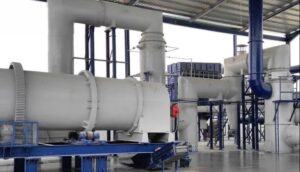
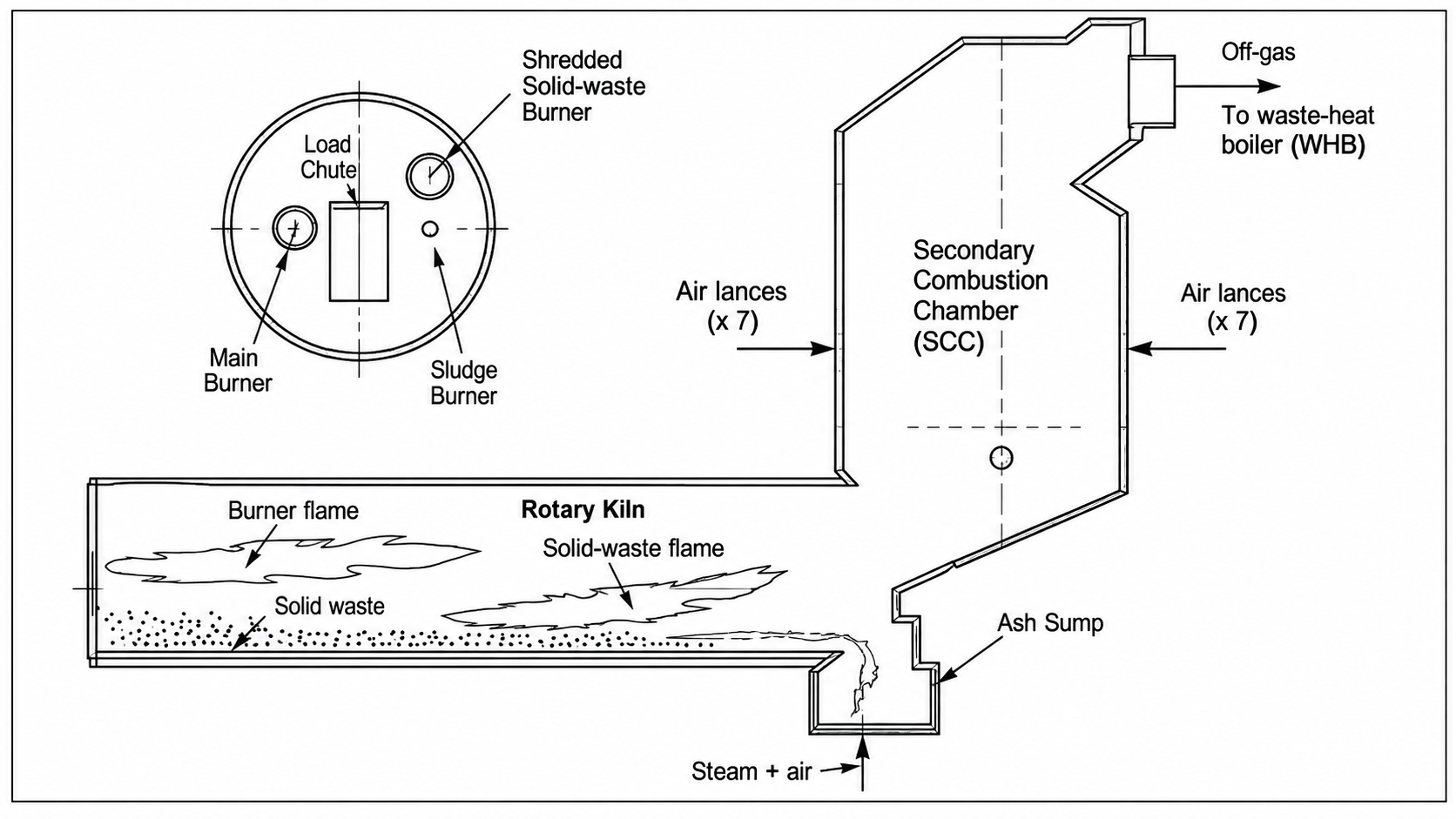
For example, a rotary kiln system continuously rotates the waste material, helping expose different portions of the feed to heat. This movement supports mixing and allows the material to progress through different thermal zones
.
What Happens Inside the Secondary Combustion Chamber?
All combustible gases emitted from waste are not necessarily completely oxidised in the primary chamber. Partially oxidised volatile compounds, CO and other compounds may move on from the first chamber and need additional treatment.
The secondary combustion chamber comes into play here.
Hot combustion gases from the first chamber are passed into the second chamber where further conditions of oxidation are provided. Controlled air supply, proper temperature, residence time and effective gas mixing provide time and conditions for the combustion of any combustible material remaining after the initial combustion.
A properly designed secondary combustion chamber focuses on four important operating requirements:
- Temperature: The chamber must maintain a temperature suitable for oxidising the combustible gases present in the exhaust stream. The required operating temperature depends on waste composition, applicable regulations and system design.
- Residence Time: Gases must remain inside the chamber long enough to undergo the intended oxidation reactions. Insufficient residence time can allow partially combusted substances to escape.
- Turbulence and Mixing: Combustion air must mix effectively with combustible gases. Poor mixing can create oxygen-deficient zones and reduce combustion efficiency.
- Oxygen Availability: An appropriate oxygen supply is necessary to support oxidation reactions. Excessive or insufficient air can both create operating problems.
These conditions are often discussed together because improving only one parameter does not necessarily guarantee effective combustion. Temperature, residence time, turbulence and oxygen availability must work together.
Primary vs Secondary Combustion Chambers: Key Differences
Although both chambers contribute to the same overall treatment process, their responsibilities are different.
|
Parameter |
Primary Chamber |
Secondary Chamber |
| Main function | Initial waste combustion and thermal decomposition | Further oxidation of combustible gases |
| Material handled | Solid or semi-solid waste | Hot combustion gases and vapours |
| Main processes | Drying, devolatilisation and initial oxidation | Gas-phase oxidation |
| Air supply | Controlled according to combustion strategy | Controlled air injection for oxidation |
| Operating focus | Waste heating and combustion stability | Temperature, mixing and residence time |
| Performance indicator | Waste conversion and burnout | Completion of gas-phase combustion |
In a typical staged-combustion arrangement, the first chamber manages the incoming waste, while the second chamber helps reduce the amount of unburned combustible material in the exhaust gases.
This separation provides greater control over the overall combustion process compared with treating waste in a single uncontrolled burning zone.
How the Two-Stage Industrial Waste Combustion Process Works
The industrial waste combustion process involves a sequence of thermal and chemical reactions rather than one simple burning operation.
A typical two-stage arrangement follows these steps:
Step 1: Waste Feeding and Preparation
Waste is introduced into the primary chamber through a suitable feeding mechanism. Depending on the application, the feed may require sorting, size reduction or moisture management before entering the system.
Step 2: Heating and Moisture Removal
The incoming material absorbs heat. Moisture evaporates, and the remaining waste becomes increasingly suitable for thermal decomposition and combustion.
Step 3: Volatile Release and Initial Combustion
Organic compounds release combustible gases and vapours. Some of these substances burn within the primary chamber, while others move towards the secondary chamber with the hot gas stream.
Step 4: Secondary Oxidation
Additional combustion air is introduced into the secondary chamber. The gases undergo further oxidation under controlled operating conditions.
Step 5: Exhaust Gas Treatment
After secondary combustion, the flue gas passes through appropriate pollution control equipment. Depending on the waste characteristics and regulatory requirements, this may include rapid cooling, acid gas scrubbers, activated carbon injection, bag filters and other treatment technologies.
Step 6: Continuous Monitoring
Important operating parameters and emissions are monitored to assess system performance and identify deviations. Temperature, oxygen concentration, carbon monoxide and other relevant emission parameters may be measured depending on the installation.
It is important to understand that secondary combustion alone does not remove every pollutant. Certain contaminants require dedicated downstream gas-cleaning technologies.
Role of Rotary Kiln Technology in Two-Stage Incineration
Rotary kiln systems are commonly used to treat various types of industrial and hazardous waste because waste is able to be moved continuously through the primary combustion zone of the kiln.
The working principle of the rotary kiln incinerator adopts indirect or direct heating (depending on the system configuration), plus controlled combustion and material moving.
The controlled speed of rotation of the cylindrical kiln ensures that waste is fed slowly from the feeding end to the discharge end. In this movement the material is subjected to drying, thermal decomposition and combustion.
The solid residue, known as bottom ash or slag depending on the waste and operating conditions is removed and discharged for disposal in an appropriate manner.
The hot gases generated inside the kiln enter a secondary combustion chamber, where additional oxidation takes place.
This arrangement offers several practical advantages:
- Handles different waste forms and compositions.
- Supports continuous or semi-continuous operation.
- Allows control over waste movement and residence time.
- Provides separate operating zones for solid waste and combustible gases.
- Can be integrated with downstream flue gas treatment systems.
However, rotary kiln performance depends on proper design, waste compatibility, refractory selection, feeding arrangements and operating conditions. It is not automatically suitable for every industrial waste stream.
Why Two-Stage Combustion Matters for Emission Control
Staged combustion is usually implemented in industries to enhance the uniformity of the waste destruction process and minimize the emissions resulting from incomplete combustion.
Bad combustion conditions may also lead to high concentrations of CO, unburned hydrocarbons, smoke and other undesirable combustion products. Depending on the composition of the waste and the operating conditions, some hazardous compounds can also be formed.
An appropriately designed two-stage industrial incinerator gives a second degree of control over the combustion of combustionable gases prior to their introduction into the exhaust gas treatment unit.
This can support:
- Better oxidation of combustible gases.
- Reduced carbon monoxide under stable operating conditions.
- Improved combustion consistency.
- Better control of smoke and unburned organic compounds.
- More predictable operation of downstream pollution control equipment.
However, good combustion design must be supported by proper maintenance, operational monitoring and suitable emission treatment. Dioxins, furans, acid gases, particulate matter and metals may require specific control measures beyond the combustion chambers.
Factors to Consider When Selecting a Two-Stage Incineration System
A proper system must be chosen and a detailed understanding of the waste to be treated is necessary. If there is a difference, a dry industrial residue used can perform differently than a wet sludge, mixed hazardous waste or materials with highly variable calorific values.
Before selecting equipment, industries should evaluate the following:
Waste Characteristics
Consider moisture content, calorific value, chemical composition, ash content and variations in feed properties.
Required Treatment Capacity
The system should be designed according to the expected waste throughput and operating schedule.
Combustion Control
Evaluate temperature control, airflow distribution, chamber design and gas residence time.
Residue Management
Consider the collection, testing, handling and disposal or recovery of bottom ash and fly ash.
Regulatory Compliance
The installation must meet applicable environmental permits, emission limits and waste treatment regulations.
A detailed waste characterisation study and engineering assessment can help avoid operational difficulties after commissioning.
Conclusion
The primary and secondary combustion chambers each have a specific role in industrial waste treatment, but their performance is closely connected. The primary chamber handles the initial heating and burning of waste, while the secondary chamber provides the conditions needed to burn the remaining gases and vapours more completely.
The overall efficiency of this process depends on several factors, including waste composition, equipment design, operating temperature, residence time, oxygen supply and proper gas mixing. When these factors are managed correctly, the system can deliver more consistent combustion results.
For industries planning to adopt thermal waste treatment, understanding how both chambers work helps in choosing the right equipment and designing a suitable process. The aim should not simply be to achieve high combustion temperatures, but to maintain reliable operation, manage exhaust gases effectively, handle combustion residues responsibly and meet the required environmental standards.