
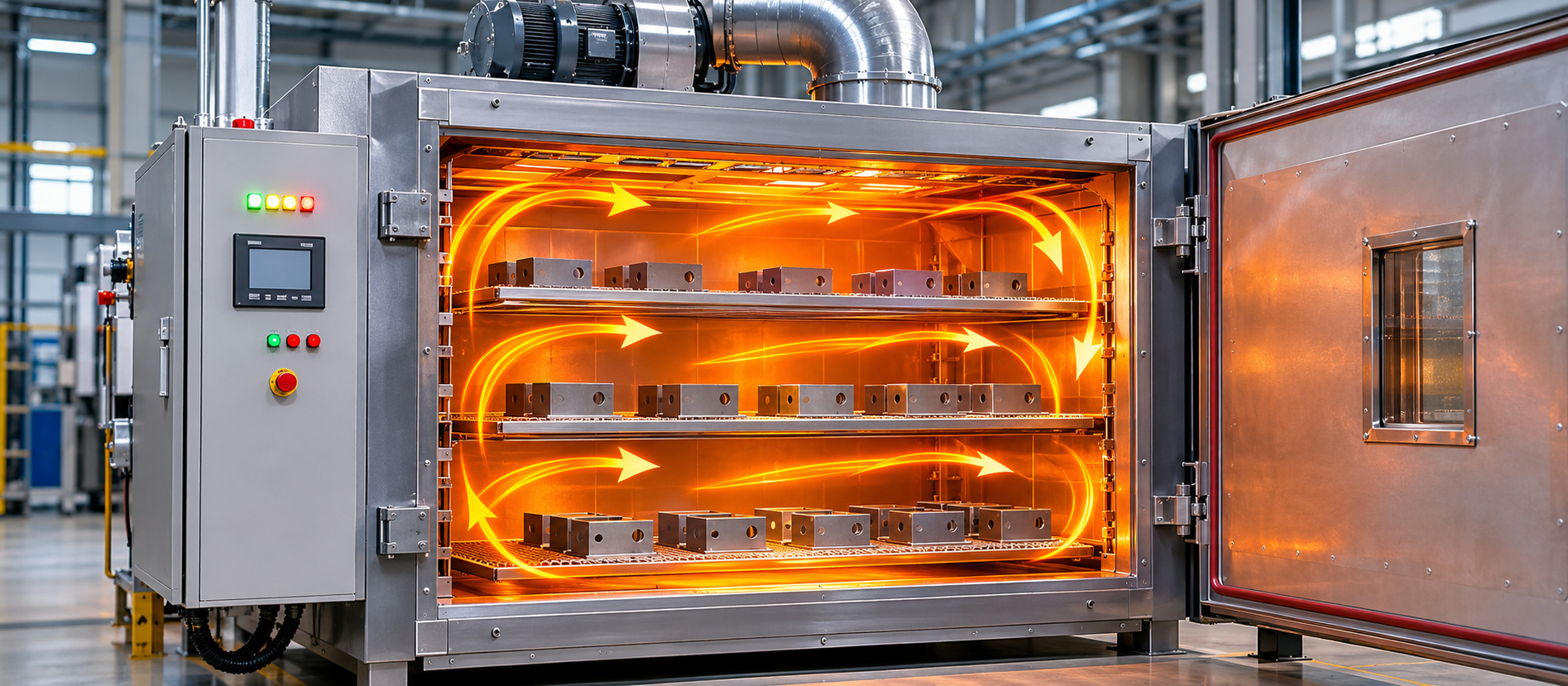
Role of Airflow Turbulence in Achieving Proper Temperature Distribution Inside an Industrial Oven
Industrial oven can show 180°C on its display while the parts on the bottom shelf are still well below that. The cause is usually the way air moves inside the chamber. Heat reaches the product through the air, so the speed, direction and mixing of that air matter as much as the size of the heater.
This article explains how industrial oven airflow affects heating, where airflow turbulence helps and where it causes trouble, and what engineers can check when results differ from one spot to another. The aim is practical: understand the causes, spot the signs, and know what to measure before touching a fan or a damper.
Why Does Temperature Vary Between Different Areas of an Industrial Oven?
When air is drawn out of the heater it is at the highest temperature that it has, and on its way it releases heat to whatever it comes in contact with, so by the time it reaches the far end of the heater it will be cooler. Hotter, faster air is found near the supply duct. Air near the return sees parts that have carried out most of their work.
Other factors contribute to the deficit. Cold air leaks in through door seals and heat leaks out through conveyor openings. A tightly packed load restricts air circulation, and reduces inner shelf circulation. Hot air rises, too, so if the fan is not powerful, the upper part of the oven is hotter than the bottom. A change in pattern can occur without being noticed, such as dirty filters, worn fan blades, or a fan that has turned the wrong direction after a motor repair.
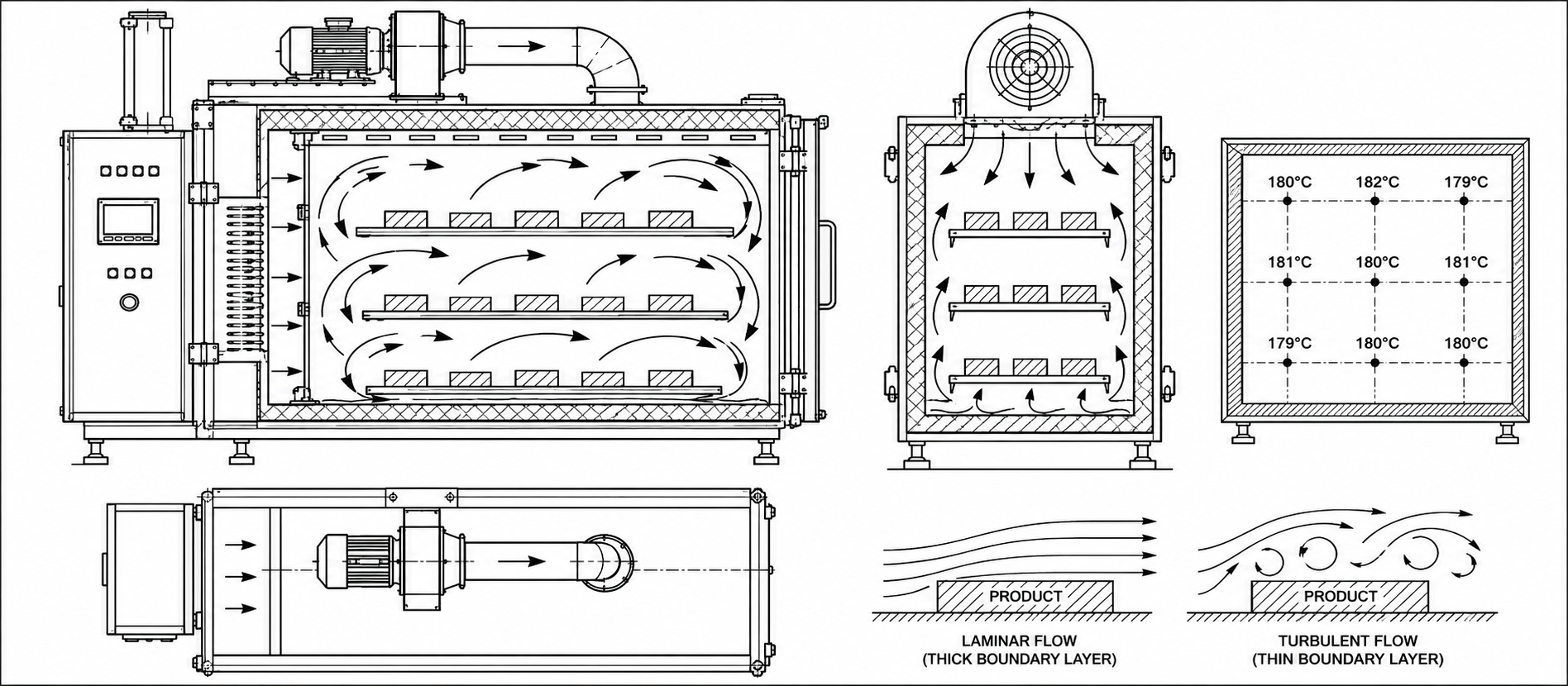
Mapping temperature distribution in industrial oven chambers usually teaches one lesson: air must reach every product surface at a similar speed and temperature. When it does not, shelf or belt position decides how much heat each part gets.
How Does Uneven Airflow Affect the Final Product Quality?
Uneven airflow shows up in the product before it shows up on any instrument. Poor industrial oven temperature uniformity means some parts get more heat than others, even inside the same batch.
During the curing phase, the cold side may become under-cured. If a coating is not completely cured, it will remain soft, be easily scratched and will peel off later. The hot side has the potential to overcure, resulting in yellowing, brittleness or dullness. When drying, the surface may dry quicker than the interior, resulting in cracks, warping or developing a hard outer surface. When baking, the baked products will have some dark and some light in color. Unbalanced heating may cause hardness variations from one region to another in metal parts or cause long sections to be distorted.
The problem is underheating. Oven did the complete cycle and the display was normal but the product was not heated to the required temperature for the process.
What Happens When Airflow Is Too Strong or Too Weak?
Suggesting stronger air, which sounds like a safe bet, because of the movement of more air carrying more heat. It does, albeit up to a certain degree. Parts that are light can be moved or dropped from a rack. Powder can be blown off a surface prior to melting and flowing. When the surface is wet, it can form a crust that will retain the moisture beneath. The speed also increases rapidly as a fan increases its power. It increases in theory as the cube of the fan speed, so a small increase in speed will require a lot of electricity.
Weak air has the opposite issue. The product cools down or gets moisturized in the air and remains so. Hot air rises in the upper shelves and the lower shelves remain cold. It takes longer to heat and to dry.
The answer is not simply more speed. Airflow turbulence, meaning well mixed air that keeps changing direction, often matters as much as raw velocity. A moderate speed with good mixing can beat a fast, straight stream.
How Does Airflow Turbulence Influence Heating Time?
Heat moves from air to a product through a thin layer of slow air that clings to the surface. This layer works like a blanket. When the flow is smooth, the blanket is thick and heat passes through slowly. Airflow turbulence breaks the layer up, brings fresh hot air to the surface and lets heat transfer happen faster.
This effect is robust because published values of the heat transfer coefficient are about 6 W/m2K for natural convection, 20 to 45 W/m2K for a typical convection oven and 70 to 170 W/m2K for air impingement (i.e., air jets impinging on surface). These are only general estimates and will vary depending on product shape and nozzle configuration.
But there’s a limit, In a thick or dense product, an industrial oven will heat more slowly, since heat must flow through the product itself. For these, the first half of the cycle is shortened by better airflow. Make sure that you’re not guaranteeing a shorter cycle time because it’s a slower surface or because it’s an inside cycle time.
Why Does the Oven Displayed Temperature Differ from the Actual Product Temperature?
The number on the display comes from one sensor in one spot, usually in the air stream near the heater or the return. It tells you the air temperature at that point. It does not tell you the temperature of the product, and it says little about temperature distribution in industrial oven chambers as a whole.
Three different temperatures need to be kept apart. Chamber air temperature is what the controller sees. Surface temperature is what the outside of the product reaches, and it lags behind the air because the product has to absorb heat first. Core temperature lags further, especially in thick, dense or wet products.
Wet products add another twist. While water is evaporating, the surface stays far cooler than the air, whatever the display says. A cold rack, fixture or wall can also pull heat from a part through radiation.
This is why many process specifications ask for a product temperature held for a set time, not just an oven setpoint.
How Can Engineers Identify Poor Air Circulation Inside an Industrial Oven?
Start with a temperature map. Place thermocouples at the corners, the center, near the door, and near the supply and return, then run the oven empty and again with a normal load. The gap between the hottest and coldest point is the number that defines industrial oven temperature uniformity. For metal heat treatment, the AMS2750 standard sets furnace classes from about plus or minus 3°C to plus or minus 28°C. Most processes need less, so set the target from the product requirement.
Then, use an anemometer to determine the air speed at a grid of points throughout the work area. The temperature differences can be attributed to large differences between the points. Smoke or fog, when heaters are off, will reveal air circulation patterns, including swirls, stalls or straight back to the return.
Then check the basics: fan rotation, belt tension, dampers, filters, door seals and blocked ducts. A CFD study can test design changes first.
How Should Airflow Be Designed for Different Industrial Oven Applications?
There is no process that works well with every airflow pattern.
The fresh air intake, exhaust and moderate velocity are important when drying because it carries moisture out and brings heat in.
Lightly-curing, which is done by powder coating or painting, requires even part temperature and gentle air. The aim is to reach the desired temperature to all parts and keep the temperature at that level.
The usual requirements for baking are to maintain even color, which requires adequate air movement, and controlled top and bottom heat.
Slow heating of heavy loads is often part of an annealing heat treatment, or other heat treatments. Strong recirculation is beneficial for even heating of the entire load at low and middle temperatures. The more radiation is responsible for doing the work, the more the load arrangement matters, and the higher the temperatures, the more.
Across all of these, good industrial oven airflow design starts from the product: its shape, spacing, thickness and allowed temperature tolerance. Industrial oven temperature uniformity should then be checked against that requirement, not a general rule. If the oven handles solvents or other flammable vapors, any airflow change must stay within the exhaust and safety requirements of NFPA 86 and local codes.
How Can Proper Airflow Design Reduce Energy Consumption and Production Losses?
Sometimes the set point is increased when one corner of the oven is cooler than the others to compensate for the cold corner. All other components are then over heated. These result in reduced fuel use, potential over-curing/ damaging heat sensitive material, and higher wall and exhaust losses. To illustrate, an oven in a 30°C room which loses heat proportional to the difference between temperature, will have approximately 7 per cent more losses if the set point is increased by 10°C.
Even heating also reduces the cycle, as the process doesn’t have to wait for the slowest spot. The subsequent number of rejected batches, rework and re-baked parts is reduced, and in many cases these savings will be greater than the fuel saved.
Fans matter too. When electricity costs are the most important cost, a variable frequency drive that has the lowest speed that provides good results can result in a reduction of electricity use, since the power increases rapidly with speed. Sealing up leaks and properly cleaning filters contributes to this.
Final Thoughts
A well run industrial oven is one where heat reaches every product in the same way. Industrial oven airflow decides how fast and how evenly that happens, and the display on the controller shows only part of the story. When quality varies, map the temperature distribution in industrial oven chambers first, measure air speed second, and only then adjust fans, dampers or loading patterns. Changes based on data tend to last, while changes based on guesswork often move the problem to another corner. A product-based target, a simple test plan and regular checks of fans, filters and seals will keep the process steady over time.
Frequently Asked Questions
What air speed should an oven use?
There is no single number. Many general batch ovens move air at a few meters per second across the product, while impingement systems use jets that are often in the range of 10 to 30 m/s at the nozzle. Treat these as starting points only. The right speed depends on product weight, coating or moisture condition and the heating rate the process allows, so confirm it with a trial.
How many thermocouples do I need to map oven temperature?
It depends on the size of the oven and the standard you follow. A common small furnace survey uses nine points: the eight corners and the center. For general ovens, begin with the corners, the center and points near the door, the supply duct and the return, then add sensors on the load itself. Larger work zones need more points.
Can I fix cold spots by raising the setpoint?
It usually makes things worse. The cold spot may improve slightly, but the rest of the load gets more heat than it needs, which wastes energy and risks overcuring or damage. Look for the cause first: blocked airflow, a leaking door, wrong fan rotation, a dirty filter or a poor loading pattern.
Does the way I load the oven change airflow?
Yes, a lot. Solid trays, tightly packed parts and large flat pieces facing the airflow can block or redirect air. Leave gaps between parts, use open racks, and keep parts clear of the ducts and the return. Run the temperature map with a normal production load, not only with an empty oven.
How often should oven airflow and temperature be checked?
For regulated processes, follow the interval in the applicable standard or customer specification. For other processes, a yearly temperature map is a sensible starting point (this is common practice, not a rule), with quick checks of fans, belts, filters and door seals at each maintenance round. Repeat the map after any repair, duct change or major change in product load.

