
How Feed Material Shape Affects Heat Transfer in Industrial Thermal Processing
Feed material shape heat transfer behaviour is one of the least studied variables in plants that heat, dry, roast, calcine or cool solids. Engineers usually fix the temperature, the air flow, the residence time and the moisture target, then assume the material will follow. In practice, two batches of the same chemical, one as round pellet and one as broken chip, can behave like two different products inside the same machine.
This matters because shape controls three things at once: how much surface is exposed to the heating medium, how far heat has to travel inside each particle, and how the gas or liquid moves through the bed. Change any one and you change the processing time and the fuel bill.
Surface area is the first thing that changes
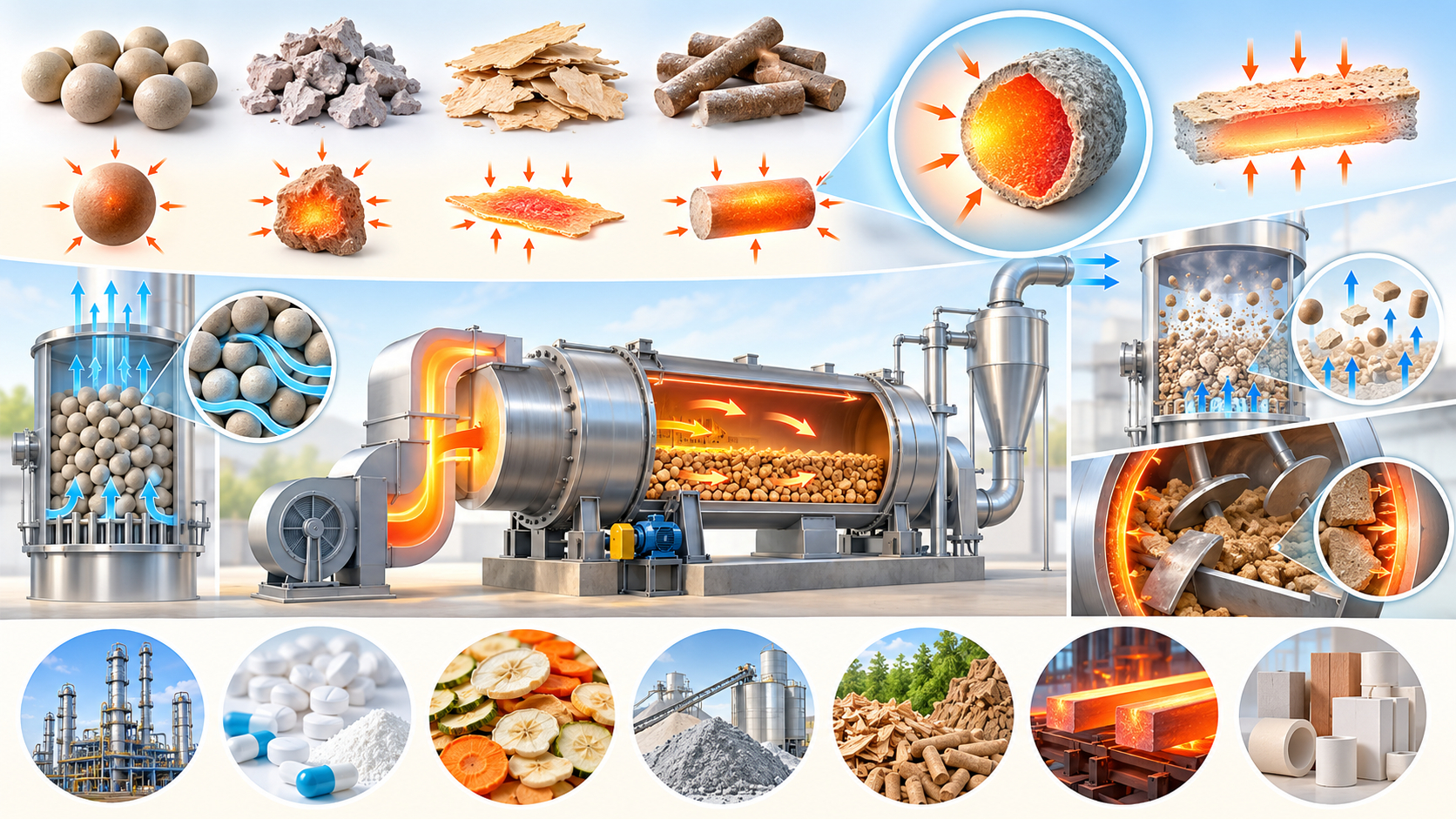
Heat enters a solid through its outer surface. For the same mass, a flake has far more surface than a sphere, and a cylinder sits somewhere between. The usual way to compare them is the specific surface area, which is the exposed area divided by the volume of the particle.
A sphere has the lowest surface area for a given volume. That is useful if you want to protect the material from over-drying or scorching, but it is a disadvantage when you want speed. Flakes, slices and thin extrudates give up mechanical strength but gain drying rate. Irregular crushed material sits in an awkward middle zone because the surface is high, but the size spread is wide, so some fragments finish long before others.
Internal conduction decides the second half of the job
Surface area controls the stage of heating. After that the limit shifts to how heat moves from the outside of the particle to the centre. The controlling number here is the path from surface to core often called the characteristic thickness.
A 10 mm sphere and a 10 mm thick slab both look like 10 mm on a sieve report. The slab takes much longer to reach core temperature because heat only enters from two faces. A cylinder that is thin heats mostly, from the side wall. This is the reason a plant can meet its target on paper and still produce material with a cold core.
The Biot number is the check. When it is small surface heat transfer is the bottleneck and better air velocity helps. When it is large internal conduction is the bottleneck and no amount of air flow will fix it. Shape moves this balance directly because the characteristic thickness is part of the calculation.
Bed voidage and the path the gas takes
In a packed bed, the shape of the feed decides how much empty space sits between particles. Uniform spheres pack in a predictable way and leave a fairly even void fraction. Irregular pieces interlock, which lowers the void fraction, raises the pressure drop and pushes the gas towards the wall of the vessel where resistance is lower.
That wall channelling is a common and expensive problem. The gas takes the easy path, the centre of the bed stays cold, and the operator responds by raising the inlet temperature. The result is over-processed material near the wall, under-processed material in the middle, and a fan motor drawing more power than it should.
Flat or plate like particles create the opposite issue. They tend to lie down and overlap, forming layers that the gas struggles to cross. Sphericity, which compares a particle to a sphere of the same volume, is the simplest single figure for tracking this in design work.
Fluidised beds are even more sensitive
In a fluidised bed, shape affects the minimum fluidisation velocity, the bubble behaviour and the tendency to segregate. Rounded particles fluidise smoothly. Needle shaped or plate shaped particles resist fluidisation, form channels and can leave dead zones at the distributor.
Mixed shapes cause layering. Lighter flakes ride on top, denser granules sink, and the two fractions see completely different heat histories. When the product specification is tight, this alone can force a change in upstream grinding or pelletising.
Contact heating works on a different rule
For paddle dryers, rotary calciners and jacketed vessels, heat moves by contact rather than by gas convection. Here the useful quantity is the real contact area between the solid and the hot wall. Spheres touch a flat surface at almost a point, so contact heating of round pellets is slow unless the bed is agitated well.
Flat or irregular material lies against the wall with more contact, which helps, but it also tends to build up a stuck layer. That layer then acts as insulation. This is why shape, agitation design and fouling behaviour have to be looked at together in indirect heating equipment.
Where this shows up across industries
Packed bed reactors in chemical plants depend on catalyst shape for both conversion and pressure drop, which is why trilobes and rings exist. Pharmaceutical granule drying is sensitive to size spread because the fine fraction over-dries while coarse granules stay wet. Food processing sees it clearly in vegetable slices, where thickness matters more than air temperature. Cement and ceramic plants deal with pellet size in preheaters, biomass plants with briquettes and chips, and metallurgical operations with billets and castings where section thickness sets the soak time.
A practical way to test it
An experimental study does not need equipment. Take one material prepare it in three geometries with the mass and the same moisture or starting temperature then run all three under identical conditions.
Record core temperature with embedded thermocouples, weight loss over time inlet and outlet gas temperature, air flow and power drawn. Plot the heating or drying curve for each shape then work out the heat transfer coefficient and the specific energy consumption in kilowatt hours per kilogram of water removed or per tonne of product treated.
Keep the bed depth medium temperature and velocity fixed so the only variable is geometry. Repeat each run least three times because irregular material gives more scatter than uniform pellets.
What to do with the results
Once the numbers exist, feed material shape heat transfer data becomes a design tool. It tells you whether to spend money on a pelletiser upstream or on a bigger dryer downstream. It shows how much of the current energy bill is caused by shape and size spread rather than by equipment limits. In many plants, a modest change in particle geometry gives a better payback than adding heating capacity.
FAQ (Frequently Ask Questions)
Which particle shape gives the fastest heating for the same material?
Thin flat shapes usually heat fastest because they combine high surface area with a short path to the core. The trade-off is dust generation, fragility and a higher risk of over-processing the edges. Extrudates and short cylinders are often the practical compromise.
Does shape matter more than temperature in drying?
Temperature sets the driving force, but shape decides how quickly that driving force actually reaches the core. Once internal conduction becomes the limiting step, raising the inlet temperature mostly damages the surface without speeding up the centre.
How do I know if my process is limited by surface heat transfer or by internal conduction?
Calculate the Biot number using the characteristic thickness of the particle. If it is well below 1, improving air velocity or agitation helps. If it is above about 1, focus on reducing particle thickness or increasing residence time instead.
Why does mixed feed size cause problems even when the average size is correct?
Heating time scales with thickness squared for conduction-limited material, so the largest particles take far longer than the average suggests. The process has to run to the slowest fraction, which means the fines are over-treated and energy is wasted.
Can I improve performance without changing my equipment?
Often yes. Tighter screening to narrow the size range, a small change in extrudate diameter or slice thickness, and better bed depth control all improve uniformity without touching the dryer or furnace itself.