Seaweed Drying Methods: Belt Dryer vs Drum Dryer – A Complete Comparison
The global seaweed and microalgae processing industry is growing rapidly driven by demand from food manufacturers, nutraceutical companies, biofuel producers, and cosmetic brands. At the heart of every seaweed processing line with drying equipment lies a critical question: which drying technology is right for your product?
Choose the wrong dryer and you risk degraded nutrients, inconsistent output quality, excessive energy costs, or a system that simply cannot scale with your business. Choose the right one, and your seaweed processing line runs efficiently, profitably, and to the exact specification your customer’s demand.
In this guide, Kerone – a trusted industrial kelp drying machine manufacturer with decades of experience in industrial drying solutions for seaweed and microalgae – compares the three most widely used drying technologies: belt (conveyor) dryers, drum dryers, and spray dryers. By the end, you will know exactly which system fits your application.
Why the Right Drying Method Matters
Seaweed and microalgae are biologically complex. They contain proteins, polysaccharides, pigments (chlorophyll, phycocyanin, fucoxanthin), vitamins, and minerals that are highly sensitive to heat, oxygen, and mechanical stress. A drying process that works for wood chips or agricultural grain will destroy the very compounds your customers are paying for.
The right industrial seaweed dryer machine for your processing line must:
- Reduce moisture to your target level (typically 8-12% for food, 3-5% for pharma)
- Preserve bioactive compounds, colour, aroma, and texture
- Deliver consistent, repeatable output batch after batch
- Operate continuously at your required throughput (kg/hr or tonnes/day)
- Meet food safety, GMP, and/or organic certification requirements if applicable
Quick Answer: Belt dryers are best for food-grade seaweed and nutrient-sensitive microalgae. Drum dryers suit large biomass and fertilizer-grade applications. Spray dryers produce ultra-fine powder for extracts and supplements. Read on to match your product to the right system.
1. Belt Dryer (Conveyor Belt Seaweed Dryer System)
How It Works

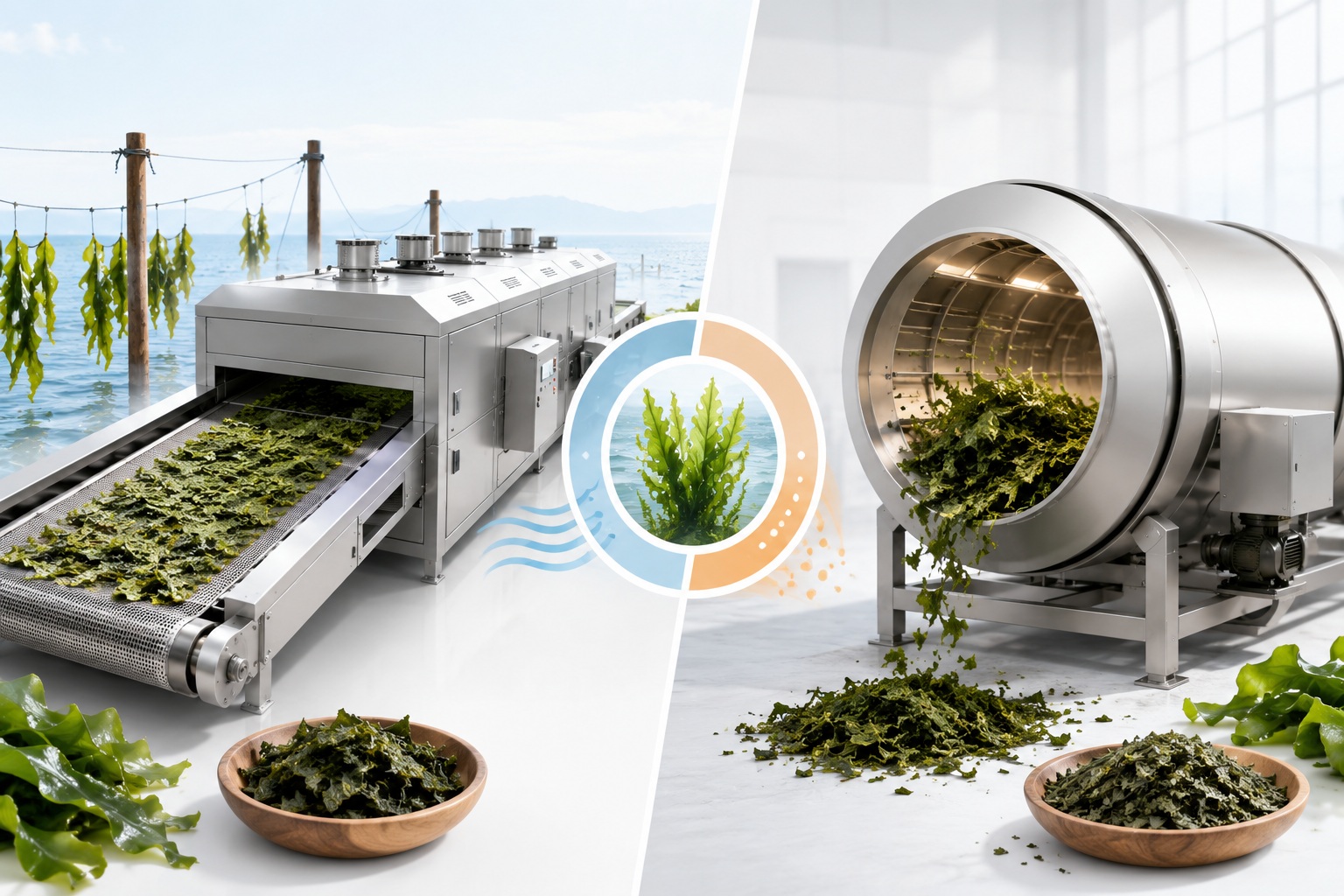
A conveyor belt seaweed dryer system transports seaweed, kelp, or microalgae cakes on a perforated stainless steel belt through a series of temperature-controlled drying zones. Hot air flows upward or downward through the belt and the product layer, gently removing moisture at controlled temperatures, typically 40 to 80°C for nutrient-sensitive species.
Residence time (the duration the product spends inside the dryer) is precisely controlled by belt speed. Multiple zones can apply different temperatures and airflow rates, allowing a gentle, staged drying profile.
Ideal Applications
- Food-grade seaweed (nori sheets, wakame flakes, dulse, kelp strips)
- Low temperature microalgae drying for nutrient retention (Spirulina, Chlorella, Haematococcus)
- Premium seaweed for human consumption or pharmaceutical use
- Seaweed with strict colour and texture requirements
Key Advantages
- Excellent nutrient, colour, and aroma retention due to low operating temperatures
- Handles whole pieces, strips, and wet cakes without damage
- Highly scalable with multi-pass or multi-deck configurations
- Continuous operation with automated seaweed dryer controls (PLC/HMI)
- Easy cleaning and maintenance with stainless steel construction
Considerations
- Larger floor footprint than drum or spray alternatives
- Not suitable for pumpable liquid feeds (use spray dryer for extracts)
- Pre-dewatering of microalgae slurry recommended before belt drying
2. Drum Dryer
How It Works

A drum dryer rotates a large cylindrical steel drum, either externally heated or fitted with internal heating elements. Seaweed or algae biomass fed into the drum tumbles continuously as the drum rotates, exposing it to heat and achieving progressive moisture reduction. Operating temperatures typically range from 80 to 150°C.
The drum dryer is a workhorse for high-volume, lower-sensitivity biomass. It handles irregular shapes, coarse material, and high-moisture feedstocks effectively.
Ideal Applications
- Industrial algae drying systems for biomass processing (biofuel, biochar, fertilizer)
- Large-volume kelp meal and seaweed-based animal feed
- Agricultural seaweed conditioners and soil amendments
- Pre-processing stage before further size reduction or pelletizing
Key Advantages
- Very high throughput capacity suited for tonnes-per-hour production
- Robust and reliable in harsh industrial environments
- Lower capital cost per tonne of output at large scale
- Handles high initial moisture content (80%+ wet basis)
Considerations
- Higher operating temperatures limit use for food or pharma applications
- Significant heat and mechanical stress degrade heat-sensitive bioactives
- Higher energy consumption per kg of evaporated water
- Output is typically granular or broken not suitable for intact sheet or flake products
Side-by-Side Comparison: Belt Dryer vs Drum Dryer
| Feature | Belt (Conveyor) Dryer | Drum Dryer |
| Drying Temp | 40–80°C (adjustable) | 80–150°C |
| Nutrient Retention | Excellent | Moderate |
| Output Form | Flakes / strips / sheets | Granules / powder |
| Scale | Medium–Large | Large |
| Energy Use | Moderate | High |
| Best For | Food, pharma, premium | Biomass, fertilizer |
| Automation | High | High |
| Capital Cost | Medium | Medium–High |
How to Identify the Right Seaweed Dryer for Your Needs
Use the following decision framework to quickly identify which industrial drying solution fits your operation:
Choose a Belt (Conveyor) Dryer if:
- Your product is destined for human food, nutraceutical, or pharmaceutical use
- You need to preserve colour, texture, aroma, or heat-sensitive bioactives
- Your seaweed comes in pieces, strips, or pre-pressed wet cakes
- You want a continuous seaweed drying system for large-scale production with full automation
- You process Spirulina, Chlorella, dulse, wakame, nori, or similar premium species
Choose a Drum Dryer if:
- You process large volumes of bulk kelp or seaweed biomass
- Your end use is fertilizer, animal feed, biogas, or biofuel
- Nutrient retention is less critical than volume and throughput
- You need a rugged, low-maintenance system in a demanding industrial environment
Why Choose Kerone for Industrial Seaweed Drying Equipment
Kerone has been designing and manufacturing industrial drying and heating systems for over five decades. As a specialized industrial kelp drying machine manufacturer, Kerone brings deep application knowledge, proven engineering, and end-to-end project delivery to every seaweed and microalgae drying project.
- Custom-engineered systems: Every system is designed to your product specification, throughput, and site conditions, not a generic catalogue item.
- Full processing line integration: From pre-dewatering and washing to drying, milling, and packaging – Kerone designs complete seaweed processing lines with drying equipment.
- Food-grade and GMP-compliant construction: Stainless steel contact surfaces, CIP-compatible designs, and compliance with food safety standards.
- Automated seaweed dryer for food processing industry: PLC/SCADA controls, remote monitoring, and data logging for full traceability.
- After-sales support: On-site commissioning, operator training, preventive maintenance contracts, and spare parts supply.
Ready to Upgrade Your Seaweed Processing Line?
Whether you are scaling up from a pilot project or replacing an inefficient legacy dryer, Kerone has the right industrial drying solution for seaweed and microalgae. Our engineers will analyze your feedstock, production targets, and quality requirements and deliver a drying system engineered to perform, not just to spec.
Contact Us to request a technical consultation, download product brochures, or get a quotation for your project. Our team is ready to support you from concept to commissioning.
Frequently Asked Questions (FAQ)
The following 13 questions cover the most common queries from seaweed and microalgae processors evaluating industrial drying systems.
Q1: What is the best dryer for food-grade seaweed processing?
A conveyor belt seaweed dryer system is the top choice for food-grade processing. It operates at low temperatures (40-80°C), preserves colour, texture, and nutrients, and delivers consistent sheet or flake output ideal for snacks, sushi nori, and culinary seaweed products.
Q2: Which industrial drying solution is best for microalgae like Spirulina or Chlorella?
For microalgae with high nutrient sensitivity, a low temperature microalgae dryer specifically a belt dryer is recommended. It retains chlorophyll, phycocyanin, and other bioactives that degrade above 60°C.
Q3: What is the difference between a belt dryer and a drum dryer for kelp?
A belt (conveyor) dryer carries kelp pieces on a perforated belt through temperature-controlled zones, ideal for retaining structure and nutrients. A drum dryer tumbles bulk kelp in a rotating cylinder at higher heat, suitable for large biomass volumes where nutrient sensitivity is less critical.
Q4: How do I choose the right industrial seaweed dryer machine for my processing line?
Consider: (1) your seaweed species and moisture content, (2) desired output form (flakes, powder, granules), (3) production scale and throughput (kg/hr), (4) quality standards (food vs. fertilizer vs. pharma), and (5) available floor space and budget. Kerone offers a free consultation to help you match the right system.
Q5: What throughput can a commercial seaweed dryer handle?
Depending on the model and configuration, industrial systems handle anywhere from 100 kg/hr to several tonnes per hour. Continuous seaweed drying systems for large-scale production can be customized with multiple belt zones or parallel drum lines to meet your exact output targets.
Q6: What is the energy consumption of these dryers?
Belt dryers are moderately energy-efficient and can integrate heat recovery systems. Drum dryers are energy-intensive due to high rotational mass and sustained heat. Spray dryers consume significant energy due to the hot air generation needed for atomization and drying.
Q7: Can I automate my seaweed drying line?
Yes. Modern automated seaweed dryers for food processing industries include PLC/HMI controls, automated feed systems, real-time temperature and humidity monitoring, and integrated conveyor lines. Kerone designs fully automated seaweed processing lines with drying equipment tailored to your facility.
Q8: What moisture content should dried seaweed have?
For food applications, the target is typically 8-12% moisture. For pharmaceutical-grade or powdered microalgae, 3-5% is common. For biomass or fertilizer applications, 10-15% may be acceptable. The dryer type and residence time are calibrated to hit your specification consistently.
Q9: Does Kerone manufacture custom industrial algae drying systems?
Yes. Kerone is an industrial kelp drying machine manufacturer and designs custom industrial algae drying systems for biomass processing, food, nutraceuticals, and agricultural applications. Systems can be built from pilot scale to full industrial continuous lines.
Q10: How long does installation and commissioning take?
For standard systems, installation and commissioning typically takes 4-8 weeks depending on site readiness and system complexity. Kerone provides on-site engineering support, operator training, and post-installation technical service.
Q11: What materials of construction are used in food-grade seaweed dryers?
Food-grade systems use 304 or 316L stainless steel for all product-contact surfaces. Non-contact structural components may use carbon steel. Systems comply with GMP and food safety standards including HACCP principles.
Q12: Can one be drying system handle both seaweed and microalgae?
A well-designed belt dryer with adjustable temperature zones and interchangeable belt meshes can process both seaweed strips and microalgae cakes (pre-dewatered). However, spray dryers are dedicated to liquid/slurry feeds and cannot process whole seaweed pieces.
Q13: How do I get a quote for an industrial seaweed dryer from Kerone?
Visit kerone.com or contact Kerone directly with your product specs (species, input moisture, output moisture, required throughput, and quality grade). Their engineering team will recommend the right system and provide a detailed technical and commercial proposal.