
Moisture Migration in Multi-Stage Industrial Oven Drying: Process, Factors & Optimization
Every industrial drying process depends on one underlying phenomenon: the movement of moisture from inside a product to its surface, where it can evaporate. Understanding moisture migration in industrial drying ovens is essential for engineers and production teams who need consistent product quality, predictable batch cycles, and controlled energy use. When moisture migration is poorly managed, products come out unevenly dried, drying cycles run longer than necessary, and energy costs rise without any real gain in output quality. Getting this process right, through proper temperature staging, airflow design, and residence time control is what separates a reliable drying operation from one that constantly fights variability.
-
What Is Moisture Migration in Industrial Oven Drying?
Moisture migration in oven drying is when the moisture inside something moves to the surface. This happens because of the heat. The surface of the thing gets faster than the inside. So, the moisture near the surface evaporates first. Then the moisture that is inside has to move to the surface to take its place.
This makes the inside of the thing wetter and the surface drier. The difference between the inside and the surface gets bigger as the drying keeps going.
At the start the moisture is easy to remove because it is right, at the surface. So, it evaporates quickly. As the drying keeps going it gets slower. This is because the moisture that is left has to travel a way through the thing to get to the surface.
It is really important to understand this if you want to make a drying plan. You cannot just use the temperature and everything all the time. You have to change it as the moisture migration changes. You have to make a plan that works for the process of industrial oven drying and moisture migration.
-
How Multi-Stage Industrial Oven Drying Works
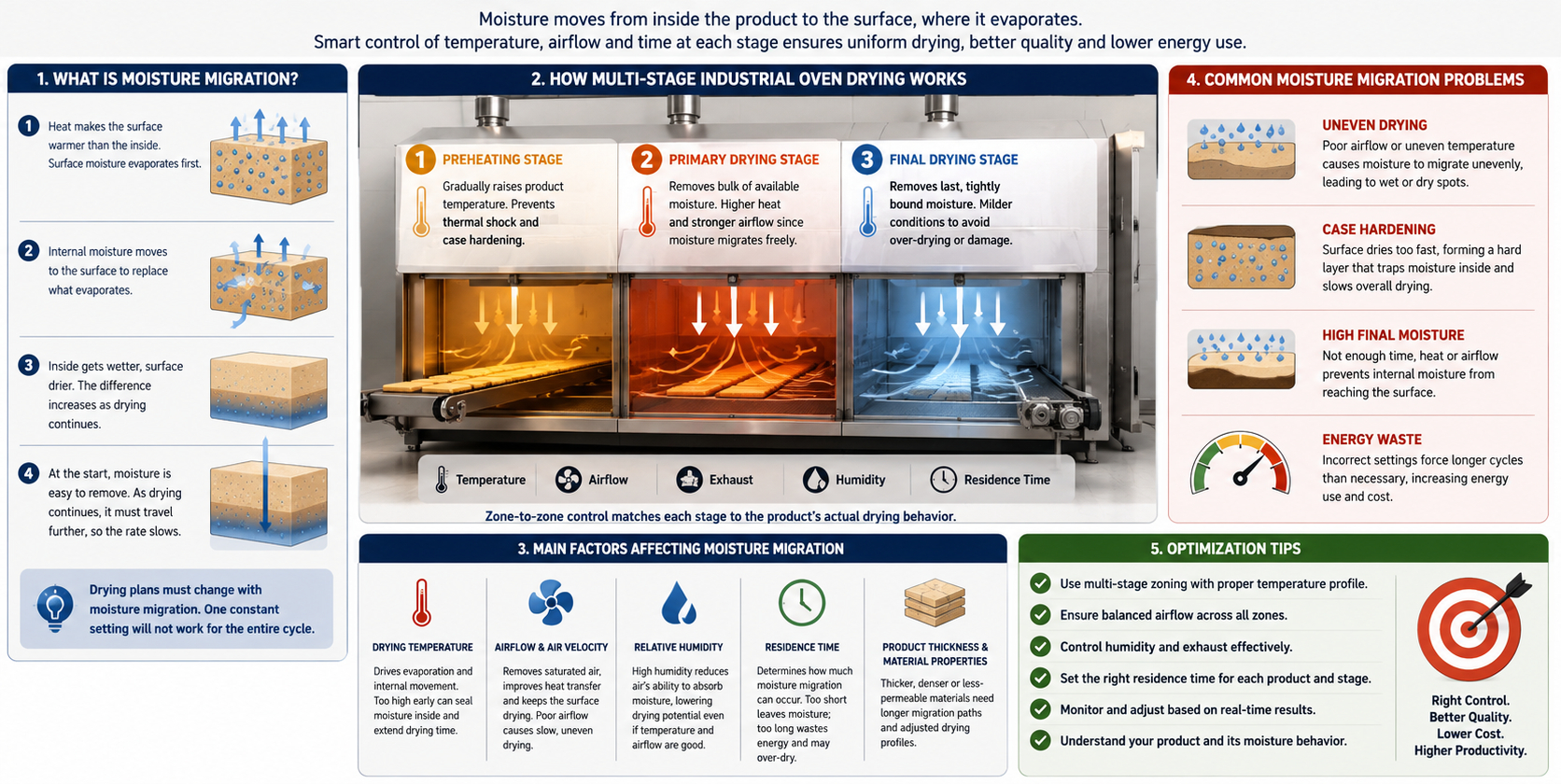
A single, constant temperature setting rarely produces optimal results across an entire drying cycle. Because moisture behaves differently at the start, middle, and end of drying, most industrial ovens are designed with multiple zones, each with its own temperature, airflow, and exhaust settings. This is the foundation of multi-stage industrial oven drying.
Preheating Stage
The preheating stage gradually raises the product’s temperature to a level that supports evaporation without causing thermal shock or case hardening, where the surface dries and seals before internal moisture can escape.
Primary Drying Stage
The primary drying stage removes the bulk of available moisture. Higher heat input and stronger airflow are typically applied here, since moisture is still plentiful and migrating relatively freely from the interior.
Final Drying Stage
The final drying stage removes the last, most tightly bound moisture. Conditions are usually milder here to avoid over-drying or surface damage, since moisture migration slows considerably at this point.
Across all three stages, temperature, airflow, exhaust, humidity, and residence time work together. Zone-to-zone control, a defining feature of multi-zone industrial drying oven systems, allows each stage to match the product’s actual drying behaviour instead of forcing one condition to do all the work.
-
Main Factors Affecting Moisture Migration
Drying Temperature
Temperature drives both surface evaporation and internal moisture movement, but higher temperature does not automatically mean better or faster drying. Excessive heat early in the cycle can dry the surface faster than internal moisture can migrate outward, sealing moisture inside and extending overall drying time rather than shortening it.
Airflow and Air Velocity
Consistent airflow supports surface evaporation by continuously replacing saturated air with drier air and improves heat transfer to the product. Poorly distributed airflow creates stagnant zones where evaporation slows, directly affecting industrial oven airflow for drying performance and uniformity.
Relative Humidity
As moisture evaporates from the product, it raises the humidity of the surrounding air. If this moisture-laden air isn’t exhausted or managed properly, the air’s capacity to absorb additional moisture drops, reducing drying potential even when temperature and airflow remain unchanged.
Residence Time
Conveyor speed, batch duration, or dwell time inside the oven directly determines how much moisture migration can actually occur. Too short a residence time leaves excess moisture behind; too long risks over-drying and unnecessary energy use.
Product Thickness and Material Properties
Thicker, denser, or less-permeable materials require longer migration paths for internal moisture to reach the surface. These products typically need extended or adjusted drying profiles compared to thinner, more porous materials, since moisture simply takes longer to travel through them.
-
Common Moisture Migration Problems
Several problems keep happening because of how moisture moves when things dry. When the air doesn’t spread evenly or the oven doesn’t have the temperature in different areas, the moisture doesn’t spread out properly. Sometimes the outside of the product dries fast while the inside still has moisture, which is known as case hardening. This happens when the heat is too strong at the beginning and the inside moisture gets stuck.
Much drying and not enough drying are both parts of the same issue: the time the product spends in the oven or the temperature used doesn’t match what the product really needs to lose moisture. Much drying uses extra energy and can hurt the product quality. Not enough drying means the product doesn’t meet the requirements and might go bad or not be stable.
Variations between batches and hot or cold spots inside the oven often come from temperature settings, air that doesn’t move well not enough air going out or the products not being placed in a way that lets air flow properly. Finding out which of these reasons is causing the problem is the first step, in fixing the uneven drying in industrial ovens.
-
How to Optimize Moisture Migration in Industrial Ovens
Optimize the Temperature Profile
Rather than applying maximum heat throughout, structure temperature to match each drying stage, moderate during preheating, higher during primary drying, and reduced during final drying to support steady moisture migration without surface sealing or over-drying.
Improve Airflow Distribution
Balanced, consistent air circulation across the entire product load reduces stagnant zones and supports more uniform industrial drying oven moisture control, particularly in ovens handling varied product shapes or dense loading configurations.
Control Exhaust and Humidity
Actively removing moisture-laden air maintains the air’s capacity to absorb more moisture, keeping drying conditions effective throughout the cycle rather than allowing humidity to build up and slow evaporation.
Optimize Residence Time
Matching conveyor speed or batch duration to the product’s actual moisture-removal curve, rather than a fixed, generic setting, helps avoid both under-drying and unnecessary energy use from excess dwell time.
Monitor Final Moisture
Regular moisture testing, in-line sensors, and process monitoring verify that drying results are consistent from batch to batch, allowing adjustments before variation becomes a quality issue.
Together, these steps support measurable gains in industrial oven drying efficiency and directly address the search for how to improve moisture uniformity in drying operations.
-
Moisture Migration and Energy Efficiency
Moisture migration and energy efficiency are really connected. When you understand how moisture moves through a product when it is drying you can do things like reduce much heating minimize the time the product sits around and make better use of heat. You can also reduce the energy that gets wasted when you exhaust the system without losing control of the humidity.
The main thing to remember is that drying something efficiently is, about controlling how the moisture is removed, not just making the oven hotter. If a facility figures out the way to dry things based on how the moisture actually behaves, they usually get more consistent results and save money on energy so they do not have to choose between moisture migration and energy efficiency or consistent production and lower energy costs they can have moisture migration and energy efficiency at the same time.
-
Role of Industrial Oven Design
The way something dries depends on the machine that is doing the drying. Things, like how the temperature’s controlled in different parts of the machine how the air moves around how much air can be removed how fast the machine moves how well it is insulated the sensors it uses and how the process is controlled all effect how well the moisture can be managed. How the products are placed in the machine is also very important. Even if the machine is well designed it will not work properly if the products are blocking the air from moving or creating areas where the air cannot reach.
Machines that have temperature control and are designed to move the air around well give the people using them the ability to adjust each stage of the drying process. The design of the machine. Helps to control the moisture precisely or it becomes the problem that cannot be fixed no matter how the process is adjusted. The machine has to be designed in a way that supports moisture control or it will limit how well the drying process works. Drying performance and moisture migration are affected by the equipment. How it is designed.
Conclusion
Drying things in a factory is a job. It is very important to get a thing just right. You have to balance the temperature the air moving around the humidity, how long things are in the oven and the design of the oven itself. This helps control how moisture moves from the stage of heating to the final drying stage.
When you manage all these things together of changing them one by one you get a much better product. The products are more consistent it uses energy the drying is more uniform you can control the moisture better and the machines work more reliably.
If you are a manufacturer and you are looking at your drying system you should think about how moisture moves. This should be the thing you think about when you are making decisions about the process and the equipment. You should think about moisture migration when you are evaluating or upgrading your drying systems. Moisture migration is very important, for manufacturers.
FAQ (Frequently Asked Questions)
What is moisture migration, in simple terms?
It’s the movement of moisture from inside a product toward its surface as heat is applied. The surface dries first because it’s exposed to heat and airflow directly, while moisture from deeper inside has to travel outward to replace what’s evaporated. Once you picture it that way, most drying problems start making a lot more sense.
Why can’t I just run the oven hot the whole way through and dry things faster?
Because the limiting factor usually isn’t how much heat you’re putting in, it’s how fast moisture can physically move through the product. Push the temperature too high too early, and you dry the surface before the interior moisture has a chance to migrate out. At that point you’ve sealed moisture in rather than removed it, and the cycle actually takes longer.
What’s really different between the primary and final drying stages?
In primary drying, moisture is abundant and close to the surface, so it comes off quickly under stronger heat and airflow. By the time you reach final drying, what’s left is more tightly bound within the material and has a longer path to travel, so conditions are deliberately gentler to avoid over-drying while that last bit works its way out.
My product dries unevenly even though the oven’s set correctly. What’s going on?
Nine times out of ten it traces back to airflow, not temperature. Stagnant zones, uneven loading, or air that isn’t circulating consistently across the whole load will produce inconsistent results even with a perfectly good temperature profile. Check the loading pattern and airflow distribution before you start adjusting setpoints.
Is over-drying really a problem, or is it just “extra safe”?
It’s a real problem. Beyond wasting energy and oven time, over-drying can degrade product quality, brittleness, shrinkage, discoloration, or loss of desired properties, depending on the material. Treating it as a harmless margin of safety usually ends up costing more than it saves.
What is case hardening, and how do I know if it’s happening to me?
Case hardening is when the surface dries and effectively seals before internal moisture has finished migrating out. You’ll often see it as a product that tests within spec on the outside but is still wet at the core, or as a drying curve that looks like it’s plateaued when it hasn’t actually finished. It usually points back to too much heat, too early in the cycle.
How do I choose the right residence time for a new product?
Start from the product’s actual moisture-removal curve rather than copying a setting from a similar-looking product. Run trial batches, sample moisture at intervals through the cycle, and look for the point where moisture removal slows down significantly; that’s usually where you’re chasing diminishing returns and residence time can be trimmed.
Does exhaust actually affect drying quality, or is it mainly a safety feature?
Both, but its role in drying quality gets underestimated. As moisture evaporates, it raises the humidity of the air around the product. If that moisture-laden air isn’t exhausted, the air loses its capacity to absorb more moisture, and drying slows down even though temperature and airflow haven’t changed at all.
Can product loading really make that much difference?
Yes, it’s one of the most common causes of “mystery” inconsistency. Overloading a tray, stacking product too densely, or blocking airflow paths creates shadowed zones that dry differently from the rest of the load, even inside an otherwise well-designed oven. The loading pattern deserves as much attention as the temperature profile does.
Do I need a brand-new oven to get proper multi-zone control, or can an existing one be retrofitted?
It depends on the oven’s current design, but many systems can be upgraded with zoned heating elements, improved air distribution, or better sensor and control coverage without a full replacement. Whether it’s worth it usually comes down to how far the existing airflow and heating layout is from supporting independent zone control.
How often should I be checking final moisture content in production?
Frequently enough to catch drift before it becomes a batch-to-batch pattern, in-line sensors are ideal where the process justifies the investment, and periodic spot testing works as a minimum baseline otherwise. The goal is catching a shift early, not confirming a problem after several batches have already gone out of spec.
Can I improve drying efficiency without raising temperature?
In most cases, yes, and it’s usually the better lever to pull first. Tightening the temperature profile per stage, improving airflow distribution, and getting exhaust and humidity under control often free up more efficiency than simply running the oven hotter.
What usually causes sudden batch-to-batch moisture variation when nothing on the oven has changed?
Check product loading and raw material variation before assuming the oven is at fault, inconsistent incoming moisture content or a change in how product is being loaded onto the line are common culprits. If those check out, look at airflow balance and exhaust performance, since gradual fouling or partial blockages can create drift that looks sudden once it crosses a threshold.
Is multi-stage drying necessary for every product, or only certain materials?
Thin, uniform, highly permeable products can sometimes get away with a simpler profile. But for anything with meaningful thickness, density, or variation in structure, a staged approach is what actually prevents the surface-sealing and uneven-moisture problems that a single-condition process tends to produce.
What’s the single biggest mistake facilities make with moisture migration?
Treating temperature as the main lever and everything else as secondary. Airflow distribution, exhaust and humidity control, residence time, and loading pattern all shape how moisture actually migrates; temperature is only one part of a system that has to work together.
