Preventing Over-Drying and Under-Drying in Continuous Production
One of the most challenging areas of continuous manufacturing is moisture consistency. Continuous drying systems are subject to much greater moisture control requirements than batch processing, since an operator cannot monitor and adjust moisture content prior to the system processing the next batch of material, which may be repeated for hours and days without interruption. A few off-notes can cause a batch to be over-dry or under-dry; and that can add up in a hurry for large production runs. Excessive drying removes texture, weight and value, while insufficient drying can leave moisture in the wood which promotes microbial growth and reduces the shelf life. In food processing, biomass, chemicals, minerals, pharmaceuticals, paper and wastewater treatment, moisture control is crucial to ensure uniformity in the production process in the continuous drying system. This balance is not only a quality concern, but it also impacts yield, energy costs and the ability to run a plant at scale. Knowing what is meant by over-drying and under-drying.
Understanding Over-Drying and Under-Drying
Over-Drying
Over-drying products will remove their texture and pliability, and can make them brittle or crack. Yield reduction due to material weight loss beyond acceptable specifications are significant in industries where weight is a determining factor in the sale of the product. Over-drying also consumes energy, each additional minute of heat to an already dry product is a minute of heat that serves no useful purpose in enhancing product quality, and that adds to utility costs.
Under-Drying
But the reverse of this is as expensive. If moisture is not removed, products can be susceptible to microbial growth, mould and spoilage, if it is above safe levels. Shelf life is reduced, sometimes substantially, and packaged items may bulge, leak or not pass quality checks before they are even delivered to a customer. Not dried enough material is also not as stable in storage and may cake, clump or deteriorate in transit resulting in product rejection at point of sale or use.
Why Continuous Production Makes Moisture Control More Challenging
Batch dryers offer a controlled, closed environment where every unit of product experiences roughly the same conditions. Due to the fact that Continuous Production makes moisture control more difficult. Batch dryers provide a controlled and closed dryer system where the conditions within each unit of dryer are slightly the same. This is not the case with continuous systems: the feed rate, particle sizes and loading density can all change from one instant to the next as the material moves through the dryer. A slightly uneven feed from the infeed conveyor produces thick and thin spots that dry at different rates, ambient humidity and temperature vary throughout the day and hot and cold spots within the drying chamber would not be tolerated by a batch system. In a moving material no time is available to stop and correct a problem before it impacts output, so corrections must occur on the fly. This is why continuous systems need dynamic, responsive process control instead of static, “set and forget” control.
Common Causes of Uneven Drying
Uneven Airflow Distribution
If air is not evenly distributed throughout the drying chamber, pockets will form where the material dries faster or slower than other parts of the batch. They are often caused by a poorly designed ductwork or damaged baffles, or by fan imbalance.
Incorrect Residence Time
If the material is moving too fast through the dryer, it will leave the dryer under dried; too slow and it could over dry.
Inconsistent Feed Moisture
Raw material seldom comes with a moisture content that is uniform to the highest degree. Fixed drying profiles cannot completely overcome moisture swings at infeed due to seasonal variation, storage conditions and differences between suppliers.
Temperature Variations
Hot and cold spots in the dryer, caused by wear of the heating elements, inadequate insulation, or an imbalance of air flow as it moves through the dryer, cause some material to receive more heat than other areas.
Product Thickness and Particle Size
Thicker pieces or larger particles take longer to release moisture from their core than thin or fine material. If a combination of wet and dry products is fed into the dryer, uniform settings may result in some being under-dried and some being over-dried.
Poor Equipment Maintenance
If Equipment left unregulated, each of these can work their way into the moisture consistency unnoticed by an operator well before a quality issue occurs.
Engineering Strategies to Prevent Over-Drying and Under-Drying
Optimize Airflow Management
The proper size fans, balanced ductwork and adjustable dampers ensure even distribution of heated air throughout the drying chamber, eliminating hot and cold spots which can create inconsistent drying results.
Maintain Uniform Product Loading
The proper size fans, balanced ductwork and adjustable dampers ensure even distribution of heated air throughout the drying chamber, eliminating hot and cold spots which can create inconsistent drying results.
Control Drying Temperature
Zoned temperature control means that different parts of a continuous dryer operate at different temperatures as needed to dry the product to the desired moisture content without taking on too much moisture.
Monitor Moisture Continuously
As moisture is removed from the product during the drying process, in-line moisture sensors provide feedback on moisture content during the drying process so that automated systems can adjust drying conditions before moisture content becomes an issue as opposed to after.
Adjust Conveyor Speed
One of the most direct methods of compensation for over drying or under drying is to adjust the belt or conveyor speed for fine tuning the residence time, particularly coupled with real-time moisture feedback.
Perform Regular Process Validation
Automatic data corrections are based on data from sensors, airflow meters, and temperature probes, which must be calibrated regularly to ensure accurate data. The best control system will only be as reliable as the measurements it is based on.
Industry Applications Where Moisture Control Is Critical
Food Processing
Taste, texture, colour, and shelf life are key factors that require careful drying control in the production of fruits, vegetables, spices and herbs, as well as snacks and pet food. The benefits of continuous conveyor dryers, heat pump dryers, microwave dryers and infrared dryers vary with the product’s sensitivity to heat and desired moisture content.
Biomass and Biochar
Wood chips, sawdust, agriculture residue, bagasse and rice husk should have uniform moisture content at the stage of pelletizing, gasification or carbonization as moisture content is the determinant at the downstream process. Typical means of preparing bulky feedstocks with variable moisture content into a uniform end product target range are biomass dryers, rotary dryers, and belt dryers.
Chemical Industry
The moisture content of powders, granules, pigments and resins needs to be uniform to ensure flow properties, prevent them from clumping and ensure that they meet strict specifications. The type of dryer depends on the heat sensitivity or fineness of the material.
Paper and Coating Industry
Uniform drying is essential for coated paper, specialty paper and laminates to avoid non-uniform coating thickness, curling, or surface defects. Consistent drying is achieved over wide, continuously moving webs of material with the use of infrared heating systems, hot air dryers and conveyor ovens.
Sludge and Waste Processing
Organic waste, industrial sludge and municipal sludge must be dried in a controlled manner prior to disposal or fuel recovery. Reducing and stabilizing material for handling with sludge dryers and conveyorized waste dryers.
Technologies That Improve Drying Consistency
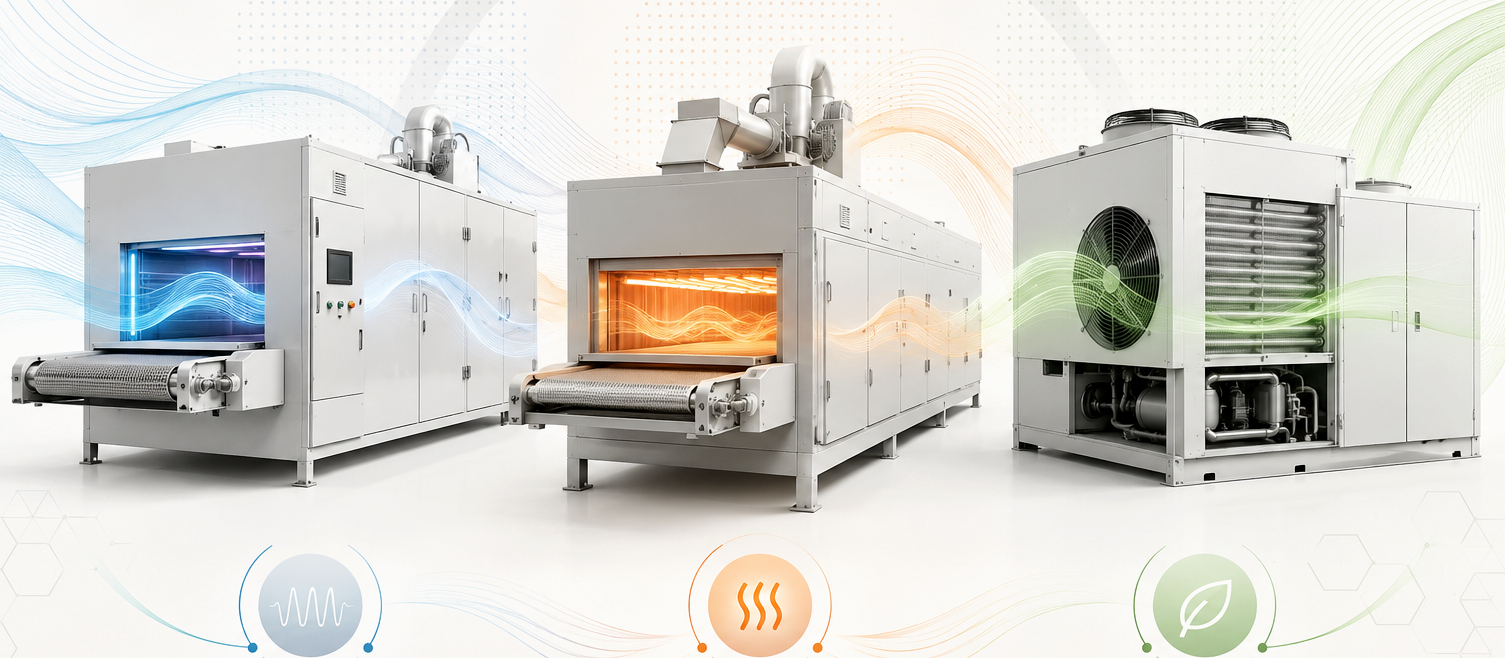
It takes a combination of technologies to provide modern continuous drying systems, not just a single one. Smart temperature control systems provide heat output based on what is happening in the moment, not on a set temperature. PLC-based automation works as a system to control airflow, temperature and conveyor speed rather than just the individual components; moisture sensors provide a view of what is actually happening in the product; and variable speed conveyors enable the residence time of the product to be adjusted without redesigning the equipment. Other types of heating that are gaining popularity include hybrid microwave/hot air, infrared/hot air or heat pump/hot air options. These combinations allow a drying system to more effectively remove moisture, have one heat source for fast moisture removal from bulk material, and another for slow uniform drying of sensitive material, and reduce the risk of over drying a sensitive material while drying out bulk material.
Best Practices for Maintaining Uniform Drying Performance
- Standardize moisture content of materials received and particle sizes as much as possible.
- Provide evenly distributed air flow throughout drying chamber
- Sweep ducts and filters regularly
- Conveyor speed monitoring & residence time accuracy adjustment
- Moisture validation points should be more than just the exit point
- Regularly calibrate sensors for accurate automatic adjustment
- Update operating parameters when products or feedstock change
Conclusion
It is not just a matter of convenience in the operation of the plant, moisture consistency is a direct influence on product quality and it is never cheap to get it wrong. Avoiding over-drying and under-drying saves material, saves unnecessary energy use and saves yield at every batch turnaround. This is particularly true in continuous production: moisture control should be regarded as a dynamic process that needs to be addressed continuously and not just as a setting once established and forgotten. Optimizing the process with improved airflow, real-time monitoring and regular validation, results in improved productivity and manufacturing performance. In any industry, the key to successful, high-quality drying product is the choice of the right dryer technology for the material and the control of that process throughout the dry run.
Frequently Ask Question (FAQs)
-
How does over-drying directly impact a facility’s profitability?
Over-drying hurts the bottom line in two main ways. First, it causes excessive weight loss, which reduces the total yield (especially costly in industries where products are sold by weight). Second, applying heat to a product that is already dry is wasted energy, needlessly inflating utility bills.
-
What are the hidden logistical dangers of under-drying a product?
Goods may clump, cake, or degrade in transit. Packaged items with trapped moisture can also cause their packaging to bulge or leak, leading to rejected shipments before they even reach the end user.
-
Why might pockets of uneven drying form inside a continuous chamber?
This is typically an airflow distribution issue. If ductwork is poorly designed, baffles are damaged, or fans are imbalanced, the heated air will not circulate evenly. This creates blind spots where material dries significantly faster or slower than the rest of the line.
-
How does conveyor speed influence the final moisture content of a product?
The speed of the conveyor dictates the “residence time” or how long the material stays inside the dryer. If the belt moves too fast, the product exits under-dried. If it moves too slowly, the product absorbs too much heat and becomes over-dried and brittle.
-
Why can’t a facility use a fixed drying profile if they process the exact same raw material every day?
Raw materials are rarely uniform. Incoming feedstocks naturally fluctuate in moisture content due to seasonal weather changes, varying storage conditions, and slight differences between suppliers. A rigid, fixed drying profile cannot adapt to these initial swings.
-
How do mixed particle sizes complicate the continuous drying process?
Larger or thicker pieces take longer to release moisture from their core compared to fine or thin pieces. If a system processes a mix of both simultaneously, uniform settings will either leave the thick pieces wet or burn the thin pieces.
-
Why are in-line moisture sensors critical for continuous production?
Unlike batch systems where an operator can test a sample before starting the next load, continuous systems run for hours or days non-stop. In-line sensors provide instant, real-time feedback, allowing automated systems to correct issues (like adjusting temperature or belt speed) before a large volume of product is ruined.
-
Why is extreme moisture precision necessary when preparing biomass and biochar?
In the biomass industry, drying is a preparatory step for downstream processes like pelletizing, gasification, or carbonization. If the moisture baseline isn’t perfectly uniform, these subsequent processes will fail or produce highly inconsistent fuel products.
-
What happens to chemical powders if they are subjected to uneven drying?
Chemical powders, pigments, and resins rely on precise moisture levels to maintain their physical properties. Uneven drying causes them to lose their flowability and start clumping, which means they will fail to meet the strict quality specifications required for industrial use.
-
Why are hybrid heating technologies becoming more popular?
Technologies that combine methods, like microwave and hot air or infrared and hot air, offer the best of both worlds. One heat source can rapidly strip surface moisture from bulk material, while the secondary source provides gentle, uniform penetration for sensitive items, vastly reducing the risk of over-drying.
-
What is the most effective way to prepare materials before they enter the dryer?
The best defensive strategy is to standardize the incoming material as much as possible. Sorting particle sizes and blending feedstocks to create a more consistent starting moisture content helps the dryer perform more predictably.
-
Why is it insufficient to simply install automated sensors and assume the process is safe?
Automated corrections are only as good as the data they receive. Over time, sensors, airflow meters, and temperature probes can drift out of alignment. If they are not regularly calibrated through process validation, the system will start making automated adjustments based on false readings.