Microwave Heating Applications in Biomass Processing: Pyrolysis and Thermal Treatment
Biomass is turning into one of the more practical answers to two problems industries have wrestled with for years, what to do with organic waste, and how to produce fuel and energy without relying entirely on fossil sources. Agricultural residues, wood waste, and municipal organic streams pile up every year in enormous volumes, and much of it either gets burned in the open or dumped, both of which carry their own environmental costs.
Pyrolysis, the thermal breakdown of organic material in a low oxygen or oxygen free environment, has been used for decades to convert this kind of waste into useful products like char, oil, and gas. What has changed more recently is how the heat gets applied. Microwave pyrolysis of biomass uses electromagnetic energy to heat material from the inside, rather than relying on external heat sources working their way in from the surface. This shift in heating method changes a lot about how the process behaves, and it is worth understanding in some detail before deciding whether it fits a particular application.
What Is Microwave Pyrolysis of Biomass
The basic principle of microwave pyrolysis is, of course, pyrolysis. Organic feedstock is heated in the absence of adequate oxygen, resulting in a breakdown into char, condensable vapours and non-condensable gases, rather than being burned. The first step in understanding the mechanism of microwave pyrolysis of biomass is to understand what makes it different from conventional pyrolysis: it is almost all about how the heat is reaching the biomass. The conventional pyrolysis reactors are based on conduction and convection. The heat is produced in the biomass and it slowly permeates towards its central part, typically by passing a wall that is heated, a hot gas stream or a direct flame. This can take a long time to evenly heat larger particles or dense feedstock, and there can be significant temperature differences between the outside and inside of the material. In contrast to microwave heating, which requires time and power. When the electromagnetic energy is in the microwave range it is able to interact directly with the molecules in the biomass and will heat the biomass from the inside out. This is what makes microwave pyrolysis significantly different from the conventional thermal processes and is sometimes termed volumetric heating.
How Microwave Heating Works in Biomass Pyrolysis
In order to use microwave heating, molecules of the material to be heated must interact with the oscillating electromagnetic field. Most work is done here by two mechanisms, dipole rotation and ionic conduction. In the case of water, or other polar molecules, in the biomass, they attempt to align themselves with the rapidly changing microwave field. These molecules rotate back and forth as the field switches direction millions of times a second, dissipating heat as a result of friction. This is added by ionic conduction, which occurs when charged ions are present in the material that move in the field and interact with the molecules around them creating more heat from resistance. It can have fairly low dielectric properties, that is, its interaction with the microwave energy, especially after moisture has been removed. Therefore, it is common to place a microwave absorbing material (also known as susceptor) in a microwave pyrolysis system, which is often biochar, activated carbon or silicon carbide, or a combination of them, mixed with or around the feedstock. These materials have a high ability to absorb microwave energy and to transfer heat to the surrounding biomass which assists the process, particularly in the initial stages before sufficient char has been generated to maintain the reaction.
Microwave Assisted Pyrolysis Process for Biomass
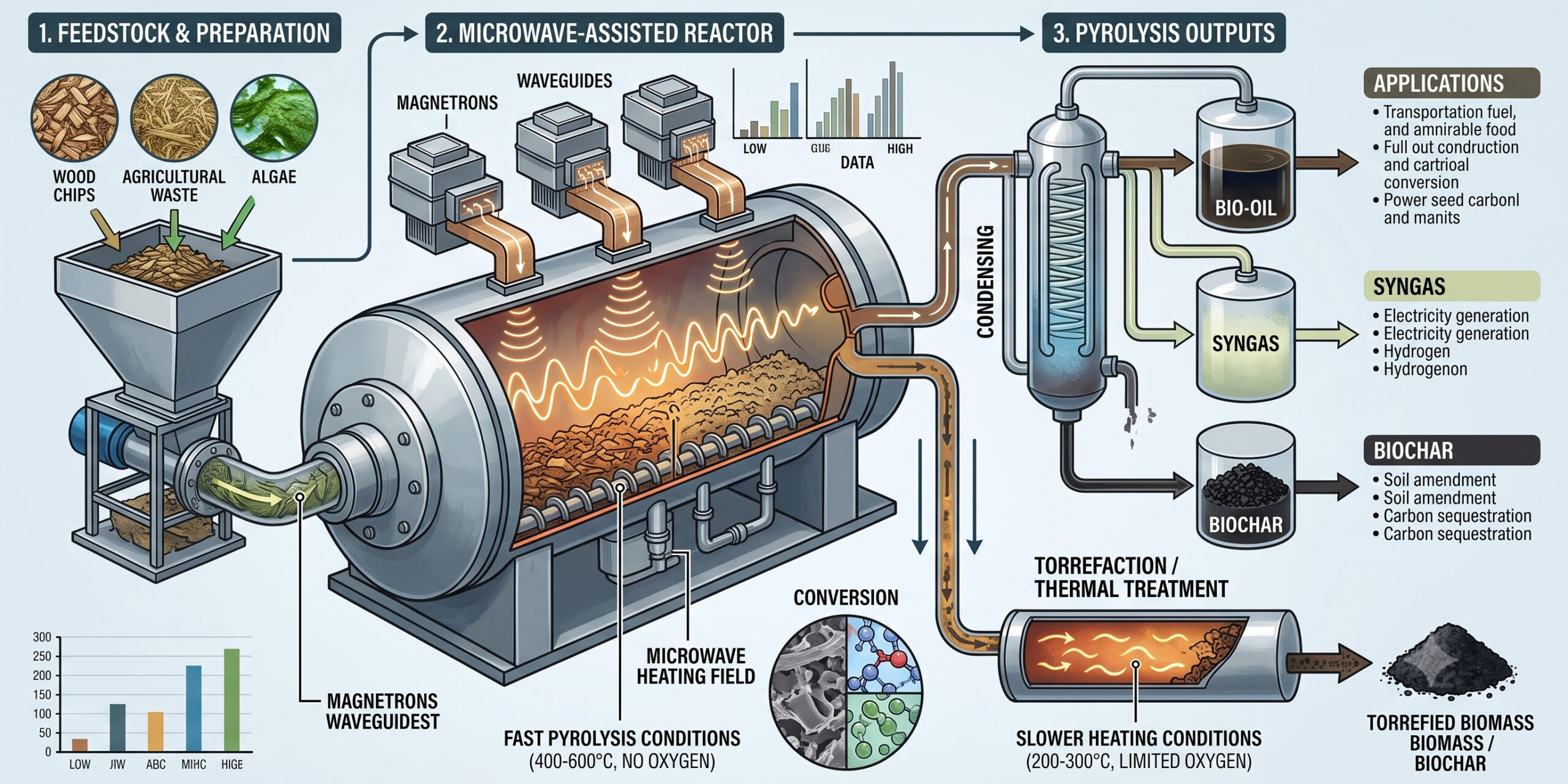
While the details may be different depending on the feedstock and output, the overall sequence for the microwave pyrolysis of biomass is logical. Preparation of the feedstock is the first step. The moisture content of biomass typically needs to be lowered, as too much water can interfere with the efficient absorption of microwave energy in some feedstocks and can absorb the energy that would otherwise be used in the pyrolysis reaction itself. Prolonged reduction in particle size is also frequently used as it would result in more uniform particles that heat more evenly, thus reducing processing time. The feedstock is loaded into the reactor chamber and a microwave absorbing additive may be added to the feedstock. Prior to the start of the heating process, the chamber is often purged with an inert gas, like nitrogen, which is used to remove oxygen from the chamber and generate the low oxygen atmosphere necessary for pyrolysis. If this is not done, it will only burn, not pyrolyse. Application of microwave energy is then performed, typically at about 2.45GHz, the standard frequency used by most microwave heating equipment for industrial applications. With the gradual increase of temperature, the biomass starts decomposing and this is the time when the real pyrolysis reaction process begins. A portion of the volatile compounds emit as gas, and some of these volatilize to solid bio-oil upon cooling, while the rest remain as gas (syngas). The end product of the process in the reactor is a solid carbon-rich material called biochar. These three output streams such as biochar, bio-oil and syngas which are collected separately and the proportions vary significantly according to the operating parameters set for the run.
Microwave Pyrolysis Operating Parameters and Temperature
The consistency and usefulness of the products of microwave pyrolysis relies on the control of multiple interacting variables. Among various factors, the pyrolysis temperature in the microwave system is most likely the most important for biomass. Average temperatures of 300–450°C are favourable for biochar yield, as less biochar turns into vapour. Increasing the temperature to the mid-range (450-600 degrees Celsius) generally results in higher bio-oil production due to more of the volatile compounds being volatilized and condensed. High temperatures, typically > 600° Celsius and sometimes up to 800° Celsius or even higher, are preferred for the production of syngas because larger molecules of vapour are cracked to produce smaller, non-condensable gases. The amount of power the microwave uses, and the length of time it is exposed, combine with temperature to determine the speed of heating and time the material is held in a range of temperatures. Higher power is also known to facilitate faster heating rates, which has been associated with different product distributions (repeated studies) than slow heating, particularly with respect to the formation of the bio-oil as opposed to the char. The moisture content of the feedstock, particle size and quantity of microwave absorbing additive used all serve as supporting elements. Excessive moisture will cause energy losses as water evaporates before pyrolysis reactions can take place. The effect of particle size is related to the uniform distribution of heat throughout the material. The proportion of absorber to feedstock can have a significant influence on the efficiency of the whole batch heating, especially at start up. Control of the atmosphere is also important. Nitrogen flow rate is typically optimized to yield a truly oxygen limited system, as well as to help to sweep the vapours out of the reaction zone to the condensation system, thereby minimizing any volatile material loss or further cracking to gas.
Microwave Pyrolysis of Agricultural Waste
There is a large proportion of the biomass being pyrolyzed that is agricultural residues and for a very good reason. The residues from crops such as crop stalks, straw, husks, shells and stems are produced in large amounts each harvest season, and responsible disposal of these residues is a continuing challenge for many areas of farmland, especially those areas where it has been customary to burn the residues in the open. These residues are usually a combination of cellulose, hemicellulose and lignin, the main components of most biomass plant materials, but in different proportions depending on the crop. This composition will influence the manner in which the material will behave during microwave pyrolysis, such as the temperature range that maximizes the production of a desired product. As in other feedstocks, the pre-processing steps can have a greater impact on bulk density when processing agricultural waste than when processing other denser waste feedstocks, as these wastes typically have a natural low bulk density and varying moisture content based on storage conditions.
Microwave Pyrolysis of Rice Husk
A special mention of rice husk is warranted as it is somewhat different from the other agricultural residues. It is an unusual biomass feedstock in that it has a high level of silica, typically between 15% and 20% of its dry weight. This silica content affects the nature of the biochar generated during rice husk pyrolysis, rendering it beneficial for various applications such as soil amendment and silica production. Moreover, rice husk has relatively low bulk density and fibrousness that influence the packing characteristics in a reactor and the uniformity of microwave energy distribution in a loaded batch. Availability of husk is usually seasonal, and in certain parts of the world, is substantial, especially in Asia because of the large areas of rice grown, thus providing an amount of feedstock that leads to a significant research interest, particularly for microwave based thermal treatment.
Microwave Pyrolysis of Sawdust
Sawdust and other wood processing wastes are a slightly different feedstock group than agricultural wastes, contain more lignin and are, in general, denser when compacted. The higher the lignin content the greater the tendency for biochar to be formed which is why the feedstocks that have higher amounts of cellulose and hemicellulose are less likely to be used for biochar formation. For microwave pyrolysis, some particle size ranges may be appropriate because sawdust has been already milled and cut in certain parts of the process, which can be advantageous as the sawdust does not need to be ground further before pyrolysis. However, moisture content can range from very high in case of green sawdust to very low for kiln dried sawdust, and this is typically the first step to take before sawdust enters a reactor.
Industrial Microwave Pyrolysis for Biomass Processing
Translating lab scale studies to industrial operation entails other considerations with respect to microwave pyrolysis. Batch processing is an option that is limited in the number of batches it can process in a certain period of time, and is important only as the operation becomes larger and more continuous, or semi-continuous, become important. Uniform microwave field distribution over a larger reactor chamber is more difficult than for a small laboratory unit and the reactor design must take this into consideration to prevent hot spots or cold spots developing within a batch. In larger-scale engineering, it is common to use multiple magnetrons around the reactor which are capable of increasing the uniformity of the field, or to use mode stirrers or rotating beds of feedstock to achieve greater uniformity. Vapor collection and condensation systems should also be scaled appropriately, as the larger the throughput, the more there will be of vapour to be efficiently and effectively separated into bio-oil and syngas – with minimal loss. Another aspect that is more common in larger industrial systems than smaller research systems is a system that includes gas cleanup systems and energy recovery systems wherein syngas is used to meet some of the energy requirement of the process.
Microwave Pyrolysis for Waste to Energy Applications
In addition to agricultural residues and wood waste, the application of microwave pyrolysis as a waste to energy technology is also being investigated to a larger extent with various industrial organic byproducts, sewage sludge and the organic fractions of municipal waste. The charm of this place is not too complicated. Pyrolysis avoids sending organic waste to landfill, where it can release methane, or not incinerate it at all, but rather convert it into products which have some energy or material value, such as biochar, bio-oil and syngas. It is part of that why microwave heating is being touted in waste to energy discussions, because there are some waste streams that are somewhat more heterogeneous, but also exhibit generally faster processing times. However, the challenge of processing feedstock variability, while real, is one that must be overcome through careful process design.
Products from Microwave Pyrolysis of Biomass
Microwave Pyrolysis for Biochar Production
Once the volatile compounds are driven off the original fuel, a solid carbon-rich material is left behind which is known as biochar. The porous structure and stable carbon content make it suitable for various applications, including as a soil amendment to enhance water holding capacity and carbon sequestration, as a filtration media and as a raw material for activated carbon, depending on the feedstock. The relatively instantaneous internal heating during microwave pyrolysis results in biochar with a fairly uniform pore structure as compared to conduction-based reactors where there is some localized overheating or underheating. Generally, lower pyrolysis temperatures are better for higher biochar yields as less of the original carbon content is vaporized or converted to gas.
Microwave Pyrolysis for Bio-oil Production
The liquid fraction of bio-oil is the condensed liquid that is gathered, after the volatile vapours from pyrolysis have been cooled. It is a complicated combination of oxygenated organic compounds whose exact composition is very dependent on the type of feedstock used and the processing conditions. Bio-oil is often the most interesting as it can be upgraded to transport fuel or fuel for heating, for operations considering microwave pyrolysis as a pathway to biofuels from biomass. The fast heating rates and controlled heating are also a reason for studying microwave heating particularly for the purpose of increasing the number of bio-oil yields compared to the slow heating rates of conventional pyrolysis, because fast heating rates would favour the production of condensable vapours, rather than secondary cracking reactions that would break them down into lighter gases. For most feedstocks, the highest yields of bio-oil are obtained from mid range pyrolysis temperatures, typically between 450 and 600°C.
Microwave Pyrolysis for Syngas Production
Non-condensable gas from the pyrolysis reaction is called synthesis gas or Syngas, and may consist of a mixture of hydrogen, carbon monoxide, carbon dioxide, methane and other light hydrocarbons in different proportions. Generally, higher pyrolysis temperatures lead to increased yield of syngas because of secondary reactions converting larger sized vapor molecules to smaller gaseous molecules. Fuel grade syngas created in this manner can have a real value as a fuel and can be utilized directly for heat or energy production, and in some installations has been used as a fuel for the microwave heating system to help meet the energy demand of the operation, further enhancing the overall energy balance of the operation. Biochar, bio-oil, and syngas are three outputs of biomass microwave pyrolysis and the proportion of each can be shifted by varying the operating parameters based on the application, such as soil improvement, liquid fuel production or renewable fuel production for energy recovery.
Benefits of Microwave Pyrolysis Compared to Conventional Methods
There are some points that are emphasized in more than one instance when microwave pyrolysis is compared to the traditional conduction based pyrolysis. Less time waiting for heat to permeate through a particle from the outside to the inside, typically means processing time will be shorter for a particular batch with volumetric heating. The control of temperature is also more accurate, as the time required for the power to be adjusted and the temperature to take effect is generally smaller than the time needed for the thermal mass of the wall of a reactor heated by conventional means. Another frequently mentioned advantage is that the energy is released directly within the material without having to heat a reactor wall or the surrounding medium first, and then transfer heat inside, which always has to lose some energy. In addition, selective heating can occur in some instances, whereby portions of the feedstock having higher dielectric loss are heated preferentially, which can be beneficial depending on the product distribution required.
Challenges to Consider
However, there are some issues with microwave pyrolysis. Due to the low dielectric loss of feedstock, especially after drying, the feedstock itself may not absorb the microwaves well and therefore using additives that can have a high dielectric loss is often required, a step which does not occur in conventional pyrolysis. The problem of scaling up, while keeping the microwave field uniform around the greater volume of a larger reactor is a real engineering challenge, and if not carefully addressed by reactor and equipment design, can result in poor product uniformity if the field is not uniform. The cost of the microwave generating equipment, such as the magnetrons and related power supplies, also is generally higher than for simpler conventional heating elements, and this should be considered along with the improvement in process efficiency that can be provided by microwave heating.
Closing Thoughts
The underlying physics of volumetric heating, as opposed to surface in heat transfer, which is the essence of conventional pyrolysis, makes microwave pyrolysis of biomass a truly different processing method of organic waste and residues to its useful outputs. The basic principles remain the same for all types of feedstocks, whether it is rice husk, sawdust, general agricultural residue or a wider municipal waste stream, but the parameters and expected yields vary depending on the feedstock type. Microwave thermal treatment is likely to remain a technology of interest to the renewable fuels industry as it seeks viable solutions to waste reduction and to recover energy or material value from biomass with a variety of pyrolysis technologies currently being developed.
Frequently Asked Questions
What makes microwave pyrolysis different from conventional pyrolysis?
Conventional pyrolysis heats biomass from the outside in through conduction or convection, while microwave pyrolysis generates heat within the material itself through dielectric interactions, resulting in more uniform, generally faster heating.
Does all biomass absorb microwave energy well?
Not necessarily. Many dry biomass feedstocks have relatively low dielectric loss, which is why microwave absorbing materials like char or silicon carbide are often mixed in to improve heating efficiency, particularly during the early stages of the process.
Which temperature range is best for microwave pyrolysis of biomass?
It depends on the desired product. Lower temperatures around 300 to 450 degrees Celsius tend to favour biochar, mid range temperatures around 450 to 600 degrees Celsius favour bio-oil, and higher temperatures above 600 degrees Celsius favour syngas.
Can microwave pyrolysis handle different types of biomass feedstock?
Yes, it has been applied to a wide range of feedstocks including rice husk, sawdust, crop residues, and organic fractions of municipal waste, though operating parameters usually need adjustment for each feedstock’s specific composition and moisture content.
What are the main products of microwave pyrolysis?
The three main products are biochar, a solid carbon rich residue, bio-oil, a condensed liquid from volatile vapours, and syngas, a combustible mixture of light gases.
Is microwave pyrolysis suitable for industrial scale operation?
It can be, though scaling up introduces engineering challenges around maintaining even microwave field distribution and managing continuous feed and vapor collection systems, which reactor design needs to specifically account for.