The Science Behind Biochar and Water Retention in Agricultural Soils
Water availability is one of the defining challenges facing modern agriculture. Growing competition for freshwater, irregular rainfall, prolonged dry periods, and rising crop water demand are placing increasing pressure on agricultural systems. Yet the challenge is not always simply a lack of water. In many fields, a significant part of the problem lies beneath the surface: the soil cannot retain enough moisture where plant roots can access it.
A coarse-textured agricultural field may receive substantial seasonal rainfall and still experience moisture stress shortly after a dry period begins. Sandy soils can allow water to drain rapidly below the active root zone, while degraded soils with low organic matter may have poor aggregation and limited capacity to store plant-available water. Under such conditions, simply applying more irrigation may increase water use without addressing the underlying limitations of the soil.
This is where biochar for water retention has attracted significant interest. Biochar is a carbon-rich material produced by heating suitable biomass under oxygen-limited conditions through a process known as pyrolysis. Its porous structure, relatively stable carbon framework, and surface properties can alter the physical and chemical environment of agricultural soils.
Biochar is different from organic residues that break down fast. A lot of the carbon in biochar can stay in the soil for a very long time. The reason it is useful for managing water is not just because it lasts a long time. Biochar can change the way water moves through the soil. It affects the size of the pores in the soil how dense the soil is, how it holds together how water it can absorb, how well it keeps nutrients and where the tiny living things in the soil live. All these things work together to control how water gets into the soil moves through it and stays in the part where the roots of the planters
It is really important to understand how biochar works because it does not work the same in every type of soil. The way it works depends on what the soil’s like to start with what the biochar is like the weather how much biochar is added, what kind of crops are being grown and how the soil is taken care of. Biochar is a kind of material that can help the soil in many ways and understanding how it works is crucial, for using it effectively.
This article explores the science behind biochar and water retention in agricultural soils, from basic soil-water relationships to pore-scale mechanisms, biological interactions, production variables, practical applications, and the role biochar may play in more water-efficient and climate-resilient agriculture.
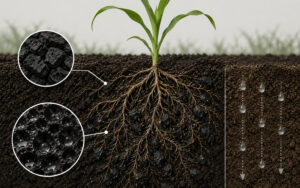
Understanding Water Retention in Agricultural Soils
Before examining how biochar influences soil moisture, it is important to understand how water naturally behaves within soil.
Soil is not a solid mass. It contains a complex network of pores between mineral particles, organic matter, roots, and biological structures. Some of these pores contain air, while others hold or transport water. The size, distribution, and connectivity of these pores strongly influence how much water a soil can retain and how much of that water remains available to plants.
What Is Soil Water Retention?
Soil water retention refers to the ability of soil to hold water against gravitational drainage. After rainfall or irrigation, some water moves downward through large pores, while some remains trapped within smaller pores or attached to soil particle surfaces.
The amount retained depends heavily on soil texture and structure.
Sandy soils contain relatively large particles and often have a high proportion of larger pores. Water can infiltrate quickly but may also drain rapidly. Clay-rich soils contain much finer particles and can hold considerably more water, although a portion may be held so tightly that plant roots cannot easily extract it.
Loamy soils generally provide a more balanced combination of drainage, aeration, and water storage.
Gravitational Water
Gravitational water is the portion that moves downward through the soil under the force of gravity after heavy rainfall or irrigation.
Although it contributes to groundwater recharge and movement through the soil profile, it is often available to plants only briefly. In highly permeable sandy soils, gravitational drainage can carry water and dissolved nutrients below the active root zone relatively quickly.
Improving agricultural water efficiency therefore does not necessarily mean maximizing the total amount of water present in the soil. The objective is to retain an appropriate proportion of water within pores from which roots can access it.
Capillary Water
Capillary water stays in the holes in the soil because of the way the water sticks to the soil and the tightness of the water’s surface. This water is really important for the roots of plants to drink.
When the soil starts to get dry the plants make a kind of pull on the water that helps the roots get moisture from the soil around them. The holes in the soil can be like a tank that holds water until it rains again. Until we water the plants.
Biochar is really good for this because the holes inside the biochar can hold water and change the size of the holes in the soil, around it.
Hygroscopic Water
Hygroscopic water forms a very thin film around soil particles and is held by strong molecular forces. Because this water is bound so tightly, plants generally cannot access it effectively.
This distinction is important when discussing the water-holding capacity of biochar. A material may increase the total quantity of water retained by soil without increasing plant-available water by the same amount.
For agricultural performance, the critical question is therefore not simply “How much water can the soil hold?” but rather “How much additional water can remain available to plants?”
Field Capacity (FC)
Field capacity describes the approximate soil moisture condition after excess gravitational water has drained and downward movement has slowed substantially.
At field capacity, the soil retains water within smaller pores while larger pores contain sufficient air for root respiration and biological activity. This balance between water and air is important for healthy crop growth.
Biochar amendments can influence field capacity by changing pore distribution and increasing the volume of pores capable of retaining moisture after drainage.
Permanent Wilting Point (PWP)
The permanent wilting point represents the soil moisture level at which plants can no longer extract sufficient water to recover from wilting under standard reference conditions.
Water may still physically exist within the soil, but it is held too strongly for the plant to access effectively.
This is why increasing total soil water content does not automatically translate into better drought resistance.
Plant-Available Water (PAW)
Plant-available water is commonly considered the water held between field capacity and the permanent wilting point.
In simplified terms:
Plant-Available Water = Field Capacity − Permanent Wilting Point
A useful soil amendment should ideally increase the amount of water stored within this accessible range rather than merely increasing strongly bound moisture.
Research on biochar generally indicates that its effects on plant-available water depend strongly on soil texture and biochar properties, with coarse-textured soils often showing more pronounced improvements than already water-retentive fine-textured soils.
Why Agricultural Soils Lose Their Ability to Retain Water
Agricultural soils are dynamic systems. Their physical properties can change considerably under long-term cultivation, and inappropriate management can gradually reduce their capacity to absorb, store, and supply water.
Organic Matter Depletion
Soil organic matter plays an important role in aggregation and water storage. Continuous cropping without sufficient organic matter replacement can gradually reduce soil carbon levels.
As organic matter declines, aggregates may become less stable, biological activity can decrease, and the soil may become more vulnerable to crusting, erosion, and compaction.
The result can be a less efficient pore structure for both water storage and root development.
Intensive Tillage
Repeated intensive tillage can temporarily loosen the soil but may eventually disrupt stable aggregates and accelerate organic matter decomposition.
When soil structure deteriorates, rainfall may infiltrate less uniformly, surface crusting can increase, and the soil may become more susceptible to erosion or compaction.
Conservation tillage, organic amendments, cover cropping, and biochar can all form part of broader strategies for rebuilding soil structure.
Soil Compaction
Compaction reduces total pore space and can alter the balance between large and small pores.
Highly compacted layers may restrict root penetration and reduce infiltration, causing water to accumulate at the surface or move laterally rather than entering the deeper root zone.
Biochar’s relatively low bulk density may contribute to physical improvements when properly incorporated, although it should not be treated as a substitute for correcting severe mechanical compaction.
Loss of Soil Structure
Healthy agricultural soil contains aggregates of different sizes, creating a network of pores that supports drainage, water storage, aeration, and root growth.
When this structure breaks down, the soil may become either excessively dense or poorly organized. Both conditions can reduce effective water use.
Climate Variability
Increasingly irregular rainfall adds another challenge. A field may receive sufficient total seasonal rainfall but experience long intervals between individual rain events.
In such situations, the ability of soil to capture and retain moisture when water is available becomes increasingly important.
Effects on Irrigation Efficiency
When soil cannot retain sufficient water in the root zone, farmers may compensate with more frequent irrigation. This can increase energy use and place additional pressure on limited water resources.
Improving the soil itself can therefore complement efficient irrigation technologies by increasing the useful residence time of water around plant roots.
What Makes Biochar Different from Other Soil Amendments?
Biochar is sometimes grouped with compost, charcoal, and other carbon-rich materials, but these materials differ significantly in production, properties, and intended use.
Production Through Pyrolysis
Biochar is generally produced by heating biomass under controlled conditions with limited oxygen. Suitable feedstocks can include wood residues, crop residues, rice husks, coconut shells, and other biomass materials.
During pyrolysis, volatile components are released while a carbon-rich solid structure remains. The process conditions strongly influence the characteristics of the resulting biochar.
Stable Carbon Structure
One distinguishing characteristic of biochar is its relatively stable aromatic carbon structure. Compared with fresh plant residues, this carbon generally decomposes much more slowly in soil.
Its persistence allows the physical effects of biochar to potentially continue over multiple growing seasons, although the actual stability varies with production conditions and environmental factors.
High Porosity
Many biochars retain or develop extensive internal pore networks during pyrolysis. These pores can interact with water, dissolved nutrients, microorganisms, and surrounding soil particles.
However, porosity varies significantly between biochars. Feedstock structure and pyrolysis conditions can produce materials with very different pore-size distributions.
Biochar, Compost and Charcoal: Differences
| Material | Primary Purpose | Stability in Soil | Main Agricultural Contribution |
| Biochar | Soil amendment and stable carbon addition | Generally high | Physical structure, water dynamics, nutrient interactions |
| Compost | Organic matter and nutrient addition | Moderate | Nutrients, biological activity, organic matter |
| Charcoal | Primarily produced as fuel | Variable | Not necessarily designed or tested for soil application |
Biochar and compost should not necessarily be viewed as competing amendments. In many applications, they can complement one another. Compost provides biologically active organic matter and nutrients, while biochar can provide persistent porous surfaces and influence long-term soil structure.
The Science Behind Biochar and Water Retention
The influence of biochar on soil moisture results from several interconnected mechanisms rather than a single property.
High Surface Area and Porosity
During pyrolysis, the original cellular structure of biomass is transformed into a carbon-rich matrix containing pores of different sizes.
This internal architecture can provide additional surfaces where water interacts with the material. When incorporated into soil, biochar particles become part of the overall pore network, potentially changing both water storage and movement.
Micropores, Mesopores and Macropores
Different pore sizes perform different functions.
| Pore Scale | General Role in a Biochar-Amended Soil System |
| Very small pores | Moisture adsorption and retention |
| Intermediate pores | Water storage and potential microbial habitat |
| Larger pores | Water movement, aeration, and root-zone connectivity |
The exact boundaries used to classify pores vary between scientific disciplines, so it is more useful in an agricultural context to focus on function.
An effective biochar contains a distribution of pore sizes rather than only extremely small pores. Water retained too strongly may not be readily available to plants, while excessively large pores may simply promote rapid drainage.
Capillary Action
Water can move and remain within narrow pores because of capillary forces created by interactions between water molecules and solid surfaces.
Biochar can introduce additional capillary-scale spaces into coarse-textured soils. These spaces may retain moisture that would otherwise drain through larger pores.
As the surrounding soil dries, some stored water can potentially move along moisture potential gradients toward drier regions and plant roots.
Soil Aggregate Formation
Biochar particles can interact with clay minerals, organic compounds, fungal structures, roots, and microbial products.
Over time, these interactions may contribute to more stable soil aggregates. Better aggregation can create a more balanced pore system, combining larger pores for aeration and infiltration with smaller pores for moisture retention.
Reduced Bulk Density
Most biochars have a lower bulk density than mineral soil.
When incorporated at sufficient rates, they can reduce the overall bulk density of the amended soil. This may improve root penetration and create additional pore space, particularly in degraded or compacted soils.
The effect depends strongly on application rate and incorporation method.
Improved Infiltration
Biochar may improve infiltration in soils were poor structure limits water entry. Better aggregation and increased pore connectivity can allow rainfall or irrigation water to move into the soil rather than being lost as surface runoff.
However, responses vary. Biochar should not automatically be expected to improve infiltration in every soil, particularly where hydrophobicity, severe compaction, or other constraints are present.
Better Plant-Available Water
One of the most agriculturally significant potential effects of biochar is an increase in plant-available water.
This occurs when biochar increases moisture retained near field capacity without causing an equivalent increase in water held below the extraction ability of plant roots.
The effect is often more pronounced in sandy soils because these soils begin with relatively limited internal surface area and water-storage capacity.
Moisture Release During Dry Periods
Biochar should not be thought of as a conventional sponge that simply fills with water and empties completely.
Instead, moisture movement is governed by water potential differences between biochar pores, surrounding soil, and plant roots.
As the soil becomes drier, part of the moisture retained within accessible pore spaces may contribute to maintaining a more stable root-zone moisture environment. This can potentially slow the rate at which crops experience water stress between irrigation events.
Biochar’s Interaction with Different Soil Types
The effectiveness of biochar depends significantly on the soil into which it is applied.
Sandy Soils
Sandy soils often show the clearest improvements in water retention because they naturally contain large pores and have relatively low specific surface area.
Biochar can introduce additional smaller pores, potentially increase field capacity and slow moisture loss.
Loamy Soils
Loamy soils already provide a relatively balanced combination of water storage and drainage.
Biochar may still improve moisture stability, aggregation, nutrient retention, and biological habitat, but changes in water-holding capacity may be less dramatic than in very sandy soils.
Clay Soils
Clay soils naturally retain considerable water, but not all of it is readily available to plants.
In heavy clay soils, the primary benefits of biochar may relate more to structure, aggregation, bulk density, and aeration than to increasing total water retention.
The Relationship Between Biochar and Soil Biology
Water retention is closely connected to biological soil health.
Microbial Habitats
The pores and surfaces of biochar can provide microsites where microorganisms may establish themselves. Some pores can offer protection from environmental fluctuations and predation.
However, microbial colonization depends on biochar properties, nutrient availability, soil conditions, and time after application.
Nutrient Cycling
By influencing moisture conditions and providing surfaces for microbial colonization, biochar can indirectly affect nutrient cycling.
Mycorrhizal Fungi
Mycorrhizal fungi form associations with plant roots and can help plants explore a larger volume of soil for water and nutrients.
Some biochar-amended soils have shown changes in mycorrhizal activity, although responses vary considerably depending on crop, soil, and biochar characteristics.
Root Development
Better-developed root systems can explore a larger soil volume, improving the plant’s ability to access both moisture and nutrients.
Rhizosphere Improvements
The rhizosphere, the narrow region of soil directly influenced by plant roots is one of the most biologically active parts of the soil. These interactions help explain why some benefits become more apparent over several growing seasons rather than immediately after application.
Factors That Influence Biochar’s Water-Holding Capacity
Not all biochar performs in the same way.
Feedstock
Wood, crop residues, rice husks, coconut shells, and other materials have different original structures and mineral compositions. These differences influence the actual properties of the final biochar.
Pyrolysis Temperature
Production temperature affects pore development, surface chemistry, volatile matter, carbon stability, and ash content.
Higher temperatures often increase carbonization and may increase surface area in some feedstocks, while lower temperatures may retain more oxygen-containing surface functional groups.
There is therefore no single universally ideal pyrolysis temperature for every agricultural application.
Residence Time and Heating Rate
How quickly biomass is heated and how long it remains under pyrolysis conditions also influence the final pore structure and chemical properties.
Controlled processing is essential for producing consistent biochar.
Particle Size
Smaller particles can distribute more uniformly through soil and provide greater contact with surrounding particles.
Larger particles may contribute differently to aeration and pore development. Extremely fine biochar can also create handling and dust-management challenges.
Surface Chemistry
Fresh biochar surfaces change over time through oxidation and interaction with soil minerals and organic compounds.
These changes can influence wettability, nutrient adsorption, and water interactions.
Soil Texture and Climate
A biochar that produces a noticeable improvement in a dry sandy soil may have a much smaller effect in a naturally moisture-retentive clay soil.
Temperature, rainfall distribution, evaporation rates, and irrigation practices further influence field performance.
Application Rate
Biochar application rates vary widely depending on the material, crop, soil, and economic considerations.
Rates in the range of several tonnes to tens of tonnes per hectare have been studied, but there is no universal application rate suitable for every field. Soil testing and small-scale field evaluation are preferable to applying a standard rate without considering local conditions.
Research Findings and Practical Field Applications
Soil is a part of scientific research. This research usually says that biochar is good for the water in soil. How well it works depends on the situation.
When we look at soil types, we see that some soils do better with biochar than others. For example, soils that are made up of particles often hold water better when they have biochar.
Vegetable Production
Vegetable crops often have relatively shallow root systems and can be sensitive to short periods of moisture stress.
Where biochar improves root-zone water storage, it may help maintain more stable soil moisture between irrigation events. This can be particularly relevant in sandy vegetable-growing soils.
Vineyards
In water-limited vineyards, maintaining controlled moisture availability is important for balancing vine growth and fruit development.
Biochar incorporated during vineyard establishment or soil rehabilitation may contribute to long-term changes in root-zone physical properties, although responses should be evaluated under local soil and irrigation conditions.
Organic Farming
Combining biochar with mature compost can provide complementary benefits.
Compost supplies nutrients and biologically active organic matter, while biochar can provide persistent surfaces that interact with water, nutrients, and microorganisms.
Nursery and Container Production
Container substrates have limited water reserves compared with field soils.
Carefully formulated biochar additions can modify substrate porosity and moisture retention. Application rates require particular attention, however, because excessive fine material can negatively affect aeration and drainage.
Production Quality Determines Field Performance
The agricultural performance of biochar begins before it reaches the field.
Feedstock Selection
Clean and consistent feedstock is essential. Different biomass sources produce biochars with different ash contents, pore structures, nutrient profiles, and pH characteristics.
Feedstock contamination must also be carefully controlled.
Temperature Effects
Pyrolysis temperature influences the physical and chemical structure of biochar.
Rather than targeting one temperature range for all applications, production conditions should be selected according to feedstock characteristics and the desired properties of the finished material.
Quality Consistency
Agricultural users need predictable material.
Significant variations between production batches can lead to inconsistent field responses. Moisture content, particle size, ash content, pH, carbon content, and contaminant levels are among the parameters that may require monitoring.
Manufacturing Control
Controlled heating, oxygen management, residence time, feedstock preparation, and process monitoring all contribute to biochar quality.
Reliable production technology is therefore an important part of developing biochar for specific agricultural applications.
Operational Limitations and Best Practices
Biochar can be valuable, but it is not a universal solution for every soil problem.
Begin with Soil Testing
Soil texture, pH, organic matter, nutrient status, salinity, and compaction should be evaluated before selecting an amendment strategy.
Match Biochar to the Application
The most suitable biochar depends on the problem being addressed. A material intended primarily for sandy-soil water retention may require different characteristics from one used to improve nutrient retention or modify an acidic soil.
Condition Biochar When Appropriate
Fresh biochar is sometimes blended or conditioned with compost, manure, or nutrient-rich materials before application.
This process can introduce nutrients and microorganisms to the pore structure and may reduce the possibility of short-term nutrient interactions that are undesirable for crops.
Avoid Assuming More Is Always Better
Increasing the application rate does not guarantee proportional benefits.
Excessive application can alter soil pH, nutrient balance, physical structure, and economics. Field-scale decisions should therefore be based on testing and crop requirements.
Integrate Biochar with Broader Soil Management
Biochar generally works best as part of an integrated soil-management strategy that may include:
- Compost and organic amendments
- Cover cropping
- Reduced or conservation tillage
- Efficient irrigation
- Soil moisture monitoring
- Balanced nutrient management
Adjust Irrigation Based on Measurements
If biochar changes the water-holding characteristics of a field, the previous irrigation schedule may no longer be optimal.
Soil moisture sensors and field observations can help determine whether irrigation frequency or duration should be adjusted.
The Future of Biochar in Climate-Smart Agriculture
Biochar sits at the intersection of several major agricultural priorities: soil health, water conservation, biomass utilization, and long-term carbon management.
Carbon Sequestration
Converting appropriate biomass into stable biochar can slow the return of part of its carbon to the atmosphere compared with rapid decomposition or uncontrolled burning.
When responsibly produced and applied, biochar can therefore form part of broader carbon-management strategies.
Water Conservation
As water becomes increasingly constrained in many agricultural regions, improving soil water-use efficiency will become more important.
Biochar cannot replace efficient irrigation, but it may help the soil retain a greater proportion of the water it receives.
Precision Farming
Future biochar applications may become increasingly site-specific.
Soil mapping, moisture sensors, remote sensing, and precision application technologies could help determine where biochar provides the greatest agronomic value instead of applying uniform rates across entire fields.
Sustainable Soil Management
The long-term potential of biochar lies in treating soil as a living physical and biological system.
Its ability to influence pore structure, water dynamics, nutrient interactions, microbial habitats, and stable carbon storage makes it an important area of continuing agricultural research.
Conclusion
The relationship between biochar and water retention is more complex than simply adding an absorbent material to soil. Its effects emerge from interactions between pore structure, surface chemistry, capillary forces, soil aggregation, bulk density, microbial activity, and plant-root dynamics.
The greatest improvements in water retention are often observed in coarse-textured soils where natural water-storage capacity is limited. In other soils, biochar may provide different benefits, including improved structure, aeration, nutrient retention, and biological habitat. This variability highlights an important principle: successful biochar application requires matching the characteristics of the material to the soil and the agricultural objective.
Biochar is something that should be considered as one part of a plan for taking care of soil and water not something that can fix everything on its own. When we use biochar with good methods like the right amount of water managing organic matter keeping an eye on the soil and using smart farming practices it can really help make farming systems stronger.
The kind of biochar we use is also very important. What we make biochar from how we heat it how long we heat it for and how we control the process all affect what the final product is like. As more people, in farming, gardening, soil repair and managing carbon start to use biochar it will become more important to make sure it is made in a controlled way and is made for uses.
Kerone develops biochar and biomass processing systems designed around controlled thermal processing and application-specific production requirements. By enabling greater control over key process parameters, such systems can support the production of consistent biochar for agricultural soil improvement, carbon management, and other environmental applications.
Frequently Asked Questions
How does biochar improve water retention in soil?
Biochar can modify soil pore structure and provide additional internal spaces capable of retaining moisture. Its effect depends on pore size, surface properties, soil texture, and application rate.
Which soils benefit most from biochar for water retention?
Sandy and other coarse-textured soils often show the greatest improvement because they naturally have relatively low water-holding capacity and rapid drainage.
Can biochar reduce irrigation requirements?
In some soils and cropping systems, improved root-zone moisture retention may allow longer intervals between irrigation events. The actual reduction depends on climate, crop demand, soil type, and biochar characteristics.
How long does biochar remain in agricultural soil?
A significant proportion of properly produced biochar carbon can persist for long periods, potentially ranging from decades to much longer. Persistence varies with feedstock, production conditions, and environmental factors.
Is biochar suitable for clay soil?
Yes, but the benefits may differ from those observed in sandy soil. In heavy clay soils, improvements in aggregation, aeration, and bulk density may be more important than increasing total water retention.
Is biochar better than compost?
The two amendments perform different functions and can be complementary. Compost is generally richer in readily available nutrients and biologically active organic matter, while biochar provides more persistent carbon and porous structure.
Does pyrolysis temperature affect biochar quality?
Yes. Pyrolysis temperature influences pore structure, surface chemistry, ash content, pH, volatile matter, and carbon stability. The appropriate production conditions depend on the feedstock and intended application.
What is the recommended biochar application rate?
There is no universal rate. Application should be determined according to soil properties, biochar characteristics, crop requirements, and economic considerations. Soil testing and field trials are recommended.
Should biochar be mixed with compost before application?
It can be beneficial in many situations. Combining or conditioning biochar with compost can introduce nutrients and microorganisms while combining the short-term benefits of compost with the longer-term structural properties of biochar.
Can biochar increase crop yields?
Biochar can improve conditions associated with crop growth, particularly in degraded or coarse-textured soils, but yield responses vary. Biochar quality, soil conditions, nutrient management, climate, and crop type all influence the outcome.