Why Industrial Machines with the Same Rated Capacity Deliver Different Production Outputs
Two industrial machines carry the same nameplate rating, yet one plant hits its daily target and the other falls short by a fifth. This is common with industrial machinery, and it often leads to arguments between buyers, operators, and equipment makers. In most cases nobody is lying. A rated capacity is a single number quoted under a specific set of conditions, and real plants rarely match those conditions.
This article explains what a rated capacity actually represents, which factors move the real output up or down, and how to read a capacity claim before you rely on it. The examples draw mostly from thermal and process equipment, but the logic applies to most industrial equipment.
What Rated Capacity Actually Means
Nameplate, design and demonstrated capacity
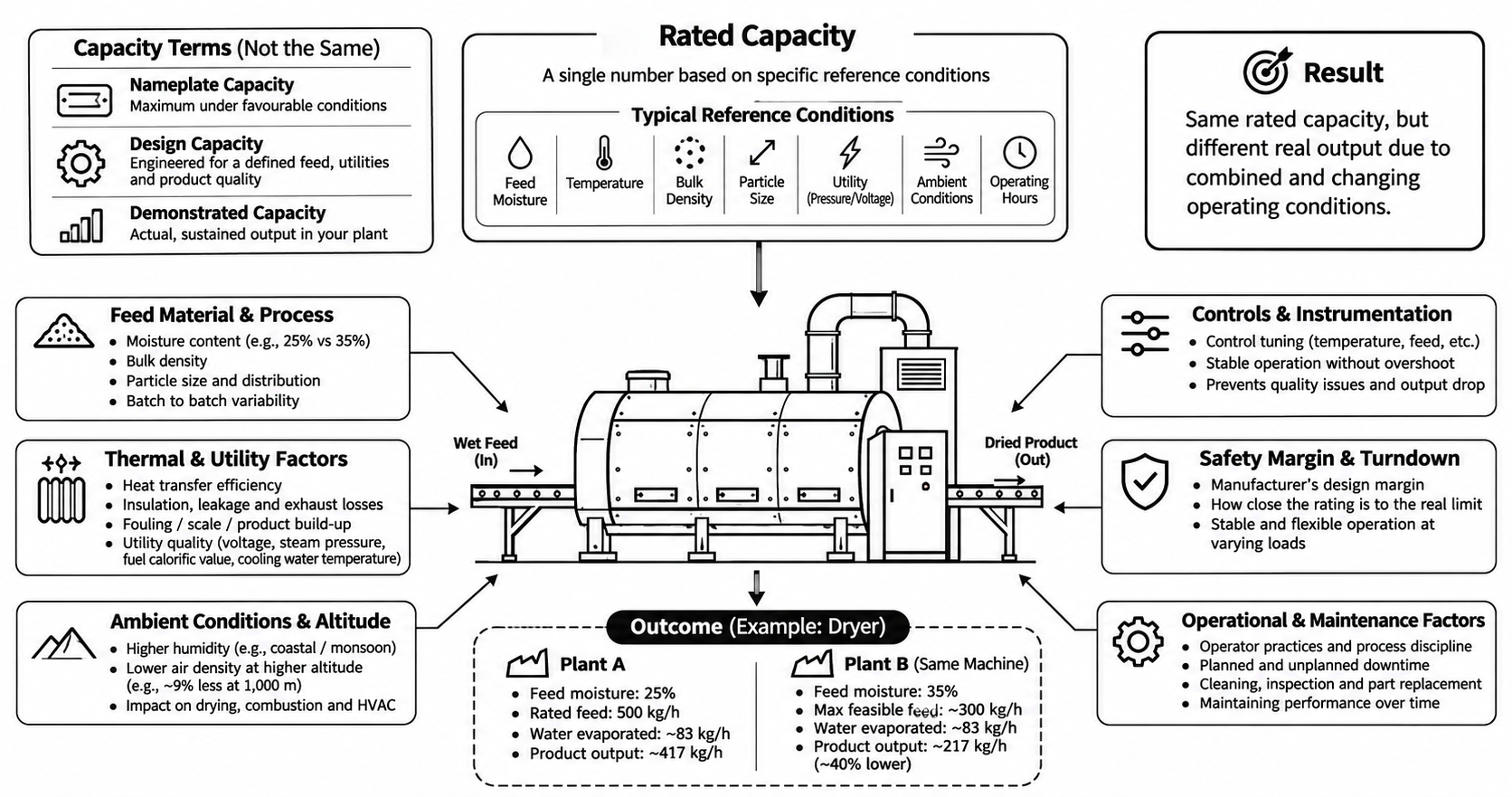
These three terms are often used as if they were the same, but they are not.
- Nameplate capacity is the figure printed on the machine or in the catalogue. It is usually the maximum the machine can reach under favourable conditions.
- Design capacity is what the machine was engineered to deliver for a defined feed, defined utilities and defined product quality.
- Demonstrated capacity is what the machine has actually delivered over a sustained run in your plant.
The gap between the first and the third is where most disputes start. A machine can reach its nameplate figure for an hour during a test and still average far less over a month.
The reference conditions behind the number
Every rating sits on a hidden list of assumptions: feed moisture, temperature, bulk density, particle size, product specification, utility pressure, ambient air state and operating hours. Change any one of them and the capacity changes. Most catalogues print only the headline figure, so the buyer never sees the list. Asking for it is the most useful first step in any capacity discussion.
Feed Material and Process Conditions
Moisture, density and particle size
Feed variation is the most underestimated cause of output differences. Consider an example with stated assumptions. Two dryers are each rated at 500 kg/h of wet feed, based on feed at 25 percent moisture dried to 10 percent moisture.
- At 25 percent feed moisture, each kg of feed releases about 0.167 kg of water, so the dryer evaporates about 83 kg/h of water.
- Plant B receives feed at 35 percent moisture. Each kg of feed now releases about 0.278 kg of water.
- If evaporation capacity is the limit, Plant B can only take about 300 kg/h of feed, which is 40 percent lower than the rating.
- Product output falls from roughly 417 kg/h to roughly 217 kg/h.
The two machines are identical. The feed is not. The same logic applies to crushers, mixers, conveyors and screens, where bulk density, stickiness and size distribution change throughput in a similar way.
Batch to batch variability
Rating tests are usually run on a consistent, well-behaved sample. Real feed changes with season, supplier and upstream process upsets. A machine sized exactly to the rated feed has no room for these swings, so output drops whenever the feed gets harder to process.
Thermal and Utility Factors in the Industrial Heating Process
Heat transfer, losses and fouling
In any industrial heating process, the output of industrial heating system is ultimately limited by how much useful heat reaches the product. Insulation condition, leakage, door seals and exhaust losses all reduce that share. Over time, scale, product build-up or oxide layers on heat transfer surfaces add resistance. A heat exchanger that was clean at commissioning can lose a noticeable part of its performance within a season if fouling is not managed.
Utility quality at the plant boundary
Utilities are usually rated at the supplier’s boundary, but the machine sees what arrives at its own inlet. Some examples:
- Electrical supply: Heater power varies with the square of voltage. A 5 percent voltage sag reduces heater output by close to 10 percent.
- Steam: Lower supply pressure means a lower saturation temperature and a smaller temperature difference for heat transfer. Wet steam carries less usable heat than dry steam.
- Fuel: Gas or oil with a lower calorific value than assumed reduces burner output at the same fuel flow.
- Cooling water: In heating and cooling systems or HVAC systems, the cooling duty depends on the water inlet temperature. A system that performs well in winter may struggle in peak summer when cooling tower water is several degrees warmer.
Ambient conditions and altitude
Air-handling equipment is very sensitive to where it’s placed. In coastal areas like Mumbai during the monsoon season the air has a lot of moisture. This means drying and conditioning systems have to work harder. In contrast dry inland locations don’t put much strain on these systems.
Altitude also makes a difference. At 1,000 meters above sea level, the air is about 9 percent less dense than at sea level. Because of this a fan will move air mass even if its volume output stays the same. This same idea applies to combustion air and process air in HVAC systems. It matters a lot when the system is serving a production hall or a controlled-environment area.
Design Details Hidden Behind an Identical Rating
Controls and instrumentation
Two machines can have the mechanical build and still behave differently because of control quality. A tuned temperature and feed control keeps each machine at its limit without overshoot. Poor tuning forces operators to run each machine at a setpoint to avoid product that does not meet the spec and that conservatism quietly reduces each machines output.
Safety margin and turndown
Some manufacturers size equipment with a generous margin, so the stated rating is easy to reach. Others rate it close to the edge. Turndown also matters. A machine that holds quality only between 70 and 100 percent of load behaves very differently from one that holds it between 30 and 100 percent when feed is irregular.
Materials and construction
Wear-resistant linings, surface finish and material grade affect how long the machine keeps its original performance. A softer material may meet the rating on day one and lose it as surfaces wear or corrode.
Operating Practice and Maintenance
I have seen the same machine behave differently when operated by people. Start-up time shut-down time how often the machine is cleaned, how often product changeovers. The skill of the operator all add up to the monthly total. A line that needs two hours of cleaning every shift has productive hours than the rating assumes. Maintenance also has an effect. Worn seals, drifting temperature sensors, clogged filters and loose belts each remove a percentage of capacity. Together they can remove an one without any single failure being obvious.
Availability, Performance and Quality: Where Hours Disappear
A rated capacity is normally a rate per running hour. Production output depends on how many hours the machine truly runs at that rate and how much of the product is acceptable. A simple way to see this is:
Actual output = rated rate x availability x performance x quality
For example, suppose a machine runs 22 of 24 hours (availability 92 percent), operates at 90 percent of its rated speed on average, and 98 percent of the product meets specification. The combined factor is about 0.92 x 0.90 x 0.98, which is roughly 81 percent. The machine is “working” all day, yet delivers about four fifths of the rated daily figure. No fault has occurred. This is simply how losses stack up.
The Bottleneck Effect in Complete Lines
Rated capacity applies to a single machine, but production depends on the whole line. If an industrial dryer is rated at 500 kg/h and the feeder upstream can supply only 420 kg/h, or the cooler downstream can handle only 450 kg/h, the line runs at the lowest of these values. Buyers often check each machine’s rating and forget to check that the ratings are balanced across the line, including the utilities and the HVAC or ventilation systems that support it.
How to Compare Capacity Claims Before You Buy
When evaluating industrial equipment manufacturers and industrial equipment suppliers, a few questions turn a vague number into a usable one:
- What feed properties, product specification and moisture or temperature targets does the rating assume?
- What utility conditions (voltage, pressure, fuel, water temperature) were used?
- What ambient temperature, humidity and altitude were assumed?
- Is the capacity quoted per hour of running time, and does it include start-up, cleaning and changeover?
- Is the figure a design value or has it been demonstrated on a similar duty?
- What happens to output if feed moisture or load changes by 10 to 20 percent?
A good answer to these questions is more valuable than a high headline number. It also gives both sides a clear basis for an acceptance test, which should specify the feed, the duration of the run and the way output will be measured.
Conclusion
Machines with the same rated capacity differ in real production because the rating is only one point on a larger performance curve. Feed properties, utility quality, ambient conditions, control quality, operating hours and maintenance all move the actual output, sometimes by 20 to 40 percent. Understanding the conditions behind a capacity figure, and checking them against your own plant, is the most reliable way to avoid surprises. For any new installation, define the capacity on your actual feed, your actual utilities and a realistic running time, and agree on how it will be measured before the machine arrives.
Frequently Asked Questions
-
What is the difference between rated capacity and actual production?
Rated capacity is the output a machine can reach under specified reference conditions, usually per hour of running time. Actual production is what the machine delivers over a real period, after accounting for feed variation, utility limits, downtime, slower operation and rejected product. Actual production is almost always lower than the rated figure.
-
Why does feed moisture change the output of industrial dryers and heating equipment?
The machine can only remove a fixed amount of water per hour. If the feed holds more water per kg, fewer kg of feed can be processed in the same hour. In the example above, raising feed moisture from 25 to 35 percent cut the allowable feed rate from 500 to about 300 kg/h for the same evaporation capacity.
-
How much do utilities and ambient conditions affect industrial machinery performance?
They can have a large effect. A 5 percent voltage drop reduces electric heater power by about 10 percent, warmer cooling water lowers cooling duty, and high altitude reduces the mass flow delivered by fans and blowers. Humid air also adds load to drying and air-conditioning systems. These effects are usually not visible in a catalogue rating.
-
What is demonstrated capacity and why is it important?
Demonstrated capacity is the output a machine has actually achieved over a sustained run on real material. It is more reliable than a nameplate figure because it includes real-world losses. Asking for demonstrated performance on a similar duty, or defining a proper acceptance test, reduces the risk of a shortfall.
-
How can a plant improve actual output without buying a bigger machine?
Start by measuring where the hours and rate are being lost. Common improvements include stabilising feed quality, cleaning heat transfer surfaces, repairing insulation and seals, improving control tuning, shortening changeovers and removing upstream or downstream bottlenecks. In many plants these steps recover more capacity than a new machine would add.